Best Examination Management System: What Universities Must Evaluate Before Choosing

University examinations are no longer just an administrative activity — they directly influence institutional credibility. Yet many institutions still struggle with delayed results, fragmented workflows, and avoidable errors. This is where a modern Examination Management System becomes essential.

As academic complexity grows, university leaders are not simply looking for digitization. They want reliability, transparency, and intelligent control over the entire examination lifecycle. Institutions that continue to rely on partially manual processes often find themselves reacting to problems instead of preventing them.

The Growing Complexity of University Examinations

Examination management in higher education has evolved significantly. Universities today manage multiple programs, continuous internal assessments, large-scale semester exams, and strict compliance requirements simultaneously.

However, when systems remain disconnected, operational pressure increases. Many universities report challenges such as:

  • Errors during marks entry or consolidation
  • Limited real-time visibility into evaluation progress
  • Heavy dependence on manual verification
  • Difficulty maintaining audit readiness
  • Delays in result declaration

Forward-looking institutions are therefore investing in structured digital ecosystems rather than isolated tools. Many leaders have already begun evaluating how an integrated Education Management System (EMS) can unify academic operations across departments.

Why Traditional Examination Processes Create Institutional Risk

Manual or semi-digital workflows may appear manageable at smaller scales. But as examination volumes grow, hidden risks begin to surface.

Error accumulation across stages

When examination data passes through multiple human checkpoints, discrepancies become almost inevitable. Even minor errors can trigger student grievances and administrative workload.

Limited transparency for leadership

Without centralized monitoring, tracking evaluation status, moderation changes, and approval flows becomes slow and reactive. This lack of visibility makes it difficult for leadership teams to intervene at the right time.

Result delays impact institutional reputation

In a competitive higher education environment, timely results are critical. Delays affect admissions planning, student progression, and placement cycles. Many universities exploring digital transformation have already recognized this shift through platforms such as online classes and exams management, which connect learning and assessment workflows more tightly.

How AI-Powered Examination Management Is Changing the Approach

A modern Examination Management System for universities goes far beyond simple marks entry. With AI and automation embedded, the entire assessment lifecycle becomes more intelligent and predictable.

Intelligent workflow automation

Automation streamlines exam scheduling, hall ticket generation, digital evaluation, moderation, and result compilation. As a result, institutions reduce manual dependency while improving process speed.

Predictive monitoring and alerts

AI-enabled systems can flag missing marks, evaluation delays, and workflow bottlenecks early. Universities that have adopted predictive platforms often see the same benefits highlighted in this detailed guide on AI-powered learning management evolution.

Stronger examination integrity

Modern digital frameworks introduce structured access controls, encrypted data handling, and complete audit trails. These capabilities significantly strengthen institutional trust and compliance readiness.

What Universities Should Evaluate Before Choosing an Examination Management System
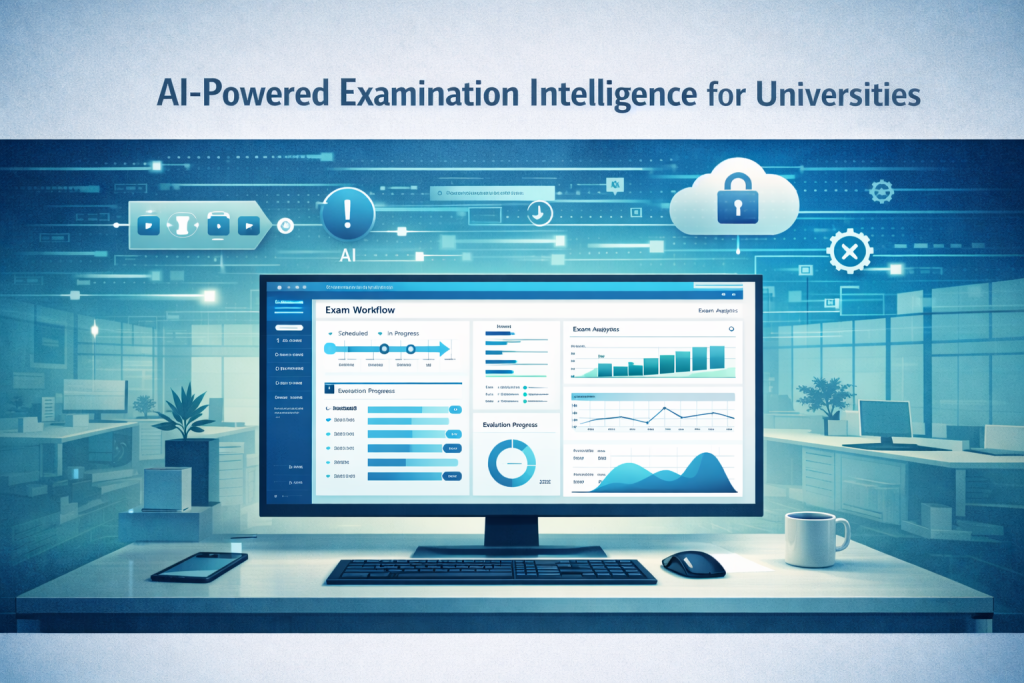
AI-powered Examination Management System dashboard showing automated university exam workflow and analytics

Selecting the right Examination Management System requires more than checking feature lists. University leadership must evaluate long-term institutional fit.

End-to-end examination coverage

The platform should support the full lifecycle — from pre-exam planning to post-result analytics. Fragmented tools often create more complexity than they solve.

AI-driven visibility

Modern institutions benefit from automated alerts, workflow intelligence, and real-time dashboards. Universities already moving toward outcome-based LMS environments are seeing how continuous academic visibility improves decision-making.

Cloud-native scalability

Universities evolve continuously. A cloud-based system ensures flexibility to handle growing data volumes, multi-campus operations, and regulatory changes without performance bottlenecks.

Seamless academic integration

An effective solution should work within the broader Digital solutions for higher education ecosystem. When examination workflows connect smoothly with admissions, academics, and accreditation, institutions gain true operational clarity. Many universities strengthening compliance readiness are already aligning examination data with accreditation management frameworks for better evidence tracking.

The Strategic Importance of Digital Solutions for Higher Education

Leading universities no longer treat examinations as isolated administrative tasks. Instead, they view assessment management as a strategic pillar of academic governance.

Adopting integrated digital platforms enables universities to:

  • Gain real-time academic visibility
  • Reduce operational friction
  • Improve compliance readiness
  • Strengthen stakeholder confidence
  • Build scalable academic processes

Institutions modernizing their examination framework often extend the same intelligence across the student recruitment lifecycle, ensuring continuity from admission to graduation.

How iCloudEMS Supports Modern Examination Management

As universities accelerate digital transformation, iCloudEMS provides a unified and AI-powered approach to managing complex academic workflows.

Built as a cloud-native Education Management System (EMS), the platform helps institutions:

  • Automate the complete examination lifecycle
  • Monitor evaluation progress in real time
  • Reduce manual intervention points
  • Maintain structured audit trails
  • Accelerate accurate result processing

Because iCloudEMS is designed specifically as Digital solutions for higher education, it connects examinations with academics, admissions, accreditation, and student success workflows within a single ecosystem. Universities exploring comprehensive modernization often review the broader capabilities available on the iCloudEMS platform before finalizing their digital roadmap.

The Road Ahead for University Examination Systems

Examination ecosystems are steadily moving toward predictive, connected, and intelligence-driven models. Universities are prioritizing systems that provide not just efficiency but foresight and governance clarity.

Institutions that invest in a robust Examination Management System today position themselves for:

  • Stronger academic integrity
  • Faster decision-making
  • Better regulatory readiness
  • Greater institutional confidence

The shift is no longer optional — it is becoming foundational to future-ready higher education.
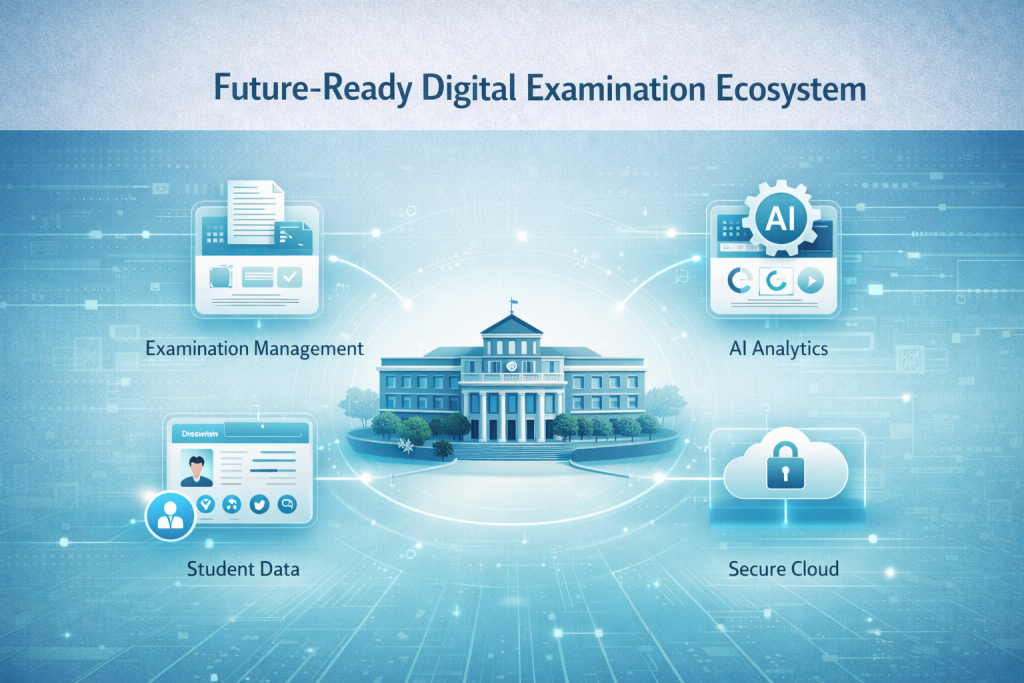
Future-ready Examination Management System ecosystem connecting university AI analytics student data and secure cloud

Conclusion

Examination credibility remains one of the most visible indicators of institutional excellence. As universities grow in scale and complexity, fragmented or manual workflows introduce unnecessary risk.

A modern Examination Management System enables universities to move toward structured, transparent, and intelligence-driven assessment management. By combining automation, AI capabilities, and cloud scalability, institutions can significantly improve accuracy and operational confidence.

As part of the broader evolution toward Digital solutions for higher education, platforms like iCloudEMS are helping universities build examination ecosystems that are not only efficient but truly future-ready.

What do you think universities must prioritize first in examination transformation — speed, accuracy, or complete process visibility?

Frequently Asked Questions

What is an Examination Management System?

An Examination Management System is a digital platform that manages the complete examination lifecycle, including scheduling, evaluation, moderation, and result processing. It helps universities improve accuracy, transparency, and operational efficiency.

How does AI help in examination management?

AI improves examination management by providing predictive alerts, automated monitoring, and real-time workflow visibility. This helps universities detect delays early, reduce manual errors, and maintain stronger control over assessment processes.

Why are universities moving to digital examination systems?

Universities are adopting digital examination systems to manage growing assessment complexity, publish results faster, maintain audit readiness, and reduce dependency on manual processes.

What should universities look for in an Examination Management System?

Universities should evaluate end-to-end workflow coverage, AI-driven alerts, cloud scalability, strong security controls, and seamless integration with their Education Management System (EMS).

Is cloud-based examination management reliable for universities?

Yes. Modern cloud-based platforms use encryption, role-based access, and complete audit trails to ensure data security and reliability. When properly implemented, they significantly strengthen examination governance.


Digital Evaluation vs Traditional Evaluation: Which Is Better for Universities?

1. Introduction: The Urgent Need for Faster, Transparent Digital Evaluation

Why do universities in India still struggle with delayed results, inconsistent marking, and rising student grievances—even after conducting exams on time?

The answer, in most cases, lies not in how exams are conducted, but how evaluations are handled.

Every academic season, universities face the same pressure cycle: completed exams, massive bundles of answer scripts, faculty burnout, manual checking errors, and anxious students waiting weeks—sometimes months—for results. In a higher education ecosystem where transparency and speed directly influence accreditation and student satisfaction, the old approach can no longer keep pace.

This is where the comparison between digital evaluation and traditional evaluation becomes not just relevant, but urgent.

2. Why Evaluation Quality Matters Today

Evaluation is no longer an internal process—it’s now an institutional performance indicator.

With NEP 2020, universities are expected to adopt tech-enabled, student-centric, data-driven academic systems. Evaluation quality directly influences:

  • NAAC scores (fairness, transparency, governance)
  • NBA outcomes (OBE-based assessment validity)
  • OBE mapping and continuous improvement
  • Student grievance redressal timelines
  • Multi-campus academic management

Regulators want universities to demonstrate accuracy, auditability, and timely results—all of which traditional evaluation often fails to ensure at scale.

This shift in expectations forces a natural question: Can manual evaluation cope with modern higher education requirements?

3. Traditional Evaluation — Key Pain Points

Traditional evaluation relies heavily on physical scripts, manual coordination, and human judgment. While it has worked for decades, its limitations are becoming more visible in large institutions.

Major Pain Points

  • Chronic delays caused by manual script distribution and faculty availability
  • High risk of script misplacement or tampering during transit
  • Inconsistent marking due to human bias, fatigue, or varied interpretation
  • Faculty overload, especially during peak academic cycles
  • Difficult revaluation, as physical scripts must be retrieved and rechecked again
  • Escalating student complaints, especially in competitive programs
  • Limited transparency, making audit processes lengthy and complex

4. Digital Evaluation — How It Works

Digital evaluation modernizes the entire process by turning physical scripts into secure digital files and enabling faculty to evaluate them online through On-Screen Marking (OSM).

How Digital Evaluation Functions

  • On-Screen Marking (OSM): Faculty evaluate answer sheets on a secure digital interface.
  • AI-Assisted Checking (supporting, not replacing): Autosuggestive tools highlight skipped answers, total mismatches, and marking inconsistencies.
  • Secure Cloud Script Management: Every script is digitally stored, encrypted, and accessible only to authorized faculty.
  • Audit Trails: Every marking action—timestamps, comments, corrections, re-evaluations—is recorded.
  • Rapid Revaluation: No physical retrieval; re-evaluators simply log in and review the digital script.
  • Error-Free Result Processing: Automated score totaling eliminates calculation errors.

Digital evaluation does not remove the academic authority of faculty—it simply removes everything that slows them down.

5. Comparison Table: Traditional vs Digital Evaluation

Criteria Traditional Evaluation Digital Evaluation
Accuracy Prone to human error Automated checks reduce mistakes
Speed Weeks to months Results in days
Transparency Limited Full audit trails
Security Physical risks Encrypted digital storage
Faculty Time High manual effort Streamlined workflows
Cost Repetitive operational cost Lower long-term cost
Scalability Difficult across campuses Effortless multi-campus scalability
Compliance Hard to document Auto-generated digital proofs

6. Benefits of Digital Evaluation for Indian Universities

Digital evaluation delivers measurable improvements in academic operations.

Key Advantages

  • Faster result processing across all programs and campuses
  • Bias-free evaluation through standard rubrics and AI-supported consistency checks
  • High data integrity, with zero risk of lost scripts
  • Real-time monitoring for COE, HODs, and evaluators
  • Cloud storage, eliminating physical script handling
  • Multi-campus scalability, enabling large universities to centralize evaluation
  • Lower operational costs over time
  • Better compliance and audit readiness, especially for NAAC and OBE requirements

7. The iCloudEMS Advantage

Many leading private universities adopt iCloudEMS because it blends seamlessly into existing academic workflows without forcing institutions to rebuild their systems from scratch.

How iCloudEMS Supports Digital Evaluation

  • AI-supported On-Screen Marking (OSM) that helps faculty maintain accuracy
  • QBMS integration enabling structured, mapped assessments
  • End-to-end evaluation workflows, from script upload to result declaration
  • Secure cloud environment that eliminates server maintenance
  • Rapid revaluation cycles, reducing student grievances
  • Result automation with total accuracy
  • Real-time dashboards giving COEs and academic leaders full visibility

It supports digital evaluation the way Indian universities actually operate—fast, scalable, and compliant.

8. Future Outlook (AI + Automation) — Already Available in iCloudEMS

Digital evaluation is no longer a future aspiration—it’s already becoming the operational reality for many progressive Indian universities. While the industry still talks about AI-driven evaluation and predictive insights as “upcoming trends,” institutions using iCloudEMS are already experiencing these advantages today.

What the Future Promises — and What iCloudEMS Already Delivers

  • Predictive analytics for learning and assessment: Universities using iCloudEMS can already study course-wise performance patterns, identify learning gaps, and generate insights that directly support OBE and curriculum improvement.
  • Automatic anomaly detection in marking: iCloudEMS algorithms highlight unusual scoring patterns, skipped answers, total mismatches, and deviations from rubrics—reducing oversight errors.
  • AI-driven evaluation insights for accreditation: Instead of searching for data during NAAC or NBA visits, iCloudEMS auto-aggregates evaluation insights, attainment analytics, mapping evidence, and audit trails.
  • Paperless exam ecosystem—already functional: From question paper generation (QBMS) to digital evaluation, revaluation, moderation, and result processing, many universities on iCloudEMS are already operating a near-paperless examination process.
  • NEP-ready continuous assessment frameworks: iCloudEMS supports continuous internal evaluation, multiple assessment types, rubrics, attainment mapping, and multi-semester analytics—aligned with NEP expectations.

The “future” of digital evaluation is not years away—it’s simply a matter of adoption. Universities that embrace platforms like iCloudEMS today will move ahead of the curve, with academic operations designed for the next decade of regulatory and technological evolution.

9. Conclusion

Digital evaluation is clearly better for universities because it provides faster results, higher accuracy, greater transparency, stronger compliance, and a significantly better student experience—advantages that traditional evaluation simply cannot match at scale.

From Questions to Results: How can Higher Education Institutes Manage their Online Exam Process easily

Every aspect of the higher education system is being impacted by technology, and pandemic has introduced educational activities, including exams, to a digital platform to enhance educational continuity. 

The administration of exams and evaluations involves a variety of time-consuming operations, and higher education institutions are constantly looking for ways to streamline the procedures and increase efficiency. 

Online examination systems is a cloud-based platform that allows for strategic evaluation of students’ online learning utilizing computers in place of physical Examination Centers.

The hassle-free management of materials and human resources in examination activities is the main function of online examination system. iCloudEMS introduces an innovative Online Exam management system that has following important features including:

  • Tight monitoring with a zero-tolerance policy for dishonesty and wrongdoing.
  • Direct communication between pupils and the monitor.
  • Digital storage of all answer scripts and supplementary materials.
  • A transparent and safe evaluation mechanism.
  • An accurate grading system and quick processing of results.
  • Monitoring student learning progress in relation to the outcome-based education (OBE) framework.

Our Online Examination system has made many time consuming tasks, quick and simple for the administration. 

  • The online examination system automates the creation of date sheets and the scheduling of exams, preventing conflicts between exams taking place on the same day.
  • It is now simple to create test questions, thanks to efficient coordination between all concerned faculty members and higher authorities for timely response and review.
  • To prepare questions papers in accordance with OBE and Bloom’s taxonomy standards, it includes bespoke question paper styles and a large question bank.
  • Unlike the traditional examination method, which assures an anti-cheating strategy, there is a facility for shuffling questions.
  • A well-planned technique for delegating faculty members’ vigilance responsibilities for various student groups.
  • Because it does away with the requirement for logistics management and exam center allocation, it makes it a cost-effective choice.
  • The iCloudEMS LIVE proctoring tool offers a logical and error-proof tech-driven ecosystem with multi-level invigilation and quick response capabilities.

Not only Examination, we also commit to make the post examination tasks including evaluation and result declaration effortless for faculty members. 

  • The web storage of answer sheets and on-screen evaluation renders them impervious to manipulation, safeguarding the integrity of evaluation.
  • A centralized dashboard evaluation creates a transparent environment that allows management to keep track of the situation.
  • Efficient mapping of marks obtained with the course outcomes makes it easier for stakeholders to assess the cognitive capacities of the students.
  • The automatic credits computation using the online examination system reduces the chance of errors and increases stakeholder confidence.
  • The private results are kept on cloud-based servers and are available to those who have permission to access them.

iCloudEMS has always supported Higher Education Institutes to establish a contemporary educational environment in a digitally driven setting where one can reap the unseen benefits of online teaching-learning. We are always ready to facilitate you with our best cloud-based management products and services for the efficient management of both material and human resources, and make all the time-consuming tasks completed with a couple of clicks only.

How iCloudEMS strengthens the digital capabilities of Higher Education with its Online Classes and Examination management system

Technology has proven its true potential by revolutionizing the conventional teaching learning methodologies and bringing the transformation in Higher Education. Our government has never left any stone unturned to leverage technology in stretching the wings of the Education system to make it accessible and affordable for every student worldwide. COVID-19 has accelerated the deployment of the Education Management System to support uninterrupted Education learning and administration. Online Classes and Examination management System is a cloud-based solution that simplifies the administration intricacies of Classes and Examination. It removes the physical barriers in delivering and assessment of student-centric quality education.

Now, let’s understand the importance of Online Classes and Examination system

Online Classes management:

COVID-19 has made the Institutes transform their traditional classroom-led teaching-learning practices with Online or Virtual learning sessions in blink of an eye and the best part is both faculty and students have leveraged the latest technologies to access quality E-learning and Examination. iCloudEMS has offered a plethora of digital possibilities for an enriching learning experience using online whiteboards, video conferencing, learning management system, instant messaging and many more tools to connect students and instructors any time and from anywhere over the internet. We cater the specific needs of learners with our versatile digital resources for both LIVE and recorded sessions to channelize the valuable efforts of instructors towards a flexible and progressive student-centric learning environment. The major advantages of our Online Classes product are:

  • We deliver an online platform where both teachers and students are free to arrange their learning according to their mutual preferences and learning styles to fill in the gaps and improve outcomes.
  • Our advanced learning methodology tends to promote pupil-teacher and peer networking across borders and cultural boundaries, making it easier to incorporate research and innovation into learning theories.
  • We offer online cloud-based documentation and repository that makes 24/7 access to study materials and progress records that facilitates digital governance of learning goals.
  • Our system is an economical learning investment that can easily be afforded with reasonable service subscriptions and a one-time hardware expenditure.

Online Examination and Evaluation:

iCloudEMS brings a comprehensive cloud-based Online Examination System that simplifies the myriad of tedious and challenging Examination and Evaluation responsibilities with efficient management of material and human resources. The important features of our product include:

  • Automatic scheduling and posting of examination datasheets that eliminates expected scheduling conflicts between exams on the same day.
  • Collaborative question paper setting mechanism that makes the faculty members to easily coordinate with each other and higher authorities to ensure outcome-based learning assessment that follows OBE and Bloom’s taxonomy guidelines.
  • Automated approach for assigning invigilation duties and exam centre to faculty members on different groups of students that streamlines the administration to conduct multiple exams with many students at the same time.
  • Our LIVE proctoring attribute includes fool proof invigilation feature that ascertains integrity of Examination under a reliable digital-driven environment.
  • The digital ecosphere safeguards the purity of evaluation by making the answer sheets and results completely immune to tampering.
  • We present a labour-saving strategy that minimizes the time of assessment and publishing results under a transparent avenue for all the stakeholders.

The importance of online education and on-demand examination has been advocated in the National Education Policy (NEP) 2020 to encourage skill-oriented learning practices. It galvanizes the use of digital platforms and the latest learning endeavors like national MOOC courses, DIKSHA and SWAYAM to empower sustained quality education globally. Recent unfavorable situations such as epidemics and pandemics have necessitated utilizing ICT-based education while addressing all potential hurdles. iCloudEMS is a game changer and has always been supportive of institutes’ technical demands in order to foster a modern education atmosphere in a digitally driven environment where one can reap the unseen benefits in situations where traditional classroom learning is not viable.