
10 AI Hacks in University ERPs That Save Admins 20+ Hours a Week

University administrators don’t struggle because they work less.
They struggle because too much of their time is spent coordinating, checking, following up, and correcting.
Most universities already have ERP systems.
Yet admin teams still stay late during admissions, exams, fee cycles, and accreditation season.
The problem isn’t effort.
And it isn’t even digitisation.
The problem is that most ERPs record work — they don’t reduce mental and coordination load.
This is where AI inside university ERPs quietly changes daily operations.
Not futuristic AI.
Not experimental automation.
Just practical, workflow-level intelligence that removes hours of invisible admin work every week.
Below are 10 AI hacks already possible inside modern university ERPs that consistently save 20+ hours per week across admin teams.
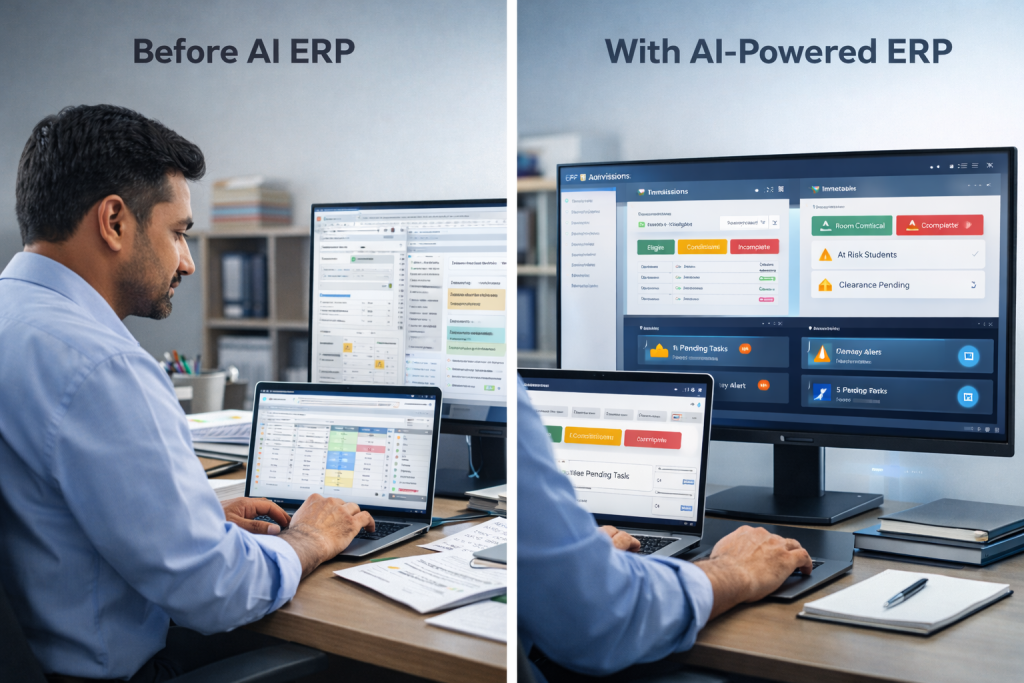
Hack #1: AI-Based Admission Application Pre-Screening

The Admin Problem
Admissions teams manually verify eligibility, documents, category rules, and missing information — even before shortlisting begins.
This involves:
- Rechecking eligibility rules
- Identifying incomplete applications
- Responding to repetitive queries
How AI Inside ERP Fixes This
AI pre-screens applications using:
- Programme eligibility rules
- Academic thresholds
- Document completeness checks
Applications are automatically tagged as:
- Eligible
- Conditionally eligible
- Incomplete
Time Saved Per Week
4–6 hours during active admission cycles
Who Benefits Most
Admissions office, registrar’s team
Hack #2: Intelligent Timetable Conflict Detection

The Admin Problem
Timetable creation looks finished — until:
- Faculty clashes appear
- Room capacity mismatches surface
- Lab allocations conflict
Admins then enter endless back-and-forth correction loops.
How AI Inside ERP Fixes This
AI detects conflicts before publishing by analysing:
- Faculty load
- Room availability
- Programme overlaps
- Student group collisions
Instead of reacting, admins resolve issues proactively.
Time Saved Per Week
2–3 hours during timetable cycles
Who Benefits Most
Academic office, department coordinators
Hack #3: Auto-Prioritised Student Grievance Routing
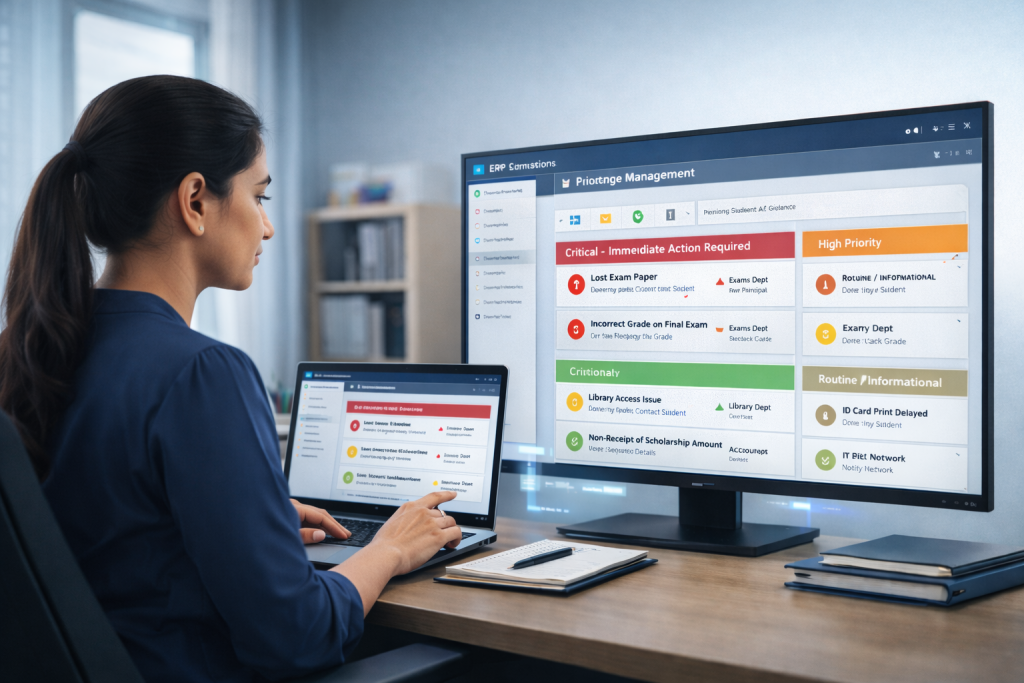
The Admin Problem
Grievances arrive via emails, portals, WhatsApp, and physical submissions.
Admins manually decide:
- Urgency
- Responsible department
- Follow-up priority
Important cases often get delayed unintentionally.
How AI Inside ERP Fixes This
AI categorises grievances based on:
- Issue type
- Past resolution timelines
- Academic calendar context
Critical cases surface instantly; routine ones follow standard workflows.
Time Saved Per Week
2 hours
Who Benefits Most
Student affairs office, grievance committees
Hack #4: Smart Fee Exception & Anomaly Detection

The Admin Problem
Finance teams spend hours reconciling:
- Partial payments
- Incorrect fee heads
- Duplicate transactions
- Pending approvals
Most effort goes into finding issues, not resolving them.
How AI Inside ERP Fixes This
AI flags:
- Unusual payment patterns
- Repeated failed transactions
- Deviations from standard fee structures
Admins focus only on exceptions, not every record.
Time Saved Per Week
3–4 hours
Who Benefits Most
Finance office, accounts team
Hack #5: AI-Assisted Exam Readiness Monitoring

The Admin Problem
Before exams, admins manually check:
- Student eligibility
- Attendance compliance
- Fee clearance
- Hall ticket readiness
This requires pulling reports from multiple modules.
How AI Inside ERP Fixes This
AI continuously monitors readiness indicators and highlights:
- At-risk students
- Missing clearances
- Policy violations
No last-minute panic.
Time Saved Per Week
2 hours during exam periods
Who Benefits Most
COE office, examination cell
Hack #6: Automated Accreditation Evidence Mapping

The Admin Problem
During accreditation, teams scramble to:
- Locate evidence
- Match documents to criteria
- Verify version accuracy
This work repeats every cycle.
How AI Inside ERP Fixes This
AI maps operational data automatically to:
- Accreditation metrics
- Criteria buckets
- Historical submissions
Evidence builds continuously — not retroactively.
Time Saved Per Week
3–5 hours, much more during accreditation years
Who Benefits Most
IQAC, accreditation committees
Hack #7: Predictive Follow-Ups for Pending Tasks

The Admin Problem
Admins chase:
- Faculty submissions
- Student approvals
- Department confirmations
Most follow-ups happen after deadlines are missed.
How AI Inside ERP Fixes This
AI predicts likely delays based on:
- Past response patterns
- Calendar load
- Role-specific behaviour
Reminders go out before escalation is required.
Time Saved Per Week
1–2 hours
Who Benefits Most
Admin coordinators, department offices
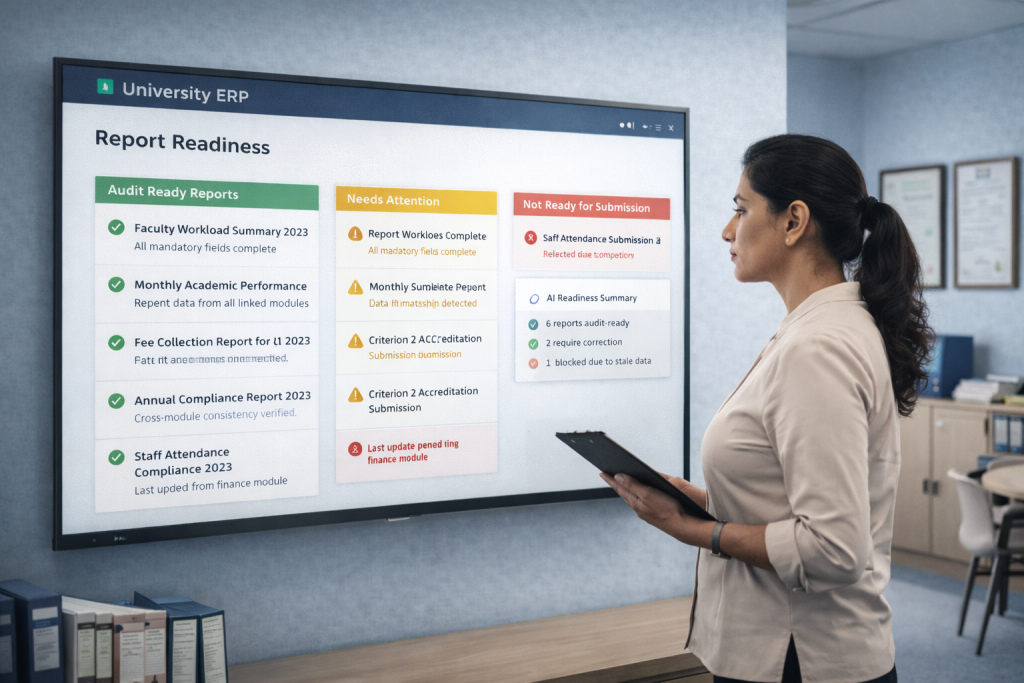
Hack #8: Intelligent Report Readiness Indicators
The Admin Problem
Reports are generated — but not always reliable.
Admins spend time validating:
- Missing fields
- Inconsistent numbers
- Data freshness
How AI Inside ERP Fixes This
AI flags:
- Data gaps
- Inconsistencies
- Reports that are not audit-ready
Admins trust what they submit.
Time Saved Per Week
1–2 hours
Who Benefits Most
Registrar’s office, compliance teams
Hack #9: Smart Communication Consolidation

The Admin Problem
Circulars, notices, and alerts go through:
- Email
- SMS
- WhatsApp
- Portals
Admins repeat the same message multiple times.
How AI Inside ERP Fixes This
AI selects:
- Right audience
- Best channel
- Optimal timing
One action replaces multiple broadcasts.
Time Saved Per Week
1–2 hours
Who Benefits Most
Admin office, communications team
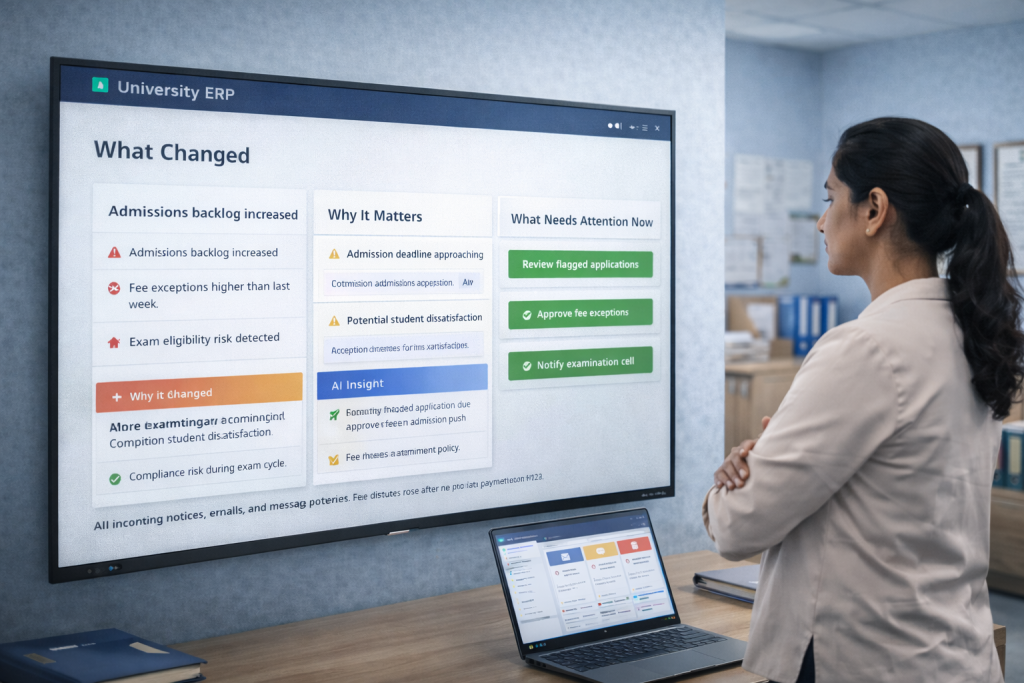
Hack #10: Context-Aware Admin Dashboards
The Admin Problem
Admins open dashboards but still ask:
“Is this normal?”
“What should I act on first?”
How AI Inside ERP Fixes This
AI highlights:
- What changed
- Why it matters
- What needs attention now
Admins stop scanning — they start acting.
Time Saved Per Week
2–3 hours
Who Benefits Most
Registrar, deans, senior admin leadership
Why Most Universities Still Feel Overworked Even After Implementing ERP
Because automation alone doesn’t reduce cognitive load.
Most ERPs:
- Execute tasks
- Store transactions
- Generate reports
But admins still:
- Decide priorities
- Detect risks
- Coordinate people
AI inside ERP doesn’t replace admins.
It removes mental overhead, uncertainty, and repetitive coordination — which is where most time is lost.
Where a Unified AI-Native ERP Makes the Difference
These AI hacks work only when:
- Data is unified
- Workflows are connected
- Intelligence is embedded, not bolted on
This is where platforms like iCloudEMS, designed as a cloud-native, AI-powered university ERP backbone across 31 integrated modules, enable such efficiencies without increasing complexity.
The goal isn’t more dashboards.
It’s fewer decisions per day.
Frequently Asked Questions
1. What is AI in university ERP systems?
AI in university ERP systems refers to built-in intelligence that helps the software analyse data, identify patterns, prioritise tasks, and support decisions. Unlike basic automation, AI helps administrators detect issues early, reduce manual checking, and manage complex workflows more efficiently across admissions, exams, finance, and student services.
2. How does AI in ERP reduce administrative workload in universities?
AI reduces administrative workload by automating repetitive checks, flagging exceptions, prioritising tasks, and predicting delays. Instead of manually reviewing every record or chasing follow-ups, administrators focus only on items that need attention, saving significant time every week.
3. Can AI-powered university ERP really save admin time every week?
Yes. When AI is embedded inside ERP workflows, it consistently saves time by reducing coordination, verification, and follow-ups. Even small efficiencies across admissions, exams, fees, and reporting add up to 15–25 hours a week across administrative teams in most universities.
4. Which administrative tasks can AI automate inside a university ERP?
AI can support tasks such as admission application screening, timetable conflict detection, exam readiness checks, fee anomaly detection, grievance routing, accreditation evidence mapping, and report validation. These tasks typically consume the most manual effort in university administration.
5. What is the difference between automation and AI in university ERP software?
Automation follows predefined rules to complete tasks. AI goes a step further by learning patterns, understanding context, and highlighting what matters most. In university ERP systems, AI helps administrators prioritise actions and detect risks, not just execute processes.
6. Is AI in university ERP useful for daily operations or only analytics?
AI is most effective when used in daily operations. It supports real-time decision-making in admissions, examinations, finance, and student services by continuously monitoring data and surfacing issues early, rather than being limited to dashboards or historical reports.
7. How does AI help admissions teams save time in universities?
AI helps admissions teams by pre-screening applications, identifying missing documents, validating eligibility rules, and categorising applications automatically. This reduces manual review effort and allows teams to focus on shortlisting and decision-making instead of routine checks.
8. Can AI reduce exam and evaluation workload for university admins?
Yes. AI can monitor exam eligibility, flag compliance issues, detect evaluation anomalies, and track readiness across departments. This reduces last-minute manual verification and coordination, which is a major source of stress during examination cycles.
9. Does AI in university ERP replace administrative staff?
No. AI does not replace administrative staff. It supports them by reducing repetitive work, uncertainty, and coordination overload. Administrators retain control and decision authority while AI helps them work faster, more accurately, and with less pressure.
10. Is AI in university ERP safe for compliance and audits?
When designed correctly, AI operates within role-based access controls, audit trails, and governance rules. It enhances compliance by improving data consistency, traceability, and early detection of issues, which is critical for audits and accreditation processes.
11. Is AI-powered ERP useful for small and mid-sized colleges?
Yes. Smaller institutions often benefit even more because limited staff handle multiple responsibilities. AI helps prioritise work, reduce manual effort, and manage peak workloads without increasing headcount or operational complexity.
12. What should universities look for in an AI-powered ERP system?
Universities should look for AI that is embedded within ERP workflows, not added as separate tools. Key factors include unified data, explainable insights, auditability, ease of use, and practical impact on daily administrative tasks rather than theoretical AI features.
