Academics Management in the Era of AI: Building a Future-Ready Education Management System (EMS)

Academic complexity in universities is no longer linear. Programs are interdisciplinary. Regulatory frameworks evolve rapidly. Outcome tracking is continuous. Faculty planning requires balance between teaching, research, and compliance.

In this environment, Academics Management cannot remain an administrative task. It must become an intelligence-driven system embedded within a future-ready Education Management System (EMS).

From Manual Coordination to AI-Enabled Academic Intelligence

Traditional systems rely on fragmented tools — spreadsheets for timetables, isolated databases for curriculum, disconnected platforms for evaluation. This creates blind spots in governance.

An AI-enabled Academics Management framework within iCloudEMS transforms this fragmentation into structured control.

Instead of reacting to problems, institutions gain:

  • AI-optimized timetable planning
  • Intelligent faculty workload balancing
  • Automated syllabus version control
  • Academic performance dashboards
  • Predictive alerts for compliance risks

This shift aligns with the evolution described in modern university digital strategies, including the transition from legacy systems to intelligent platforms discussed in AI-driven university systems.

Comparison of manual academic management versus AI-enabled cloud-based Academics Management in Education Management System (EMS)From manual coordination to AI-driven academic intelligence

Cloud-Native Academic Governance

A cloud-based academic structure ensures real-time synchronization across departments and campuses. Academic leaders gain centralized oversight without restricting departmental flexibility.

Cloud infrastructure enables:

This is digital evolution in practice — not just digitization, but intelligent orchestration.

Integrated Curriculum, OBE, and Accreditation Alignment

Academics Management cannot function in isolation. It must align with outcome measurement and accreditation frameworks.

Through integration with Outcome-Based LMS, universities can map course delivery directly to measurable academic outcomes.

Similarly, alignment with Accreditation Management ensures academic documentation, reports, and compliance evidence remain audit-ready at all times.

Instead of preparing for accreditation cycles reactively, institutions operate in continuous compliance mode.

Integrated AI-powered Academics Management ecosystem inside cloud-based Education Management System (EMS) connecting accreditation, LMS, exams, and student lifecycle modulesUnified Academic Ecosystem connecting curriculum, LMS, accreditation, and lifecycle management

Academic Lifecycle Visibility

Modern Academics Management must extend beyond semester planning. It connects with the complete student journey — from admission to progression.

By integrating with Student Recruitment Lifecycle Management, institutions create a continuous academic data flow. This enables:

  • Early academic risk detection
  • Progression analytics
  • Performance-based interventions
  • Institutional outcome visibility

The result is a unified academic intelligence ecosystem.

Building a Future-Ready Institution

A future-ready university does not depend on disconnected systems. It operates on a unified, AI-powered Education Management System (EMS) that brings academic governance, compliance, learning, and evaluation into one intelligent platform.

iCloudEMS positions Academics Management as the operational backbone of Digital solutions for higher education — where automation reduces friction, AI enhances decision-making, and cloud infrastructure ensures resilience.

Academic excellence today is sustained by intelligence embedded in operations.

Executive AI-powered Academics Management dashboard in cloud-based Education Management System (EMS) showing real-time academic intelligence and compliance analyticsExecutive-level academic intelligence enabling strategic university governance

Leadership Questions About Academics Management

What defines modern Academics Management?

It is the AI-enabled coordination of curriculum planning, faculty allocation, scheduling, performance monitoring, and compliance tracking within a centralized Education Management System (EMS).

How does AI improve academic governance?

AI introduces predictive alerts, workload analytics, scheduling optimization, and real-time dashboards — allowing leaders to act before academic disruptions escalate.

Why must Academics Management be cloud-based?

Cloud architecture ensures scalability, cross-campus synchronization, secure collaboration, and uninterrupted academic continuity.

How does iCloudEMS strengthen academic control?

By integrating Academics Management with accreditation, OBE tracking, lifecycle analytics, and online exam systems, iCloudEMS creates a unified academic intelligence environment rather than isolated software functions.

Academic complexity will continue to grow.

The question is not whether institutions will digitize — it is whether they will embed intelligence into their academic governance.

How is your institution currently managing academic operations — through manual coordination or AI-driven strategy?

We invite university leaders to share their experiences, perspectives, and transformation journeys in advancing Academics Management toward a smarter future.
ERP for University and the AI Shift: From Data Storage to Decision Automation

Universities initially adopted ERP for university systems to centralize operations, digitize workflows, and eliminate manual inefficiencies. A structured university ERP system helped institutions unify admissions, academics, finance, and examinations under one digital framework.

That was the first phase of transformation.

Today, the expectation is different.

An ERP for university can no longer function as a data warehouse. It must operate as a decision engine.

This is where the AI shift in ERP higher education begins.

The Traditional ERP University Model: Centralized but Reactive

Most early ERP university platforms focused on:

  • Admission tracking
  • Fee collection
  • Examination management
  • Payroll and HR
  • Compliance reporting

These systems improved traceability. They reduced paperwork. They streamlined coordination.

But they remained reactive.

Institutions facing ERP maturity challenges often discover that centralized systems still fail to deliver institutional visibility. Fragmented architecture limits foresight.

A traditional university ERP software solution tells leadership what already happened.

It rarely indicates what might happen next.

Why ERP University Systems Are Reaching Their Ceiling

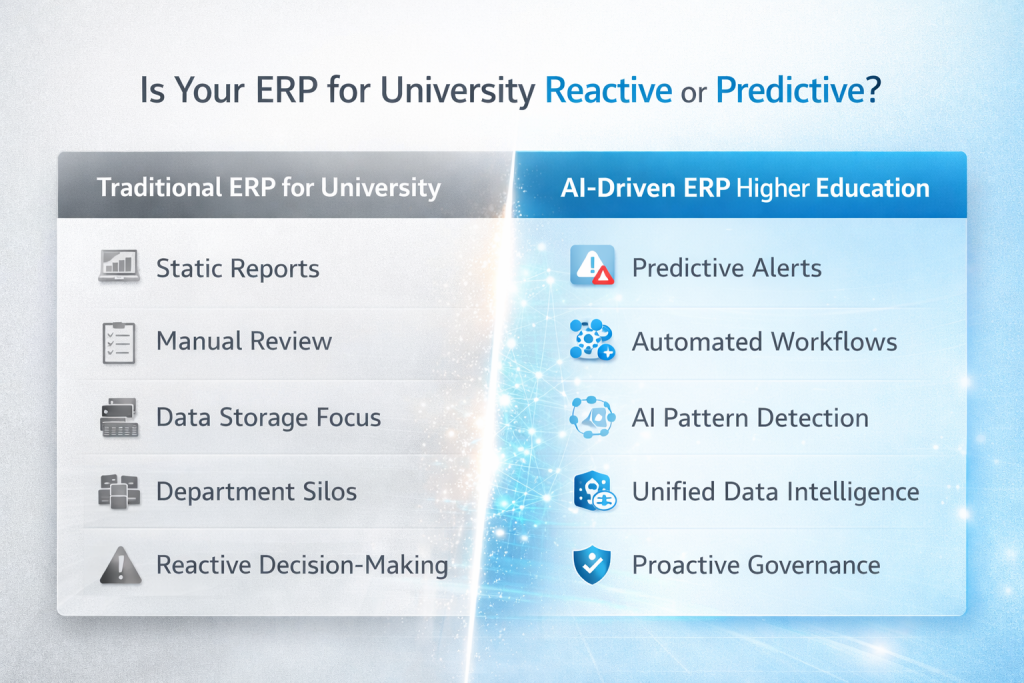
Comparison of traditional ERP for university and AI-driven ERP higher education system showing reactive versus predictive governanceIs Your ERP for University Reactive or Predictive?
University leadership must manage:

  • Retention instability
  • Accreditation pressure
  • Financial volatility
  • Digital examination complexity
  • Outcome-based academic frameworks

Many institutions experience operational blind spots because their university ERP system lacks predictive intelligence. Governance visibility gaps slow decision-making, especially during audits and accreditation cycles.

Without AI-driven support, even a robust higher ed ERP remains dependent on manual analysis.

This dependency creates risk.

The AI Shift in Higher Ed ERP

The AI shift transforms ERP higher education from record-keeping to proactive governance.

Modern ERP higher ed systems embed:

  • Predictive alerts
  • Risk flagging
  • Automated workflows
  • Pattern recognition

For example, intelligent systems can detect early disengagement signals using structured early awareness mechanisms, helping prevent escalation.

Similarly, AI-powered analytics enhance academic readiness and improve exam preparedness through integrated learning intelligence.

An evolved ERP for university does not wait for leadership to request reports. It surfaces actionable signals automatically.

From University ERP Software to Decision Automation

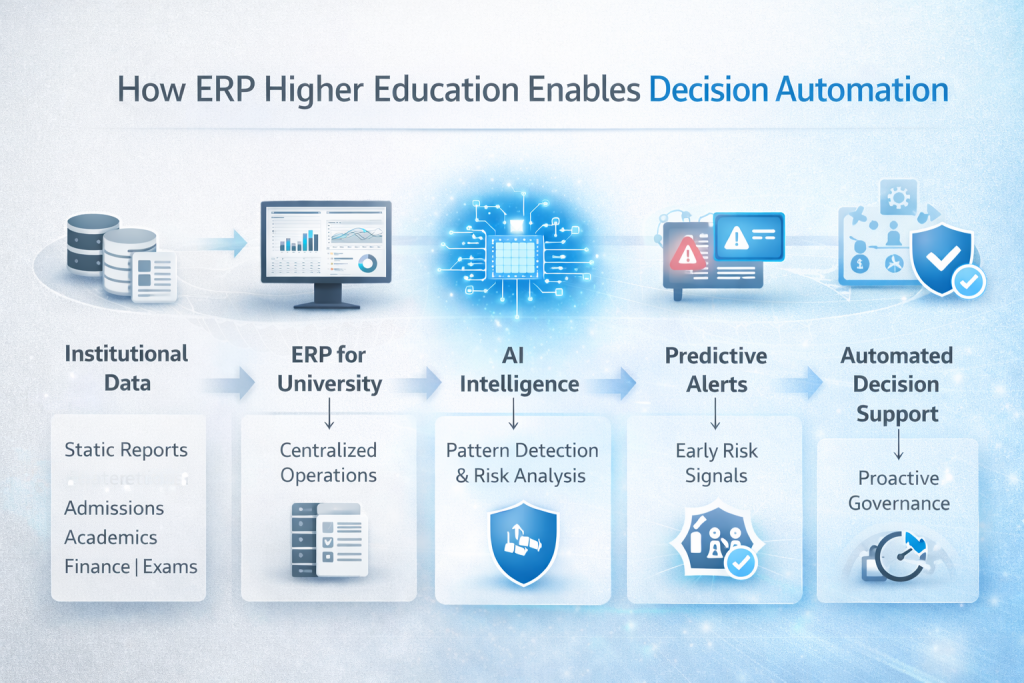
ERP for university decision automation process showing institutional data, AI intelligence, predictive alerts, and automated governanceHow ERP Higher Education Enables Decision Automation

Decision automation changes how institutions operate.

Instead of manual follow-ups:

  • Attendance drops trigger mentor alerts.
  • Budget deviations activate finance reviews.
  • Compliance deadlines initiate documentation workflows.

Automated accreditation management processes reduce last-minute pressure and ensure structured readiness.

Integrated platforms that connect learning, finance, and operations within a unified ERP university architecture reduce institutional friction.

The shift is clear:

From documentation → to intelligent action.

ERP Higher Education and Predictive Governance

Predictive governance requires connected ecosystems.

An advanced ERP for university integrates:

  • Recruitment pipelines
  • Student lifecycle tracking
  • Learning analytics
  • Online assessment systems

For instance:

When these systems operate independently, leadership loses context.

When unified inside an intelligent Education Management System (EMS), governance becomes predictive.

This is the essence of Digital solutions for higher education.

Governance Visibility and Cybersecurity in ERP Higher Ed

Visibility without security creates vulnerability.

Institutions must ensure that their ERP higher education infrastructure integrates cybersecurity safeguards. Modern governance demands more than cloud hosting; it requires embedded protection layers and risk monitoring frameworks.

An AI-enabled higher ed ERP must combine intelligence with resilience.

Strategic architecture matters.

Evaluating ERP for University in the AI Era

Leadership teams evaluating ERP for university platforms must look beyond feature lists.

They should assess:

  • Predictive intelligence capability
  • Integration depth
  • Accreditation automation
  • Lifecycle management
  • AI-driven governance visibility

A structured evaluation framework helps institutions avoid fragmented deployments and ensures long-term scalability.

Understanding institutional readiness and governance alignment becomes essential before system adoption.

The Future of ERP Higher Ed Architecture

The next generation of university ERP software will emphasize:

  • Cloud-native scalability
  • AI-powered analytics
  • Modular expansion
  • Governance dashboards
  • Workflow automation

Institutions no longer ask:

“Does our ERP university platform manage operations?”

They ask:

“Does it strengthen strategic foresight?”

An AI-driven Education Management System (EMS) integrates ERP functionality with predictive alerts, automated workflows, and decision intelligence into a unified backbone.

This shift defines the future of ERP higher education.

Conclusion: ERP for University Must Move Beyond Storage

An ERP for university that only centralizes information limits leadership agility.

An AI-enabled ERP higher ed system empowers institutions to anticipate risk, allocate resources intelligently, and improve governance clarity.

Universities adopting predictive higher ed ERP platforms move from reactive management to proactive strategy.

If your institution is rethinking its digital foundation, explore how a structured university ERP system aligns with comprehensive Digital solutions for higher education.

To understand the broader institutional vision, visit the About Us page.

For strategic discussions, connect directly through the Contact Us page.

Frequently Asked Questions

What is ERP for university?

ERP for university is an integrated platform that manages admissions, academics, finance, examinations, HR, and compliance within higher education institutions.

How does ERP higher education enable decision automation?

ERP higher education systems use AI-driven alerts, predictive analytics, and automated workflows to assist leadership in proactive governance.

What differentiates higher ed ERP from traditional campus software?

Higher ed ERP integrates institutional processes into a unified intelligence system, while traditional campus tools often operate in isolated modules.

What is the difference between ERP for university and AI-driven EMS?

An ERP for university centralizes and manages institutional data.

An AI-driven Education Management System (EMS) goes further. It analyzes patterns, generates predictive alerts, and supports automated interventions.

The difference lies in intelligence depth, not just functionality.

How does higher ed ERP support predictive governance?

Higher ed ERP systems integrate academic, financial, and administrative data streams.

When AI layers analyze these streams, leaders receive early-warning signals instead of delayed reports.

This enables proactive strategy.

What makes university ERP software future-ready?

Future-ready university ERP software must:

  • Operate in the cloud
  • Integrate AI analytics
  • Support automation
  • Ensure real-time visibility
  • Enable scalable modular architecture

Systems built only for reporting will not sustain long-term competitiveness.

How can ERP higher education systems automate decisions?

ERP higher education platforms automate decisions through rule-based triggers and predictive models.

When predefined conditions occur, the system initiates alerts, assignments, or workflows automatically.

This reduces human delay.

Why is ERP university software evolving beyond reporting?

Universities operate in a high-accountability environment.

Leadership cannot rely solely on historical reports.

ERP university software evolves because institutions now demand intelligence, not just information.

Leadership Reflection

Is your current ERP for university delivering strategic foresight — or only administrative reporting?

What governance blind spots still exist within your university ERP system?

We invite university leaders to share their perspective and experience.

Collage ERP vs Education Management System: What Universities Need in 2026

Universities do not struggle because they lack software.

They struggle because their systems were never designed for modern higher education.

Many institutions still search for Collage ERP when planning digital upgrades. Others evaluate a modern University ERP or broader Campus Management ERP tools. But the real strategic question in 2026 is not which Collage ERP to buy.

The real question is:

Should universities invest in another traditional ERP — or adopt a true Education Management System built for institutional intelligence?

What Is Collage ERP?

Collage ERP generally refers to an enterprise resource planning system adapted for colleges and universities. Institutions use it to manage:

  • Admissions
  • Academics
  • Finance
  • HR and payroll
  • Examinations
  • Reporting

A traditional ERP Campus Management system centralizes administrative workflows. It replaces manual processes with digital forms and reporting dashboards.

Many universities exploring a new college ERP or evaluating a scalable university ERP solution often focus on operational control.

But higher education is not only about operations.

It is about outcomes.

Why Traditional University ERP Systems Are No Longer Enough

A University ERP organizes data.

A modern Education Management System interprets it.

Most legacy Collage ERP implementations face structural limitations:

1. Disconnected Data

Academic records, financial data, and compliance metrics often exist in separate modules. This fragmentation weakens institutional visibility.

2. Reactive Compliance

When institutions prepare for accreditation, teams manually reconstruct historical data. A proactive accreditation management system should provide real-time dashboards instead.

3. Limited Student Lifecycle Intelligence

A typical ERP For University Management tracks students from admission to graduation. But it rarely integrates predictive signals across the full student lifecycle.

That gap prevents early intervention.

AI-powered student lifecycle with predictive intelligence in Education Management SystemPredictive AI Intervention Across the Student Journey

4. Weak Academic Performance Mapping

Many Higher Ed ERP platforms manage exam records but do not align learning outcomes effectively. Institutions now require a tightly integrated outcome-based learning system that maps assessments to measurable performance indicators.

5. Exam and Evaluation Complexity

Digital transformation in higher education demands secure online classes and examination management with automation, proctoring, and analytics — not just scheduling tools.

Traditional ERP Campus Management systems struggle to deliver that depth.

Collage ERP vs Education Management System

Structural comparison between Collage ERP and Education Management System architecture in higher educationOperational ERP vs Strategic EMS: Structural Differences Explained

The debate is not Collage ERP versus another Collage ERP.

It is Collage ERP versus a unified Education Management System (EMS) designed specifically as digital solutions for higher education.

Here is the structural difference:

Feature Traditional Collage ERP Modern Education Management System
Architecture Enterprise-adapted Cloud-native higher ed design
Data Flow Module-based Unified ecosystem
Student Risk Detection Manual analysis AI-powered alerts
Compliance Readiness Reactive reporting Real-time dashboards
Automation Process-focused Predictive intelligence
Decision Support Historical reports Strategic analytics

A Campus Management ERP manages operations.

An Education Management System strengthens governance.

That distinction defines competitive advantage.

What Leaders Should Expect from ERP for University Management

University boards must evaluate technology beyond features.

When assessing Collage ERP or Higher Ed ERP platforms, leadership should ask:

  • Does this University ERP unify academic, financial, and compliance data?
  • Can this ERP Higher Ed solution detect student risk before escalation?
  • Does this ERP For University Management support real-time accreditation dashboards?
  • Will this ERP Campus Management architecture scale with digital-first campuses?

Many institutions now implement AI-powered early awareness systems to proactively address student performance risks — a capability traditional Collage ERP rarely provides.

Technology must not only record data.

It must guide action.

Real-time institutional intelligence dashboard for higher education governance and compliance monitoringReal-Time Governance Powered by Institutional Intelligence

The Future of ERP Higher Ed Systems

Higher education is shifting from operational digitization to institutional intelligence.

Modern digital solutions for higher education integrate:

  • Academic planning
  • Attendance analytics
  • Financial monitoring
  • Faculty performance tracking
  • Examination automation
  • Accreditation dashboards

An advanced Education Management System functions as a strategic intelligence backbone.

Unlike traditional ERP Campus Management tools, it connects every institutional function into a single, decision-ready framework.

Universities increasingly recognize that ERP Higher Ed must evolve beyond record-keeping.

It must deliver clarity.

From Campus Management ERP to Institutional Intelligence

Collage ERP helped universities digitize paperwork.

Education Management Systems help universities interpret performance patterns.

This evolution includes:

  • Predictive attendance alerts
  • AI-driven academic insights
  • Integrated examination analytics
  • Unified communication systems
  • Accreditation-ready compliance dashboards

When data flows seamlessly across departments, leadership makes faster and smarter decisions.

Operational control becomes strategic foresight.

Choosing the Right Digital Solutions for Higher Education

Selecting between Collage ERP platforms is not merely a procurement exercise.

It is a governance decision.

Institutions should prioritize systems that:

  • Operate on secure cloud architecture
  • Embed AI-driven automation
  • Offer modular scalability
  • Provide real-time institutional dashboards
  • Integrate accreditation, lifecycle, and academic modules

A true Education Management System must function as the digital backbone of the institution.

This is how iCloudEMS positions itself — not just as a traditional ERP, but as a comprehensive Education Management System designed specifically for higher education ecosystems.

By integrating academics, examinations, finance, lifecycle workflows, compliance management, and analytics into one unified platform, iCloudEMS transforms ERP For University Management into an intelligence-driven environment.

If you would like to understand the philosophy and vision behind the platform, you can explore our institutional approach.

And if your institution is evaluating Collage ERP or Campus Management ERP options, you may request a personalized consultation to assess long-term strategic fit.

The Strategic Shift Universities Must Make

Technology should not simply automate tasks.

It should illuminate patterns.

Collage ERP represented the first phase of digitization in higher education.

Education Management Systems represent the next phase — predictive, integrated, and leadership-aligned.

In 2026 and beyond, institutions that adopt intelligent digital solutions for higher education will gain:

  • Stronger accreditation readiness
  • Better student retention visibility
  • Faster administrative coordination
  • Higher governance transparency

The question is no longer whether to implement ERP.

The question is whether your institution is ready to evolve beyond traditional Collage ERP into a strategic Education Management System.

Frequently Asked Questions

What is Collage ERP?

Collage ERP refers to enterprise resource planning software adapted for colleges and universities to manage admissions, academics, finance, HR, and examinations within a centralized system.

Is Collage ERP the same as University ERP?

In most contexts, Collage ERP and University ERP describe similar campus-wide ERP systems. However, architectural capabilities and intelligence levels vary across platforms.

What is the difference between Campus Management ERP and Education Management System?

A Campus Management ERP focuses on administrative workflow automation. An Education Management System integrates predictive analytics, accreditation dashboards, lifecycle intelligence, and AI-driven decision support tailored for higher education.

Why are universities moving beyond traditional Higher Ed ERP?

Institutions now require proactive student analytics, compliance readiness, and unified dashboards. Many traditional Higher Ed ERP systems provide operational control but lack predictive intelligence.

What should institutions look for in ERP For University Management?

Institutions should evaluate scalability, cloud architecture, AI integration, accreditation readiness, and unified data visibility when selecting ERP For University Management solutions.