
Cybersecurity in Higher Education ERP: Why “Cloud-Based” Alone Is Not Enough

University leadership teams increasingly take comfort in one statement: “Our ERP is cloud-based.”
The assumption is simple—if the system runs on the cloud, security is already taken care of.
In reality, this assumption is where many cybersecurity risks begin.
Cloud hosting solves only one part of the problem: infrastructure reliability. It does not automatically protect sensitive academic data, financial records, examination workflows, or personal information spread across thousands of users. For universities handling long-term student records and high-stake operations, security must be designed far beyond the hosting layer.
Why Universities Are High-Value Cyber Targets
Higher education institutions hold an unusually broad and sensitive data mix under one roof.
They manage:
- Personal student and parent information
- Academic records spanning multiple years
- Examination data with reputational impact
- Payroll, finance, and vendor payments
- Research data and intellectual property
Unlike many enterprises, universities retain data for long durations and allow access to diverse user groups—students, faculty, administrators, finance teams, external evaluators, and regulators. This complexity makes higher education systems especially vulnerable when controls are weak or fragmented.
Why “Cloud-Hosted” Does Not Mean “Secure by Design”
A cloud platform secures servers, networks, and physical infrastructure. Everything above that layer—the ERP application, data access rules, workflows, and integrations—remains the institution’s responsibility.
Security failures often arise not from cloud breaches, but from:
- Poor access control design
- Excessive permissions across departments
- Weak approval workflows
- Manual data handling outside the system
In simple terms, the cloud keeps the building safe. It does not control who gets the keys to every room inside.
The Hidden Security Gaps in Traditional University ERPs
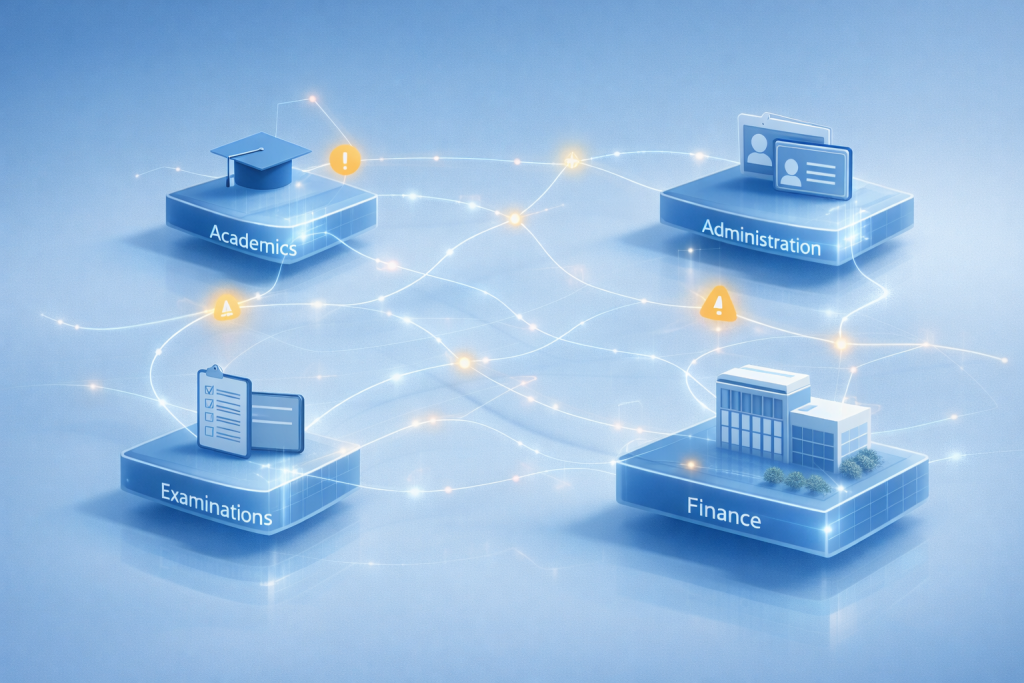
Many legacy or partially modernized ERPs expose institutions to silent risks.
Common gaps include:
- Users having more access than their role requires
- Critical actions executed without digital approvals
- Limited or non-existent audit trails
- Disconnected modules sharing data informally
- Dependence on spreadsheets for reporting and reconciliation
These gaps rarely trigger immediate alarms. Instead, they accumulate quietly until a compliance issue, data inconsistency, or operational failure surfaces—often too late.
What Real ERP Cybersecurity Looks Like in Higher Education
Effective cybersecurity in a university ERP is embedded into everyday operations, not bolted on as an afterthought.
Key characteristics include:
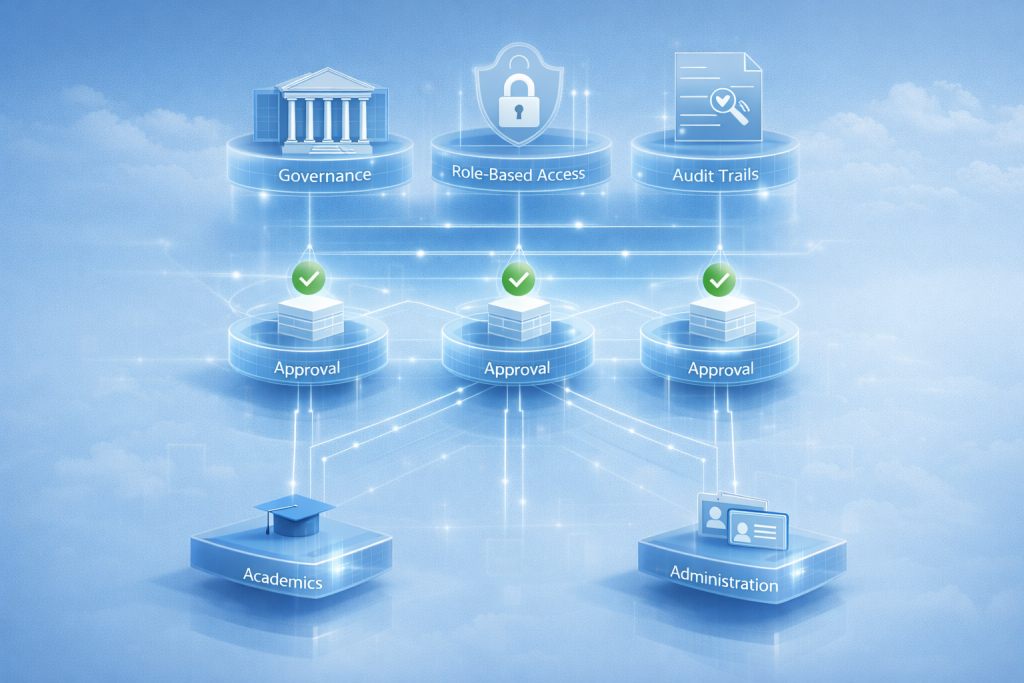
- Role-based access control aligned with institutional hierarchy
- Approval workflows for sensitive actions like concessions, results, and payments
- End-to-end audit logs for every critical transaction
- Encrypted data flow between academic, finance, and administrative modules
- Centralized alerts that flag unusual or risky activity early
When security is built into workflows, compliance becomes automatic instead of enforced manually.
Why Governance Matters More Than Firewalls
Firewalls protect perimeters. Governance protects decisions.
In universities, governance defines:
- Who can access what—and for how long
- How approvals are granted and recorded
- How responsibility is assigned and tracked
- How deviations are identified and addressed
Without governance embedded into the ERP, institutions rely on policies that exist on paper but not in practice. Systems must enforce governance by default, not depend on individual discipline.
How Cloud-Native Architecture Changes the Security Equation
Cloud-native ERP platforms are designed differently from systems merely hosted on the cloud.
They enable:
- A unified data model instead of siloed databases
- Controlled, API-driven integrations with external tools
- Real-time visibility into operations rather than retrospective reports
- Consistent security rules applied across all modules
This architectural consistency significantly reduces blind spots and strengthens institutional control.

Where iCloudEMS Fits In
iCloudEMS is designed as a cloud-native, AI-powered ERP backbone for higher education, with security and governance embedded at the architectural level.
Rather than treating cybersecurity as a separate layer, iCloudEMS integrates:
- Structured access control across academic and administrative functions
- Built-in auditability for compliance and accountability
- Unified visibility across departments and campuses
This approach helps institutions move from reactive security measures to proactive risk management—without increasing operational complexity.
Conclusion
Cybersecurity in higher education is not an IT checkbox. It is a leadership decision shaped by architecture, governance, and operational discipline.
A cloud-based ERP is a starting point, not a guarantee. True security emerges when systems are designed to enforce accountability, visibility, and control at every level.
For universities focused on trust, continuity, and long-term reputation, investing in secure-by-design ERP architecture is no longer optional—it is foundational.
What makes higher education ERP systems vulnerable to cyber threats?
Higher education ERP systems manage large volumes of sensitive academic, financial, and personal data while allowing access to many stakeholders. Long data retention periods, complex workflows, and inconsistent access controls increase vulnerability if security is not designed into the system architecture.
Why is cloud hosting alone insufficient for university data security?
Cloud hosting secures infrastructure, not application behavior. Data access rules, approval workflows, audit trails, and integrations are controlled by the ERP design. Without strong governance at the application level, cloud-hosted systems can still expose critical data.
How can universities enforce role-based access in ERP systems?
Universities can enforce role-based access by defining permissions based on job roles rather than individuals, limiting access strictly to required functions, and automatically updating permissions when roles change within the institution.
What are common cybersecurity mistakes in campus management software?
Common mistakes include excessive user permissions, lack of approval workflows, weak audit logging, manual data exports, and disconnected modules that exchange data without proper controls.
How does ERP governance reduce institutional cyber risk?
ERP governance ensures that every action is accountable, approved, and traceable. It embeds institutional policies directly into workflows, reducing reliance on manual enforcement and preventing unauthorized access or changes.
What should university leaders ask ERP vendors about cybersecurity?
University leaders should ask how access controls are designed, how approvals and audit trails work, how data flows between modules, how integrations are secured, and how governance is enforced across the system.
How do audit trails improve accountability in academic systems?
Audit trails record who performed an action, when it was done, and what data was affected. This transparency deters misuse, simplifies compliance, and enables quick investigation when issues arise.
Why are fragmented ERP modules a security risk?
Fragmented modules often duplicate data and bypass centralized controls. This creates inconsistencies, weakens visibility, and increases the likelihood of unauthorized access or data leakage.
How does cloud-native architecture enhance cybersecurity?
Cloud-native architecture uses a unified data model and standardized security rules across modules. This reduces blind spots, strengthens access control, and allows real-time monitoring instead of post-incident analysis.
What role does AI play in detecting early security risks in universities?
AI helps identify unusual patterns, delayed approvals, abnormal access behavior, and operational anomalies early, allowing institutions to respond before issues escalate into serious security incidents.
How can universities protect long-term student data effectively?
Universities can protect long-term data by enforcing strict access lifecycle management, encrypting data flows, maintaining audit logs, and ensuring that security rules remain consistent even as students graduate or staff change.
Why is cybersecurity a leadership issue in higher education?
Cybersecurity impacts institutional reputation, regulatory compliance, financial stability, and student trust. Decisions about architecture, governance, and accountability must be led by institutional leadership, not treated as a purely technical concern.
Need Help? Chat with us
Start a Conversation
Hi! Click one of our member below to chat on Whatsapp
The team typically replies in a few minutes.