

Learning Management Software for Modern Institutions: Enabling Better Teaching and Stronger Academic Outcomes
How learning management software is helping institutions bring clarity, consistency, and confidence to teaching and learning
In many higher education institutions, conversations about teaching quality now begin with a question that isn’t about technology at all: why does teaching feel reliably strong in one department but inconsistent in another? That question — about clarity, continuity, and trust — is exactly where learning management software has quietly become indispensable. When configured and used thoughtfully, it becomes the system that helps institutions turn academic intent into measurable outcomes while supporting faculty and strengthening leadership oversight.
The evolving role of learning management software in higher education
A decade ago most platforms were simple content hosts: upload slides, collect submissions, push announcements. Those basics matter, but they do not create institutional coherence. Today’s institutions expect their learning platforms to do more — to connect course design, assessments, student engagement, and outcome measurement into one credible academic story.
If you want to signal this evolution clearly early in the article, point readers to a resource that explains LMS as an institutional pillar: learning management software. That page adds practical context for readers who want a focused primer on why the platform is more than a repository.
Modern learning systems are part of a larger shift toward evidence-driven academia: mapping curriculum to competencies, tracking attainment, and creating auditable academic trails. Many institutions are now combining learning platforms with outcome frameworks — see the Outcome-Based Learning Management System (OBE-LMS) to understand how course-level intent aligns to program-level outcomes.

What institutions really expect (and rarely say aloud)
Senior leaders rarely ask for more dashboards. They ask for confidence — confidence that their institution’s learning programs are consistent, defensible during reviews, and improving year on year.
That expectation translates into practical needs:
- Clear mapping between course objectives, assessments, and outcomes.
- Continuous evidence that students are meeting expected standards.
- Trustworthy academic records that survive scrutiny during audits or accreditation.
- Seamless, low-friction workflows so faculty can teach, not administer.
A succinct way to explain institutional positioning is to link to your brand hub: Digital solutions for higher education. It helps readers move from idea to product-level context without disrupting the leadership tone.
When teaching quality improves: structure, not control
Good teaching thrives when the environment reduces friction. It’s not about forcing conformity — it’s about giving faculty structures that let their craft shine. In my conversations with lecturers and deans, they repeatedly return to the same point: the difference between chaotic delivery and consistent excellence is often a shared course design process and a reliable way to evidence student progress.
Practical features that support that shift include course-file standards and easy course planning. If you want an example of how course documents can be systematised, see the iCloudEMS guide on how to design the course file. Small process changes here cut down faculty admin and let teachers invest time back into pedagogy.
When course design, assessment, and feedback are coordinated inside learning systems, faculty spend less time reconciling versions and more time iterating on what actually improves learning. Students, for their part, benefit from clearer expectations and coherent learning journeys.

Outcome-based education: from policy to practice
Outcome-based frameworks look elegant on paper. Their success, however, is decided in the daily orchestration of courses and assessments. Learning management software becomes the practical tool that moves outcomes from concept to data.
When learning outcomes are embedded into course design and tracked through assessments, institutions can:
- Measure attainment across cohorts, not just single exams.
- Identify systemic gaps early — for example, a course where multiple sections underperform on the same outcome.
- Use evidence in accreditation processes rather than relying on ad-hoc artifacts.
If you’re building the outcome story in your institution, link readers to the focused OBE resource: outcome-based learning. That makes the case that outcomes are most useful when they’re measurable and visible within the daily workflow.
Assessment intelligence, early support, and student success
Assessment is no longer just a summative stamp at the end of a term. Modern platforms provide course-level and program-level insights that help faculty intervene early. Predictive flags, engagement indices, and assessment analytics let teams support students before small issues become failures.
For example, institutions that add AI-assisted readiness tools to their exam ecosystem are better positioned to ensure integrity and preparedness. If you want a concrete exploration of these capabilities, see AI-enhanced exam readiness. The key is simple: use intelligence as an early-warning and support mechanism, not as a replacement for academic judgment.
Academic governance, visibility, and trust
This is the leadership chapter: where visibility matters most. Deans, registrars, and accreditation teams need reliable evidence. They do not need noise; they need curated signals that answer the questions they will be asked under pressure:
- Are our programs delivering the competencies we claim?
- Can we demonstrate consistent assessment standards across departments?
- Where are the immediate risks, and what mitigation is underway?
That’s where targeted governance tools help. For accreditation workflows and automated evidence collection, link to the accreditation management system. When leaders can produce audit-ready evidence quickly, institutional confidence increases and stress during review cycles falls.
Leadership also needs consolidated reporting and analytics. A high-level benefits page explaining reporting capabilities is helpful here — see how iCloudEMS is beneficial to higher education institutes for a broader view of reporting and governance features.
Faculty remain central — systems are in service of teaching
A recurring fear is that systems will replace judgment or reduce academic agency. The opposite is true when systems are designed for support. They let faculty focus on pedagogy by taking care of version-control, assessment consistency, and compliance overhead.
Practical faculty benefits include:
- Reusable assessment banks and rubrics.
- Simple course clones that preserve learning outcomes across sections.
- Integrated feedback loops to speed up formative assessment.
Those are functional wins that translate into time for mentoring, curriculum iteration, and higher-quality student interactions.
Student experience and continuity
A learning system must serve students first — by making learning predictable, accessible, and continuous. Mobile access, single-sign-on for course materials, and transparent assessment timelines reduce anxiety and increase engagement.
If you mention mobile support in your section, link to the evidence page about mobile features: smart mobile app facilities. That helps operational teams see the student-facing side of a learning strategy.
Integrating learning management software into an Education Management System (EMS)
Learning systems gain power when they are part of a broader institutional platform. Framing them within Digital solutions for higher education and an Education Management System (EMS) positions them as academic infrastructure, not point solutions. That broader context improves governance, data consistency, and operational scalability.
When LMS sits inside an EMS, the benefits compound: admission and student records feed into learning histories, assessment outcomes feed into program reviews, and leadership dashboards draw from consistent, centralised data. This alignment makes change sustainable rather than episodic.
Moving forward with confidence: practical next steps for leadership
If you are a Dean, Registrar, or Head of Academics, here are pragmatic actions that turn intent into outcomes:
- Map outcomes to practice. Start with a single program and map its core outcomes to assessments and course activities. Use the OBE guidance as a reference. (OBE-LMS resource)
- Pilot faculty-centred workflows. Remove low-value admin work for one department and measure time saved. Reinvest that time into pedagogy.
- Design leadership signals. Define 4–6 KPIs that leadership truly cares about and make sure the learning system surfaces them (quality checkpoints, outcome attainment, progression risk).
- Prepare evidence for accreditation. Build audit trails as you teach — not after. The accreditation system guidance shows how. (accreditation management system)
- Prioritise student continuity. Ensure mobile and portal access is seamless for students so engagement metrics are meaningful. (smart mobile app facilities)
Conclusion
Institutions succeed when they bring clarity to teaching, support to faculty, and confidence to leadership. Learning management software, when treated as a strategic element of an Education Management System (EMS), enables that clarity. It’s not about more technology — it’s about connecting academic intent to observable student learning in ways that help people make better decisions.
If you’d like one practical next step: pick one program, map its core outcomes, and run a short six-week pilot with faculty volunteers. The insights you gain will be immediate and instructive.
If you want more detail on any of the implementation steps above, I can expand any section — from outcome mapping to pilot design — and provide editable templates.
Frequently Asked Questions: Learning Management Software
What is learning management software in higher education?
Learning management software is a platform that organises course delivery, assessment, feedback, and outcome tracking for institutions. It helps structure teaching, engage students, and provide leadership with institutional-level insights.
How does learning management software improve teaching quality?
By creating clear course structures, aligning assessments with outcomes, and automating low-value administrative work, learning management software enables faculty to focus on pedagogy and mentoring.
Can learning management software support outcome-based education?
Yes. Modern systems let institutions map assessments to learning outcomes, track attainment across cohorts, and use evidence during program reviews and accreditation.
What role does AI play in learning management software?
AI typically provides insights — for example, identifying engagement patterns or early risk indicators — that help faculty and leaders act earlier. It supports decision-making without replacing human judgment.
How does learning management software support accreditation?
When outcomes, assessments, and evidence are recorded within a system, institutions can produce audit-ready reports and documentation more efficiently. Automated accreditation workflows reduce last-minute admin pressure.
Is learning management software only for online learning?
No. It supports on-campus, blended, and remote learning by providing consistent structures, transparent assessment processes, and centralised academic records across all modalities.
How does learning management software fit within an Education Management System (EMS)?
Within an EMS, learning management software integrates with admissions, student records, exams, and reporting to create a unified academic environment — a strategic asset for long-term institutional resilience.

How University Leaders Should Evaluate an Education Management System (EMS)
Why choosing an Education Management System (EMS) is no longer a simple software decision
In many universities, digital systems were initially introduced to solve operational challenges such as admissions processing, examination management, or reducing paperwork. Once implemented, these systems often remained unchanged for years. Today, the role of an Education Management System (EMS) has fundamentally changed.
Universities operate under continuous accountability. Accreditation requirements are ongoing, compliance expectations are rising, students expect transparency, and leadership teams must make faster, well-informed decisions. In this environment, an Education Management System (EMS) becomes the central digital foundation of the institution.
Modern institutions rely on Digital solutions for higher education to ensure academic continuity, operational clarity, and institutional credibility. As a result, evaluating an Education Management System (EMS) is no longer an IT-only or department-level task. It is a leadership decision that directly affects governance, trust, and long-term sustainability.

The key question university leadership must answer
Before comparing features or requesting demonstrations, leadership teams must ask:
How do we choose an Education management solution that will support our institution today and remain reliable in the years ahead?
This question matters because many institutional challenges do not appear immediately. They surface during accreditation reviews, audits, leadership transitions, or periods of institutional growth. A well-evaluated Education Management System (EMS) prepares universities to handle these moments with confidence rather than urgency.
What university leaders should evaluate when selecting an Education Management System (EMS)

Leadership visibility and decision clarity
University leadership needs a clear and accurate view of academics, administration, compliance, and student engagement.
An Education Management System (EMS) should provide consolidated, role-based visibility without relying on fragmented reports or manual data consolidation. When leadership lacks real-time insight, decisions become reactive instead of strategic.
This limitation is common in legacy platforms, as explained in Why traditional university systems struggle with institutional visibility.
Digital solutions for higher education must prioritise leadership clarity over operational noise.
Continuous accreditation readiness
Accreditation is not a one-time event. It is a continuous institutional responsibility.
Universities often experience pressure during accreditation cycles because academic and administrative data exists across departments without long-term structure. An Education management solution should support continuous accreditation readiness by preserving evidence, outcomes, and records year after year.
This process is explained in detail in A guide on accreditation and how iCloudEMS automates the groundwork.
Alignment of academic and administrative decisions
Academic planning and administrative execution are closely connected. Curriculum changes affect faculty workload, scheduling, infrastructure usage, and financial planning.
An effective Education management solution aligns academic and administrative data within a single framework. This allows leadership to understand how decisions in one area impact another.
This alignment becomes critical when managing the complete student journey, as described in how iCloudEMS manages the entire student lifecycle.
True Digital solutions for higher education bring all stakeholders onto one connected platform.
Proactive decision support through intelligence
Automation reduces manual effort, but leadership also needs early insight to prevent problems before they escalate.
An advanced Education Management System (EMS) supports proactive governance by identifying trends, risks, and deviations early. AI-driven intelligence helps leadership take timely action without replacing human judgment.
This proactive approach is outlined in how early awareness systems prevent institutional problems.
In an Education management solution, AI should support leadership decisions, not complicate them.

Institutional adoption and ease of use
The success of an Education management solution depends on adoption by faculty, administrators, and staff.
Systems that disrupt academic workflows or increase complexity often face resistance. Leadership should evaluate how the system supports onboarding, training, and everyday usability.
Practical examples of improving adoption and administrative efficiency are discussed in AI-driven workflows that reduce administrative effort.
Digital solutions for higher education must support people, not overwhelm them.
Long-term adaptability and scalability
Universities evolve continuously due to regulatory changes, new programs, and changing expectations. An Education Management System (EMS) must evolve alongside the institution.
Leadership should assess whether the system is cloud-based, secure, and designed for long-term scalability. Simply being cloud-hosted is not enough, as explained in why cloud-based alone is not sufficient for higher education security.
A future-ready Education Management System (EMS) protects institutional flexibility and data security.
Common mistakes universities make while selecting an Education Management System (EMS)
Many institutions face challenges not because systems lack capability, but because evaluation processes are incomplete.
Common mistakes include:
- Selecting systems based only on feature lists
- Allowing departments to evaluate systems independently
- Underestimating data migration complexity
- Ignoring faculty experience
- Treating the Education management solution as a one-time project
These challenges are frequently observed in legacy platforms, as discussed in why many university systems never reach institutional maturity.
What defines a future-ready Education Management System (EMS)
A future-ready Education Management System (EMS) strengthens institutional governance rather than simply digitising processes.
It improves leadership visibility, supports continuous accreditation, enables proactive decision-making, and adapts to institutional change. This direction is explained in next-generation platforms unifying cloud, AI, and automation.
How iCloudEMS supports a leadership-focused approach
iCloudEMS is designed to support universities with clarity, continuity, and confidence.
As an Education Management System (EMS), iCloudEMS enables leadership-level visibility, continuous accreditation readiness, academic and administrative alignment, AI-driven early awareness, and a secure cloud-based foundation built for long-term growth. A broader overview of this approach is available in iCloudEMS: EMS solution for modern education systems.
Final thoughts for university leadership
Selecting an Education Management System (EMS) is not just a technology upgrade. It is a long-term institutional decision that influences governance, compliance, and trust.
Universities that evaluate their Education Management System (EMS) strategically are better prepared to adapt, grow, and lead with confidence.
Let’s talk about how universities are choosing their Education Management System (EMS)

How is your institution currently evaluating its Education Management System (EMS)?
What challenges have you faced during selection or implementation?
Which factors matter most to your leadership team?
Share your experience and perspective. Conversations around Digital solutions for higher education become stronger when institutions learn from one another.
Frequently Asked Questions about Education Management System (EMS)
What is an Education Management System (EMS)?
An Education Management System (EMS) is a unified digital platform that manages academic, administrative, and institutional processes, supporting governance, compliance, and leadership decision-making.
Why is an Education Management System (EMS) important for university leadership?
An Education Management System (EMS) provides leadership with visibility, accountability, and structured data to manage institutional performance and reduce risk.
How should universities evaluate an Education Management System (EMS)?
Universities should evaluate an Education Management System (EMS) based on leadership visibility, accreditation readiness, data alignment, adoption capability, decision intelligence, and long-term adaptability.
Is selecting an Education management solution an IT decision?
No. Selecting an Education management solution is a leadership decision because it directly impacts governance, compliance, and institutional stability.
How does an Education management solution support accreditation?
An Education management solution supports accreditation by maintaining structured evidence, outcome tracking, and continuous readiness across accreditation cycles.
What role does AI play in an Education Management System (EMS)?
AI in an Education Management System (EMS) supports early awareness, risk identification, and proactive institutional decision-making.
What makes an Education Management System (EMS) future-ready?
A future-ready Education Management System (EMS) is cloud-based, secure, scalable, and designed to evolve with regulatory, academic, and institutional changes.
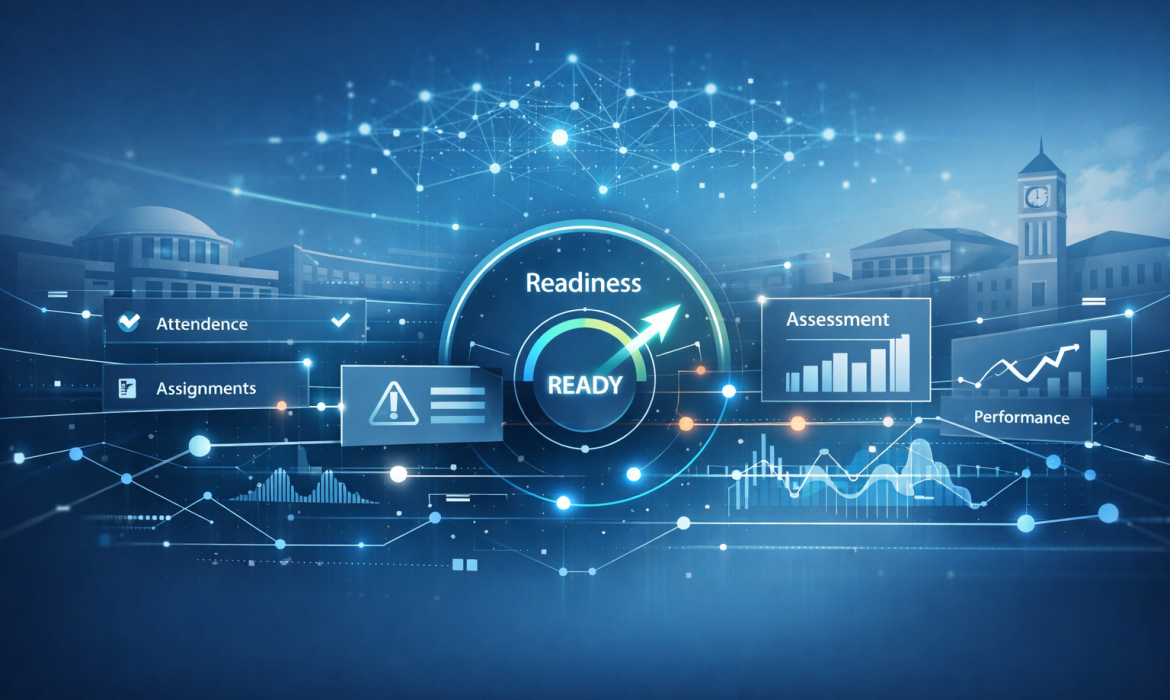
AI-Enhanced Exam Readiness: How iCloudEMS Prepares Students with Intelligent Tools
Introduction: Exam Season Chaos Is a System Failure, Not a Student Failure
Every exam season across Indian universities follows a familiar pattern.
Students attend classes, submit assignments, and complete internal assessments. Yet when final results are declared, a significant number underperform or fail. Faculty are left questioning student seriousness, examination departments face pressure, and leadership struggles to explain fluctuating pass percentages.
The uncomfortable truth is this:
Most students were exam registered, but not exam ready.
The issue is not student intent or faculty effort.
The issue is the absence of continuous academic intelligence.
Traditional systems are designed to manage processes, not preparedness. They track attendance, record marks, and schedule exams—but they fail to answer the most critical question:
Is the student truly ready to perform in the exam?
Through advanced Digital solutions for higher education, universities can move from reactive exam management to proactive academic preparedness using an AI-powered Education Management System (EMS) designed for real academic intelligence.
This gap is where AI-enhanced exam readiness becomes essential. At the center of this shift is iCloudEMS, an AI-powered Education Management System (EMS) built to give students, faculty, and institutional leaders real-time visibility into exam readiness—long before failure becomes inevitable.
The Hidden Problem: Why Students Are “Exam Registered” but Not “Exam Ready”
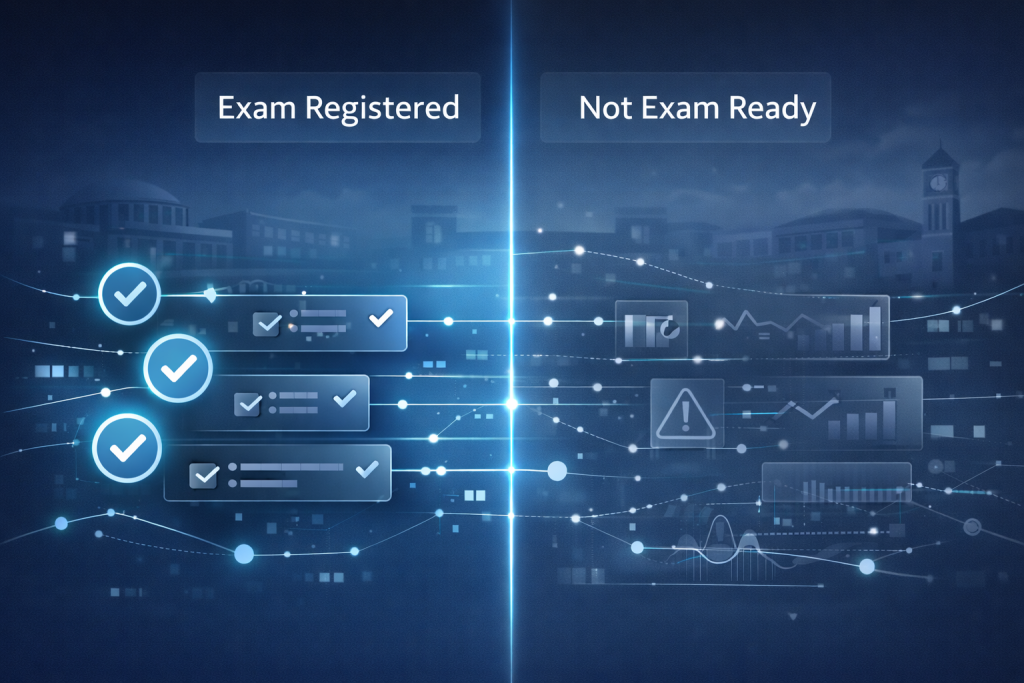
Most institutions rely on a few traditional indicators to assume readiness:
- Minimum attendance completed
- Syllabus coverage confirmed
- Internal assessments conducted
While these metrics satisfy administrative requirements, they do not reflect academic preparedness.
Where Traditional Approaches Break Down
Attendance Does Not Equal Understanding
A student may be physically present yet conceptually lost.
Marks Without Insight Offer No Direction
Internal assessments generate scores, but rarely reveal trends, patterns, or academic risk.
Late-Stage Identification of Weak Students
Interventions often begin after poor performance has already occurred.
Manual Monitoring Cannot Scale
Faculty intuition replaces data-driven clarity, especially as institutions grow.
Uniform Preparation Ignores Individual Gaps
All students receive the same guidance, despite very different learning needs.
As institutions scale, these blind spots widen—making exam outcomes unpredictable and stressful.
What “AI-Enhanced Exam Readiness” Actually Means
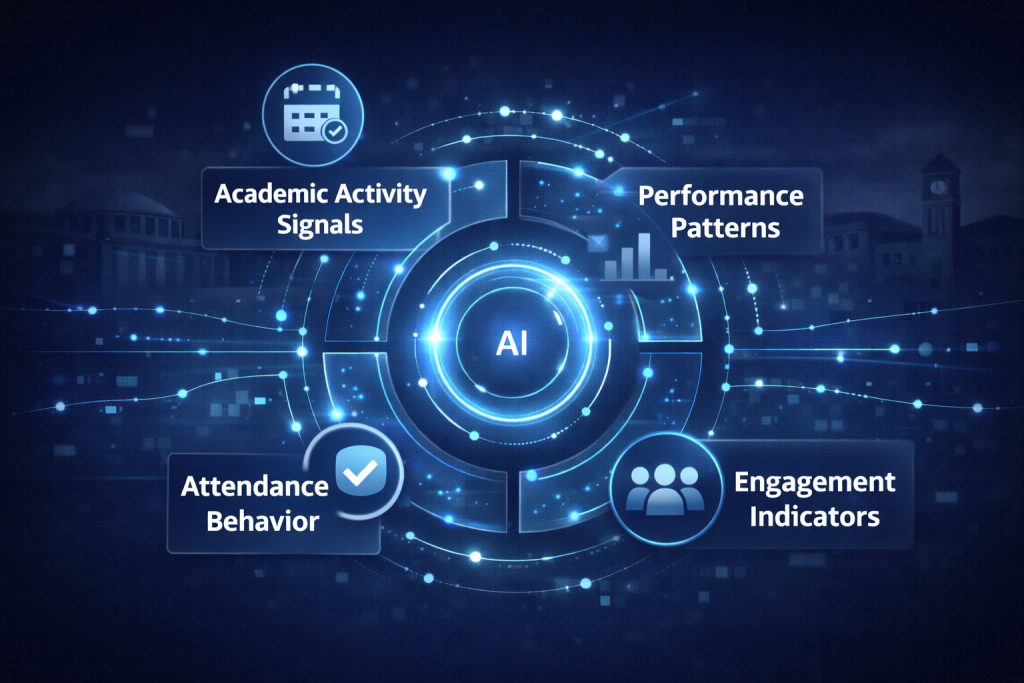
AI-enhanced exam readiness is not about automating exams or digitizing question papers.
It is about continuously understanding and improving student preparedness.
At its core, it is built on four principles:
- Predictive, not reactive
- Continuous, not episodic
- Personalized, not generic
- Insight-driven, not assumption-based
Instead of asking “Who failed?”, institutions begin asking:
“Who is likely to struggle, why, and how early can we intervene?”
This shift is only possible through intelligent, connected academic data—exactly what modern Digital solutions for higher education are designed to deliver.
How iCloudEMS Enables AI-Enhanced Exam Readiness
iCloudEMS treats exam readiness as an institution-wide intelligence layer, embedded across academics, assessments, attendance, and student engagement.
AI-Based Performance Trend Analysis
iCloudEMS continuously analyzes:
- Internal assessment scores
- Assignment performance patterns
- Historical subject-wise results
Instead of static marks, the system identifies performance trajectories—highlighting whether a student is improving, declining, or stagnating. Academic risk is identified early, not after final exams.
Attendance–Performance Correlation Intelligence
Attendance becomes meaningful only when interpreted in context.
iCloudEMS correlates:
- Attendance consistency
- Subject difficulty levels
- Individual performance history
This helps identify students who are compliant but disengaged—enabling academic support rather than disciplinary action.
Subject-Level Exam Readiness Indicators
Every subject carries a different academic risk.
iCloudEMS provides subject-wise readiness insights, helping students and faculty focus preparation where it matters most—eliminating blanket revision strategies.
Early Warning Alerts for Students, Mentors, and Faculty
One of the strongest strengths of iCloudEMS lies in its ability to deliver AI-driven early awareness systems in universities that proactively identify academic risks weeks before examinations begin, enabling timely academic intervention.
AI-driven alerts are generated when the system detects:
- Declining performance trends
- Attendance–performance mismatches
- Engagement drop-offs
Alerts reach the right stakeholders at the right time, ensuring intervention happens weeks before exams—not after results.
Digital Exam Readiness Dashboards
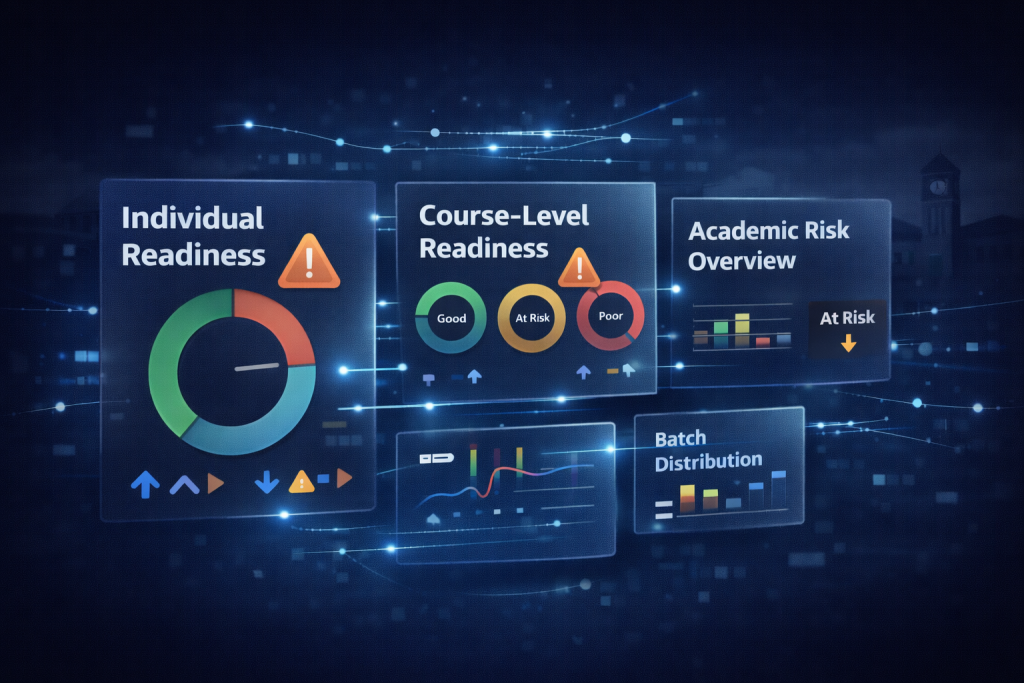
Visibility changes behavior.
iCloudEMS dashboards display:
- Individual student readiness status
- Course-level preparedness distribution
- Batch-wise academic risk overview
Students gain clarity.
Faculty see where support is needed.
Leadership understands readiness at scale.
AI-Driven Academic Intervention Workflows
Insights without action deliver no value.
iCloudEMS enables:
- Mentor meetings triggered by AI alerts
- Targeted remedial plans
- Academic support tracking across departments
Exam readiness becomes a managed academic process, not a last-minute emergency.
Student-Centric Intelligence: How Students Benefit Directly
This clarity is further strengthened through a smart mobile app experience for students, where academic information, alerts, and exam-related updates are accessible in real time without dependency on administrative follow-ups.
For students, exams are emotional as much as academic. Anxiety often stems from uncertainty.
Students benefit from:
- Early identification of weak subjects
- Clear preparation priorities
- Reduced last-minute pressure
- Confidence built on visibility, not guesswork
Instead of wondering “Am I prepared?”, students see their readiness and act accordingly.
Faculty and Examination Department Advantages
By integrating digital evaluation and examination management, institutions can reduce result delays, minimize revaluation pressure, and improve academic transparency across departments.
Faculty Benefits
- Early identification of at-risk students
- Data-backed mentoring conversations
- Better alignment between teaching and outcomes
Examination Department Benefits
- Reduced failures and revaluation load
- Improved result consistency
- Smoother exam cycles at scale
Exams become predictable, manageable, and academically fair.
Institutional Impact for University Leadership
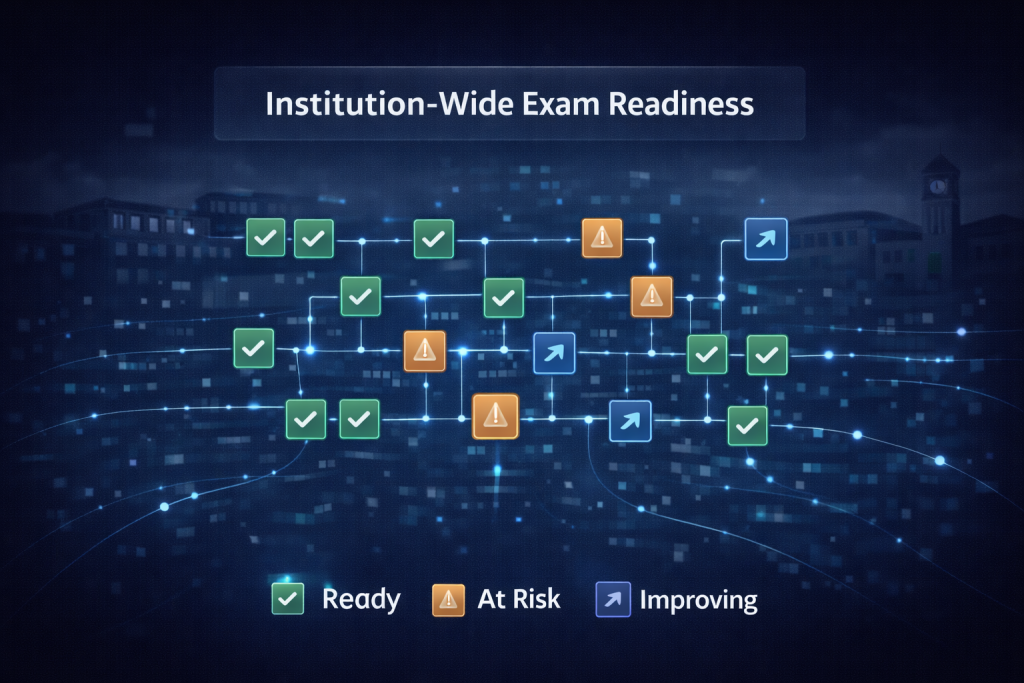
Exam outcomes directly influence reputation, accreditation, and long-term credibility.
AI-powered readiness enables:
- Improved pass percentages
- Stronger academic governance
- Better accreditation data readiness
- Higher student satisfaction and trust
These outcomes directly support stronger accreditation and academic governance by ensuring reliable academic data, consistent results, and evidence-based quality assurance.
An AI-driven Education Management System (EMS) like iCloudEMS moves leadership from intuition-based decisions to evidence-driven governance.
Why AI-Enhanced Exam Readiness Is the Future of Indian Higher Education
The role of AI in universities is no longer limited to automation but extends to early intelligence, academic prediction, and continuous readiness monitoring.
Indian higher education is expanding rapidly. Manual systems cannot keep pace with:
- Large student populations
- Complex compliance requirements
- Rising expectations from students and parents
National quality frameworks and higher education quality and assessment standards increasingly emphasize outcome visibility, academic monitoring, and institutional accountability.
higher education quality and assessment standards↗
Without AI-driven readiness intelligence, exam seasons will remain reactive and stressful. The future belongs to institutions that treat exams as a continuous preparedness journey, not a single event.
iCloudEMS as the Strategic Enabler
iCloudEMS integrates academics, assessments, attendance, student engagement, and AI intelligence into a unified platform.
As a cloud-native, AI-powered Education Management System (EMS), iCloudEMS delivers scalable Digital solutions for higher education.
Trusted by 160+ universities and colleges and supporting 170,000+ students, iCloudEMS enables exam readiness that is intelligent, measurable, and sustainable.
Conclusion: Exam Readiness Is a Responsibility, Not a Deadline
Exams should never surprise students or institutions.
With AI-enhanced exam readiness, universities can:
- Support students earlier
- Reduce academic stress
- Improve outcomes responsibly
The transformation is clear:
From exam management to exam intelligence.
That shift defines the next generation of higher education.
To understand how AI-driven exam readiness can be implemented institution-wide, explore how iCloudEMS supports intelligent academic preparedness.
Frequently Asked Questions on AI-Enhanced Exam Readiness in Universities
What is AI-enhanced exam readiness in higher education?
AI-enhanced exam readiness refers to the use of artificial intelligence within Digital solutions for higher education to continuously assess, predict, and improve a student’s preparedness for examinations. Instead of relying only on attendance and internal marks, AI analyzes performance trends, engagement patterns, and academic behavior to identify readiness gaps early and enable timely interventions.
How does AI help universities identify students who are not exam-ready?
AI systems within an Education Management System (EMS) like iCloudEMS analyze multiple academic indicators such as internal assessments, attendance-performance correlation, subject-level trends, and historical outcomes. This allows universities to detect students at academic risk weeks before exams, rather than discovering issues after results are declared.
Why are traditional exam preparation methods insufficient for universities?
Traditional methods focus on syllabus completion and exam scheduling but lack real-time intelligence. They do not provide visibility into individual student preparedness, early warning signals, or performance patterns at scale. As student numbers grow, manual tracking becomes unreliable, leading to reactive exam management instead of proactive readiness planning.
How does iCloudEMS improve student exam performance using AI?
iCloudEMS uses AI-driven insights to provide students with clarity on weak subjects, preparation priorities, and academic risk indicators. Through intelligent dashboards, alerts, and continuous performance tracking, students gain early awareness and guided preparation, reducing last-minute stress and improving exam outcomes.
Can AI reduce exam stress and anxiety among students?
Yes. Exam stress often comes from uncertainty. AI-powered readiness indicators within iCloudEMS give students clear visibility into their preparation status, helping them plan better, seek help earlier, and approach exams with confidence rather than panic.
How do faculty benefit from AI-based exam readiness tools?
Faculty gain early visibility into student performance trends, enabling data-backed mentoring instead of assumption-driven support. AI helps faculty identify at-risk students, focus academic interventions effectively, and align teaching strategies with actual learning outcomes.
What advantages do examination departments gain from AI-driven readiness systems?
AI-enhanced readiness reduces last-minute failures, revaluation workloads, and result volatility. Examination departments benefit from better preparedness visibility, improved pass percentages, and smoother exam cycles, especially in large institutions with complex academic structures.
How does AI-enhanced exam readiness support university leadership and governance?
For leadership, AI provides institution-wide visibility into academic preparedness, helping improve decision-making, accreditation readiness, and academic credibility. An AI-powered Education Management System (EMS) supports data-driven governance by replacing intuition with measurable insights.
Is AI-enhanced exam readiness suitable for large universities?
Yes. AI-enhanced readiness is especially critical for universities with 3,000+ students, where manual monitoring is impractical. Platforms like iCloudEMS are designed to scale intelligence across departments, courses, and campuses without increasing administrative burden.
Why is AI-driven exam readiness considered the future of higher education?
As higher education scales and compliance expectations rise, universities need predictive intelligence rather than reactive processes. AI-driven exam readiness transforms exams from one-time events into continuous academic intelligence systems, making it a foundational component of future-ready Digital solutions for higher education.

How iCloudEMS Empowers University Students with Smart Mobile App Facilities
In today’s fast-paced digital era, universities must go beyond traditional administrative systems and embrace student-centric digital solutions. Students expect instant access, transparency, and mobility in every academic interaction.
iCloudEMS, a modern Education Management System (EMS) with a powerful mobile app, is designed to simplify academic and administrative processes for students, faculty, and parents—all from a single platform.
One Mobile App. Multiple Academic Services.
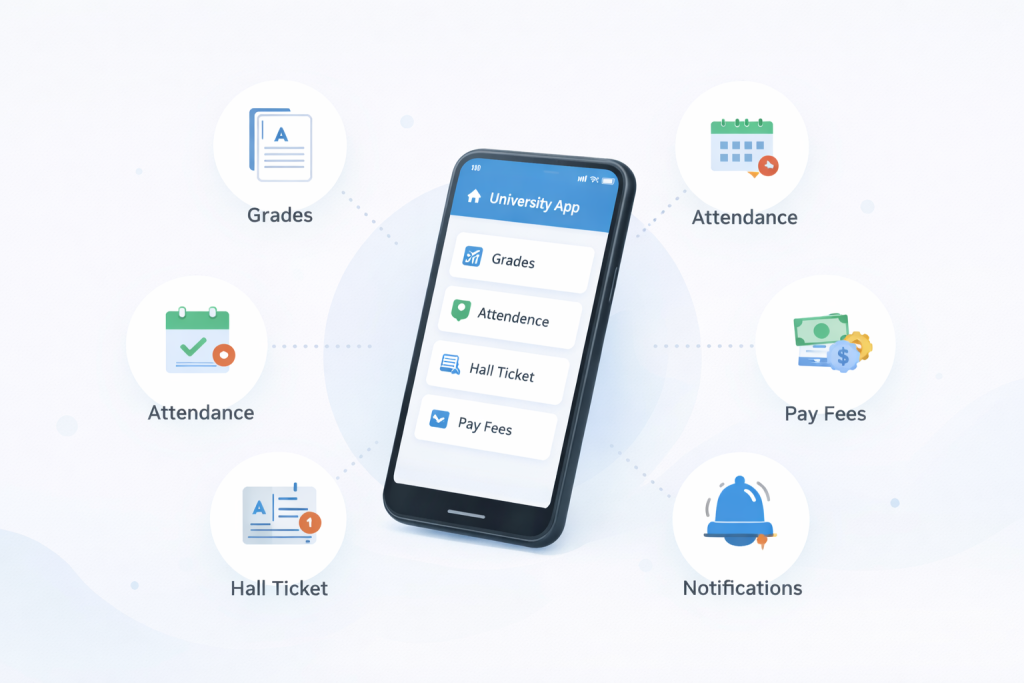
The iCloudEMS Mobile App enables university students to access essential academic services anytime, anywhere—without visiting campus offices or standing in long queues.
Key Student Benefits
Instant Grade Card Access
Students can view and download their semester-wise grade cards directly from the mobile app as soon as results are published.
Hall Ticket Download in One Click
No more last-minute campus visits. Exam hall tickets are available instantly on the app, reducing stress during examination periods.
Online Fee Payment
Students can pay academic fees securely from anywhere through integrated online payment options—no counters, no paperwork, no delays.
Zero Campus Dependency
Routine academic activities no longer require physical interaction with university staff, saving time and effort for both students and administrators.
Focus More on Studies, Not Administration
By eliminating manual processes and physical visits, iCloudEMS allows students to focus on what truly matters—learning, skill development, and extracurricular activities.
The mobile-first approach significantly reduces anxiety during exams, admissions, and fee submission periods by keeping everything transparent and accessible.
Smart Tools for Teachers
Faculty members also benefit from the iCloudEMS ecosystem, which streamlines daily academic responsibilities.
Faculty Capabilities
- Student performance tracking
- Attendance management
- Internal marks entry
- Academic communication through the mobile app
With reduced paperwork and fewer administrative interruptions, teachers can spend more time on teaching, mentoring, and student engagement.
Real-Time Transparency for Parents
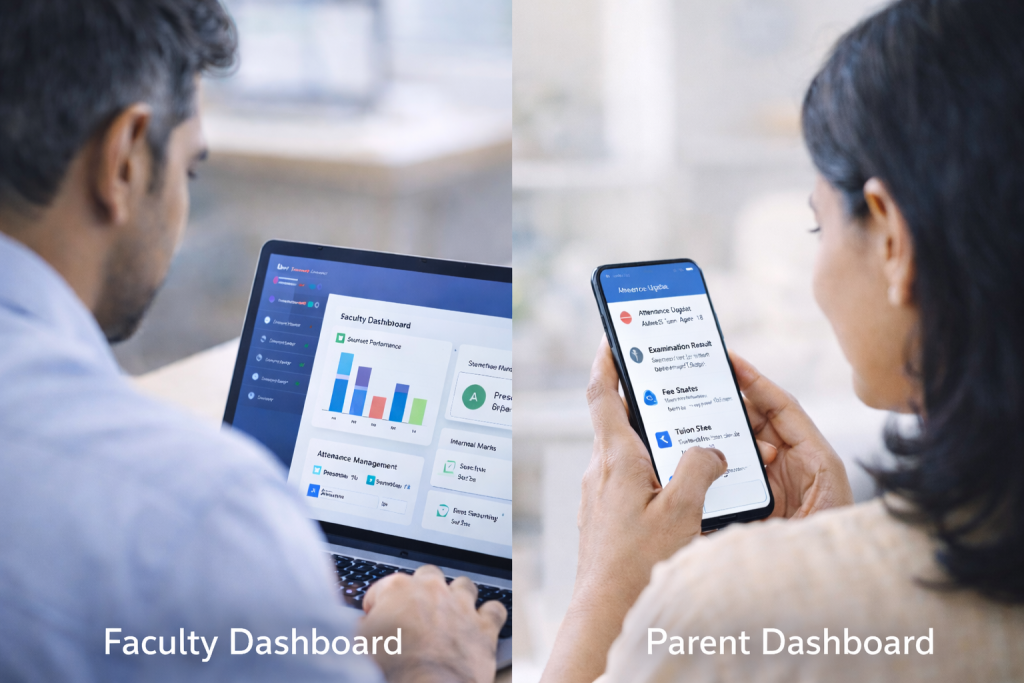
Parents remain informed and connected through the dedicated Parent Mobile App.
What Parents Can Access
- Real-time academic performance of their ward
- Attendance updates
- Examination results
- Fee status notifications
This level of transparency builds trust, accountability, and confidence between parents and the institution.
A Time-Saving, Secure & Smart University Solution
iCloudEMS is designed to support modern university operations with reliability and scalability.
Key Characteristics
- ✔ Time-saving
- ✔ User-friendly
- ✔ Secure & reliable
- ✔ Mobile-first
- ✔ Cloud-based
By aligning academic services with digital expectations, iCloudEMS helps institutions evolve into smart, digitally governed campuses.
Why Universities Choose iCloudEMS
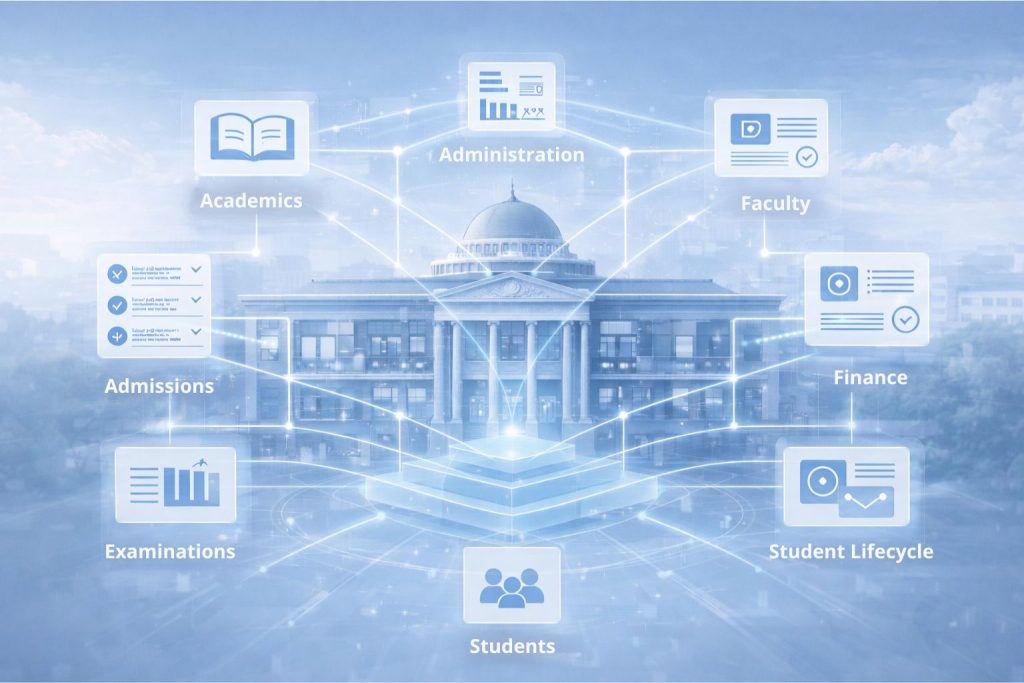
Universities adopt iCloudEMS as their Education Management System (EMS) because it delivers measurable institutional value.
Institutional Benefits
- Improved student satisfaction
- Reduced administrative workload
- Faster service delivery
- Enhanced parent engagement
- Strong digital brand image
Conclusion: A Smart Tool for a Smart University
iCloudEMS is not just a software—it is a digital transformation partner for universities.
With its powerful mobile app and unified Education Management System (EMS), universities can deliver seamless academic services, empower students, engage parents, support faculty, and build a truly smart academic ecosystem aligned with the future of higher education.
Frequently Asked Questions
What is the iCloudEMS mobile app for university students?
The iCloudEMS mobile app is a student-centric digital platform that allows university students to access academic and administrative services directly from their smartphones. It enables students to view grade cards, download hall tickets, check attendance, pay fees online, and receive important academic notifications without visiting campus offices.
How does the iCloudEMS mobile app help students save time?
The iCloudEMS mobile app eliminates manual processes such as standing in queues, visiting multiple departments, and submitting paperwork. By providing instant access to results, attendance, fee payments, and exam-related documents, students can complete essential tasks in minutes and focus more on academics and personal development.
Can students download exam hall tickets and grade cards through the app?
Yes. Students can securely download their exam hall tickets and semester-wise grade cards directly from the iCloudEMS mobile app. These documents are available in real time once published by the university, reducing last-minute stress and dependency on administrative offices.
Is online fee payment secure in the iCloudEMS mobile app?
Yes. The iCloudEMS mobile app supports secure online fee payments through trusted payment gateways. Transactions are encrypted, logged, and instantly reflected in the system, ensuring transparency for students, parents, and university finance teams.
How does iCloudEMS support teachers and faculty members?
iCloudEMS provides faculty members with digital tools to manage attendance, track student performance, enter internal marks, and communicate academic updates efficiently. This reduces paperwork and allows teachers to focus more on teaching, mentoring, and student engagement.
How does the iCloudEMS parent app improve transparency for parents?
The parent mobile app provides real-time visibility into a student’s academic journey. Parents can monitor attendance, examination results, fee status, and important notifications, helping them stay informed and confident about their child’s progress.
Does iCloudEMS reduce administrative workload for universities?
Yes. iCloudEMS automates routine academic and administrative processes across departments, significantly reducing manual effort, repetitive queries, and paperwork. This leads to faster service delivery, improved operational efficiency, and better governance.
Why do universities choose iCloudEMS as their Education Management System (EMS)?
Universities choose iCloudEMS because it offers reliable digital solutions for higher education that scale with institutional growth. It improves student satisfaction, enhances parent engagement, empowers faculty, strengthens compliance, and supports long-term digital transformation.
Is iCloudEMS suitable for large universities with multiple campuses?
Yes. iCloudEMS is designed for large universities and multi-campus institutions by providing centralized data visibility, standardized academic processes, and secure access across locations, ensuring consistent governance at scale.
How does iCloudEMS help build a smart digital campus?
iCloudEMS connects academics, administration, faculty, students, and parents through a unified Education Management System (EMS). Mobile-first access, real-time updates, and cloud-based operations help universities become smart, digitally governed campuses.
What makes iCloudEMS a future-ready solution for higher education?
iCloudEMS is built on modern cloud architecture with automation and intelligent workflows that support long-term institutional growth. Its focus on mobility, transparency, and operational efficiency makes it a future-ready foundation for higher education institutions.

10 AI Hacks in University ERPs That Save Admins 20+ Hours a Week
University administrators don’t struggle because they work less.
They struggle because too much of their time is spent coordinating, checking, following up, and correcting.
Most universities already have ERP systems.
Yet admin teams still stay late during admissions, exams, fee cycles, and accreditation season.
The problem isn’t effort.
And it isn’t even digitisation.
The problem is that most ERPs record work — they don’t reduce mental and coordination load.
This is where AI inside university ERPs quietly changes daily operations.
Not futuristic AI.
Not experimental automation.
Just practical, workflow-level intelligence that removes hours of invisible admin work every week.
Below are 10 AI hacks already possible inside modern university ERPs that consistently save 20+ hours per week across admin teams.
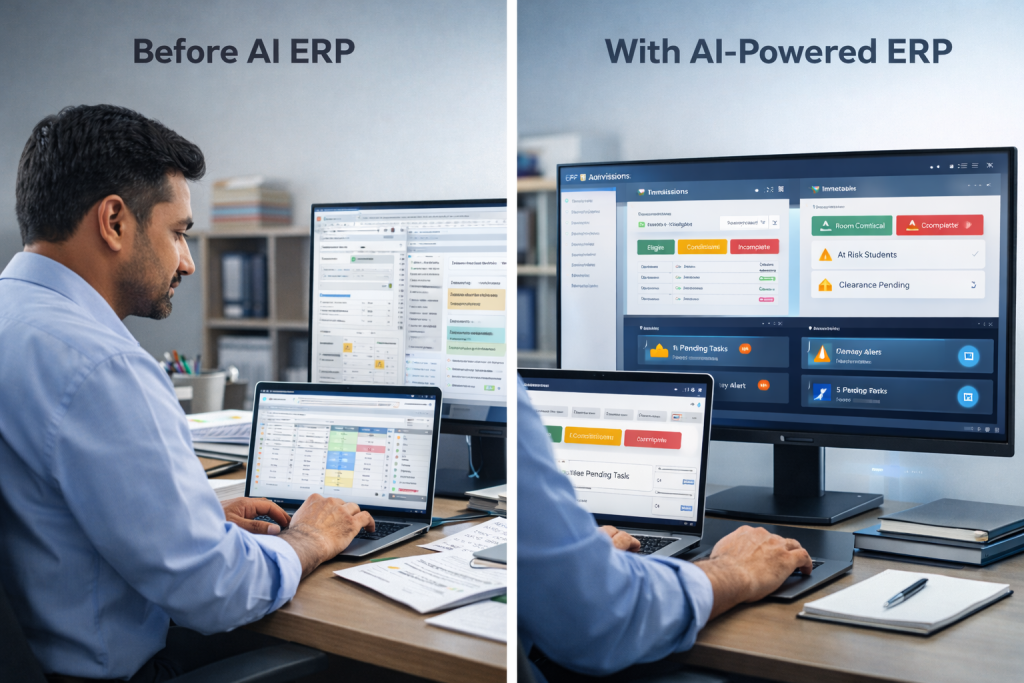
Hack #1: AI-Based Admission Application Pre-Screening

The Admin Problem
Admissions teams manually verify eligibility, documents, category rules, and missing information — even before shortlisting begins.
This involves:
- Rechecking eligibility rules
- Identifying incomplete applications
- Responding to repetitive queries
How AI Inside ERP Fixes This
AI pre-screens applications using:
- Programme eligibility rules
- Academic thresholds
- Document completeness checks
Applications are automatically tagged as:
- Eligible
- Conditionally eligible
- Incomplete
Time Saved Per Week
4–6 hours during active admission cycles
Who Benefits Most
Admissions office, registrar’s team
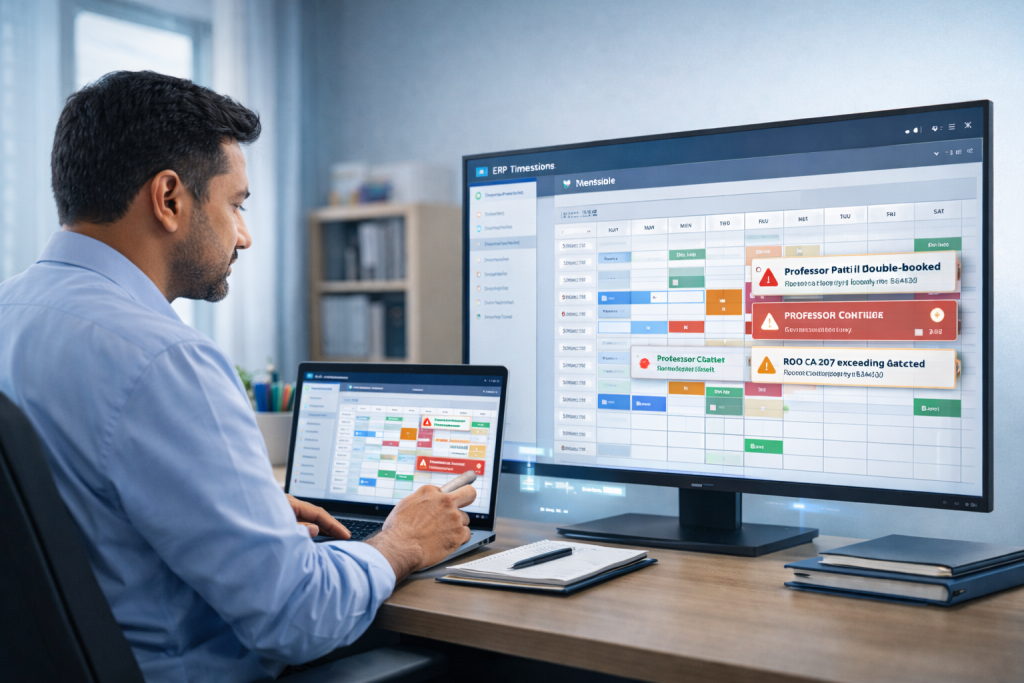
Hack #2: Intelligent Timetable Conflict Detection
The Admin Problem
Timetable creation looks finished — until:
- Faculty clashes appear
- Room capacity mismatches surface
- Lab allocations conflict
Admins then enter endless back-and-forth correction loops.
How AI Inside ERP Fixes This
AI detects conflicts before publishing by analysing:
- Faculty load
- Room availability
- Programme overlaps
- Student group collisions
Instead of reacting, admins resolve issues proactively.
Time Saved Per Week
2–3 hours during timetable cycles
Who Benefits Most
Academic office, department coordinators
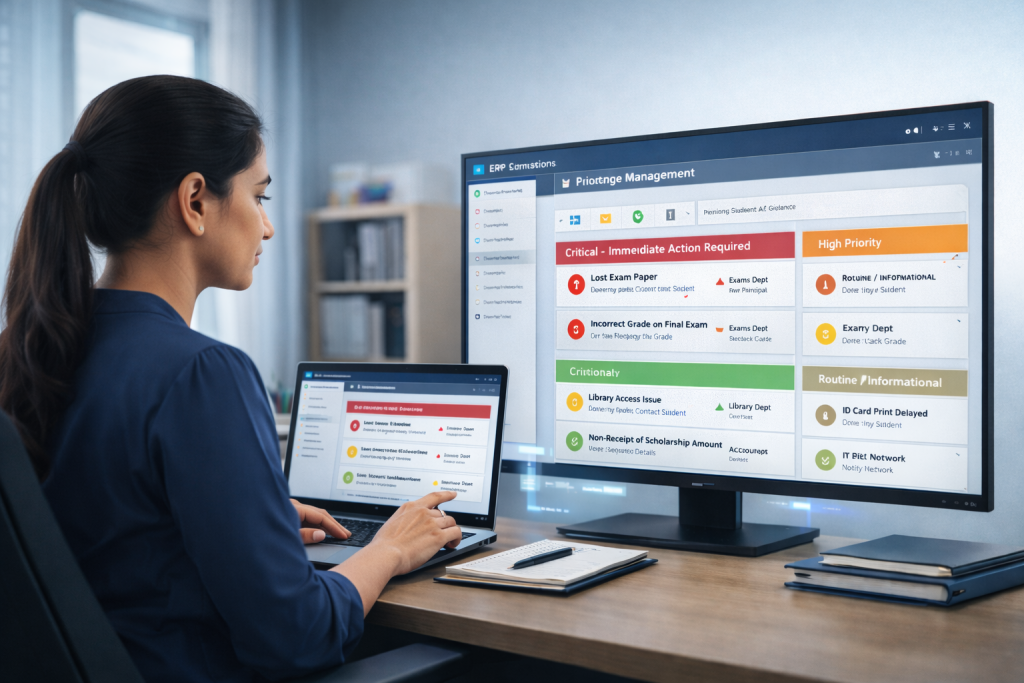
Hack #3: Auto-Prioritised Student Grievance Routing
The Admin Problem
Grievances arrive via emails, portals, WhatsApp, and physical submissions.
Admins manually decide:
- Urgency
- Responsible department
- Follow-up priority
Important cases often get delayed unintentionally.
How AI Inside ERP Fixes This
AI categorises grievances based on:
- Issue type
- Past resolution timelines
- Academic calendar context
Critical cases surface instantly; routine ones follow standard workflows.
Time Saved Per Week
2 hours
Who Benefits Most
Student affairs office, grievance committees
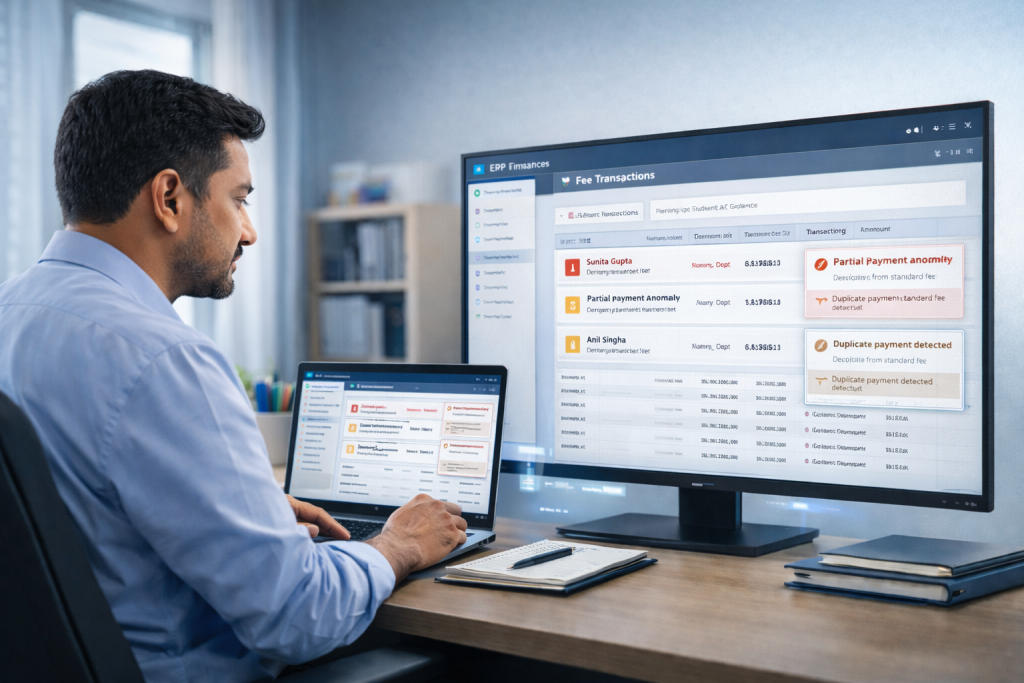
Hack #4: Smart Fee Exception & Anomaly Detection
The Admin Problem
Finance teams spend hours reconciling:
- Partial payments
- Incorrect fee heads
- Duplicate transactions
- Pending approvals
Most effort goes into finding issues, not resolving them.
How AI Inside ERP Fixes This
AI flags:
- Unusual payment patterns
- Repeated failed transactions
- Deviations from standard fee structures
Admins focus only on exceptions, not every record.
Time Saved Per Week
3–4 hours
Who Benefits Most
Finance office, accounts team
Hack #5: AI-Assisted Exam Readiness Monitoring
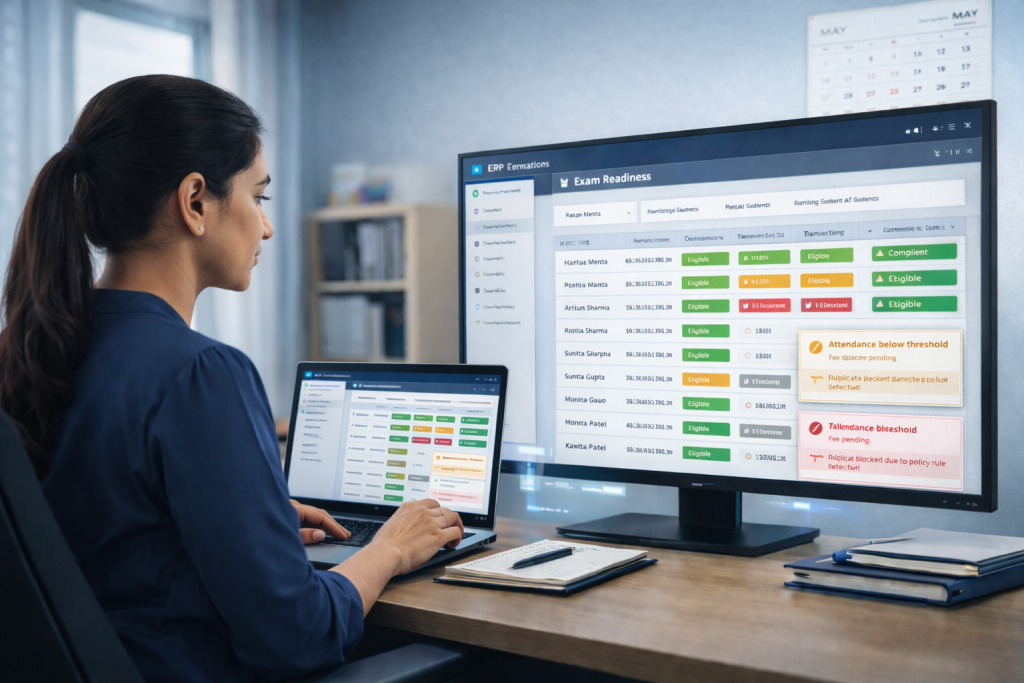
The Admin Problem
Before exams, admins manually check:
- Student eligibility
- Attendance compliance
- Fee clearance
- Hall ticket readiness
This requires pulling reports from multiple modules.
How AI Inside ERP Fixes This
AI continuously monitors readiness indicators and highlights:
- At-risk students
- Missing clearances
- Policy violations
No last-minute panic.
Time Saved Per Week
2 hours during exam periods
Who Benefits Most
COE office, examination cell
Hack #6: Automated Accreditation Evidence Mapping

The Admin Problem
During accreditation, teams scramble to:
- Locate evidence
- Match documents to criteria
- Verify version accuracy
This work repeats every cycle.
How AI Inside ERP Fixes This
AI maps operational data automatically to:
- Accreditation metrics
- Criteria buckets
- Historical submissions
Evidence builds continuously — not retroactively.
Time Saved Per Week
3–5 hours, much more during accreditation years
Who Benefits Most
IQAC, accreditation committees
Hack #7: Predictive Follow-Ups for Pending Tasks

The Admin Problem
Admins chase:
- Faculty submissions
- Student approvals
- Department confirmations
Most follow-ups happen after deadlines are missed.
How AI Inside ERP Fixes This
AI predicts likely delays based on:
- Past response patterns
- Calendar load
- Role-specific behaviour
Reminders go out before escalation is required.
Time Saved Per Week
1–2 hours
Who Benefits Most
Admin coordinators, department offices
Hack #8: Intelligent Report Readiness Indicators
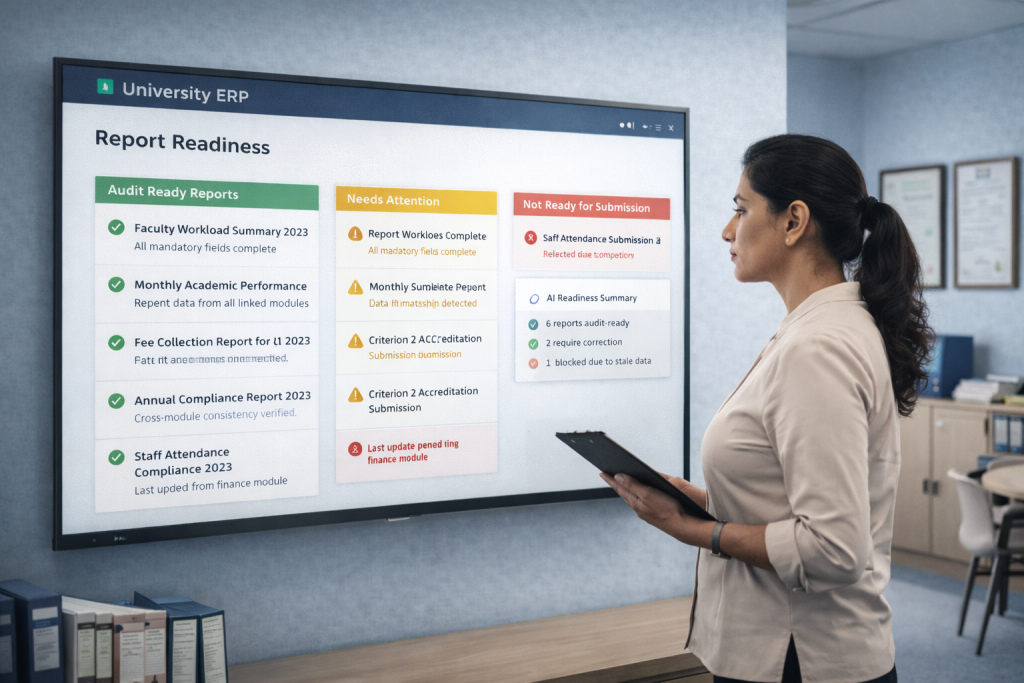
The Admin Problem
Reports are generated — but not always reliable.
Admins spend time validating:
- Missing fields
- Inconsistent numbers
- Data freshness
How AI Inside ERP Fixes This
AI flags:
- Data gaps
- Inconsistencies
- Reports that are not audit-ready
Admins trust what they submit.
Time Saved Per Week
1–2 hours
Who Benefits Most
Registrar’s office, compliance teams
Hack #9: Smart Communication Consolidation
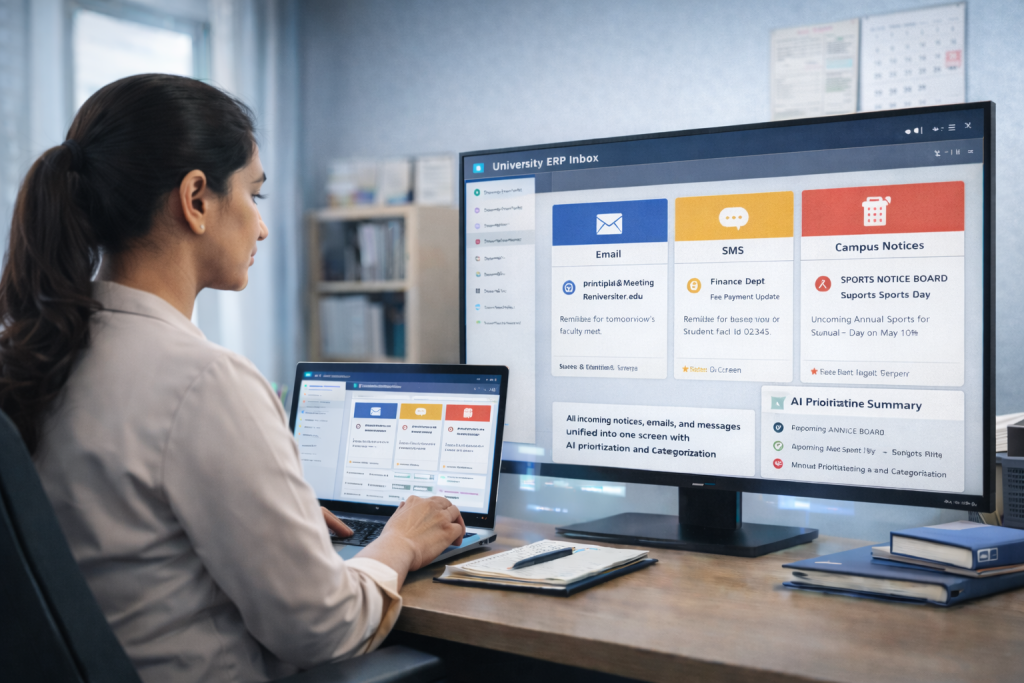
The Admin Problem
Circulars, notices, and alerts go through:
- Email
- SMS
- WhatsApp
- Portals
Admins repeat the same message multiple times.
How AI Inside ERP Fixes This
AI selects:
- Right audience
- Best channel
- Optimal timing
One action replaces multiple broadcasts.
Time Saved Per Week
1–2 hours
Who Benefits Most
Admin office, communications team
Hack #10: Context-Aware Admin Dashboards
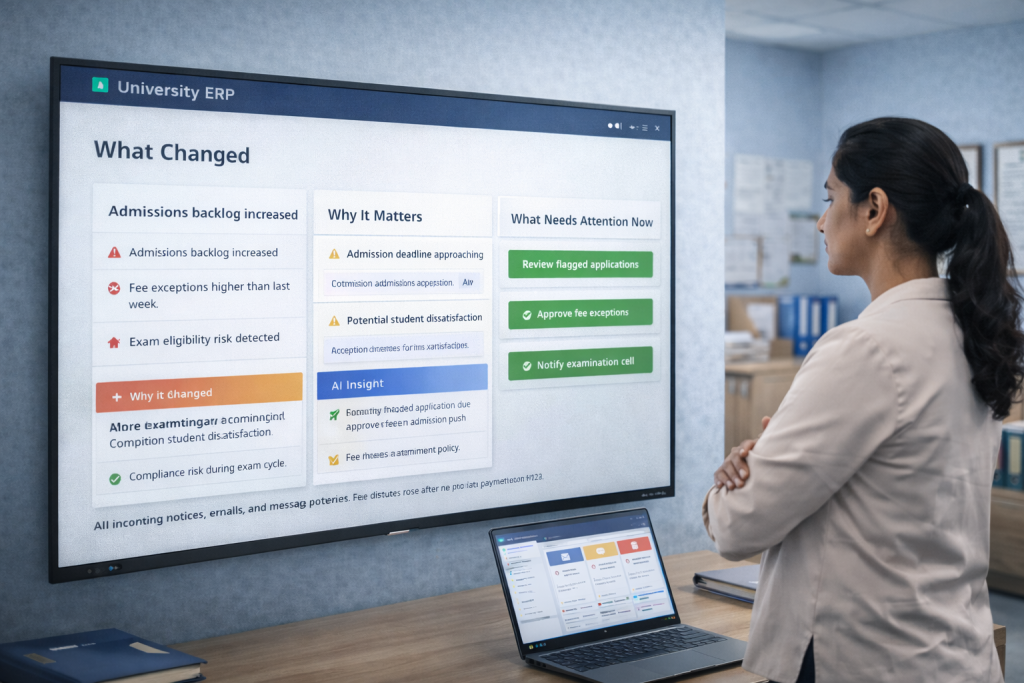
The Admin Problem
Admins open dashboards but still ask:
“Is this normal?”
“What should I act on first?”
How AI Inside ERP Fixes This
AI highlights:
- What changed
- Why it matters
- What needs attention now
Admins stop scanning — they start acting.
Time Saved Per Week
2–3 hours
Who Benefits Most
Registrar, deans, senior admin leadership
Why Most Universities Still Feel Overworked Even After Implementing ERP
Because automation alone doesn’t reduce cognitive load.
Most ERPs:
- Execute tasks
- Store transactions
- Generate reports
But admins still:
- Decide priorities
- Detect risks
- Coordinate people
AI inside ERP doesn’t replace admins.
It removes mental overhead, uncertainty, and repetitive coordination — which is where most time is lost.
Where a Unified AI-Native ERP Makes the Difference
These AI hacks work only when:
- Data is unified
- Workflows are connected
- Intelligence is embedded, not bolted on
This is where platforms like iCloudEMS, designed as a cloud-native, AI-powered university ERP backbone across 31 integrated modules, enable such efficiencies without increasing complexity.
The goal isn’t more dashboards.
It’s fewer decisions per day.
Frequently Asked Questions
1. What is AI in university ERP systems?
AI in university ERP systems refers to built-in intelligence that helps the software analyse data, identify patterns, prioritise tasks, and support decisions. Unlike basic automation, AI helps administrators detect issues early, reduce manual checking, and manage complex workflows more efficiently across admissions, exams, finance, and student services.
2. How does AI in ERP reduce administrative workload in universities?
AI reduces administrative workload by automating repetitive checks, flagging exceptions, prioritising tasks, and predicting delays. Instead of manually reviewing every record or chasing follow-ups, administrators focus only on items that need attention, saving significant time every week.
3. Can AI-powered university ERP really save admin time every week?
Yes. When AI is embedded inside ERP workflows, it consistently saves time by reducing coordination, verification, and follow-ups. Even small efficiencies across admissions, exams, fees, and reporting add up to 15–25 hours a week across administrative teams in most universities.
4. Which administrative tasks can AI automate inside a university ERP?
AI can support tasks such as admission application screening, timetable conflict detection, exam readiness checks, fee anomaly detection, grievance routing, accreditation evidence mapping, and report validation. These tasks typically consume the most manual effort in university administration.
5. What is the difference between automation and AI in university ERP software?
Automation follows predefined rules to complete tasks. AI goes a step further by learning patterns, understanding context, and highlighting what matters most. In university ERP systems, AI helps administrators prioritise actions and detect risks, not just execute processes.
6. Is AI in university ERP useful for daily operations or only analytics?
AI is most effective when used in daily operations. It supports real-time decision-making in admissions, examinations, finance, and student services by continuously monitoring data and surfacing issues early, rather than being limited to dashboards or historical reports.
7. How does AI help admissions teams save time in universities?
AI helps admissions teams by pre-screening applications, identifying missing documents, validating eligibility rules, and categorising applications automatically. This reduces manual review effort and allows teams to focus on shortlisting and decision-making instead of routine checks.
8. Can AI reduce exam and evaluation workload for university admins?
Yes. AI can monitor exam eligibility, flag compliance issues, detect evaluation anomalies, and track readiness across departments. This reduces last-minute manual verification and coordination, which is a major source of stress during examination cycles.
9. Does AI in university ERP replace administrative staff?
No. AI does not replace administrative staff. It supports them by reducing repetitive work, uncertainty, and coordination overload. Administrators retain control and decision authority while AI helps them work faster, more accurately, and with less pressure.
10. Is AI in university ERP safe for compliance and audits?
When designed correctly, AI operates within role-based access controls, audit trails, and governance rules. It enhances compliance by improving data consistency, traceability, and early detection of issues, which is critical for audits and accreditation processes.
11. Is AI-powered ERP useful for small and mid-sized colleges?
Yes. Smaller institutions often benefit even more because limited staff handle multiple responsibilities. AI helps prioritise work, reduce manual effort, and manage peak workloads without increasing headcount or operational complexity.
12. What should universities look for in an AI-powered ERP system?
Universities should look for AI that is embedded within ERP workflows, not added as separate tools. Key factors include unified data, explainable insights, auditability, ease of use, and practical impact on daily administrative tasks rather than theoretical AI features.

University ERP in India: Why Most Systems Never Reach Institutional Maturity
Most Indian universities today are digitally active.
Admissions are online.
Fees are collected digitally.
Exams are conducted using software.
Reports are generated on dashboards.
Yet very few institutions can confidently say their university operates as one coordinated digital system.
This gap between digital activity and institutional maturity is where most ERP initiatives in Indian higher education stall. The problem is not adoption. The problem is evolution.
This article examines why ERP systems in universities rarely mature beyond basic automation, and how forward-looking institutions move from digital tools to institutional intelligence.
ERP Adoption vs ERP Maturity: A Critical Difference
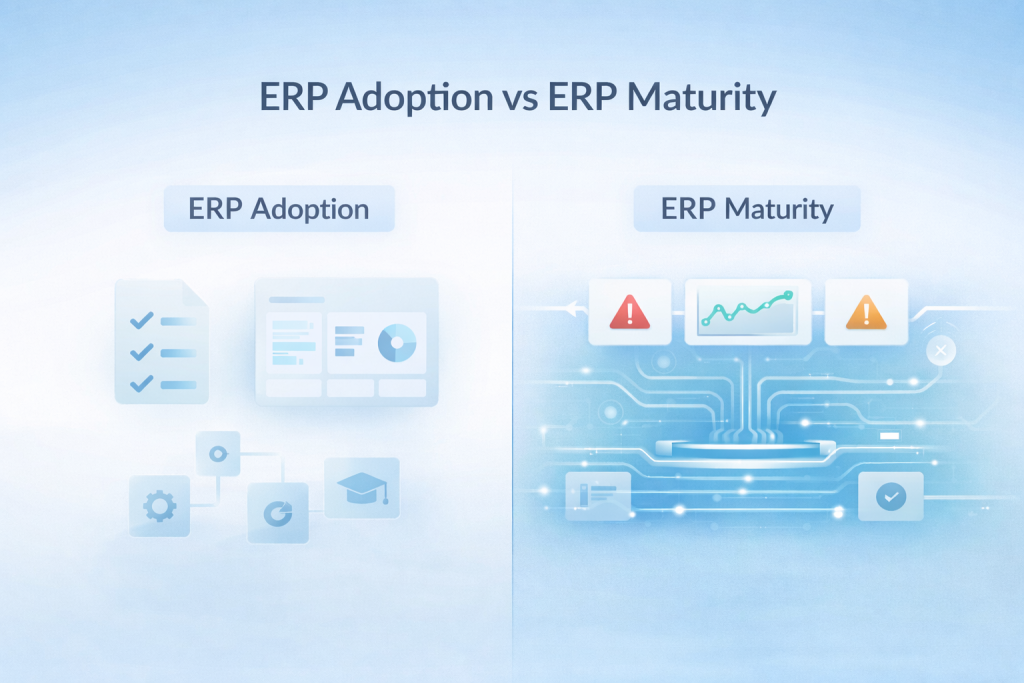
ERP adoption answers one question:
“Is the software installed and in use?”
ERP maturity answers a far more important one:
“Does the system actively improve institutional decision-making?”
In many universities, ERP stops at adoption. The system records transactions but does not influence outcomes. It captures data but does not create foresight. It stores information but does not reduce risk.
Mature ERP systems behave differently. They do not wait for reports to be generated. They surface issues early. They guide leadership attention. They reduce dependence on individuals.
This distinction is rarely discussed, yet it explains why similar ERP investments produce very different results across institutions.
The Hidden Ceiling Most University ERPs Hit
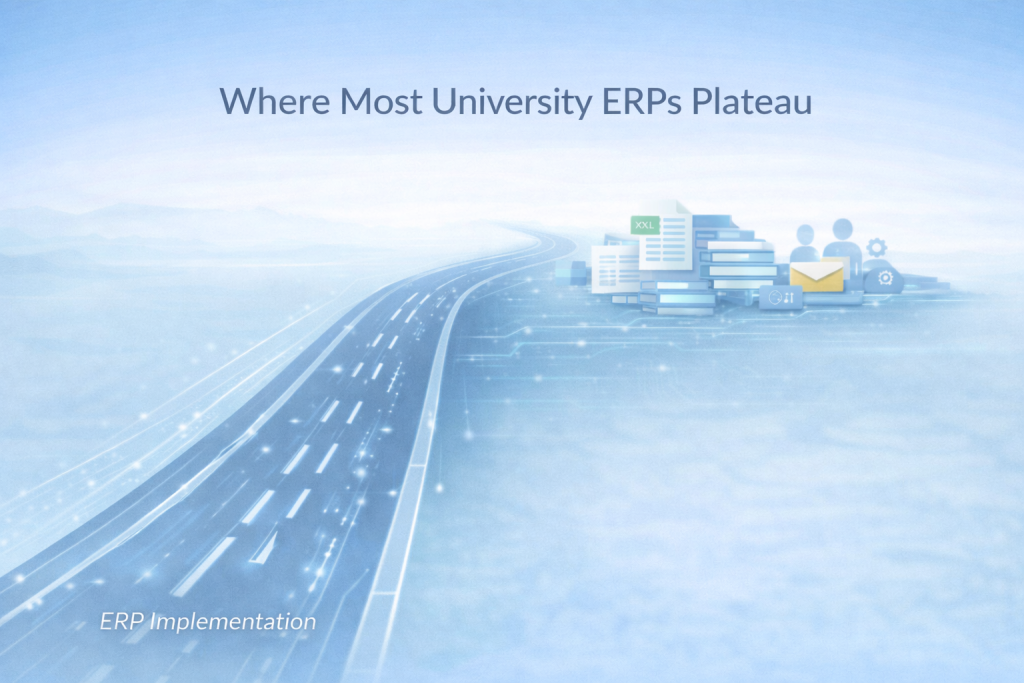
After initial implementation, most university ERP systems hit an invisible ceiling.
At this stage:
- Core workflows are digitized
- Users are trained at a functional level
- Basic reports are available
- Compliance requirements are technically met
But beyond this point, progress slows dramatically.
Why?
Because the ERP was never designed to support institution-wide intelligence, only process digitization.
Universities then compensate by adding:
- More tools
- More reports
- More manual coordination
- More people to “manage the system”
Ironically, the ERP meant to reduce complexity begins to add it.
Why Fragmentation Persists Even After ERP Implementation
Process Digitization Without Process Alignment
Many ERP implementations digitize existing workflows exactly as they are — including inefficiencies, exceptions, and inconsistencies.
When each department digitizes its own version of “how things work,” the ERP becomes a digital reflection of silos rather than a unifying force.
Without process alignment at the institutional level, ERP cannot create a single source of truth.
Data Visibility Without Decision Context
Universities often generate large volumes of data but struggle to answer simple leadership questions:
- Which students are at academic risk right now?
- Where are fee delays likely to escalate?
- Which departments are operationally overloaded?
- What compliance risks are emerging this semester?
The issue is not lack of data. It is lack of decision context.
ERP systems that stop at reporting force leadership to interpret data manually. Mature systems embed logic, thresholds, and alerts so leadership attention is directed automatically.
Over-Reliance on Individuals
In many institutions, ERP effectiveness depends on a few key people who “know how things really work.”
They reconcile data.
They handle exceptions.
They bridge gaps between departments.
When systems rely on people instead of logic, scalability suffers. Institutional memory becomes personal memory. Continuity becomes fragile.
True ERP maturity reduces this dependency by embedding institutional rules into the system itself.
How Mature Universities Think About ERP Differently
Institutions that move beyond ERP stagnation adopt a fundamentally different mindset.
They stop asking:
“What features does the ERP have?”
They start asking:
“What institutional behavior should the system enforce?”
This shift changes everything.
ERP as Governance Infrastructure
Mature universities treat ERP as governance infrastructure, not operational software.
This means:
- Rules are enforced consistently across departments
- Exceptions are visible, not hidden
- Accountability is systemic, not personal
- Leadership oversight is continuous, not periodic
ERP becomes a mechanism for institutional discipline rather than administrative convenience.
Intelligence Before Expansion
Instead of adding more modules or tools, successful institutions first strengthen intelligence.
They focus on:
- Early warning systems
- Automated alerts for deviations
- Predictive indicators, not historical summaries
- Real-time visibility into student and operational health
This aligns closely with concepts discussed in iCloudEMS’ perspective on early awareness systems in higher education, where ERP acts as a preventive layer rather than a reactive one.
Unified Lifecycle Thinking
Rather than treating admissions, academics, exams, finance, and placement as separate domains, mature institutions design ERP around the student lifecycle.
This ensures:
- Data continuity across years
- Reduced duplication
- Better academic and financial forecasting
- Improved student experience without added effort
This lifecycle-based design philosophy is foundational to long-term ERP success.
Why Cloud Alone Does Not Create ERP Maturity
Many universities assume that moving ERP to the cloud automatically improves outcomes. In reality, cloud infrastructure solves availability and scalability problems — not intelligence problems.
A cloud-hosted system with fragmented logic will still behave like a fragmented system.
What matters is:
- Whether the system is cloud-native
- Whether intelligence is embedded into workflows
- Whether real-time monitoring is designed into operations
This distinction is explored in iCloudEMS’ analysis of why cloud-based ERP alone is not enough for higher education.
ERP as an Institutional Nervous System
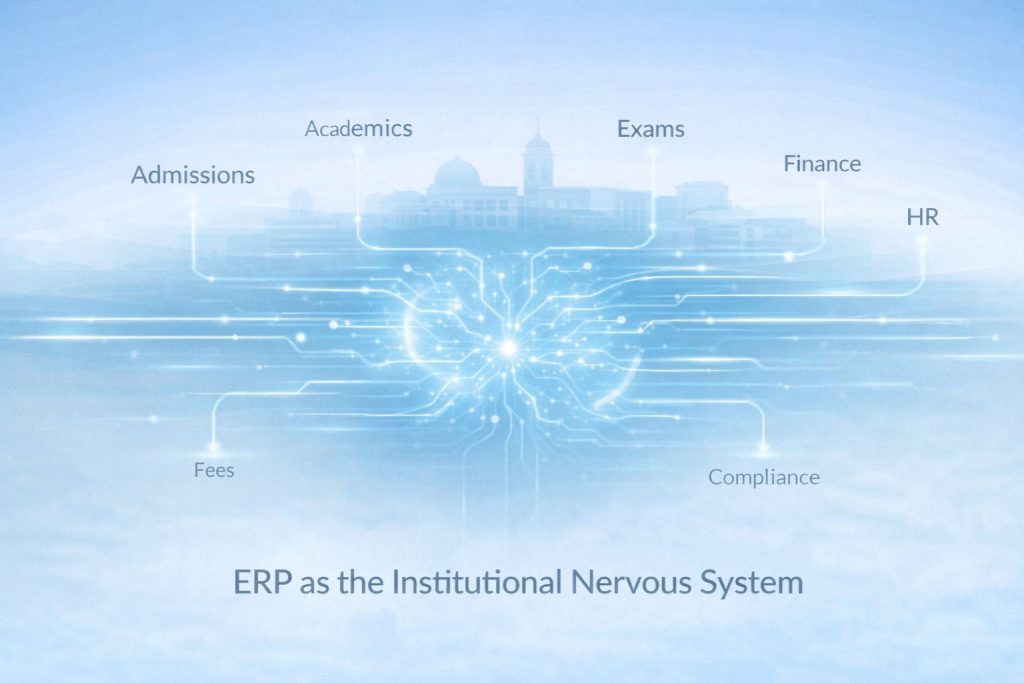
The most advanced universities treat ERP as an institutional nervous system.
Just as a nervous system:
- Detects signals early
- Prioritizes responses
- Coordinates actions across organs
A mature ERP:
- Detects risks early
- Prioritizes leadership attention
- Coordinates departments automatically
In this model, ERP does not replace people. It amplifies their effectiveness by reducing noise and delay.
Where iCloudEMS Aligns with Institutional Maturity
iCloudEMS is designed around this maturity-first philosophy.
Rather than focusing on isolated digitization, it emphasizes:
- Unified data architecture
- AI-driven alerts and monitoring
- Lifecycle-based design
- Governance-friendly workflows
- Cloud-native scalability for Indian higher education realities
This approach aligns with institutions seeking long-term institutional resilience, not short-term automation.
Final Thought: ERP Success Is a Maturity Journey
ERP success in universities is not binary. It is evolutionary.
Institutions that remain stuck at adoption experience frustration, fragmentation, and rising operational cost. Institutions that pursue maturity build systems that quietly support leadership, faculty, and students every day.
The difference lies not in the software alone, but in how the institution defines the role of ERP in its future.
Frequently Asked Questions
What does ERP maturity mean in higher education?
ERP maturity refers to how effectively an ERP system supports institutional decision-making, governance, and early risk detection—not just transaction recording.
Why do universities still rely on Excel after ERP implementation?
This usually indicates fragmented workflows, lack of unified data architecture, and ERP systems that digitize processes without enforcing institutional alignment.
Is cloud-based ERP enough for universities?
Cloud infrastructure improves scalability and access, but without embedded intelligence and lifecycle integration, it does not ensure ERP maturity.
How does AI improve university ERP outcomes?
AI enables early alerts, predictive monitoring, and proactive intervention—helping institutions address issues before they escalate.
What should universities prioritize after ERP implementation?
Universities should prioritize intelligence, governance alignment, and lifecycle integration rather than adding more tools or modules.

Cybersecurity in Higher Education ERP: Why “Cloud-Based” Alone Is Not Enough
University leadership teams increasingly take comfort in one statement: “Our ERP is cloud-based.”
The assumption is simple—if the system runs on the cloud, security is already taken care of.
In reality, this assumption is where many cybersecurity risks begin.
Cloud hosting solves only one part of the problem: infrastructure reliability. It does not automatically protect sensitive academic data, financial records, examination workflows, or personal information spread across thousands of users. For universities handling long-term student records and high-stake operations, security must be designed far beyond the hosting layer.
Why Universities Are High-Value Cyber Targets
Higher education institutions hold an unusually broad and sensitive data mix under one roof.
They manage:
- Personal student and parent information
- Academic records spanning multiple years
- Examination data with reputational impact
- Payroll, finance, and vendor payments
- Research data and intellectual property
Unlike many enterprises, universities retain data for long durations and allow access to diverse user groups—students, faculty, administrators, finance teams, external evaluators, and regulators. This complexity makes higher education systems especially vulnerable when controls are weak or fragmented.
Why “Cloud-Hosted” Does Not Mean “Secure by Design”
A cloud platform secures servers, networks, and physical infrastructure. Everything above that layer—the ERP application, data access rules, workflows, and integrations—remains the institution’s responsibility.
Security failures often arise not from cloud breaches, but from:
- Poor access control design
- Excessive permissions across departments
- Weak approval workflows
- Manual data handling outside the system
In simple terms, the cloud keeps the building safe. It does not control who gets the keys to every room inside.
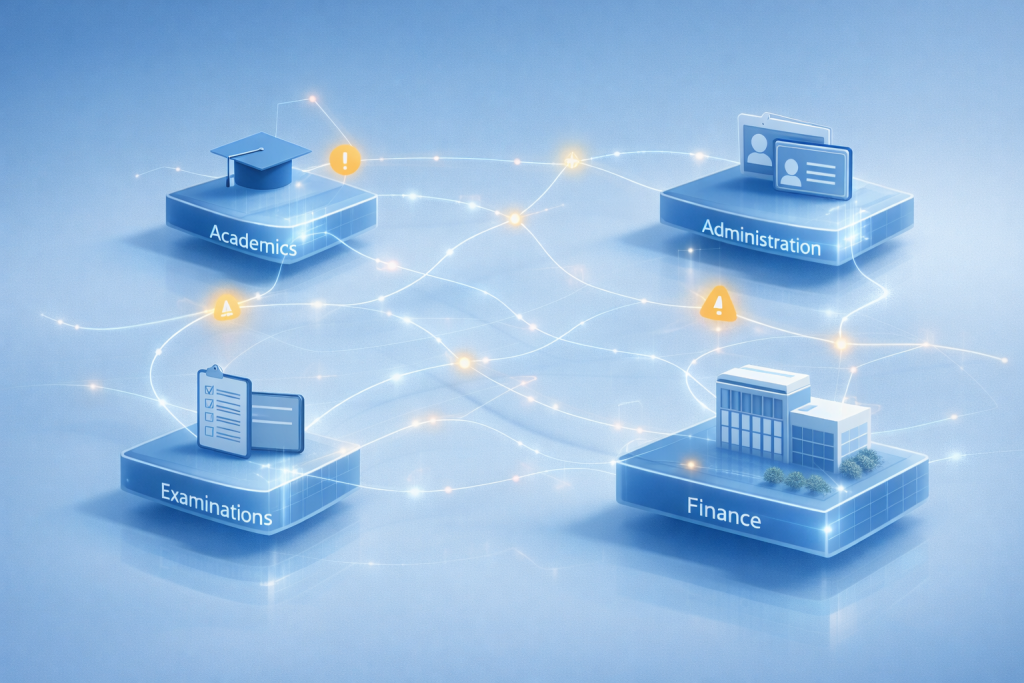
The Hidden Security Gaps in Traditional University ERPs
Many legacy or partially modernized ERPs expose institutions to silent risks.
Common gaps include:
- Users having more access than their role requires
- Critical actions executed without digital approvals
- Limited or non-existent audit trails
- Disconnected modules sharing data informally
- Dependence on spreadsheets for reporting and reconciliation
These gaps rarely trigger immediate alarms. Instead, they accumulate quietly until a compliance issue, data inconsistency, or operational failure surfaces—often too late.
What Real ERP Cybersecurity Looks Like in Higher Education
Effective cybersecurity in a university ERP is embedded into everyday operations, not bolted on as an afterthought.
Key characteristics include:
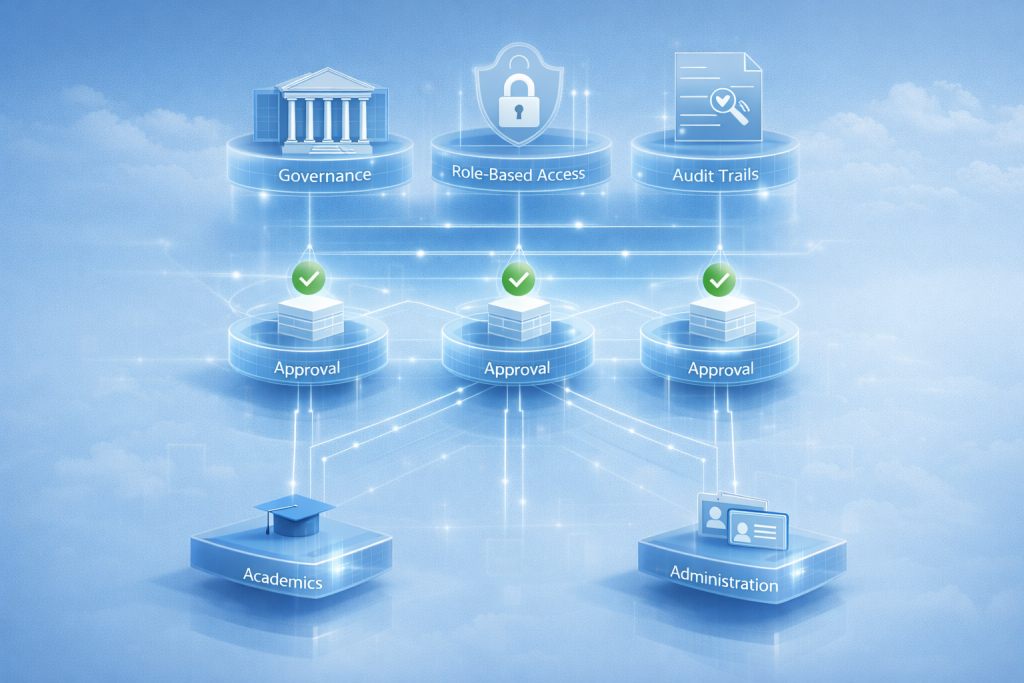
- Role-based access control aligned with institutional hierarchy
- Approval workflows for sensitive actions like concessions, results, and payments
- End-to-end audit logs for every critical transaction
- Encrypted data flow between academic, finance, and administrative modules
- Centralized alerts that flag unusual or risky activity early
When security is built into workflows, compliance becomes automatic instead of enforced manually.
Why Governance Matters More Than Firewalls
Firewalls protect perimeters. Governance protects decisions.
In universities, governance defines:
- Who can access what—and for how long
- How approvals are granted and recorded
- How responsibility is assigned and tracked
- How deviations are identified and addressed
Without governance embedded into the ERP, institutions rely on policies that exist on paper but not in practice. Systems must enforce governance by default, not depend on individual discipline.
How Cloud-Native Architecture Changes the Security Equation
Cloud-native ERP platforms are designed differently from systems merely hosted on the cloud.
They enable:
- A unified data model instead of siloed databases
- Controlled, API-driven integrations with external tools
- Real-time visibility into operations rather than retrospective reports
- Consistent security rules applied across all modules
This architectural consistency significantly reduces blind spots and strengthens institutional control.

Where iCloudEMS Fits In
iCloudEMS is designed as a cloud-native, AI-powered ERP backbone for higher education, with security and governance embedded at the architectural level.
Rather than treating cybersecurity as a separate layer, iCloudEMS integrates:
- Structured access control across academic and administrative functions
- Built-in auditability for compliance and accountability
- Unified visibility across departments and campuses
This approach helps institutions move from reactive security measures to proactive risk management—without increasing operational complexity.
Conclusion
Cybersecurity in higher education is not an IT checkbox. It is a leadership decision shaped by architecture, governance, and operational discipline.
A cloud-based ERP is a starting point, not a guarantee. True security emerges when systems are designed to enforce accountability, visibility, and control at every level.
For universities focused on trust, continuity, and long-term reputation, investing in secure-by-design ERP architecture is no longer optional—it is foundational.
What makes higher education ERP systems vulnerable to cyber threats?
Higher education ERP systems manage large volumes of sensitive academic, financial, and personal data while allowing access to many stakeholders. Long data retention periods, complex workflows, and inconsistent access controls increase vulnerability if security is not designed into the system architecture.
Why is cloud hosting alone insufficient for university data security?
Cloud hosting secures infrastructure, not application behavior. Data access rules, approval workflows, audit trails, and integrations are controlled by the ERP design. Without strong governance at the application level, cloud-hosted systems can still expose critical data.
How can universities enforce role-based access in ERP systems?
Universities can enforce role-based access by defining permissions based on job roles rather than individuals, limiting access strictly to required functions, and automatically updating permissions when roles change within the institution.
What are common cybersecurity mistakes in campus management software?
Common mistakes include excessive user permissions, lack of approval workflows, weak audit logging, manual data exports, and disconnected modules that exchange data without proper controls.
How does ERP governance reduce institutional cyber risk?
ERP governance ensures that every action is accountable, approved, and traceable. It embeds institutional policies directly into workflows, reducing reliance on manual enforcement and preventing unauthorized access or changes.
What should university leaders ask ERP vendors about cybersecurity?
University leaders should ask how access controls are designed, how approvals and audit trails work, how data flows between modules, how integrations are secured, and how governance is enforced across the system.
How do audit trails improve accountability in academic systems?
Audit trails record who performed an action, when it was done, and what data was affected. This transparency deters misuse, simplifies compliance, and enables quick investigation when issues arise.
Why are fragmented ERP modules a security risk?
Fragmented modules often duplicate data and bypass centralized controls. This creates inconsistencies, weakens visibility, and increases the likelihood of unauthorized access or data leakage.
How does cloud-native architecture enhance cybersecurity?
Cloud-native architecture uses a unified data model and standardized security rules across modules. This reduces blind spots, strengthens access control, and allows real-time monitoring instead of post-incident analysis.
What role does AI play in detecting early security risks in universities?
AI helps identify unusual patterns, delayed approvals, abnormal access behavior, and operational anomalies early, allowing institutions to respond before issues escalate into serious security incidents.
How can universities protect long-term student data effectively?
Universities can protect long-term data by enforcing strict access lifecycle management, encrypting data flows, maintaining audit logs, and ensuring that security rules remain consistent even as students graduate or staff change.
Why is cybersecurity a leadership issue in higher education?
Cybersecurity impacts institutional reputation, regulatory compliance, financial stability, and student trust. Decisions about architecture, governance, and accountability must be led by institutional leadership, not treated as a purely technical concern.

AI in Universities Is No Longer Optional — But Blind Automation Is Dangerous
Artificial intelligence has crossed a quiet threshold in higher education.
What was once experimental is now embedded in daily academic life. Universities are using AI to assist admissions teams, support learning management systems, analyse assessments, automate finance workflows, monitor attendance patterns, and respond to student queries. In many institutions, AI is no longer discussed as a future initiative. It is already present—sometimes visibly, sometimes quietly—inside operational systems.
This shift is not driven by hype. It is driven by scale.
Universities today manage far more complexity than they did even a decade ago. Student populations are larger. Academic offerings are broader. Regulatory expectations are tighter. Accreditation cycles are more frequent. Leadership decisions are expected to be faster, better informed, and defensible.
In this environment, manual oversight alone cannot keep up. AI becomes not a luxury, but a structural necessity.
Yet there is an emerging risk that deserves equal attention.
As universities rush to adopt AI, many are doing so through blind automation—deploying tools that act quickly, but without institutional awareness, governance context, or architectural integration. When automation outpaces understanding, efficiency gains can quietly turn into academic, compliance, and leadership risks.
The challenge for universities in 2025 is no longer whether to adopt AI.
It is how to adopt AI without losing control.
Why AI Has Become Unavoidable in University Operations
Universities operate at the intersection of education, governance, and public trust. Every academic decision carries reputational and regulatory consequences. Every operational delay compounds across departments. Every data inconsistency eventually surfaces during audits, inspections, or accreditation reviews.
AI responds to these pressures in very practical ways:
- It processes volume faster than human teams can
- It detects patterns across large datasets
- It reduces repetitive manual workload
- It surfaces anomalies that might otherwise be missed
As student numbers cross into the thousands and processes span dozens of departments, AI-assisted systems become essential simply to maintain baseline reliability.
This is why AI adoption has accelerated so rapidly across:
- Learning Management Systems
- Student Information Systems
- Examination and evaluation workflows
- Finance, fees, and reconciliation
- Student support and grievance handling
At scale, the alternative is operational fatigue.
But speed alone is not intelligence.
The Hidden Problem With Automation-First AI Adoption
Many AI deployments in universities are introduced as standalone tools.
A chatbot for admissions queries.
An AI proctoring layer for examinations.
A predictive model for attendance risk.
A reporting engine that auto-generates dashboards.
Individually, each tool appears useful. Together, they often create fragmentation.
Automation-first AI focuses on task completion, not institutional continuity. It answers questions, executes rules, and generates outputs—but it rarely understands how one decision affects another department, another regulation, or another reporting cycle.
This is where danger quietly enters the system.
When AI operates without a unified institutional backbone:
- Decisions are made in isolation
- Context is lost between departments
- Exceptions are automated instead of reviewed
- Accountability becomes difficult to trace
The university does not fail loudly.
It drifts silently.
Automation Is Not the Same as Institutional Intelligence
It is important to distinguish between three very different concepts that are often grouped together under “AI”.
Task Automation
This is the simplest form. Systems execute predefined actions:
- Sending reminders
- Updating records
- Triggering notifications
Automation reduces workload, but it does not understand the consequences.
Decision Intelligence
Here, systems analyse patterns and suggest actions:
- Flagging at-risk students
- Highlighting unusual financial entries
- Predicting operational bottlenecks
This adds value, but still requires oversight.
Institutional Awareness
This is the highest level—and the rarest.
Institutional awareness means AI understands:
- Academic calendars
- Regulatory constraints
- Approval hierarchies
- Cross-department dependencies
- Historical decisions and their outcomes
Without this layer, automation can move faster than governance can respond.
Where Blind Automation Creates Real Risk
Universities do not operate like generic enterprises. They carry academic authority, regulatory responsibility, and social accountability. Blind automation introduces risks precisely because it does not recognise these nuances.
Academic Integrity and Assessment Sensitivity
Automated evaluation systems can flag anomalies, but without an academic context, they may:
- Misinterpret interdisciplinary grading structures
- Ignore approved exceptions
- Escalate false positives during examinations
In assessment environments, speed without judgment is dangerous.
Compliance and Accreditation Pressure
Accreditation frameworks such as NAAC and NIRF depend on consistent, traceable, and explainable data.
When AI systems generate outputs without:
- Clear data lineage
- Cross-module consistency
- Human validation checkpoints
Institutions struggle to justify outcomes during reviews.
Leadership Visibility vs Operational Noise
Dashboards filled with automated metrics can overwhelm leadership instead of informing them.
When every system speaks, clarity disappears.
Leadership does not need more data.
Leadership needs reliable signals.
Why Disconnected AI Tools Increase Institutional Anxiety
A common misconception is that more AI tools equal better intelligence.
In practice, disconnected AI systems create parallel versions of truth:
- The LMS reports one pattern
- The SIS reports another
- Finance flags something unrelated
- Student support sees a different risk profile
Each system may be “correct” in isolation, yet misleading in combination.
This fragmentation increases:
- Decision latency
- Review cycles
- Leadership uncertainty
- Audit stress
Universities begin to spend more time reconciling outputs than acting on insights.
Why ERP-Embedded AI Changes the Equation
The alternative is not less AI.
It is architected AI.
When AI is embedded inside a unified ERP backbone, it operates with shared context. Data flows across modules without duplication. Decisions are informed by institutional rules, not just algorithms.
In an ERP-embedded model:
- Academic actions reflect finance and compliance realities
- Alerts are contextual, not generic
- Patterns are evaluated across the institution, not within silos
- Human authority remains central
AI assists. It does not override.
This distinction is foundational.
Governance Requires Controlled Intelligence, Not Autonomous Automation
University governance is not about speed alone. It is about defensibility.
Every major decision must be explainable:
- Why was this student flagged?
- Why was this approval delayed?
- Why did this outcome differ from last cycle?
Blind automation struggles with “why”.
Controlled intelligence, by contrast:
- Preserves audit trails
- Maintains institutional memory
- Aligns AI outputs with policy frameworks
- Supports leadership confidence
This is why AI architecture matters more than AI capability.
How iCloudEMS Approaches AI Differently
iCloudEMS was designed with this reality in mind.
Rather than treating AI as an external layer, it embeds intelligence within the operational core of the institution. AI functions are aligned with workflows across academics, examinations, finance, HR, admissions, accreditation, and student services.
Key principles guide this approach:
- AI operates inside a unified cloud-native ERP backbone
- Intelligence is contextual, not generic
- Alerts are advisory, not autonomous
- Leadership retains decision authority
- Visibility is prioritised over automation volume
With more than 31 tightly integrated modules running on secure AWS infrastructure, AI insights emerge from real institutional patterns—not isolated datasets.
The result is not faster automation for its own sake, but calmer governance.
AI as an Enabler of Institutional Maturity
When implemented thoughtfully, AI does not destabilise universities. It strengthens them.
It allows leadership to:
- Detect issues earlier
- Allocate resources more intelligently
- Respond to compliance requirements with confidence
- Support students without reactive firefighting
But this maturity emerges only when AI is aligned with institutional architecture.
The future belongs not to universities with the most AI tools, but to those with the most coherent systems.
The Real Question Universities Must Answer
AI in universities is no longer optional.
The real question is whether institutions will adopt it blindly or wisely.
Automation without awareness accelerates risk.
Intelligence without governance erodes trust.
But AI, grounded in a unified ERP architecture, becomes something far more valuable:
a steady, reliable partner in institutional decision-making.
Questions Universities Are Asking
Is AI adoption mandatory for universities today?
Yes. At current operational scale and regulatory complexity, AI-assisted systems are necessary to maintain reliability, visibility, and responsiveness.
Why is blind automation risky in academic environments?
Because automation often lacks academic, regulatory, and institutional context, leading to decisions that are fast but not defensible.
Can AI replace human judgment in university governance?
No. AI should support decision-making, not replace it. Human oversight is essential for accountability and trust.
How does ERP-embedded AI differ from standalone AI tools?
ERP-embedded AI operates with shared institutional context, ensuring consistency, traceability, and alignment across departments.
Does more AI always mean better outcomes?
Not necessarily. Without integration and governance, more AI tools can increase fragmentation and confusion.
How does AI affect accreditation and compliance?
When properly architected, AI improves data consistency and audit readiness. When poorly integrated, it complicates reviews.
What should leadership expect from AI systems?
Clarity, early warnings, explainable insights, and reduced operational noise—not autonomous decisions.
Is AI mainly an IT concern?
No. AI adoption impacts academic policy, governance structures, compliance, and leadership decision-making.
How can universities adopt AI without destabilising operations?
By embedding AI within a unified ERP system that preserves institutional rules and human authority.
What role does iCloudEMS play in this transition?
iCloudEMS provides a cloud-native ERP foundation where AI enhances visibility and governance rather than creating uncontrolled automation.

Why Traditional University ERPs Struggle with Institutional Visibility — and How Modern Platforms Are Architected Differently
For more than two decades, university ERP systems have played a stabilising role in institutional operations. They introduced an order where paperwork once dominated. They replaced fragmented records with structured databases. They standardised processes across admissions, academics, finance, examinations, and administration.
For a long time, this was enough.
Universities were smaller. Regulatory expectations were episodic. Governance cycles moved at a slower pace. Leadership relied on periodic reports to assess progress and intervene when required. ERP systems were designed precisely for this environment — one where execution certainty mattered more than continuous awareness.
That context no longer exists.
Modern universities operate at a level of complexity that traditional ERP architectures were never designed to observe in real time. The result is not system failure, nor leadership shortfall. It is an architectural mismatch between how institutions now function and how legacy systems were built to see.
The Original Design Assumptions of Traditional ERPs
Most traditional university ERPs were architected with a clear and practical objective: to ensure that institutional processes execute reliably.
Their design logic prioritised:
- Transaction completion
- Workflow control
- Data validation
- Periodic reporting
This model worked well when institutional activity followed predictable cycles and when governance oversight could rely on consolidated snapshots.
Execution was the primary challenge. Visibility was assumed to follow naturally.
In reality, visibility was never explicitly designed for. It was treated as a by-product of completed transactions rather than a continuous institutional state.
As long as universities remained within the boundaries of this model, ERP systems appeared sufficient.
How Institutional Reality Has Changed
Universities today no longer operate as linear, compartmentalised organisations.
They are:
- Multi-campus and multi-program
- Continuously audited and accredited
- Subject to overlapping regulatory expectations
- Managing far more data across longer institutional timelines
Academic operations, financial decisions, compliance readiness, student progression, and faculty performance now intersect continuously rather than sequentially.
This change did not happen suddenly. It emerged gradually as institutions scaled, diversified, and matured.
Traditional ERPs did not fail. They were simply not designed for this level of simultaneity.
Execution-First Architecture and Its Visibility Limits
Execution-first systems are excellent at answering a specific question:
Has the process been completed correctly?
They struggle to answer a different, more consequential one:
What does the institution look like right now as a whole?
Because traditional ERPs treat each function as a separate operational domain, visibility becomes fragmented. Information exists, but it is distributed across:
- Modules
- Reporting cycles
- Functional boundaries
Leadership does not lack data. What it lacks is coherence.
Visibility becomes an act of assembly rather than observation. Institutional understanding depends on reconciliation rather than recognition.
This is not a usage issue. It is a design outcome.
Why Reporting Cannot Substitute for Visibility
In response to growing governance pressure, many institutions attempt to compensate for visibility gaps by increasing reporting.
More dashboards are created.
More summaries are generated.
More review meetings are scheduled.
Yet leadership confidence rarely increases proportionally.
Reports describe what has already stabilised. Governance, however, depends on recognising what is still forming.
When systems are built around periodic extraction rather than continuous observation, visibility arrives late by design. By the time reports consolidate reality, decision windows have already narrowed.
The institution appears orderly. Governance feels heavier.
The Transactional Blind Spot
Traditional ERPs are transactional by nature.
They capture events:
- A student registers
- A fee is paid
- An exam is conducted
- A result is published
What they do not naturally capture is trajectory.
Trajectory requires longitudinal awareness — the ability to observe how patterns evolve across time, departments, and institutional layers without manual synthesis.
When systems focus on events rather than trajectories:
- Early deviations remain invisible
- Pressure accumulates quietly
- Risk surfaces abruptly
Leadership experiences this as sudden complexity, even though the signals existed earlier — just not coherently.
Visibility Gaps Emerge as Institutions Mature
One of the most misunderstood aspects of ERP dissatisfaction is timing.
Visibility gaps often become visible only after institutions grow more complex.
In early stages:
- Departments are smaller
- Exceptions are manageable
- Informal awareness compensates for system limits
As scale increases:
- Informal channels break down
- Dependencies multiply
- Governance relies more heavily on systems
At this stage, execution-first ERPs reveal their limits.
The discomfort that follows is not a sign of regression. It is a sign of institutional maturity exceeding system design assumptions.
The Shift Toward Visibility-First Architecture
Modern university platforms are being architected differently because the problem definition has changed.
Instead of asking:
How do we ensure processes execute correctly?
They ask:
How do we maintain continuous institutional awareness as the university operates?
Visibility-first architecture prioritises:
- Continuity over completion
- Coherence over compartmentalisation
- Awareness over reporting
This does not replace execution. It reframes it.
Processes still matter. But they are observed as part of an institutional flow rather than isolated tasks.
Continuity as a Design Principle
Visibility requires continuity.
Continuity means that academic activity, administrative decisions, financial posture, and compliance readiness are not viewed as separate domains, but as interrelated signals within a single institutional system.
When continuity is designed into the architecture:
- Leadership does not wait for reconciliation
- Readiness is sensed, not declared
- Governance becomes anticipatory
This is the architectural shift modern platforms represent.
Governance Alignment as a System Outcome
Governance alignment cannot be added through policy alone.
It emerges when systems surface reality at the level leadership governs — patterns, timing, and risk.
Visibility-first platforms support governance by:
- Preserving context across functions
- Maintaining institutional memory
- Observing change as it unfolds
This allows leadership to engage with the institution as it is, not as it was during the last reporting cycle.
Where iCloudEMS Fits into This Evolution
Platforms such as iCloudEMS reflect this architectural shift.
They are built as cloud-native, AI-powered institutional backbones — not simply to digitise processes, but to preserve institutional coherence as universities scale.
The emphasis is not on replacing workflows, but on sustaining awareness across:
- Academics
- Administration
- Compliance
- Governance timelines
iCloudEMS represents a move away from transaction-centric design toward continuity-centric architecture.
This is not an upgrade. It is a rethinking of what institutional systems are expected to do.
From Operational Order to Institutional Sightlines
Traditional ERPs succeeded in bringing order to operations.
Modern platforms are expected to provide sightlines across the institution.
Order ensures stability.
Sightlines enable confidence.
As universities continue to grow in scale, scrutiny, and complexity, visibility is no longer optional. It becomes foundational to governance maturity.
The question is no longer whether systems work.
It is whether institutions can be seen as they work.
Why do traditional university ERPs struggle with institutional visibility?
Because they were architected for transactional execution and periodic reporting, not for continuous, cross-functional awareness as institutions operate in real time.
Is this struggle caused by leadership or system usage?
No. The limitation is architectural. As universities mature and scale, execution-first systems naturally reveal visibility gaps that were not problematic at smaller scales.
Why doesn’t increased reporting solve the visibility problem?
Because reports reflect stabilised outcomes, while governance decisions depend on recognising emerging patterns and trajectories before they formalise.
What is the difference between execution-first and visibility-first ERP design?
Execution-first design focuses on completing tasks correctly. Visibility-first design focuses on maintaining continuous institutional awareness across time, functions, and governance layers.
How does visibility-first architecture support governance readiness?
By preserving continuity and coherence, leadership can sense readiness progressively rather than assess it episodically, reducing urgency and improving confidence.
Why does ERP dissatisfaction often emerge after institutional growth?
Because informal awareness mechanisms break down as complexity increases, exposing architectural limits that were previously masked by scale.
How do modern platforms address these limitations differently?
They are architected around continuity, longitudinal insight, and governance-aligned awareness rather than isolated transactional completion.
What role do cloud-native, AI-powered systems play in visibility?
They enable continuous observation and contextual alignment across institutional domains without relying on manual consolidation or delayed reporting.
How does iCloudEMS align with this architectural evolution?
iCloudEMS is designed as an institutional backbone that preserves coherence and visibility across academics, administration, and governance as universities scale.
