Best Examination Management System: What Universities Must Evaluate Before Choosing

University examinations are no longer just an administrative activity — they directly influence institutional credibility. Yet many institutions still struggle with delayed results, fragmented workflows, and avoidable errors. This is where a modern Examination Management System becomes essential.

As academic complexity grows, university leaders are not simply looking for digitization. They want reliability, transparency, and intelligent control over the entire examination lifecycle. Institutions that continue to rely on partially manual processes often find themselves reacting to problems instead of preventing them.

The Growing Complexity of University Examinations

Examination management in higher education has evolved significantly. Universities today manage multiple programs, continuous internal assessments, large-scale semester exams, and strict compliance requirements simultaneously.

However, when systems remain disconnected, operational pressure increases. Many universities report challenges such as:

  • Errors during marks entry or consolidation
  • Limited real-time visibility into evaluation progress
  • Heavy dependence on manual verification
  • Difficulty maintaining audit readiness
  • Delays in result declaration

Forward-looking institutions are therefore investing in structured digital ecosystems rather than isolated tools. Many leaders have already begun evaluating how an integrated Education Management System (EMS) can unify academic operations across departments.

Why Traditional Examination Processes Create Institutional Risk

Manual or semi-digital workflows may appear manageable at smaller scales. But as examination volumes grow, hidden risks begin to surface.

Error accumulation across stages

When examination data passes through multiple human checkpoints, discrepancies become almost inevitable. Even minor errors can trigger student grievances and administrative workload.

Limited transparency for leadership

Without centralized monitoring, tracking evaluation status, moderation changes, and approval flows becomes slow and reactive. This lack of visibility makes it difficult for leadership teams to intervene at the right time.

Result delays impact institutional reputation

In a competitive higher education environment, timely results are critical. Delays affect admissions planning, student progression, and placement cycles. Many universities exploring digital transformation have already recognized this shift through platforms such as online classes and exams management, which connect learning and assessment workflows more tightly.

How AI-Powered Examination Management Is Changing the Approach

A modern Examination Management System for universities goes far beyond simple marks entry. With AI and automation embedded, the entire assessment lifecycle becomes more intelligent and predictable.

Intelligent workflow automation

Automation streamlines exam scheduling, hall ticket generation, digital evaluation, moderation, and result compilation. As a result, institutions reduce manual dependency while improving process speed.

Predictive monitoring and alerts

AI-enabled systems can flag missing marks, evaluation delays, and workflow bottlenecks early. Universities that have adopted predictive platforms often see the same benefits highlighted in this detailed guide on AI-powered learning management evolution.

Stronger examination integrity

Modern digital frameworks introduce structured access controls, encrypted data handling, and complete audit trails. These capabilities significantly strengthen institutional trust and compliance readiness.

What Universities Should Evaluate Before Choosing an Examination Management System
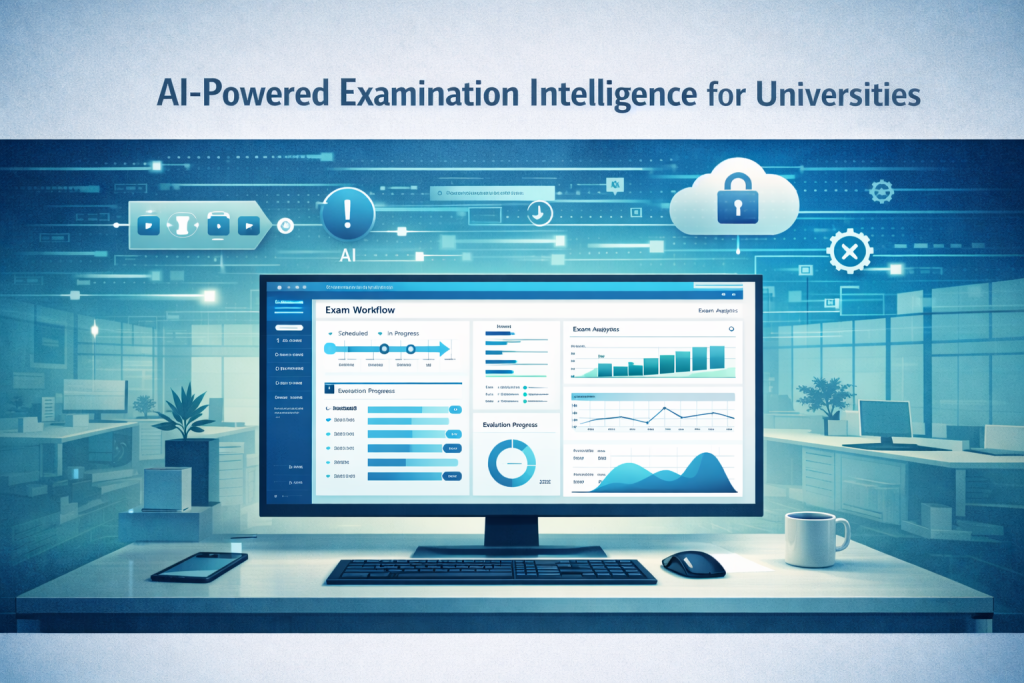
AI-powered Examination Management System dashboard showing automated university exam workflow and analytics

Selecting the right Examination Management System requires more than checking feature lists. University leadership must evaluate long-term institutional fit.

End-to-end examination coverage

The platform should support the full lifecycle — from pre-exam planning to post-result analytics. Fragmented tools often create more complexity than they solve.

AI-driven visibility

Modern institutions benefit from automated alerts, workflow intelligence, and real-time dashboards. Universities already moving toward outcome-based LMS environments are seeing how continuous academic visibility improves decision-making.

Cloud-native scalability

Universities evolve continuously. A cloud-based system ensures flexibility to handle growing data volumes, multi-campus operations, and regulatory changes without performance bottlenecks.

Seamless academic integration

An effective solution should work within the broader Digital solutions for higher education ecosystem. When examination workflows connect smoothly with admissions, academics, and accreditation, institutions gain true operational clarity. Many universities strengthening compliance readiness are already aligning examination data with accreditation management frameworks for better evidence tracking.

The Strategic Importance of Digital Solutions for Higher Education

Leading universities no longer treat examinations as isolated administrative tasks. Instead, they view assessment management as a strategic pillar of academic governance.

Adopting integrated digital platforms enables universities to:

  • Gain real-time academic visibility
  • Reduce operational friction
  • Improve compliance readiness
  • Strengthen stakeholder confidence
  • Build scalable academic processes

Institutions modernizing their examination framework often extend the same intelligence across the student recruitment lifecycle, ensuring continuity from admission to graduation.

How iCloudEMS Supports Modern Examination Management

As universities accelerate digital transformation, iCloudEMS provides a unified and AI-powered approach to managing complex academic workflows.

Built as a cloud-native Education Management System (EMS), the platform helps institutions:

  • Automate the complete examination lifecycle
  • Monitor evaluation progress in real time
  • Reduce manual intervention points
  • Maintain structured audit trails
  • Accelerate accurate result processing

Because iCloudEMS is designed specifically as Digital solutions for higher education, it connects examinations with academics, admissions, accreditation, and student success workflows within a single ecosystem. Universities exploring comprehensive modernization often review the broader capabilities available on the iCloudEMS platform before finalizing their digital roadmap.

The Road Ahead for University Examination Systems

Examination ecosystems are steadily moving toward predictive, connected, and intelligence-driven models. Universities are prioritizing systems that provide not just efficiency but foresight and governance clarity.

Institutions that invest in a robust Examination Management System today position themselves for:

  • Stronger academic integrity
  • Faster decision-making
  • Better regulatory readiness
  • Greater institutional confidence

The shift is no longer optional — it is becoming foundational to future-ready higher education.
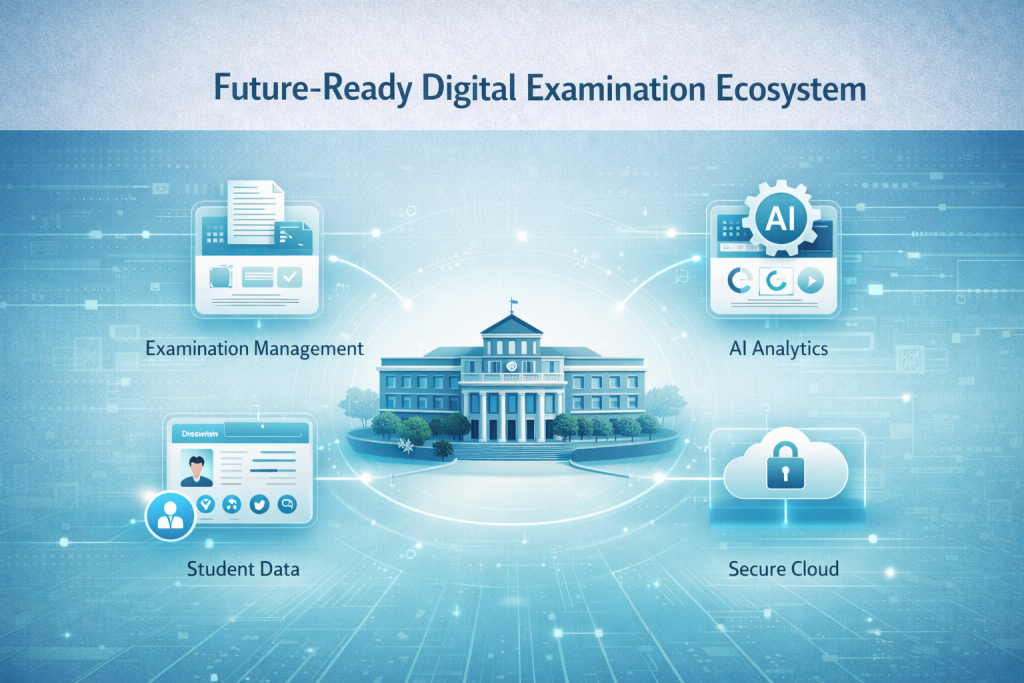
Future-ready Examination Management System ecosystem connecting university AI analytics student data and secure cloud

Conclusion

Examination credibility remains one of the most visible indicators of institutional excellence. As universities grow in scale and complexity, fragmented or manual workflows introduce unnecessary risk.

A modern Examination Management System enables universities to move toward structured, transparent, and intelligence-driven assessment management. By combining automation, AI capabilities, and cloud scalability, institutions can significantly improve accuracy and operational confidence.

As part of the broader evolution toward Digital solutions for higher education, platforms like iCloudEMS are helping universities build examination ecosystems that are not only efficient but truly future-ready.

What do you think universities must prioritize first in examination transformation — speed, accuracy, or complete process visibility?

Frequently Asked Questions

What is an Examination Management System?

An Examination Management System is a digital platform that manages the complete examination lifecycle, including scheduling, evaluation, moderation, and result processing. It helps universities improve accuracy, transparency, and operational efficiency.

How does AI help in examination management?

AI improves examination management by providing predictive alerts, automated monitoring, and real-time workflow visibility. This helps universities detect delays early, reduce manual errors, and maintain stronger control over assessment processes.

Why are universities moving to digital examination systems?

Universities are adopting digital examination systems to manage growing assessment complexity, publish results faster, maintain audit readiness, and reduce dependency on manual processes.

What should universities look for in an Examination Management System?

Universities should evaluate end-to-end workflow coverage, AI-driven alerts, cloud scalability, strong security controls, and seamless integration with their Education Management System (EMS).

Is cloud-based examination management reliable for universities?

Yes. Modern cloud-based platforms use encryption, role-based access, and complete audit trails to ensure data security and reliability. When properly implemented, they significantly strengthen examination governance.
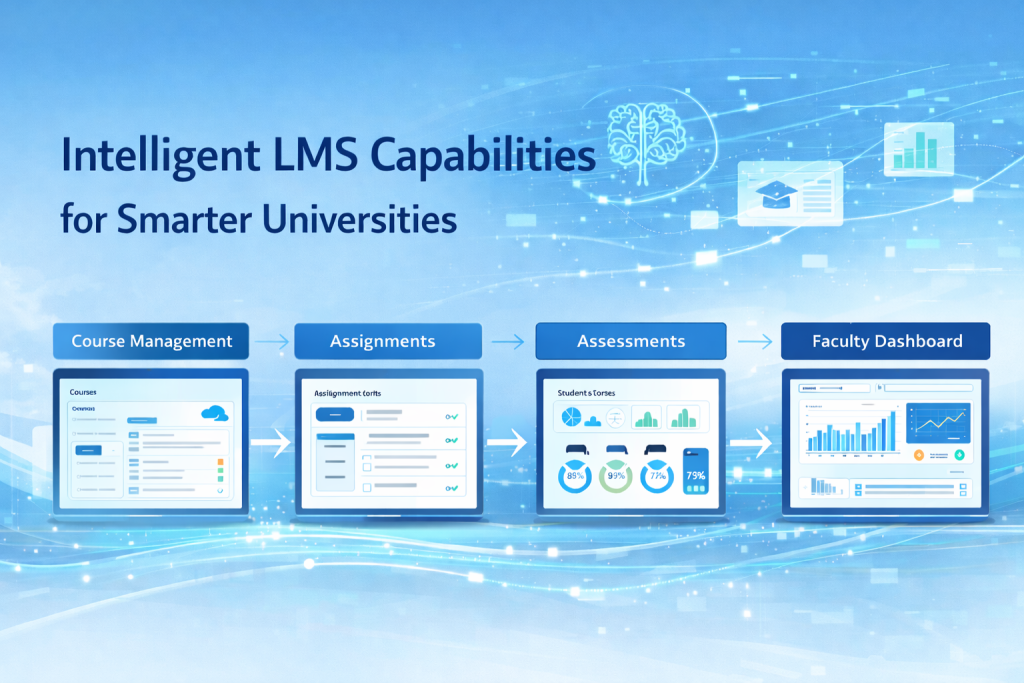
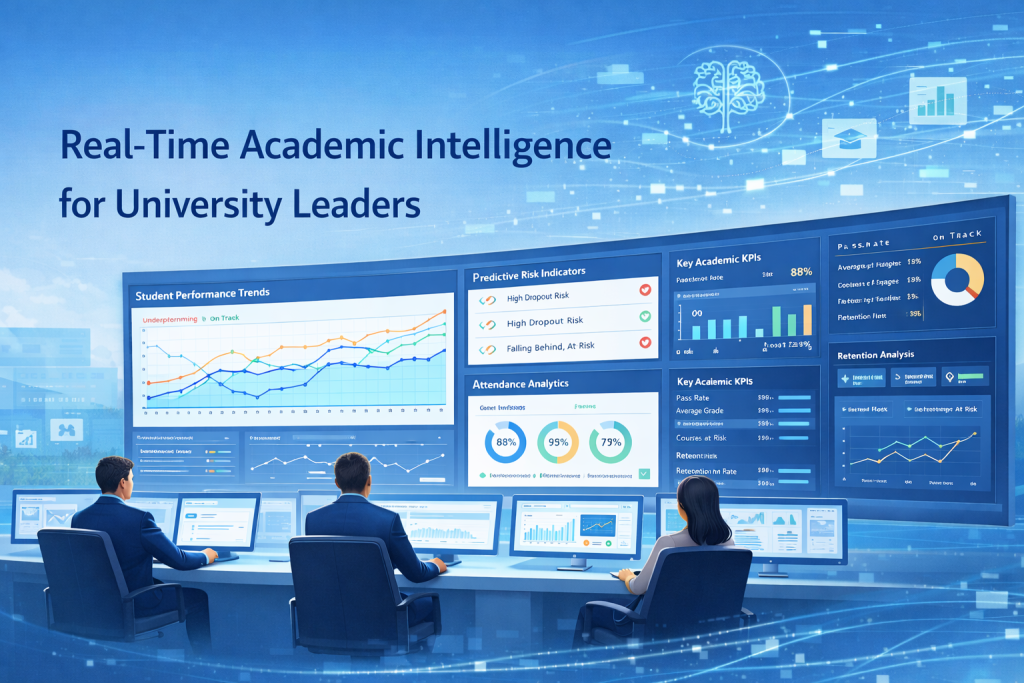
Why Every University Is Upgrading to an AI-Powered Learning Management System (LMS)

Universities are no longer asking whether digital learning matters.
They are asking how fast they can modernize.

Across higher education, institutional leaders are confronting a hard reality: traditional platforms cannot keep pace with evolving academic expectations. Students expect seamless digital learning. Faculty demand intelligent automation. Meanwhile, administrators need real-time academic visibility to make confident decisions.

As a result, the shift toward an AI-Powered Learning Management System is accelerating. Universities are not simply upgrading software — they are redesigning the digital learning backbone that supports teaching, engagement, and outcomes.

The New Expectations from University Learning Environments

Higher education has entered a performance-driven era. Today’s institutions operate under pressure to improve retention, enhance learning quality, and deliver measurable academic outcomes. However, many legacy systems were never designed for this level of complexity.

Students now expect:

  • Always-on access to course materials
  • Mobile-first learning experiences
  • Personalized academic support
  • Faster feedback cycles
  • Seamless digital interactions

Faculty expectations have also evolved. They want tools that reduce administrative burden while improving instructional effectiveness. Moreover, leadership teams require consolidated academic intelligence rather than fragmented reports.

Therefore, universities are rethinking the role of the modern Learning Management System for universities. It is no longer just a content repository — it must function as an intelligent academic engine supported by an integrated Education Management System (EMS).

What Defines an AI-Powered Learning Management System

A traditional LMS primarily manages content delivery and assignment tracking. In contrast, an AI-Powered Learning Management System introduces intelligence, prediction, and automation into the learning ecosystem.

At its core, an AI-enabled platform can:

  • Analyze student engagement patterns
  • Predict academic risk early
  • Automate routine academic workflows
  • Personalize learning pathways
  • Provide real-time institutional insights

However, the true transformation occurs when the LMS operates as part of a unified Education Management System (EMS). When learning data connects with admissions, attendance, and examinations, universities gain a 360-degree academic view.

Forward-looking institutions are therefore investing in Digital solutions for higher education that combine learning intelligence with lifecycle visibility such as student recruitment lifecycle management.

Must-Have Capabilities Universities Now Demand

AI-powered Learning Management System capabilities dashboard for universities

University decision-makers have become far more strategic in evaluating LMS platforms. Basic functionality is no longer sufficient. Instead, institutions are prioritizing intelligence, scalability, and ecosystem integration.

Predictive Academic Intelligence

Modern universities want early warning systems. An advanced AI LMS platform should identify:

  • At-risk students
  • Low engagement patterns
  • Course-level performance gaps
  • Attendance-risk correlations

Consequently, leadership teams can intervene before problems escalate — a challenge widely discussed in student risk detection strategies.

Unified Academic Visibility

Fragmented dashboards create confusion. Institutions now prefer a cloud-based LMS that integrates seamlessly within a broader Education Management System.

Key expectations include:

  • Single academic view across departments
  • Real-time performance monitoring
  • Automated alerts for stakeholders
  • Cross-functional data flow

This unified approach aligns with best practices in evaluating an Education Management System.

Automation-First Workflows

Manual academic processes slow institutions down. Therefore, universities increasingly demand automation in areas such as:

  • Assignment workflows
  • Evaluation cycles
  • Course publishing
  • Faculty notifications
  • Student communications

Automation not only saves time but also reduces operational errors, as highlighted in AI-driven administrative automation.

Mobile-First Learning Experience

Today’s learners are mobile-native. As a result, the university learning platform must deliver:

  • Responsive student portals
  • Mobile assessments
  • On-the-go faculty tools
  • Instant notifications

Institutions that ignore mobile experience often see declining engagement, a pattern explored in AI-powered student portal strategies.

Strategic Advantages for Institutional Leadership

The decision to adopt an AI-Powered Learning Management System is no longer purely technical. It is strategic.

Improved Academic Governance

With AI-driven insights, administrators can monitor academic health continuously. Instead of reactive firefighting, institutions move toward proactive governance supported by modern AI-enabled academic management.

Data-Driven Decision Making

When learning analytics connect with institutional data, leaders can:

  • Identify program effectiveness
  • Optimize faculty workload
  • Monitor student progression
  • Forecast academic risks

Therefore, decisions become evidence-based rather than assumption-driven — addressing gaps often caused by limited student information visibility.

Scalable Digital Infrastructure

As universities expand programs and student populations, scalability becomes critical. A modern LMS in higher education must support institutional growth without performance bottlenecks.

Cloud-first ecosystems such as online classes and exams management demonstrate how scalable infrastructure supports uninterrupted academic delivery.

Stronger Compliance and Accreditation Readiness

Accreditation bodies increasingly expect documented academic processes. An intelligent platform automatically maintains audit trails, reports, and performance records.

Institutions pursuing stronger compliance maturity often align LMS strategy with accreditation management systems and improved institutional data readiness.

How Students and Faculty Experience the Transformation

Technology investments succeed only when end users feel the impact. Fortunately, AI-driven platforms deliver measurable improvements across the academic community.

Student Experience Improvements

Students benefit from:

  • Personalized learning recommendations
  • Early academic alerts
  • Faster feedback cycles
  • Centralized learning access
  • Greater academic transparency

These improvements closely align with outcome-focused frameworks such as outcome-based education and a dedicated outcome-based LMS approach.

Faculty Experience Improvements

Faculty members experience:

  • Reduced manual workload
  • Automated grading assistance
  • Better class performance insights
  • Streamlined course management
  • Improved student communication

Consequently, instructors can focus more on teaching quality rather than administrative overhead.

Warning Signs Your University Has Outgrown Its Current LMS

Many institutions continue using legacy platforms longer than they should. However, several indicators clearly signal the need for modernization.

Watch for these red flags:

  • Faculty relying on external tools outside the LMS
  • Delayed academic reporting cycles
  • Limited mobile usability
  • No predictive student alerts
  • Manual intervention required for routine workflows
  • Fragmented academic data across systems
  • Difficulty scaling new programs

If multiple symptoms appear, the institution is likely operating below its digital potential — a maturity gap often seen in university system maturity challenges.

Future Trends Shaping AI-Driven Learning Ecosystems

The evolution of AI in higher education is only accelerating. Universities planning long-term digital strategy should pay attention to emerging shifts.

Hyper-Personalized Learning Paths

AI will increasingly tailor course journeys based on student behavior, performance, and learning style.

Continuous Academic Risk Prediction

Predictive models will move from periodic analysis to continuous monitoring, enabling near real-time intervention — similar to modern AI-enabled exam readiness systems.

Intelligent Faculty Assistants

AI will support instructors with automated content suggestions, assessment insights, and engagement recommendations.

Unified Digital Campus Architecture

Forward-looking institutions are moving toward fully integrated Digital solutions for higher education, where LMS, academics, finance, and student lifecycle systems operate as one ecosystem.

Universities that delay this transition risk falling behind more agile competitors.

How iCloudEMS Enables Intelligent Digital Learning

AI-powered academic intelligence dashboard for university leadership decision making

Institutions seeking a future-ready approach are increasingly adopting platforms that unify learning intelligence with institutional operations.

As part of its advanced Education Management System (EMS) framework, iCloudEMS delivers:

  • AI-powered academic monitoring
  • Cloud-native scalability
  • Real-time performance alerts
  • Integrated student lifecycle visibility
  • Automation-driven academic workflows
  • Mobile-first learning access
  • Unified institutional dashboards

Importantly, iCloudEMS approaches the AI-Powered Learning Management System not as an isolated module but as a connected intelligence layer within the broader digital campus — including solutions for university management and college management.

Therefore, universities gain not just a learning platform, but a coordinated academic ecosystem designed for long-term institutional growth.

Conclusion: The Upgrade Is No Longer Optional

Higher education is entering an intelligence-driven decade. Universities that continue relying on static learning platforms may struggle to meet rising expectations from students, faculty, and regulators.

An AI-Powered Learning Management System is rapidly becoming the foundation of modern academic strategy. However, the real advantage emerges when the LMS operates within a unified Education Management System (EMS) supported by robust Digital solutions for higher education.

The question is no longer whether institutions will upgrade.
The real question is how prepared they are for the transition ahead.

How prepared is your institution for AI-driven learning transformation? Share your perspective and experiences.

Frequently Asked Questions

What is an AI-powered Learning Management System?

An AI-powered Learning Management System uses artificial intelligence to analyze student behavior, automate academic workflows, and provide predictive insights. Unlike traditional platforms, it enables proactive academic support, personalized learning experiences, and real-time institutional visibility for universities.

Why do universities need AI in LMS platforms?

Universities need AI in LMS platforms to move from reactive to proactive academic management. AI helps identify at-risk students early, improves engagement tracking, automates routine tasks, and provides leadership with data-driven insights that enhance academic outcomes and operational efficiency.

How does an LMS improve student outcomes?

A modern LMS improves student outcomes by centralizing learning resources, enabling continuous assessment, providing faster feedback, and supporting personalized learning paths. When enhanced with AI, it can also predict academic risks and trigger timely interventions that support student success.

What features should universities look for in an LMS?

Universities should prioritize AI-driven analytics, mobile accessibility, automation capabilities, real-time dashboards, seamless integration within an Education Management System (EMS), and cloud-native scalability. These features ensure the platform supports both current academic needs and future institutional growth.

How is iCloudEMS different from traditional LMS platforms?

iCloudEMS delivers an AI-powered Learning Management System as part of a unified Education Management System (EMS). Instead of operating as a standalone tool, it connects learning data with the broader digital campus, enabling real-time academic visibility, automation-driven workflows, and intelligent decision support for institutional leadership.

Is a cloud-based LMS better for universities?

Yes. A cloud-based LMS offers better scalability, remote accessibility, automatic updates, and reduced infrastructure burden. For universities managing complex academic operations, cloud deployment also supports faster innovation and stronger system reliability.

How an AI-Powered Student Portal Improves Student Experience and Retention

In today’s digital-first academic environment, the Student Portal has evolved from a basic information window into a strategic engine for institutional success. Universities that still rely on fragmented systems often struggle with delayed insights and reactive decision-making — a concern highlighted in this analysis of hidden gaps in traditional student information environments.

However, a modern AI-powered student portal changes the equation. It transforms disconnected student data into actionable intelligence, enabling institutions to deliver personalized support, proactive communication, and seamless digital experiences.

For university leaders focused on outcomes, the Student Portal is no longer just a convenience layer — it is a critical lever for improving both student experience and retention.

The Growing Pressure on Universities to Deliver Better Student Experiences

Higher education expectations have shifted dramatically. Students now compare their university experience with the digital convenience they receive elsewhere.

Yet many institutions still operate with:

  • Fragmented student touchpoints
  • Limited visibility into engagement patterns
  • Manual follow-up processes
  • Delayed academic risk identification
  • Disconnected communication channels

As explored in the discussion on the silent dropout challenge, many risks remain invisible until it is too late.

Without real-time intelligence, even well-managed universities remain in reactive mode. This is where a modern university student portal powered by AI begins to create measurable impact.

What Defines a Modern AI-Powered Student Portal

A traditional portal typically acts as a static dashboard. In contrast, an AI-enabled Student Portal functions as an intelligent engagement layer that continuously analyzes student behavior, academic signals, and interaction patterns.

A modern student self-service portal should provide:

  • Centralized access to academic, financial, and administrative data
  • Real-time status updates across the student lifecycle
  • Intelligent alerts and notifications
  • Personalized dashboards for students and faculty
  • Seamless mobile accessibility
  • Cross-department data visibility

Institutions adopting Digital solutions for higher education through iCloudEMS are already seeing how unified intelligence changes campus decision-making.

How an AI-Powered Student Portal Elevates Student Experience

University student using AI-powered student portal on mobile for real-time academic updates

Student experience is shaped by speed, clarity, and personalization. When these elements are missing, frustration builds quietly across the campus ecosystem.

An AI-powered higher education student portal improves experience in several high-impact ways.

Real-Time Transparency Builds Student Trust

Students no longer want to chase departments for updates. With a modern portal:

  • Attendance updates appear instantly
  • Fee status is always visible
  • Examination information is centralized
  • Academic progress is continuously tracked

This level of visibility becomes even more powerful when integrated with intelligent finance workflows such as the AI-powered fee management approach.

Personalized Digital Journeys Increase Engagement

AI enables the Student Portal to move beyond one-size-fits-all dashboards. Instead, it can:

  • Highlight pending student actions
  • Recommend academic resources
  • Surface important deadlines
  • Provide contextual reminders

When combined with outcome-driven learning environments like the Outcome-Based LMS, universities can create deeply personalized academic journeys.

Frictionless Self-Service Reduces Administrative Dependency

Modern students expect autonomy. A well-designed student engagement platform allows them to:

  • Download documents instantly
  • Submit requests digitally
  • Track approvals in real time
  • Access learning resources on demand

Institutions modernizing their academic operations — as discussed in the future-ready academics management strategy — are seeing measurable reductions in administrative load.

Unified Communication Eliminates Information Gaps

One of the biggest experience failures in higher education is fragmented communication. An AI-enabled modern student portal centralizes:

  • Academic notifications
  • Fee reminders
  • Institutional announcements
  • Faculty communications

When paired with integrated online classes and exams management, communication becomes both timely and contextual.

The Direct Link Between Student Portal Intelligence and Retention

While experience improvements are visible, the deeper strategic value of a Student Portal lies in retention intelligence. Universities rarely lose students suddenly — warning signals usually appear months in advance.

AI helps institutions detect those signals early.

How AI-Powered Portals Strengthen Student Retention

Early Risk Detection Through Behavioral Signals

An advanced AI-powered student portal continuously monitors patterns such as:

  • Declining attendance
  • Reduced portal activity
  • Assignment delays
  • Fee payment irregularities
  • LMS engagement drops

These signals align closely with modern student recruitment and lifecycle management strategies.

Predictive Alerts Enable Proactive Intervention

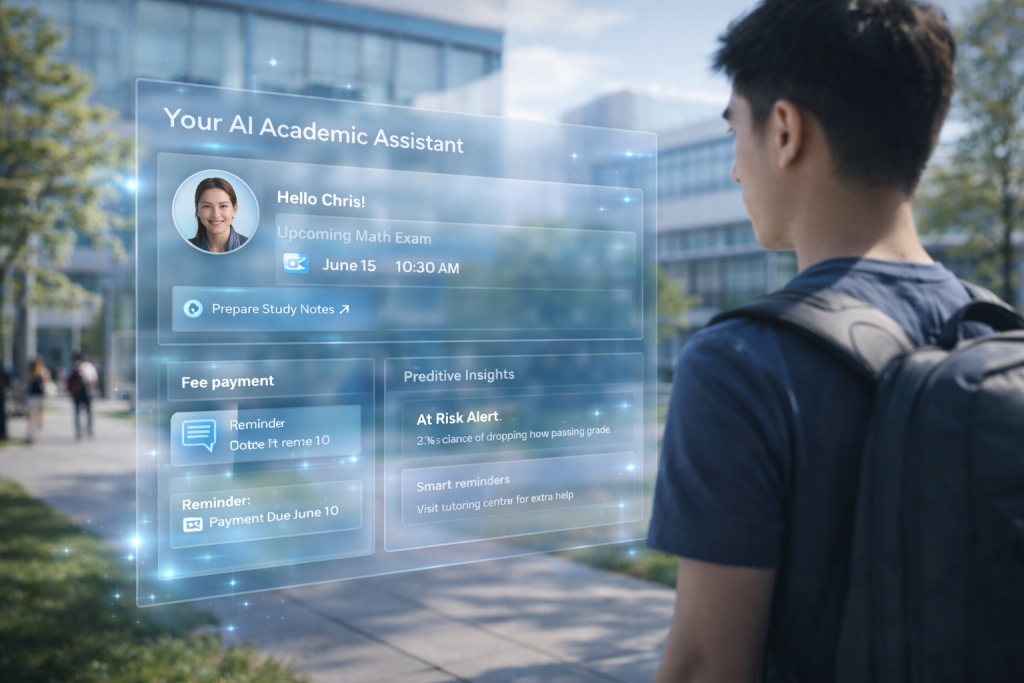
AI-powered academic assistant providing personalized student success guidance on a modern university campus

Instead of waiting for semester-end surprises, leadership teams receive:

  • Automated risk alerts
  • Engagement anomaly notifications
  • Academic performance warnings
  • Escalation triggers for counselors

This shift toward predictive operations reflects the broader evolution explained in the AI shift in university systems.

Data-Driven Retention Strategies Replace Guesswork

Historically, retention initiatives relied heavily on manual reviews. A modern Student Portal now provides:

  • Cohort-level engagement analytics
  • Department-wise risk heatmaps
  • Intervention tracking dashboards
  • Outcome-based retention insights

These capabilities strongly complement institutional quality frameworks supported by accreditation management systems.

Automated Workflows Ensure No Student Falls Through the Cracks

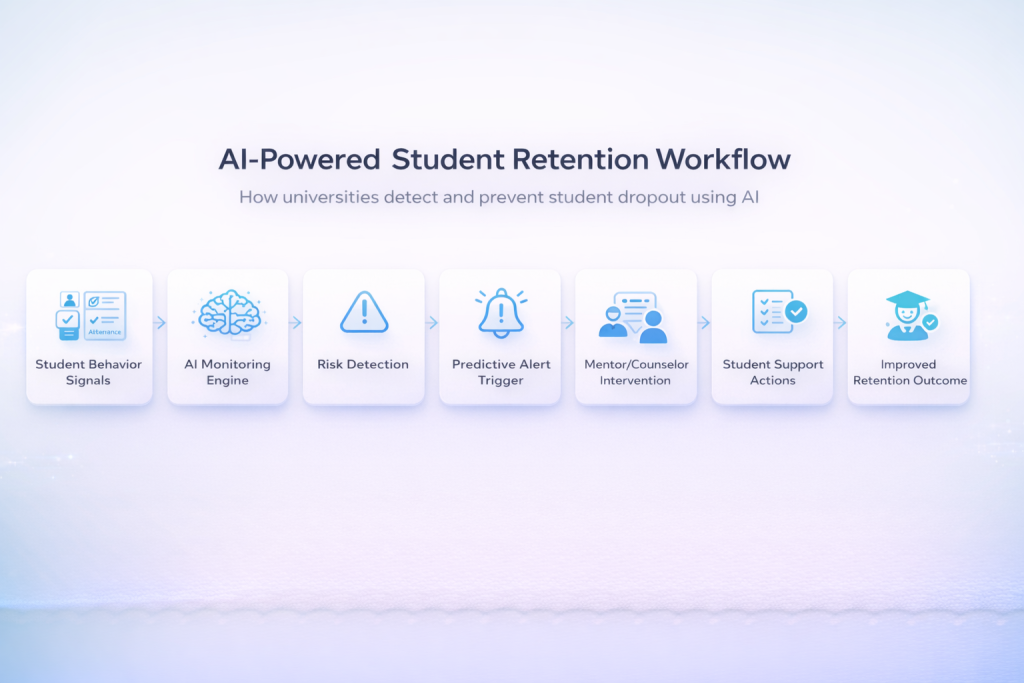
AI-powered workflows can automatically:

  • Notify mentors
  • Trigger counseling workflows
  • Escalate unresolved issues
  • Track follow-up completion

Institutions evaluating next-generation platforms often compare traditional approaches versus modern EMS capabilities in the EMS vs traditional systems comparison.

The Strategic Role of iCloudEMS in Enabling Intelligent Student Portals

Forward-looking universities are increasingly adopting Digital solutions for higher education that unify data, intelligence, and user experience.

The iCloudEMS Education Management System (EMS) provides a cloud-native, AI-powered Student Portal that enables institutions to:

  • Achieve unified student visibility across departments
  • Monitor engagement through intelligent dashboards
  • Activate predictive alerts for at-risk students
  • Deliver personalized digital experiences at scale
  • Automate cross-campus workflows
  • Maintain real-time operational transparency

Institutions exploring comprehensive modernization paths often review capabilities across both the university solution environment and the college solution environment to understand the full transformation scope.

The Future of the Student Portal: From Access Point to Intelligence Hub

The next generation of the Student Portal will not merely display information — it will actively guide student success.

We are already seeing the emergence of:

  • AI copilots for student support
  • Hyper-personalized academic pathways
  • Predictive campus ecosystems
  • Intelligent nudges for engagement
  • Autonomous administrative workflows

Universities that modernize early will build stronger student relationships, while those that delay risk operating with blind spots in an increasingly data-driven education landscape.

Conclusion

The Student Portal has quietly become one of the most influential digital assets in higher education. When powered by AI, it delivers visibility, personalization, and predictive intelligence that directly impact student experience and retention.

For university leaders navigating rising expectations and competitive pressures, the real question is no longer whether a portal exists — but whether it is intelligent enough to support proactive student success.

AI-powered student retention workflow flowchart showing predictive alerts and intervention process in universities

Reflection

How effectively is your current Student Portal helping your institution identify disengaged or at-risk students early?

University leaders who are re-evaluating their digital student experience strategy often uncover significant improvement opportunities once they begin examining real-time engagement intelligence.

Key Questions University Leaders Ask

What is a student portal in higher education?

A student portal is a centralized digital platform that gives students secure access to academic records, fees, schedules, communication, and institutional services. Modern portals use AI to provide real-time insights, personalized dashboards, and proactive alerts that improve engagement and operational visibility.

How does an AI-powered student portal improve retention?

An AI-powered student portal improves retention by continuously analyzing behavioral and academic signals to identify at-risk students early. It generates predictive alerts, enables timely interventions, and helps universities track engagement trends so leadership teams can act proactively before disengagement turns into attrition.

Why do universities need a modern student portal?

Universities need a modern student portal to provide real-time transparency, seamless self-service, and unified communication. Traditional systems lack predictive intelligence, whereas AI-enabled portals help institutions monitor engagement, reduce administrative friction, and support data-driven decision-making across the student lifecycle.

What features should a university student portal include?

A robust university student portal should include real-time dashboards, AI-driven alerts, mobile accessibility, self-service workflows, unified communication tools, and cross-department data visibility. These capabilities ensure students receive timely information while administrators gain actionable insights into engagement and performance.

How does a student portal improve student engagement?

A student portal improves engagement by centralizing information, delivering personalized notifications, and simplifying access to academic and administrative services. When students can easily track progress, receive reminders, and interact digitally with the institution, their participation and satisfaction levels typically increase.

Can a student portal support personalized learning journeys?

Yes, AI-enabled student portals can support personalized learning journeys by analyzing academic performance, behavior patterns, and engagement data. The system can recommend resources, highlight risks, and surface relevant actions, helping institutions guide each student more effectively toward academic success.

Your Student Information System Is Lying to You — Here’s What University Leaders Don’t See

Most universities believe their Student Information System works.

Admissions data gets stored. Attendance updates daily. Examination marks reflect in dashboards. Fee reports generate on time.

From a distance, everything appears structured.

But structure does not guarantee intelligence.

A Student Information System that only stores information without detecting institutional risk creates a dangerous illusion of control. University leaders often rely on dashboards that show stability while hidden inefficiencies grow silently beneath the surface.

The real question is not whether your Student Information System functions.

The real question is whether it protects institutional governance.

A Student Information System Must Evolve Beyond Data Storage

Historically, a Student Information System digitized administrative workflows. It replaced manual registers and disconnected spreadsheets.

Today, Digital solutions for higher education demand more.

A modern Student Information System must operate inside a unified ecosystem such as a cloud-native Education Management System (EMS) where admissions, academics, finance, lifecycle, accreditation, and evaluation operate in real time.

Leadership frameworks for evaluating institutional systems consistently emphasize integration, scalability, and predictive capability as non-negotiable criteria. A fragmented platform cannot support executive decision-making at scale.

If your Student Information System cannot:

  • Detect academic risk early
  • Flag financial exposure
  • Integrate lifecycle data
  • Support accreditation workflows
  • Generate predictive alerts

Then it operates as a digital archive, not a governance engine.

Fragmented Student Data Creates Invisible Institutional Risk

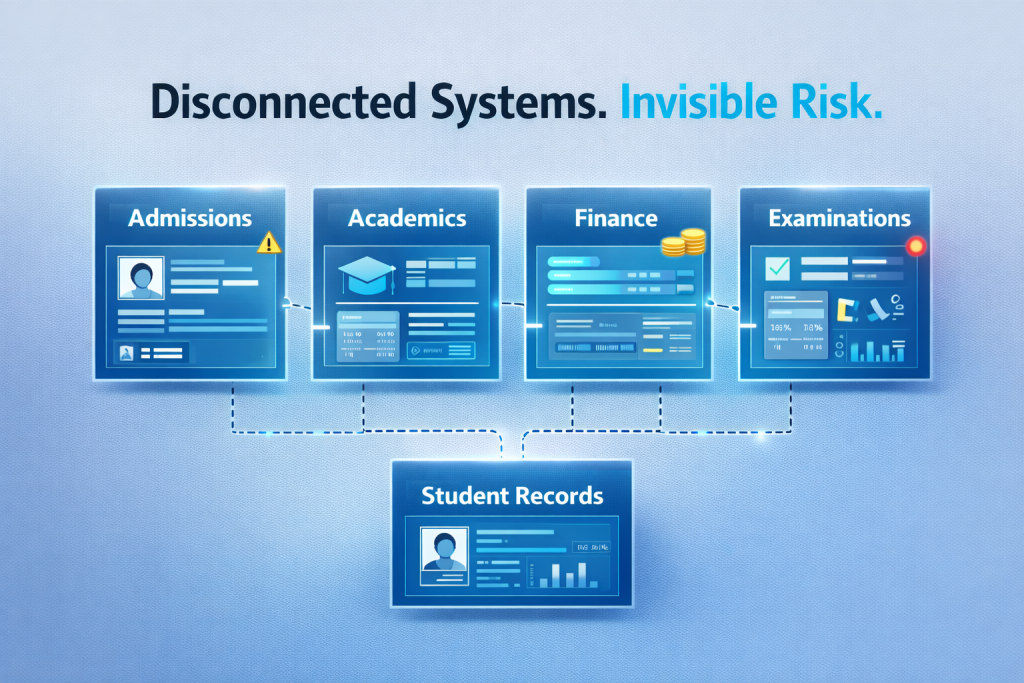
Five-node university Student Information System fragmentation diagram showing disconnected departments

Many institutions still operate across departmental silos:

  • Admissions handles recruitment separately
  • Academics track performance independently
  • Finance reconciles fees manually
  • Examination cells manage isolated records

Without structured student recruitment lifecycle management, the student journey breaks into disconnected segments.

When inquiry, enrollment, progression, and alumni tracking fail to align within one Student Information System, the institution loses visibility.

Lifecycle fragmentation leads to:

  • Duplicate student records
  • Attendance inconsistencies
  • Manual grade adjustments
  • Fee reconciliation delays
  • Delayed intervention in disengagement

A centralized lifecycle intelligence framework, as explored in student lifecycle automation strategies, strengthens data continuity across the entire academic journey.

Disconnected systems increase workload. Integrated systems increase clarity.

When Dashboards Show Stability but Risk Is Rising

University dashboards typically display:

  • Enrollment totals
  • Fee collection summaries
  • Attendance percentages
  • Examination outcomes

These metrics describe the present.

They rarely forecast disruption.

Gradual disengagement, performance decline, and dropout probability often remain invisible until they become irreversible. Institutions that fail to monitor early risk signals experience delayed intervention.

The pattern of missed warning signs becomes clear when analyzing early disengagement detection challenges in siloed systems.

An AI-powered Student Information System must detect anomalies before institutional damage occurs.

Without predictive intelligence, leadership relies on retrospective reporting instead of proactive governance.

Compliance and Accreditation Demand Data Integrity

Accreditation bodies expect structured, verifiable, and audit-ready data.

If your Student Information System requires manual compilation before evaluation cycles, institutional exposure increases.

Modern compliance readiness depends on:

  • Automated audit logs
  • Timestamped academic tracking
  • Outcome mapping
  • Secure documentation workflows

Institutions adopting structured accreditation management automation reduce regulatory friction and improve data transparency.

Data fragmentation often affects accreditation scores more than academic quality itself. Addressing accreditation data intelligence gaps requires systemic integration rather than surface-level reporting.

A Student Information System must embed compliance intelligence at its core.

Academic Intelligence Requires LMS and Evaluation Integration

A Student Information System cannot operate in isolation from learning systems.

Institutions implementing outcome-based learning analytics gain measurable visibility into curriculum alignment and academic performance.

Similarly, structured online classes and examination management ensures transparency in assessments, digital evaluation, and result processing.

When learning delivery, examination workflows, and student progression data integrate within one Student Information System, academic governance strengthens.

Without LMS integration, student performance insights remain incomplete.

Financial Visibility Must Align with Academic Progression

Academic data alone does not define institutional stability.

Financial intelligence plays an equally critical role.

Institutions implementing predictive AI-powered fee tracking systems gain early visibility into revenue exposure and payment behavior patterns.

When fee data integrates directly into the Student Information System, leadership can:

  • Identify high-risk receivables
  • Correlate disengagement with financial stress
  • Reduce manual reconciliation
  • Improve revenue forecasting

Separating academic and financial systems weakens strategic oversight.

From Legacy ERP to Intelligent Governance

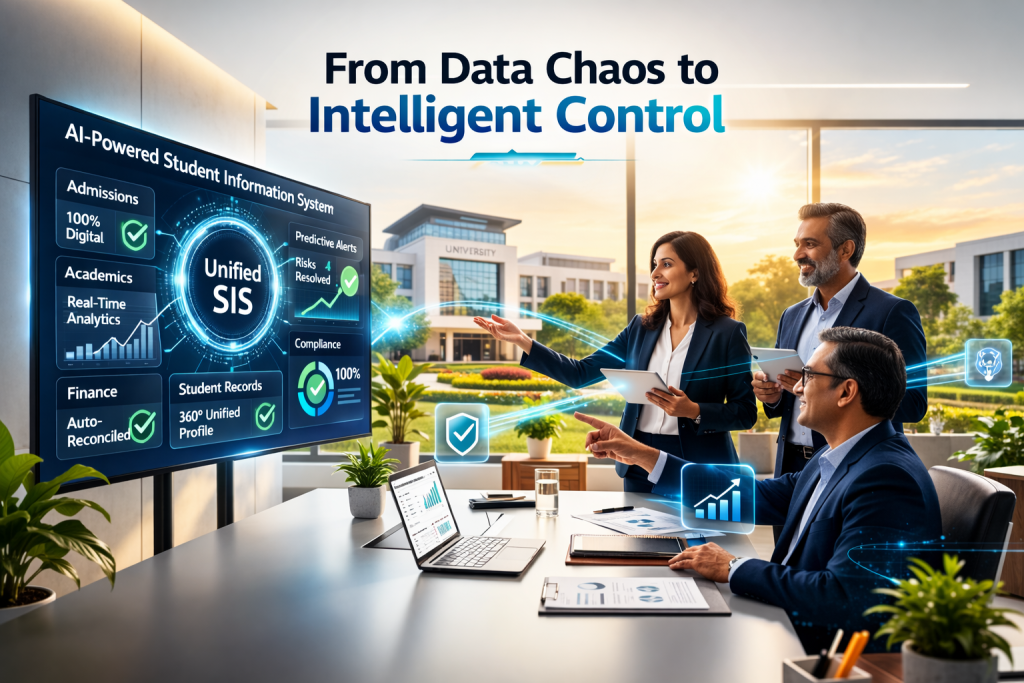
Indian university leadership team reviewing unified AI-powered Student Information System dashboard

Many institutions still operate within legacy university ERP environments or traditional college ERP systems focused primarily on process automation.

However, the sector increasingly recognizes the shift toward AI-driven decision automation as essential for governance maturity.

A modern Student Information System embedded within an intelligent Education Management System (EMS) transforms operational data into institutional foresight.

Process automation is no longer sufficient.

Predictive intelligence defines the next evolution.

Infrastructure and Cybersecurity Cannot Be Secondary

Cloud adoption alone does not guarantee protection.

Universities must implement structured advanced cybersecurity frameworks for higher education systems to ensure data integrity.

A cloud-native Student Information System should provide:

  • Real-time synchronization
  • Secure role-based access
  • Encrypted data storage
  • Automated backups
  • Audit-ready traceability

Infrastructure resilience strengthens governance confidence.

The Strategic Question University Leaders Must Ask

Most institutions ask:

“Does our Student Information System work?”

A more strategic question would be:

“Does our Student Information System prevent risk before it becomes visible?”

If leadership still depends on manual correction, delayed alerts, or disconnected dashboards, the system may be documenting risk instead of preventing it.

Modern Digital solutions for higher education demand predictive intelligence, lifecycle integration, financial alignment, accreditation automation, and secure cloud architecture within one unified ecosystem.

A Student Information System must evolve from administrative software into institutional intelligence infrastructure.

How does your institution currently evaluate the maturity of its student data systems?

Leadership Questions About Student Information Systems

1. What defines a modern Student Information System?

A modern Student Information System integrates admissions, academics, finance, lifecycle tracking, and compliance workflows inside a unified Education Management System (EMS).

2. Why is predictive intelligence critical?

It identifies academic decline, dropout probability, and financial exposure before damage occurs.

3. How does LMS integration improve governance?

Outcome-based learning analytics align curriculum, assessment, and performance tracking within the Student Information System.

4. What risks exist in fragmented systems?

Duplicate data, audit exposure, delayed intervention, and inaccurate reporting weaken institutional control.

5. How does financial integration enhance insight?

Aligned fee and academic data enable early detection of revenue and engagement risks.

6. Why is cloud architecture essential?

It ensures secure access, scalability, synchronization, and audit readiness.

7. Can a Student Information System improve accreditation readiness?

Yes. Structured data architecture and automated documentation streamline regulatory evaluation.

Transforming University Finance Through an AI-Powered Fee Management System

University finance is no longer a back-office function. It directly influences institutional stability, accreditation readiness, and long-term sustainability. However, many institutions still rely on semi-digital fee processes, delayed reconciliation, and reactive tracking models.

An AI-Powered Fee Management System for Universities redefines this structure. Instead of merely collecting payments, it builds predictive intelligence into financial governance. Moreover, when embedded within a unified Education Management System (EMS), it strengthens Digital solutions for higher education across departments.

Financial digitization is no longer about convenience. It is about institutional control.

The Hidden Risk Inside Traditional Fee Systems

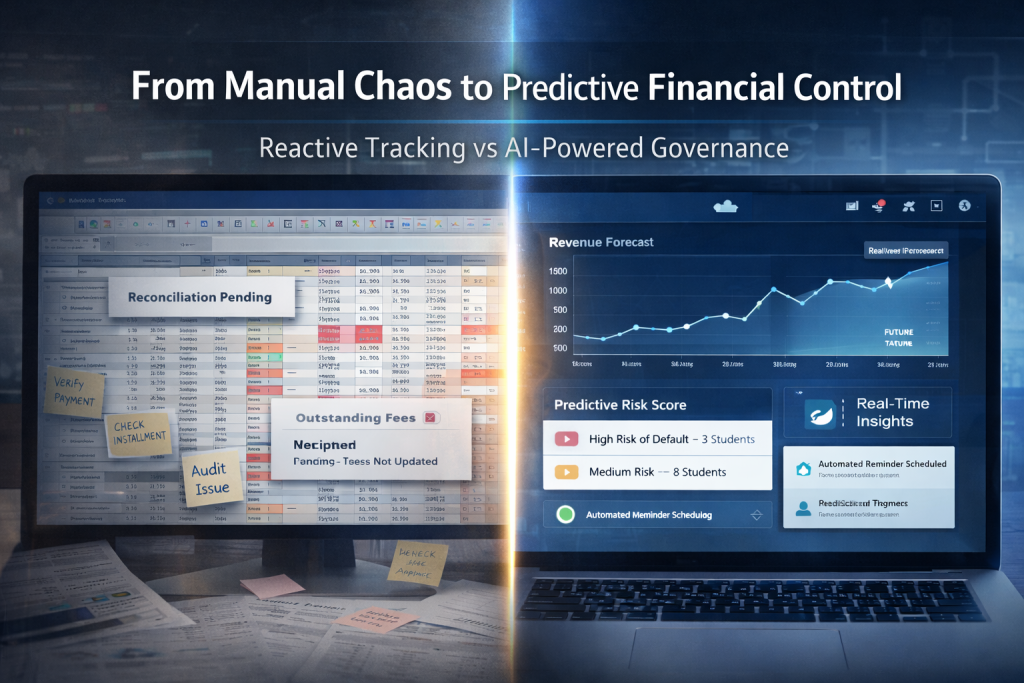
Split-screen comparison of manual spreadsheet-based fee tracking versus AI-powered financial governance dashboardFrom manual reconciliation chaos to AI-powered financial control
Most universities offer online payments. Yet digital transactions alone do not create financial visibility.

Manual reconciliation, spreadsheet dependency, and fragmented dashboards create:

  • Revenue leakage
  • Delayed financial forecasting
  • Limited audit readiness
  • Compliance exposure
  • Student dissatisfaction due to unclear fee tracking

As discussed in our analysis on legacy university systems, fragmented data architectures often prevent institutions from reaching operational maturity.

Therefore, the real challenge is not payment collection. It is intelligent orchestration.

The Evolution Toward an AI-Powered Fee Management System for Universities

An AI-Powered Fee Management System for Universities transforms static finance operations into predictive ecosystems.

AI-driven fee analytics identify:

  • High-risk delayed payment patterns
  • Installment default probability
  • Scholarship impact forecasting
  • Seasonal cash flow variations

Consequently, finance leaders gain foresight rather than reactive insight.

This predictive approach mirrors how AI now supports academics and lifecycle tracking, as explored in our work on student lifecycle management. When institutions connect financial data with behavioral analytics, risk detection becomes proactive.

Automation does not replace teams. It empowers them.

Cloud-Based Financial Governance and Real-Time Dashboards

AI intelligence must operate on scalable infrastructure. Therefore, cloud-native architecture becomes essential.

A cloud-based fee management system ensures:

  • Real-time revenue dashboards
  • Instant reconciliation across gateways
  • Secure payment processing
  • Centralized compliance visibility
  • Anywhere access for authorized stakeholders

As emphasized in our insights on cloud security in higher education, institutions require more than hosting—they require encrypted governance frameworks.

Meanwhile, centralized dashboards allow leadership to align budgets with live revenue data. This shift transforms financial reporting into strategic intelligence.

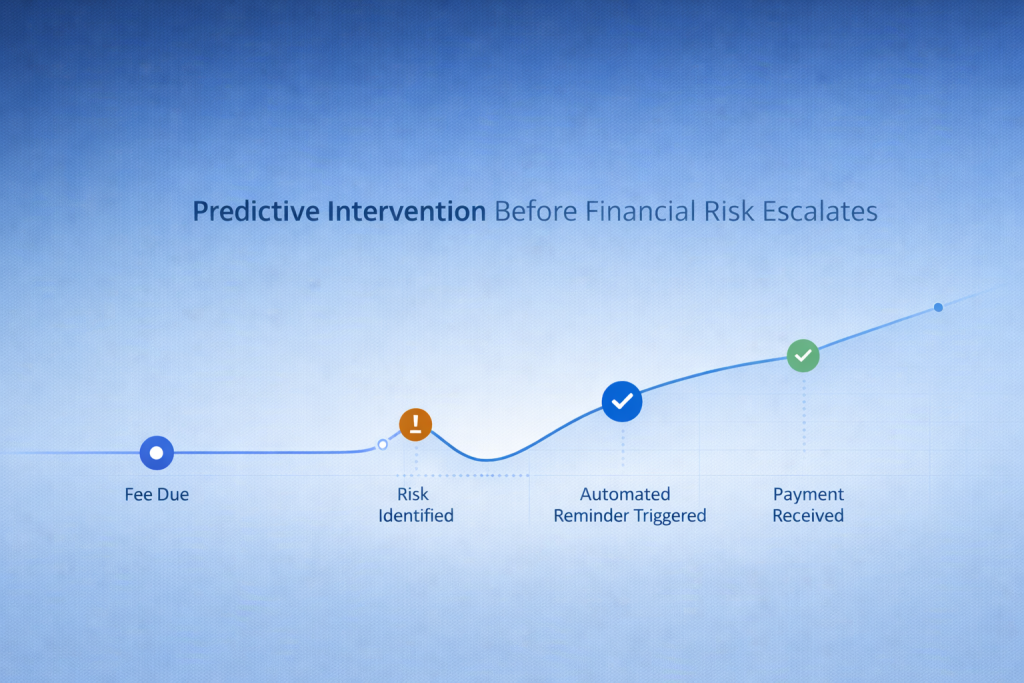
Predictive Alerts and Intelligent Automation

Timeline illustration showing early risk identification, automated reminder trigger, and successful payment recovery in university fee managementPredictive intervention prevents financial risk before escalation

Traditional reminder systems follow fixed schedules. However, predictive fee defaulter alerts adapt to real-time behavior.

For instance:

  • AI flags potential delays early
  • Contextual reminders trigger automatically
  • Installment plans adjust dynamically
  • Finance heads receive priority exception alerts

Therefore, institutions improve collection rates without creating friction.

This predictive logic reflects the same AI-enabled readiness philosophy used in exam preparation analytics, where early detection improves outcomes.

Intelligence always outperforms reaction.

Eliminating Reconciliation Chaos Through Digital Precision

Manual reconciliation consumes administrative hours. More importantly, it introduces avoidable risk.

An intelligent fee reconciliation engine:

  • Matches payments across gateways instantly
  • Aligns scholarships and concessions automatically
  • Flags discrepancies in real time
  • Maintains transparent audit trails

Consequently, audit readiness improves without additional workload.

As institutions have learned from accreditation data challenges, governance failures rarely stem from absence of effort. They stem from fragmented systems.

Precision eliminates fragmentation.

Connecting Fee Intelligence With the Academic Ecosystem

Finance does not operate in isolation. It influences admissions, course registration, examination access, and accreditation documentation.

When integrated with:

Fee data becomes part of a unified governance model.

Moreover, institutions transitioning from traditional college ERP systems to modern EMS architectures experience stronger operational coherence.

Digital solutions for higher education require interconnected intelligence—not isolated modules.

Leadership-Level Decision Intelligence

University executives reviewing cloud-based financial governance dashboard in a modern boardroomCloud-based financial governance empowering institutional leadership

University boards and finance committees require forward-looking insights.

An AI-Powered Fee Management System for Universities provides:

  • Cash flow projections
  • Department-wise revenue mapping
  • Predictive defaulter modeling
  • Scholarship impact dashboards
  • Compliance monitoring visibility

Therefore, leadership decisions become data-backed rather than assumption-driven.

When fee management integrates within iCloudEMS, financial governance aligns seamlessly with academics, examinations, and institutional reporting.

Digital transformation becomes measurable.

A Strategic Reflection for Institutional Leaders

If your university still reconciles fees manually or tracks defaulters reactively, what invisible risks remain buried in spreadsheets?

And more importantly — does your finance system generate intelligence, or only transactions?

The institutions that will lead the next decade of higher education will not merely digitize payments. They will operationalize predictive financial governance.

Frequently Asked Leadership Questions

What is an AI-Powered Fee Management System for Universities?

It is a predictive financial automation platform that analyzes payment behavior, triggers intelligent alerts, automates reconciliation, and provides real-time dashboards within a unified Education Management System (EMS).

How does cloud-based fee management improve institutional governance?

Cloud infrastructure centralizes financial data, enables secure access, strengthens compliance tracking, and delivers real-time reporting. Consequently, leadership gains continuous visibility into institutional cash flow.

Why are predictive fee defaulter alerts critical?

Predictive alerts identify potential payment delays before they disrupt revenue cycles. Therefore, finance teams intervene early and reduce collection risk while preserving student relationships.

How does fee intelligence support accreditation and compliance?

Automated audit trails and centralized reporting simplify documentation for regulatory bodies. When connected with accreditation workflows, financial transparency strengthens institutional credibility.

How does fee management integrate with broader Digital solutions for higher education?

When embedded inside a unified Education Management System (EMS), fee operations align with admissions, academics, examinations, and compliance. This integration creates a cohesive institutional ecosystem.

If you are evaluating your institution’s financial transformation roadmap, what strategic capability matters most—automation, predictive alerts, or real-time governance visibility?

Your answer will define the next stage of institutional maturity.

The Silent Dropout Crisis: Why Universities Don’t See Student Risk Until It’s Too Late

Most students don’t drop out in a single moment.

They disengage gradually.

Attendance declines.
Internal marks fluctuate.
Fee payments become irregular.
LMS activity slows.
Mentorship meetings are missed.

By the time a withdrawal application reaches the administration, the decision has already been forming for months.

Student attrition is rarely sudden.
It is usually undetected.

And in many institutions, the issue is not effort.
It is visibility.

Dropout Is a Pattern, Not an Event

Universities often attribute attrition to external pressures:

  • Financial constraints
  • Family circumstances
  • Career shifts
  • Personal transitions

But these external factors almost always surface internally first — through measurable signals.

The warning signs are already present inside the institution:

  • Gradual attendance decline
  • Repeated assessment dips
  • Reduced LMS engagement
  • Fee payment irregularity
  • Placement disengagement
  • Hostel or transport withdrawal
  • Repeated grievances

Individually, these look operational.
Collectively, they reveal emerging risk.

This structural blind spot is similar to what many institutions experience during accreditation cycles — as discussed in Your NAAC Score Isn’t the Problem — Your Data Is.

Fragmented data prevents pattern recognition.

The same fragmentation quietly affects retention.

The Leadership Visibility Gap

University administrator viewing separate academic, financial, and engagement reports without unified visibilityData exists across departments — but without integration, patterns remain invisible.

Most universities already collect the right data.

Academic departments monitor attendance.
Examination cells track performance.
Finance teams manage fee records.
Placement offices observe engagement.
LMS platforms record learning activity.

Yet these systems rarely communicate with each other in real time.

As explored in Why Traditional University ERPs Struggle with Institutional Visibility — and How Modern Platforms Are Architected Differently, many legacy architectures were built for recording transactions — not interpreting patterns.

Leadership receives summaries.
Not risk intelligence.

Monthly dashboards cannot detect weekly deterioration.
Siloed systems cannot reveal cumulative behavioral shifts.

The result is reactive governance.

Reactive Monitoring vs Early Awareness

Most institutions operate on a post-event model:

  • Dropout occurs
  • Exit reasons are recorded
  • Reports are generated
  • Policies are reviewed

But forward-looking universities are shifting toward early awareness models.

As detailed in Early Awareness Systems in Universities: How AI-Driven ERP Prevents Problems Before They Escalate, predictive frameworks monitor behavioral shifts continuously rather than waiting for formal withdrawal.

This distinction defines digital maturity.

Student disengagement is rarely invisible.
It is simply not connected.

Why Data Fragmentation Prevents Early Intervention

Consider a student who shows:

  • 20% attendance decline
  • Two consecutive internal assessment drops
  • Reduced engagement in the Learning Management System
  • Delayed fee installment

Separately, these look manageable.

Together, they represent escalation.

The importance of LMS visibility in academic engagement is explored in Learning Management Software for Modern Institutions: Enabling Better Teaching and Stronger Academic Outcomes.

But LMS insight alone is insufficient.

Without cross-department correlation, institutions cannot identify risk trajectories.

An integrated Education Management System (EMS) connects these signals into one analytical layer — transforming operational data into predictive intelligence.

AI as a Risk Detection Engine — Not a Buzzword

AI in universities must go beyond automation.

As emphasized in AI in Universities Is Not About Automation — It’s About Early Awareness, its real value lies in pattern detection.

A structured predictive framework can:

  • Identify attendance trajectory deviation
  • Detect academic volatility
  • Flag prolonged LMS inactivity
  • Monitor cumulative risk scoring

However, AI is only as reliable as the data architecture beneath it.

Blind automation — as discussed in AI in Universities Is No Longer Optional — But Blind Automation Is Dangerous — creates noise without clarity.

Retention strategy requires structured, unified data flow.

The Lifecycle Perspective

Student disengagement often begins long before final withdrawal.

It may originate in:

  • Admission-stage mismatch
  • Early academic overload
  • Lack of mentoring
  • Financial stress
  • Career uncertainty

A lifecycle-based institutional approach — explained in How iCloudEMS Helps the Higher Education Institutes to Manage the Entire Lifecycle of Their Students — enables universities to monitor student progression from entry to alumni status.

Retention cannot be addressed in isolation.
It must be embedded in lifecycle intelligence.

From Administrative Software to Institutional Intelligence

University executive reviewing institutional early warning dashboard showing aggregated student risk analyticsPredictive visibility enables institutions to detect risk patterns before student disengagement becomes irreversible.
Traditional ERP-style systems were built to log data.

Modern Digital solutions for higher education must interpret it.

University leaders evaluating technology infrastructure — as discussed in How University Leaders Should Evaluate an Education Management System (EMS) — should ask a critical question:

Does the system only record what happened?
Or does it identify what might happen next?

An advanced Education Management System (EMS) acts as:

  • A cross-module intelligence layer
  • A behavioral analytics engine
  • A risk-scoring framework
  • A real-time alert mechanism

This shift transforms retention from reactive reporting to predictive governance.

The Institutional Cost of Late Detection

When dropout risk is detected late, consequences extend beyond student loss:

Academic Impact

  • Reduced completion rates
  • Disrupted cohorts
  • Increased faculty workload

Financial Impact

  • Revenue volatility
  • Higher dependence on fresh admissions

Governance Impact

  • Reactive board meetings
  • Limited forecasting capability

Reputational Impact

  • Weak retention indicators
  • Lower alumni trust

Attrition is not merely an operational statistic.

It is a strategic performance indicator.

Retention Is a Visibility Strategy

Student support improves when institutions detect risk early.

Intervention becomes structured.
Outcomes become measurable.
Governance becomes proactive.

When Digital solutions for higher education are architected strategically — as seen across modern integrated platforms like iCloudEMS — universities gain the clarity required to act before disengagement becomes permanent.

The goal is not surveillance.
It is timely support.

Key Questions Institutional Leaders Are Asking

Why do universities fail to identify student dropout risk early?

Because academic, financial, and behavioral data are stored in disconnected systems, preventing cumulative pattern detection.

How can predictive analytics reduce student attrition?

By continuously monitoring attendance trends, assessment volatility, and engagement shifts to identify probability before formal withdrawal.

What data should institutions monitor to prevent dropouts?

Attendance trajectory, internal performance trends, LMS engagement, fee behavior, grievance frequency, and placement participation.

How does an Education Management System (EMS) support early intervention?

An integrated EMS connects cross-departmental data, applies risk scoring models, and generates timely alerts for structured intervention.

What is the difference between reactive and predictive monitoring?

Reactive monitoring records dropout after departure. Predictive monitoring identifies risk while intervention is still possible.

Can AI alone solve retention challenges?

No. AI requires structured, unified data architecture to produce reliable early warning insights.

Student attrition rarely begins with a resignation letter.

It begins with small, measurable shifts.

The strategic question for institutional leadership is simple:

Does your university detect risk early —
or only after the seat is already vacant?We invite university leaders to reflect:
How visible is student risk within your current system architecture?

AI-Enhanced Exam Readiness: How iCloudEMS Prepares Students with Intelligent Tools

Introduction: Exam Season Chaos Is a System Failure, Not a Student Failure

Every exam season across Indian universities follows a familiar pattern.

Students attend classes, submit assignments, and complete internal assessments. Yet when final results are declared, a significant number underperform or fail. Faculty are left questioning student seriousness, examination departments face pressure, and leadership struggles to explain fluctuating pass percentages.

The uncomfortable truth is this:

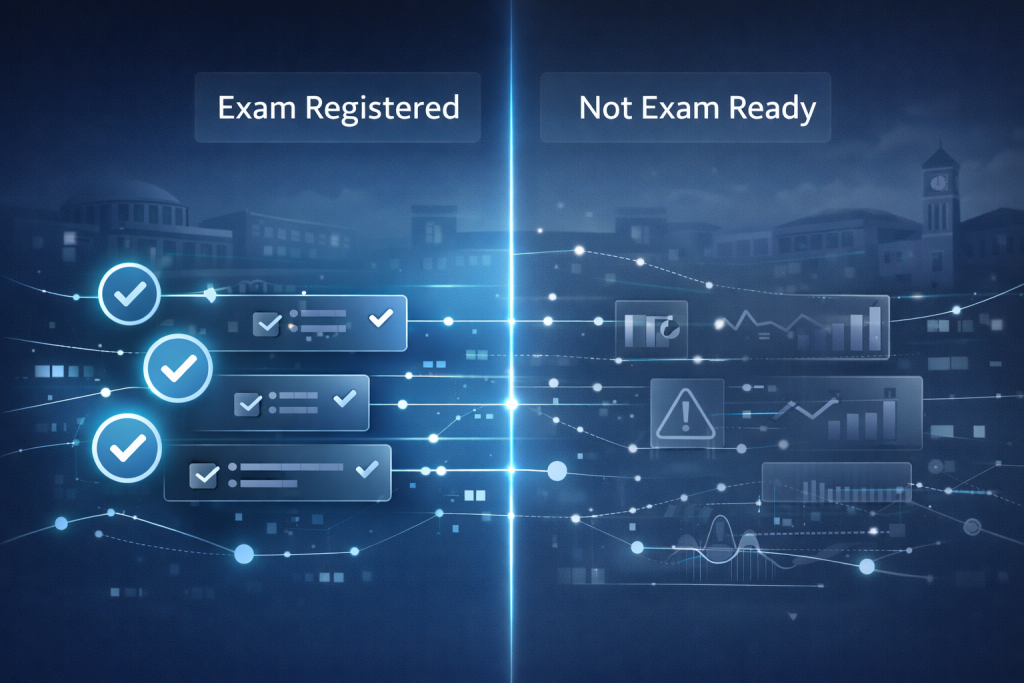
Most students were exam registered, but not exam ready.

The issue is not student intent or faculty effort.
The issue is the absence of continuous academic intelligence.

Traditional systems are designed to manage processes, not preparedness. They track attendance, record marks, and schedule exams—but they fail to answer the most critical question:

Is the student truly ready to perform in the exam?

Through advanced Digital solutions for higher education, universities can move from reactive exam management to proactive academic preparedness using an AI-powered Education Management System (EMS) designed for real academic intelligence.

This gap is where AI-enhanced exam readiness becomes essential. At the center of this shift is iCloudEMS, an AI-powered Education Management System (EMS) built to give students, faculty, and institutional leaders real-time visibility into exam readiness—long before failure becomes inevitable.

The Hidden Problem: Why Students Are “Exam Registered” but Not “Exam Ready”

Visual comparison of exam registered students versus actual exam readiness highlighting hidden academic riskAdministrative exam registration does not guarantee academic exam readiness.
Most institutions rely on a few traditional indicators to assume readiness:

  • Minimum attendance completed
  • Syllabus coverage confirmed
  • Internal assessments conducted

While these metrics satisfy administrative requirements, they do not reflect academic preparedness.

Where Traditional Approaches Break Down

Attendance Does Not Equal Understanding

A student may be physically present yet conceptually lost.

Marks Without Insight Offer No Direction

Internal assessments generate scores, but rarely reveal trends, patterns, or academic risk.

Late-Stage Identification of Weak Students

Interventions often begin after poor performance has already occurred.

Manual Monitoring Cannot Scale

Faculty intuition replaces data-driven clarity, especially as institutions grow.

Uniform Preparation Ignores Individual Gaps

All students receive the same guidance, despite very different learning needs.

As institutions scale, these blind spots widen—making exam outcomes unpredictable and stressful.

What “AI-Enhanced Exam Readiness” Actually Means

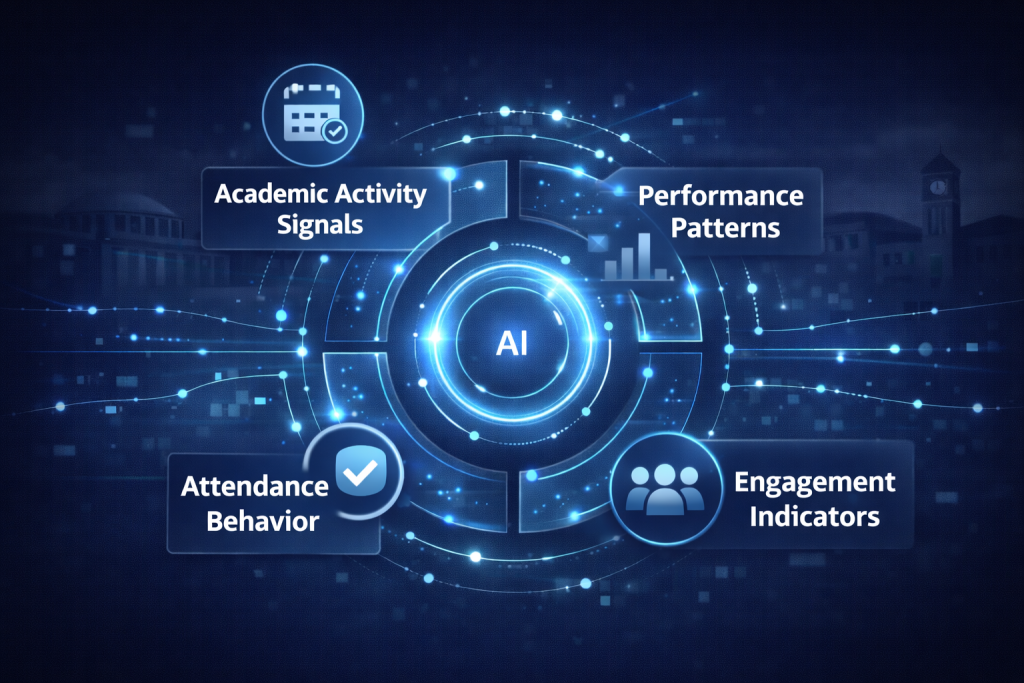
AI-enhanced exam readiness framework integrating attendance, performance, engagement, and academic signalsAI-enhanced exam readiness works as a continuous academic intelligence framework.
AI-enhanced exam readiness is not about automating exams or digitizing question papers.
It is about continuously understanding and improving student preparedness.

At its core, it is built on four principles:

  • Predictive, not reactive
  • Continuous, not episodic
  • Personalized, not generic
  • Insight-driven, not assumption-based

Instead of asking “Who failed?”, institutions begin asking:

“Who is likely to struggle, why, and how early can we intervene?”

This shift is only possible through intelligent, connected academic data—exactly what modern Digital solutions for higher education are designed to deliver.

How iCloudEMS Enables AI-Enhanced Exam Readiness

iCloudEMS treats exam readiness as an institution-wide intelligence layer, embedded across academics, assessments, attendance, and student engagement.

AI-Based Performance Trend Analysis

iCloudEMS continuously analyzes:

  • Internal assessment scores
  • Assignment performance patterns
  • Historical subject-wise results

Instead of static marks, the system identifies performance trajectories—highlighting whether a student is improving, declining, or stagnating. Academic risk is identified early, not after final exams.

Attendance–Performance Correlation Intelligence

Attendance becomes meaningful only when interpreted in context.

iCloudEMS correlates:

  • Attendance consistency
  • Subject difficulty levels
  • Individual performance history

This helps identify students who are compliant but disengaged—enabling academic support rather than disciplinary action.

Subject-Level Exam Readiness Indicators

Every subject carries a different academic risk.

iCloudEMS provides subject-wise readiness insights, helping students and faculty focus preparation where it matters most—eliminating blanket revision strategies.

Early Warning Alerts for Students, Mentors, and Faculty

One of the strongest strengths of iCloudEMS lies in its ability to deliver AI-driven early awareness systems in universities that proactively identify academic risks weeks before examinations begin, enabling timely academic intervention.

AI-driven alerts are generated when the system detects:

  • Declining performance trends
  • Attendance–performance mismatches
  • Engagement drop-offs

Alerts reach the right stakeholders at the right time, ensuring intervention happens weeks before exams—not after results.

Digital Exam Readiness Dashboards

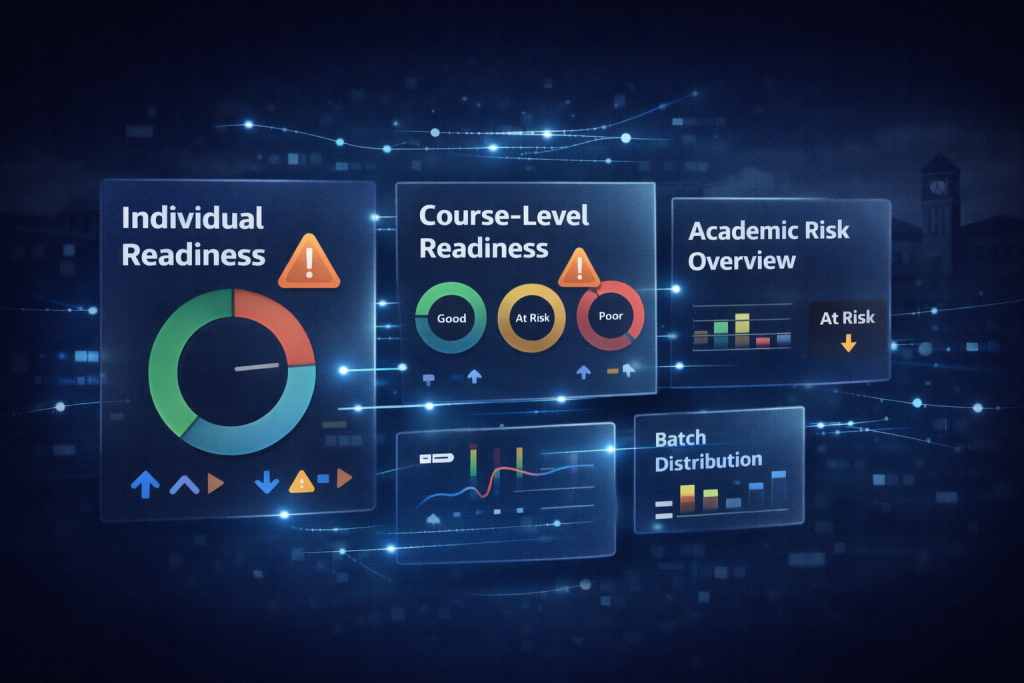
AI-driven early warning dashboards showing student, course, and batch-level exam readinessEarly warning dashboards make academic risk visible before exam failure occurs.
Visibility changes behavior.

iCloudEMS dashboards display:

  • Individual student readiness status
  • Course-level preparedness distribution
  • Batch-wise academic risk overview

Students gain clarity.
Faculty see where support is needed.
Leadership understands readiness at scale.

AI-Driven Academic Intervention Workflows

Insights without action deliver no value.

iCloudEMS enables:

  • Mentor meetings triggered by AI alerts
  • Targeted remedial plans
  • Academic support tracking across departments

Exam readiness becomes a managed academic process, not a last-minute emergency.

Student-Centric Intelligence: How Students Benefit Directly

This clarity is further strengthened through a smart mobile app experience for students, where academic information, alerts, and exam-related updates are accessible in real time without dependency on administrative follow-ups.

For students, exams are emotional as much as academic. Anxiety often stems from uncertainty.

Students benefit from:

  • Early identification of weak subjects
  • Clear preparation priorities
  • Reduced last-minute pressure
  • Confidence built on visibility, not guesswork

Instead of wondering “Am I prepared?”, students see their readiness and act accordingly.

Faculty and Examination Department Advantages

By integrating digital evaluation and examination management, institutions can reduce result delays, minimize revaluation pressure, and improve academic transparency across departments.

Faculty Benefits

  • Early identification of at-risk students
  • Data-backed mentoring conversations
  • Better alignment between teaching and outcomes

Examination Department Benefits

  • Reduced failures and revaluation load
  • Improved result consistency
  • Smoother exam cycles at scale

Exams become predictable, manageable, and academically fair.

Institutional Impact for University Leadership

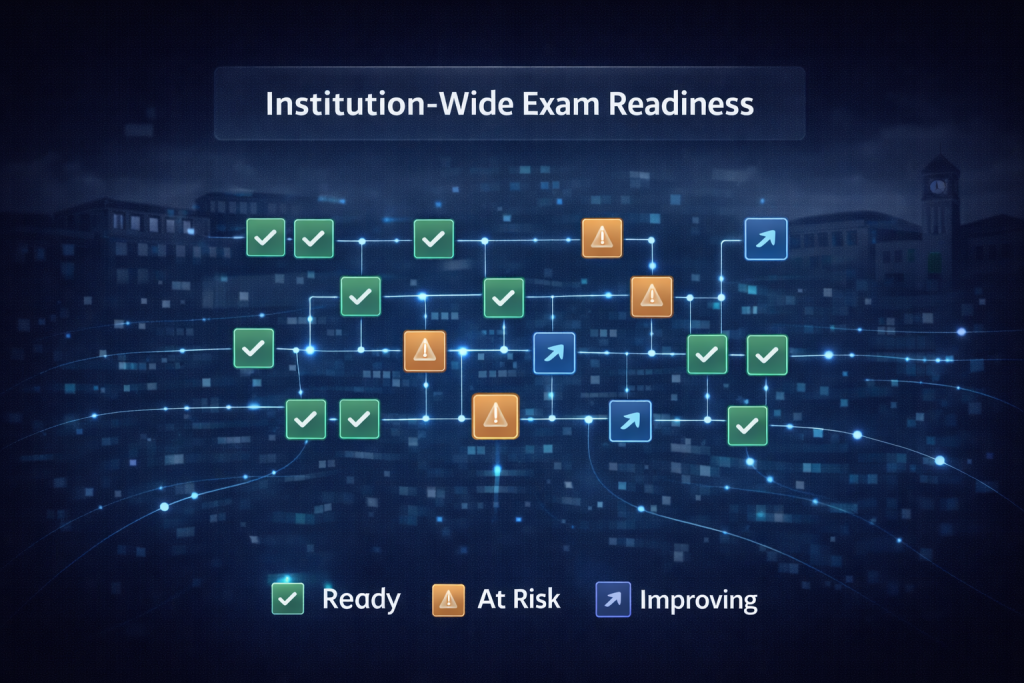
Institution-wide exam readiness overview showing university-level academic preparedness and risk statusUniversity leadership gains institution-wide visibility into exam readiness and academic risk.

Exam outcomes directly influence reputation, accreditation, and long-term credibility.

AI-powered readiness enables:

  • Improved pass percentages
  • Stronger academic governance
  • Better accreditation data readiness
  • Higher student satisfaction and trust

These outcomes directly support stronger accreditation and academic governance by ensuring reliable academic data, consistent results, and evidence-based quality assurance.

An AI-driven Education Management System (EMS) like iCloudEMS moves leadership from intuition-based decisions to evidence-driven governance.

Why AI-Enhanced Exam Readiness Is the Future of Indian Higher Education

The role of AI in universities is no longer limited to automation but extends to early intelligence, academic prediction, and continuous readiness monitoring.

Indian higher education is expanding rapidly. Manual systems cannot keep pace with:

  • Large student populations
  • Complex compliance requirements
  • Rising expectations from students and parents

National quality frameworks and higher education quality and assessment standards increasingly emphasize outcome visibility, academic monitoring, and institutional accountability.

higher education quality and assessment standards↗

Without AI-driven readiness intelligence, exam seasons will remain reactive and stressful. The future belongs to institutions that treat exams as a continuous preparedness journey, not a single event.

iCloudEMS as the Strategic Enabler

iCloudEMS integrates academics, assessments, attendance, student engagement, and AI intelligence into a unified platform.

As a cloud-native, AI-powered Education Management System (EMS), iCloudEMS delivers scalable Digital solutions for higher education.

Trusted by 160+ universities and colleges and supporting 170,000+ students, iCloudEMS enables exam readiness that is intelligent, measurable, and sustainable.

Conclusion: Exam Readiness Is a Responsibility, Not a Deadline

Exams should never surprise students or institutions.

With AI-enhanced exam readiness, universities can:

  • Support students earlier
  • Reduce academic stress
  • Improve outcomes responsibly

The transformation is clear:

From exam management to exam intelligence.

That shift defines the next generation of higher education.

To understand how AI-driven exam readiness can be implemented institution-wide, explore how iCloudEMS supports intelligent academic preparedness.

Frequently Asked Questions on AI-Enhanced Exam Readiness in Universities

What is AI-enhanced exam readiness in higher education?

AI-enhanced exam readiness refers to the use of artificial intelligence within Digital solutions for higher education to continuously assess, predict, and improve a student’s preparedness for examinations. Instead of relying only on attendance and internal marks, AI analyzes performance trends, engagement patterns, and academic behavior to identify readiness gaps early and enable timely interventions.

How does AI help universities identify students who are not exam-ready?

AI systems within an Education Management System (EMS) like iCloudEMS analyze multiple academic indicators such as internal assessments, attendance-performance correlation, subject-level trends, and historical outcomes. This allows universities to detect students at academic risk weeks before exams, rather than discovering issues after results are declared.

Why are traditional exam preparation methods insufficient for universities?

Traditional methods focus on syllabus completion and exam scheduling but lack real-time intelligence. They do not provide visibility into individual student preparedness, early warning signals, or performance patterns at scale. As student numbers grow, manual tracking becomes unreliable, leading to reactive exam management instead of proactive readiness planning.

How does iCloudEMS improve student exam performance using AI?

iCloudEMS uses AI-driven insights to provide students with clarity on weak subjects, preparation priorities, and academic risk indicators. Through intelligent dashboards, alerts, and continuous performance tracking, students gain early awareness and guided preparation, reducing last-minute stress and improving exam outcomes.

Can AI reduce exam stress and anxiety among students?

Yes. Exam stress often comes from uncertainty. AI-powered readiness indicators within iCloudEMS give students clear visibility into their preparation status, helping them plan better, seek help earlier, and approach exams with confidence rather than panic.

How do faculty benefit from AI-based exam readiness tools?

Faculty gain early visibility into student performance trends, enabling data-backed mentoring instead of assumption-driven support. AI helps faculty identify at-risk students, focus academic interventions effectively, and align teaching strategies with actual learning outcomes.

What advantages do examination departments gain from AI-driven readiness systems?

AI-enhanced readiness reduces last-minute failures, revaluation workloads, and result volatility. Examination departments benefit from better preparedness visibility, improved pass percentages, and smoother exam cycles, especially in large institutions with complex academic structures.

How does AI-enhanced exam readiness support university leadership and governance?

For leadership, AI provides institution-wide visibility into academic preparedness, helping improve decision-making, accreditation readiness, and academic credibility. An AI-powered Education Management System (EMS) supports data-driven governance by replacing intuition with measurable insights.

Is AI-enhanced exam readiness suitable for large universities?

Yes. AI-enhanced readiness is especially critical for universities with 3,000+ students, where manual monitoring is impractical. Platforms like iCloudEMS are designed to scale intelligence across departments, courses, and campuses without increasing administrative burden.

Why is AI-driven exam readiness considered the future of higher education?

As higher education scales and compliance expectations rise, universities need predictive intelligence rather than reactive processes. AI-driven exam readiness transforms exams from one-time events into continuous academic intelligence systems, making it a foundational component of future-ready Digital solutions for higher education.

Early Awareness Systems in Universities: How AI-Driven ERP Prevents Problems Before They Escalate

Introduction

Universities rarely encounter failure as a sudden event. Academic decline, student attrition, financial stress, reputational damage, or operational breakdowns usually develop slowly, often unnoticed. Long before outcomes become visible in rankings, results, or balance sheets, early signs are already present—missed classes, declining engagement, unresolved grievances, delayed payments, or inconsistent academic performance. The issue is not the absence of data. It is the absence of early awareness.

Most institutions today operate multiple digital systems. Admissions platforms, learning management systems, examination tools, finance software, and reporting dashboards are widely deployed. Yet leadership teams frequently discover problems only when consequences are difficult or costly to reverse. By the time a student is marked as “at risk,” disengagement may already be entrenched. By the time fee defaults become visible, financial stress may have pushed students toward withdrawal. By the time placement outcomes disappoint, employability gaps may be too late to address.

This pattern reveals a structural weakness in how universities perceive information. Traditional systems are designed to record events, not to surface emerging risks. Early Awareness Systems (EAS) address this gap. They focus on detecting meaningful signals early, correlating information across functions, and enabling timely human intervention. When embedded within an AI-assisted ERP, early awareness becomes a strategic capability rather than an operational afterthought.

The Real Problem in Universities Is Not Lack of Systems — It’s Late Visibility

Universities are not short of software. In fact, many institutions struggle with the opposite problem: too many disconnected tools. Each department often operates its own systems, optimized for local efficiency but disconnected from the broader institutional context.

This fragmentation creates several structural issues:

  • Data silos prevent a holistic view of student and institutional health.
  • Manual consolidation delays insights, often producing reports weeks after issues emerge.
  • Departmental isolation means early warning signs remain local rather than institutional.
  • Leadership dashboards tend to reflect historical performance instead of emerging risk.

As a result, decision-making becomes reactive. Leaders respond to outcomes rather than influences. Academic interventions occur after failure rates rise. Financial reviews happen after arrears accumulate. Student support is triggered after dissatisfaction escalates. The systems function correctly, yet awareness arrives too late.

Early awareness is not about adding more reports. It is about changing when and how insight reaches decision-makers.

What Is an Early Awareness System in a University Context?

An Early Awareness System in a university context is a structured capability designed to identify emerging academic, financial, operational, or engagement risks before they escalate into visible problems.

What an Early Awareness System Is

An EAS is a decision-support layer that continuously evaluates signals across the institution and highlights deviations that require attention. It does not replace human judgment; it prioritises it.

Key characteristics include:

  • Continuous signal evaluation rather than periodic reporting
  • Correlation across academic, financial, and engagement data
  • Context-sensitive alerts rather than generic thresholds

What an Early Awareness System Is Not

It is not:

  • Automated decision-making
  • Predictive certainty
  • Surveillance without purpose

Early awareness focuses on timing and relevance, not control.

Monitoring vs Awareness

Monitoring answers the question: What has happened or is happening?
Awareness answers: What is likely to become a problem if we do nothing now?

This distinction is central. Awareness enables action while intervention is still effective and proportionate.

Core Components of an EAS

A functional early awareness system includes:

  • Data signals from multiple domains
  • Risk indicators derived from patterns and deviations
  • Contextual scoring based on student and institutional profiles
  • Alert mechanisms tuned for relevance, not volume
  • Clearly defined human intervention workflows

AI assists by identifying patterns and deviations. Humans decide how to act.

Why Traditional University ERPs Fail at Early Awareness

Most traditional ERPs were designed to support transactional integrity, not institutional foresight. Their primary function is to ensure accuracy, compliance, and record-keeping. While these capabilities are essential, they are insufficient for early awareness.

Common limitations include:

  • Event-centric architecture that captures what happened but not what is emerging
  • Report-driven insight, requiring users to actively search for risk
  • Weak cross-module intelligence, limiting correlation across domains
  • High manual dependency, relying on staff vigilance rather than system insight

In such environments, awareness depends on individual experience and intuition rather than institutional capability. This creates inconsistency and increases the likelihood that early signals are missed.

The Shift from Automation to Early Awareness

Automation has long been positioned as the goal of digital transformation. While automation improves efficiency, it does not inherently improve outcomes. In some cases, automation without awareness can accelerate negative consequences by executing processes faster without understanding context.

Early awareness represents a more mature approach. Instead of focusing solely on process execution, it emphasises situational understanding. AI plays a supporting role by highlighting anomalies, trends, and deviations. It does not decide. It informs.

This shift reframes technology as a partner in judgment rather than a substitute for it.

Key Early Awareness Signals Universities Must Track

Attendance → Academic Risk

Gradual declines in attendance often precede academic underperformance. Early awareness allows institutions to identify patterns before assessments are affected and offer academic or personal support while recovery is still possible.

LMS Engagement → Learning Disengagement

Reduced logins, incomplete activities, or declining interaction with learning content can signal disengagement. Early intervention may involve academic counseling, pedagogical adjustments, or mentoring support.

Internal Assessments → Outcome Risk

Consistent underperformance in formative assessments often predicts final result challenges. Early awareness enables targeted academic assistance instead of post-result remediation.

Fee Patterns → Financial & Retention Risk

Irregular or delayed payments may indicate financial stress. Awareness allows institutions to explore structured support or counseling options before disengagement escalates.

Grievances → Student Well-Being Risk

Repeated grievances, especially across departments, can signal systemic issues affecting student well-being. Early visibility helps prevent escalation and reputational harm.

Placement Readiness → Employability Risk

Low participation in training or placement activities may indicate employability challenges. Early intervention enables skill development and targeted preparation.

How AI-Driven ERP Correlates Signals Across the Campus

Early awareness becomes powerful when signals are correlated across domains. A single indicator may not justify action, but patterns across multiple areas often do.

AI-assisted ERP systems support:

  • Cross-module intelligence linking academics, finance, and engagement
  • Pattern recognition based on historical institutional data
  • Trend deviation analysis highlighting unusual changes
  • Contextual alerts aligned to program, cohort, and timing

This correlation transforms isolated data points into actionable insight.

From Alert to Action — Designing an Intervention Playbook

Awareness without action delivers limited value. Effective early awareness systems are supported by structured intervention frameworks.

Key elements include:

  • Clear ownership defining who responds to specific alerts
  • Time-bound workflows ensuring timely action
  • Escalation paths for unresolved cases
  • Documentation of interventions and outcomes
  • Feedback loops improving future detection

Intervention playbooks ensure that awareness leads to measurable improvement rather than alert fatigue.

Measuring Success — KPIs That Actually Matter

Early awareness systems should be evaluated through outcomes, not alert volumes.

Relevant indicators include:

  • Retention improvement reflecting sustained engagement
  • Reduction in academic failures indicating timely support
  • Faster intervention times showing operational responsiveness
  • Improved fee recovery supporting financial stability
  • Stronger placement outcomes demonstrating employability readiness

Each KPI reflects institutional effectiveness rather than system activity.

Building Early Awareness into Campus Culture

Technology alone does not create awareness. Cultural adoption is critical.

Sustainable early awareness requires:

  • Leadership commitment to proactive decision-making
  • Faculty involvement in interpreting and acting on signals
  • Trust in data through transparency and explainability
  • Ethical guardrails preventing misuse or over-monitoring
  • Disciplined alert design to avoid fatigue

When embedded into daily decision-making, early awareness becomes an institutional habit rather than a technical feature.

How a Unified Cloud-Native ERP Enables Early Awareness at Scale

Early awareness depends on unified data, consistent context, and real-time visibility. Fragmented systems make this difficult to achieve at scale.

Platforms like iCloudEMS act as the cloud-native, AI-powered backbone that enables early awareness systems to function seamlessly across the entire campus.

By unifying academic, financial, engagement, and administrative data within a single architecture, institutions gain consistent visibility without increasing operational complexity.

Conclusion

Early awareness is not a feature; it is a leadership capability. Universities that recognise emerging risks early can respond with precision, empathy, and effectiveness. Those that rely on delayed reports are forced into reactive decisions that are often more costly and less impactful.

As higher education environments grow more complex, the ability to see problems before they escalate becomes a strategic advantage. Institutions that invest in early awareness strengthen student outcomes, institutional resilience, and long-term credibility.

The difference between proactive and reactive universities is not intent. It is awareness.

What is an early awareness system in universities?
An early awareness system helps universities identify emerging academic, financial, or engagement risks before they become critical. It focuses on early signals rather than historical performance data.

How does AI support early awareness without replacing humans?
AI identifies patterns and deviations across large datasets, helping humans prioritise attention. Decisions and interventions remain human-led.

Is early awareness the same as predictive analytics?
No. Predictive analytics estimates likelihoods, while early awareness focuses on timely visibility and actionable insight.

Can ERP systems reduce student attrition?
When designed for early awareness, ERP systems help institutions intervene sooner, improving retention outcomes.

What signals matter most for early intervention?
Attendance trends, engagement patterns, assessment performance, fee behaviour, and grievance frequency are among the most impactful indicators.

How do universities avoid alert fatigue?
By designing context-sensitive alerts, limiting volume, and linking alerts to clear action paths.

Does early awareness compromise student privacy?
When implemented ethically, it focuses on support and transparency rather than surveillance.

Who should act on early awareness alerts?
Ownership depends on the signal, typically involving faculty, academic advisors, finance teams, or student support services.

Can early awareness improve placement outcomes?
Yes. Identifying employability gaps early allows targeted training and mentoring.

Is early awareness relevant only to students?
No. It applies equally to finance, operations, faculty workload, and institutional performance.

How quickly can institutions see impact?
Meaningful improvements often appear within one or two academic cycles.

What makes early awareness scalable?
Unified data, consistent context, and structured workflows enable scale without manual overload.

AI in Universities Is Not About Automation — It’s About Early Awareness

Digital Maturity and Lingering Discomfort

Digital maturity is now a given across Indian private universities and large colleges. ERP platforms, digital examination systems, dashboards, and analytics tools are embedded into daily operations. Leadership conversations no longer revolve around adoption or basic capability.

Yet within this maturity, an unease persists. Issues often surface later than expected. Patterns become visible only after outcomes are locked in. Data support decisions, but still feel reactive rather than anticipatory. The institution appears efficient, but leadership visibility often arrives after momentum has already shifted.

This discomfort is rarely articulated as a technology gap. It shows up instead as questions around timing, preparedness, and confidence. Despite having systems in place, leadership insight still trails events.

Why Automation-Centric AI Feels Incomplete

AI has largely entered universities through an operational lens. Automation, efficiency, and workload reduction dominate how value is discussed. These outcomes matter, particularly in institutions managing scale, compliance, and administrative complexity.

From a leadership perspective, however, this framing feels incomplete. Automation improves execution after the activity occurs. It enforces consistency and accelerates processing, but it does not consistently provide early understanding. Leadership does not struggle with execution capacity; it struggles with sensing institutional movement early enough to shape direction.

This is why AI, despite growing adoption, can still feel insufficient at the governance level. Institutions become faster and more organised, yet remain surprised by certain outcomes. The limitation is not technological capability, but how AI is positioned within decision-making.

Where Leadership Actually Feels the Pressure

The pressures universities face rarely arrive suddenly. They accumulate quietly across academic, financial, and student-related domains before becoming visible outcomes. Leadership teams encounter this pattern repeatedly.

Common pressure points include:

  • Gradual shifts in attendance that become visible only after thresholds are crossed
  • Fee-cycle stress that escalates once timelines tighten
  • Academic performance gaps recognised after assessments conclude
  • Student disengagement is noticed after participation declines.

In most cases, early signals exist. They simply fail to align with insight soon enough. Fragmentation intensifies this delay, with academic, financial, examination, and student systems operating on parallel tracks rather than as a connected whole.

These experiences do not indicate inattentive leadership. They reflect systems designed to record activity, not to observe behaviour over time.

Early Awareness as a Governance Capability

Early awareness is rarely named explicitly, yet it is something senior leaders instinctively value. It is the ability to recognise when institutional direction is beginning to shift, before that shift hardens into outcomes. This recognition does not arrive through alerts or constant monitoring.

Early awareness emerges through continuity and context. When patterns are allowed to form across time and across functions, leadership begins to see movement rather than snapshots. This awareness creates space for interpretation rather than urgency.

From a governance standpoint, early awareness supports composure. Decisions are made with context, conversations focus on trajectory, and leadership confidence strengthens because insight arrives early enough to matter.

Why Automation Alone Falls Short

Automation plays an important role in institutional efficiency, but its contribution is inherently bounded. It operates on predefined rules and thresholds, responding once conditions are met. Awareness operates on progression and alignment.

Attendance systems can enforce compliance effectively, but leadership insight emerges when attendance behaviour begins to shift gradually across cohorts or programmes. Financial systems process transactions reliably, yet awareness develops when payment behaviour changes consistently within specific segments. Academic systems generate results, but foresight appears when performance trends align or diverge from engagement over time.

Automation answers what action should follow. Awareness reveals what story is unfolding. Universities operate on rhythm, continuity, and institutional memory rather than isolated events.

How AI Supports Leadership Quietly

The most effective AI capabilities in universities are often the least visible. They do not interrupt leadership workflows or demand attention through constant dashboards and alerts. Their influence is felt indirectly, through the quality of institutional conversations they enable.

When awareness is embedded into systems, leadership reviews become more focused because context is already present. Discussions move away from explanation toward interpretation. Decisions feel steadier, not because complexity disappears, but because it is encountered earlier.

AI’s value, in this sense, lies not in visibility but in preparedness. Leadership is supported before questions are asked, not after issues escalate.

Why Unified, Cloud-Native Systems Matter

Early awareness cannot emerge from disconnected tools or short-term datasets. It depends on continuity across the institution and coherence between functions. Longitudinal data allows patterns to surface naturally, while cross-functional integration reveals relationships that isolated systems cannot show.

Unified, cloud-native systems preserve institutional memory. They enable leadership to see progression rather than snapshots and alignment rather than fragmentation. This continuity becomes increasingly critical as universities grow in size, complexity, and geographic spread.

A modern university ERP system, therefore, functions as a governance infrastructure, not merely operational software. It provides the structural foundation on which awareness can develop over time.

Where iCloudEMS Fits Naturally

Within this context, iCloudEMS aligns as an institutional backbone rather than a feature-led platform. As a cloud-native, AI-enabled system built for higher education in India, it supports early awareness by maintaining continuity across academic, administrative, and student domains within a unified environment.

Its presence is not intrusive, nor does it demand constant attention. It ensures that leadership insight arrives early enough to influence direction, while preserving the calm required for confident governance.

A Strategic Leadership Reflection

The conversation around AI in universities is already shifting, even if quietly. The focus is moving away from how many processes can be automated toward why certain outcomes still feel surprising despite digital maturity. This reflects a deeper recognition that efficiency alone does not create foresight.

AI in universities is not fundamentally about acceleration. It is about early understanding. Institutions that recognise this distinction operate with greater composure, stronger timing, and increased leadership confidence. In higher education, that composure is not incidental. It is strategic.

Leadership Questions on AI in Universities

Why does AI still feel insufficient at the governance level?
Most implementations emphasise automation and efficiency, while leadership requires early recognition of institutional patterns rather than post-event processing.

Why do universities struggle with early visibility despite digital systems?
Systems are often designed to record activity in isolation, not to observe behaviour across time and functions in a connected manner.

How is early awareness different from automation?
Automation responds to predefined conditions, while early awareness recognises gradual shifts in institutional rhythm before they become outcomes.

Why does decision timing matter more than operational efficiency?
Because leadership effectiveness depends on when insight arrives, not how quickly processes execute after outcomes are visible.

What role does a university ERP system play in institutional awareness?
A unified ERP system preserves continuity and cross-functional context, enabling leadership to see progression rather than fragmented snapshots.

How does AI support leadership without creating noise?
By improving preparedness and context quietly, allowing leadership conversations and decisions to become more focused and composed.

How Automation has brought revolution in the world of Education

In the present time, every industry is working to make the best of technology to ease their workflow and save the important time of administration in doing mundane and repetitive tasks. Digital transformation has offered the information accessibility anytime and from anywhere for efficient functioning of organization. Digitization paves the way of automation and automation has become an integrated part of our daily lives as well, we can see automation all around us like in our washing machines, dishwasher, refrigerators and may more, in education sector is no longer an exception in being digitized and automated.

Automation is the use of technology to minimize manual efforts in performing time-consuming and recurring assignments resulting in improvement of outcomes. The education model is made up of different stakeholders who are responsible for their associated academic and non-academic functions. Automation makes the best use of academic resources and gets most of the task paperless in the institute.

Here are the main points that make us realize, how automation has impacted the all the level of education sector and leads to the creation of an efficient and innovative world of education.

1. For the administrative staff

There are many non-academic activities at the administrative level which if becomes automated can drastically reduce the workload for the associated staff. Back-office activities include students’ registration, enrolment, fee collection and record, receipt generation etc. Such kind of tasks are labour-intensive, time consuming and paper based, but with the implementation of Artificial intelligence, machine learning and other automation technologies, the tasks at this level can be performed effortless with minimal human intervention which saves time and other important resources.

2. For the Instructors

The core objective of instructor is to teach and train the learners, but with the workload of other supporting daily activities like maintenance of attendance record, assignment grading, lecture scheduling etc. consumes their considerable time and effort. Today in the time of automation, all such tedious tasks can be performed in a few clicks of mouse and encourages the trainer to achieve more productive and meaningful academic outcomes.

3. For the Parents

Parents are important stakeholder of the education sector. Earlier it was a regular practice for the parents to visit the institute to keep check their wards’ performance, for his safety and many more concerns. Automation has benefitted their lives as well, now they are no longer required to visit institute for such regular tasks, digital platforms allow to connect them full-time with the institute and they can keep regular track of their children progress. Some advanced features like SMS alert on the absence of child boosts the security and relaxes the safety concern of the parents.

4. For the Students

In present time learning is no longer bounded to chalk-and-board classroom. With each passing day it is required to be more innovative and interactive. Students are no longer interested in being passive participant, they enjoy creative and interactive meaningful sessions. Automation has made all these things possible for learners. Now with the advancement of technology, students can easily connect with teachers regarding any feedback or query which bridges the learning gap more efficiently and improve the learning outcomes. Automation has enhanced the transparency of system, now students are always aware of their attendance, grades, lecture schedule and other academic activities. They can easily fetch the study content like e-notes, lecture videos, research papers etc by login on their academic platform which adds more value in gaining knowledge and skill.

Conclusion: The list of automation benefits in any sector can go on and on. Automation and digitization have transformed all sphere of life. Many complex and complicated problems can be easily solved today with just a few clicks of mouse. The contribution of automation in education sector is incredible and now it has become an inevitable part of teaching and non-teaching activities. It has positioned the stakeholders to make the best of their time and resources to bring revolutionary changes in the education system– for now and in the future.