Transforming University Finance Through an AI-Powered Fee Management System

University finance is no longer a back-office function. It directly influences institutional stability, accreditation readiness, and long-term sustainability. However, many institutions still rely on semi-digital fee processes, delayed reconciliation, and reactive tracking models.

An AI-Powered Fee Management System for Universities redefines this structure. Instead of merely collecting payments, it builds predictive intelligence into financial governance. Moreover, when embedded within a unified Education Management System (EMS), it strengthens Digital solutions for higher education across departments.

Financial digitization is no longer about convenience. It is about institutional control.

The Hidden Risk Inside Traditional Fee Systems
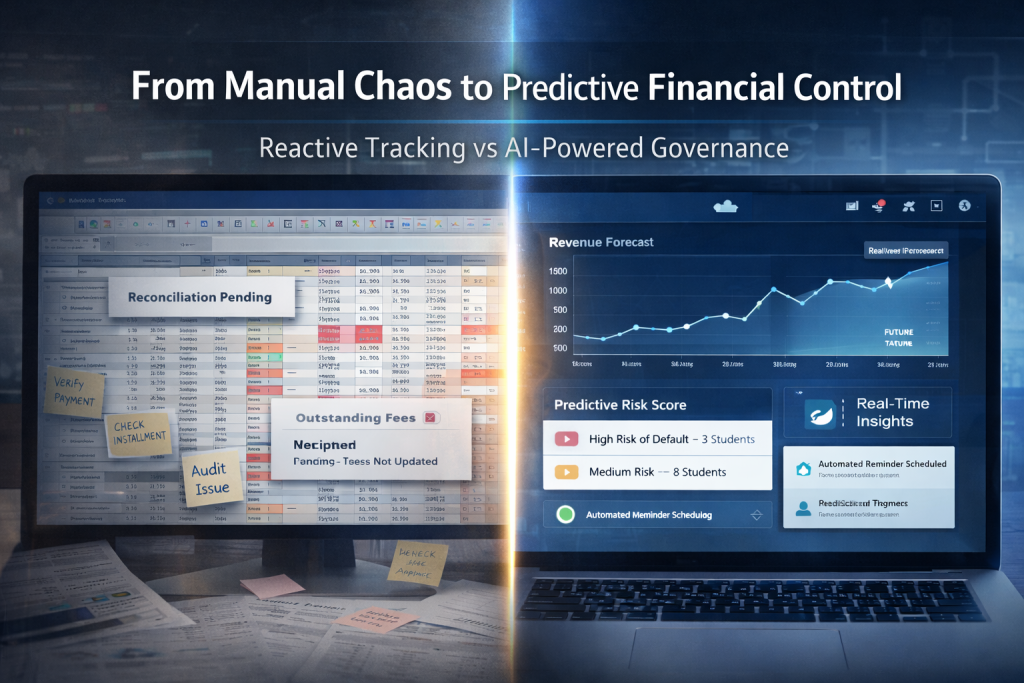
Split-screen comparison of manual spreadsheet-based fee tracking versus AI-powered financial governance dashboardFrom manual reconciliation chaos to AI-powered financial control

Most universities offer online payments. Yet digital transactions alone do not create financial visibility.

Manual reconciliation, spreadsheet dependency, and fragmented dashboards create:

  • Revenue leakage
  • Delayed financial forecasting
  • Limited audit readiness
  • Compliance exposure
  • Student dissatisfaction due to unclear fee tracking

As discussed in our analysis on legacy university systems, fragmented data architectures often prevent institutions from reaching operational maturity.

Therefore, the real challenge is not payment collection. It is intelligent orchestration.

The Evolution Toward an AI-Powered Fee Management System for Universities

An AI-Powered Fee Management System for Universities transforms static finance operations into predictive ecosystems.

AI-driven fee analytics identify:

  • High-risk delayed payment patterns
  • Installment default probability
  • Scholarship impact forecasting
  • Seasonal cash flow variations

Consequently, finance leaders gain foresight rather than reactive insight.

This predictive approach mirrors how AI now supports academics and lifecycle tracking, as explored in our work on student lifecycle management. When institutions connect financial data with behavioral analytics, risk detection becomes proactive.

Automation does not replace teams. It empowers them.

Cloud-Based Financial Governance and Real-Time Dashboards

AI intelligence must operate on scalable infrastructure. Therefore, cloud-native architecture becomes essential.

A cloud-based fee management system ensures:

  • Real-time revenue dashboards
  • Instant reconciliation across gateways
  • Secure payment processing
  • Centralized compliance visibility
  • Anywhere access for authorized stakeholders

As emphasized in our insights on cloud security in higher education, institutions require more than hosting—they require encrypted governance frameworks.

Meanwhile, centralized dashboards allow leadership to align budgets with live revenue data. This shift transforms financial reporting into strategic intelligence.

Predictive Alerts and Intelligent Automation
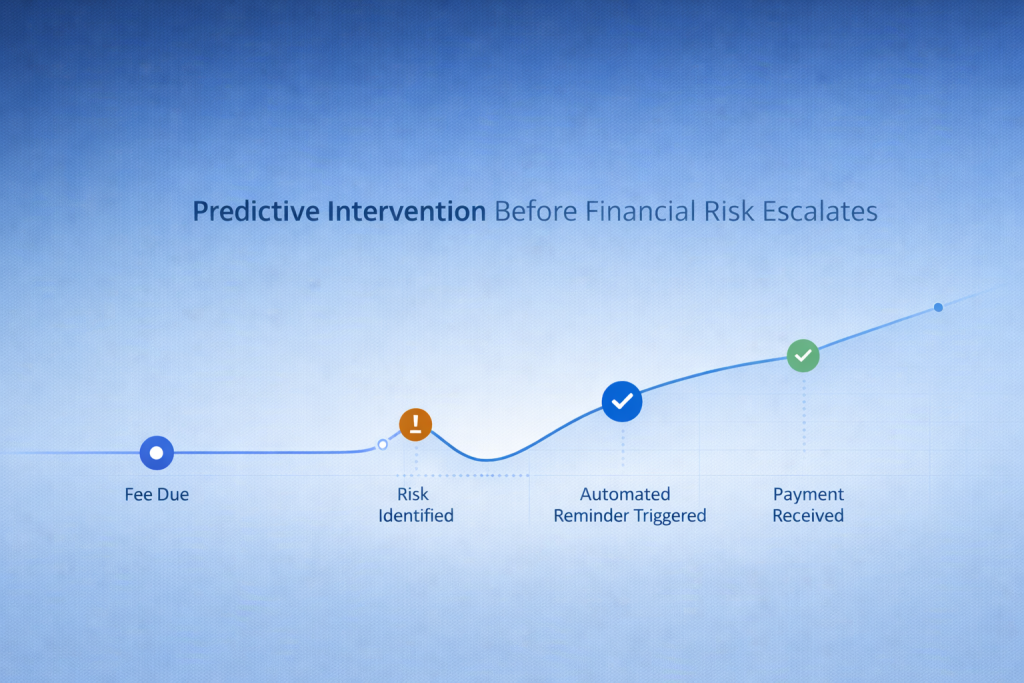
Timeline illustration showing early risk identification, automated reminder trigger, and successful payment recovery in university fee managementPredictive intervention prevents financial risk before escalation

Traditional reminder systems follow fixed schedules. However, predictive fee defaulter alerts adapt to real-time behavior.

For instance:

  • AI flags potential delays early
  • Contextual reminders trigger automatically
  • Installment plans adjust dynamically
  • Finance heads receive priority exception alerts

Therefore, institutions improve collection rates without creating friction.

This predictive logic reflects the same AI-enabled readiness philosophy used in exam preparation analytics, where early detection improves outcomes.

Intelligence always outperforms reaction.

Eliminating Reconciliation Chaos Through Digital Precision

Manual reconciliation consumes administrative hours. More importantly, it introduces avoidable risk.

An intelligent fee reconciliation engine:

  • Matches payments across gateways instantly
  • Aligns scholarships and concessions automatically
  • Flags discrepancies in real time
  • Maintains transparent audit trails

Consequently, audit readiness improves without additional workload.

As institutions have learned from accreditation data challenges, governance failures rarely stem from absence of effort. They stem from fragmented systems.

Precision eliminates fragmentation.

Connecting Fee Intelligence With the Academic Ecosystem

Finance does not operate in isolation. It influences admissions, course registration, examination access, and accreditation documentation.

When integrated with:

Fee data becomes part of a unified governance model.

Moreover, institutions transitioning from traditional college ERP systems to modern EMS architectures experience stronger operational coherence.

Digital solutions for higher education require interconnected intelligence—not isolated modules.

Leadership-Level Decision Intelligence

University executives reviewing cloud-based financial governance dashboard in a modern boardroomCloud-based financial governance empowering institutional leadership

University boards and finance committees require forward-looking insights.

An AI-Powered Fee Management System for Universities provides:

  • Cash flow projections
  • Department-wise revenue mapping
  • Predictive defaulter modeling
  • Scholarship impact dashboards
  • Compliance monitoring visibility

Therefore, leadership decisions become data-backed rather than assumption-driven.

When fee management integrates within iCloudEMS, financial governance aligns seamlessly with academics, examinations, and institutional reporting.

Digital transformation becomes measurable.

A Strategic Reflection for Institutional Leaders

If your university still reconciles fees manually or tracks defaulters reactively, what invisible risks remain buried in spreadsheets?

And more importantly — does your finance system generate intelligence, or only transactions?

The institutions that will lead the next decade of higher education will not merely digitize payments. They will operationalize predictive financial governance.

Frequently Asked Leadership Questions

What is an AI-Powered Fee Management System for Universities?

It is a predictive financial automation platform that analyzes payment behavior, triggers intelligent alerts, automates reconciliation, and provides real-time dashboards within a unified Education Management System (EMS).

How does cloud-based fee management improve institutional governance?

Cloud infrastructure centralizes financial data, enables secure access, strengthens compliance tracking, and delivers real-time reporting. Consequently, leadership gains continuous visibility into institutional cash flow.

Why are predictive fee defaulter alerts critical?

Predictive alerts identify potential payment delays before they disrupt revenue cycles. Therefore, finance teams intervene early and reduce collection risk while preserving student relationships.

How does fee intelligence support accreditation and compliance?

Automated audit trails and centralized reporting simplify documentation for regulatory bodies. When connected with accreditation workflows, financial transparency strengthens institutional credibility.

How does fee management integrate with broader Digital solutions for higher education?

When embedded inside a unified Education Management System (EMS), fee operations align with admissions, academics, examinations, and compliance. This integration creates a cohesive institutional ecosystem.

If you are evaluating your institution’s financial transformation roadmap, what strategic capability matters most—automation, predictive alerts, or real-time governance visibility?

Your answer will define the next stage of institutional maturity.
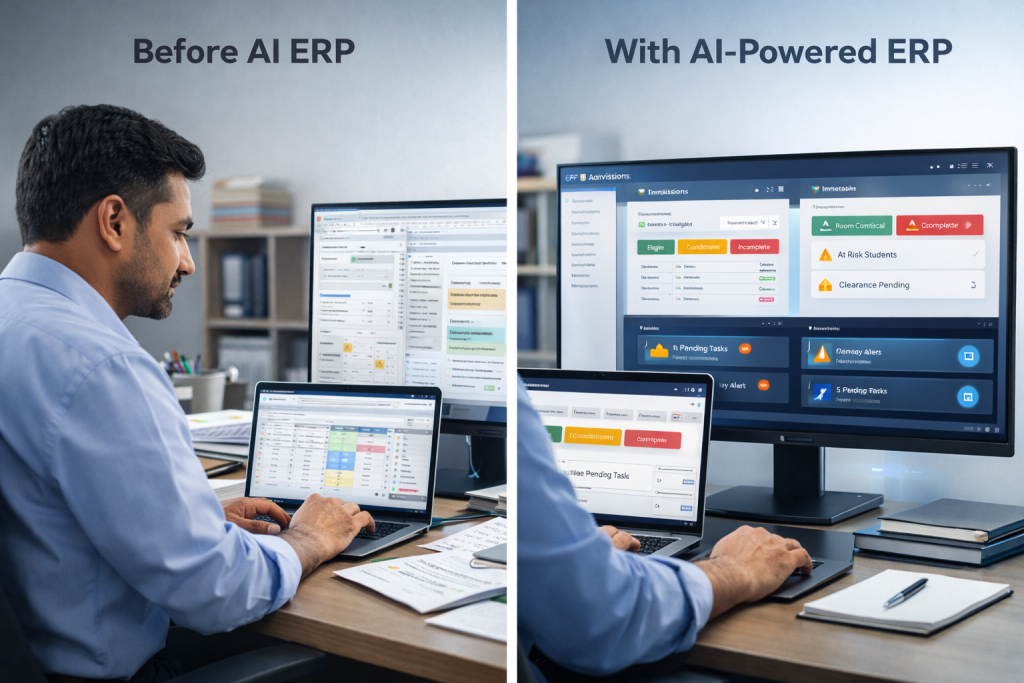
10 AI Hacks in University ERPs That Save Admins 20+ Hours a Week

University administrators don’t struggle because they work less.
They struggle because too much of their time is spent coordinating, checking, following up, and correcting.

Most universities already have ERP systems.
Yet admin teams still stay late during admissions, exams, fee cycles, and accreditation season.

The problem isn’t effort.
And it isn’t even digitisation.

The problem is that most ERPs record work — they don’t reduce mental and coordination load.

This is where AI inside university ERPs quietly changes daily operations.

Not futuristic AI.
Not experimental automation.

Just practical, workflow-level intelligence that removes hours of invisible admin work every week.

Below are 10 AI hacks already possible inside modern university ERPs that consistently save 20+ hours per week across admin teams.

How AI inside university ERP reduces administrative workload and coordination effortHow AI inside university ERP reduces administrative workload and coordination effort

Hack #1: AI-Based Admission Application Pre-Screening

AI-based admission application pre-screening inside a university ERP systemAI-based admission application pre-screening inside a university ERP system

The Admin Problem

Admissions teams manually verify eligibility, documents, category rules, and missing information — even before shortlisting begins.

This involves:

  • Rechecking eligibility rules
  • Identifying incomplete applications
  • Responding to repetitive queries

How AI Inside ERP Fixes This

AI pre-screens applications using:

  • Programme eligibility rules
  • Academic thresholds
  • Document completeness checks

Applications are automatically tagged as:

  • Eligible
  • Conditionally eligible
  • Incomplete

Time Saved Per Week

4–6 hours during active admission cycles

Who Benefits Most

Admissions office, registrar’s team

Hack #2: Intelligent Timetable Conflict Detection

AI-powered timetable conflict detection for faculty, rooms, and student groups in university ERPAI-powered timetable conflict detection for faculty, rooms, and student groups in university ERP
The Admin Problem

Timetable creation looks finished — until:

  • Faculty clashes appear
  • Room capacity mismatches surface
  • Lab allocations conflict

Admins then enter endless back-and-forth correction loops.

How AI Inside ERP Fixes This

AI detects conflicts before publishing by analysing:

  • Faculty load
  • Room availability
  • Programme overlaps
  • Student group collisions

Instead of reacting, admins resolve issues proactively.

Time Saved Per Week

2–3 hours during timetable cycles

Who Benefits Most

Academic office, department coordinators

Hack #3: Auto-Prioritised Student Grievance Routing

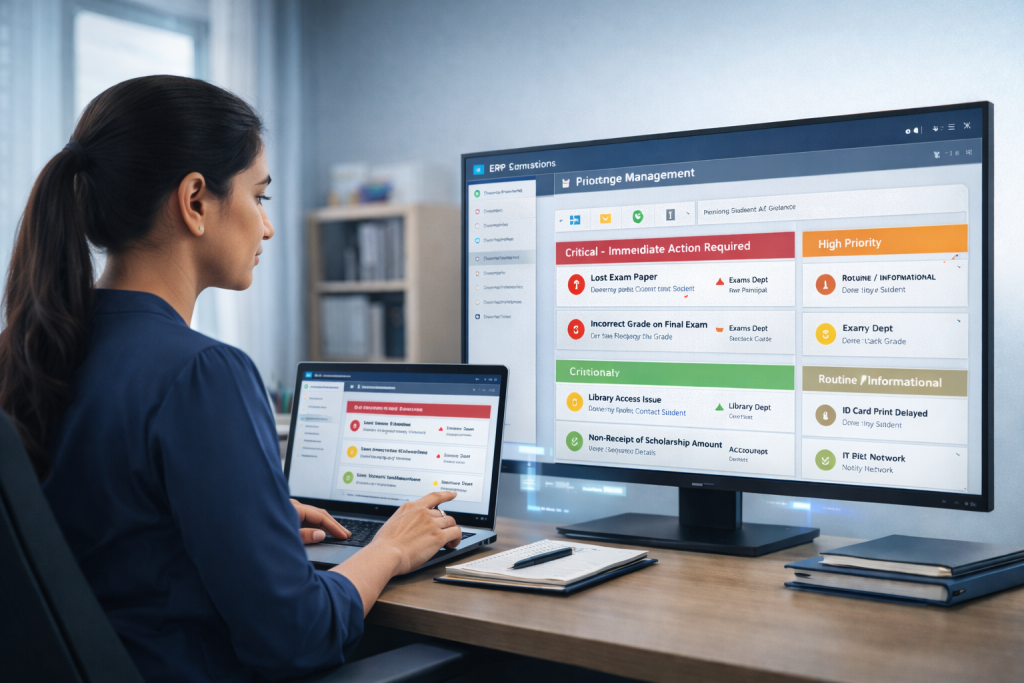
AI-prioritised student grievance routing inside university ERP systemAI-prioritised student grievance routing inside university ERP system

The Admin Problem

Grievances arrive via emails, portals, WhatsApp, and physical submissions.
Admins manually decide:

  • Urgency
  • Responsible department
  • Follow-up priority

Important cases often get delayed unintentionally.

How AI Inside ERP Fixes This

AI categorises grievances based on:

  • Issue type
  • Past resolution timelines
  • Academic calendar context

Critical cases surface instantly; routine ones follow standard workflows.

Time Saved Per Week

2 hours

Who Benefits Most

Student affairs office, grievance committees

Hack #4: Smart Fee Exception & Anomaly Detection

AI-based fee exception and anomaly detection in university finance ERPAI-based fee exception and anomaly detection in university finance ERP

The Admin Problem

Finance teams spend hours reconciling:

  • Partial payments
  • Incorrect fee heads
  • Duplicate transactions
  • Pending approvals

Most effort goes into finding issues, not resolving them.

How AI Inside ERP Fixes This

AI flags:

  • Unusual payment patterns
  • Repeated failed transactions
  • Deviations from standard fee structures

Admins focus only on exceptions, not every record.

Time Saved Per Week

3–4 hours

Who Benefits Most

Finance office, accounts team

Hack #5: AI-Assisted Exam Readiness Monitoring

AI-assisted exam readiness monitoring for eligibility and compliance in university ERPAI-assisted exam readiness monitoring for eligibility and compliance in university ERP

The Admin Problem

Before exams, admins manually check:

  • Student eligibility
  • Attendance compliance
  • Fee clearance
  • Hall ticket readiness

This requires pulling reports from multiple modules.

How AI Inside ERP Fixes This

AI continuously monitors readiness indicators and highlights:

  • At-risk students
  • Missing clearances
  • Policy violations

No last-minute panic.

Time Saved Per Week

2 hours during exam periods

Who Benefits Most

COE office, examination cell

Hack #6: Automated Accreditation Evidence Mapping

Automated accreditation evidence mapping using AI inside university ERP systemAutomated accreditation evidence mapping using AI inside university ERP system

The Admin Problem

During accreditation, teams scramble to:

  • Locate evidence
  • Match documents to criteria
  • Verify version accuracy

This work repeats every cycle.

How AI Inside ERP Fixes This

AI maps operational data automatically to:

  • Accreditation metrics
  • Criteria buckets
  • Historical submissions

Evidence builds continuously — not retroactively.

Time Saved Per Week

3–5 hours, much more during accreditation years

Who Benefits Most

IQAC, accreditation committees

Hack #7: Predictive Follow-Ups for Pending Tasks

AI-predictive follow-ups for pending administrative tasks in university ERPAI-predictive follow-ups for pending administrative tasks in university ERP
The Admin Problem

Admins chase:

  • Faculty submissions
  • Student approvals
  • Department confirmations

Most follow-ups happen after deadlines are missed.

How AI Inside ERP Fixes This

AI predicts likely delays based on:

  • Past response patterns
  • Calendar load
  • Role-specific behaviour

Reminders go out before escalation is required.

Time Saved Per Week

1–2 hours

Who Benefits Most

Admin coordinators, department offices

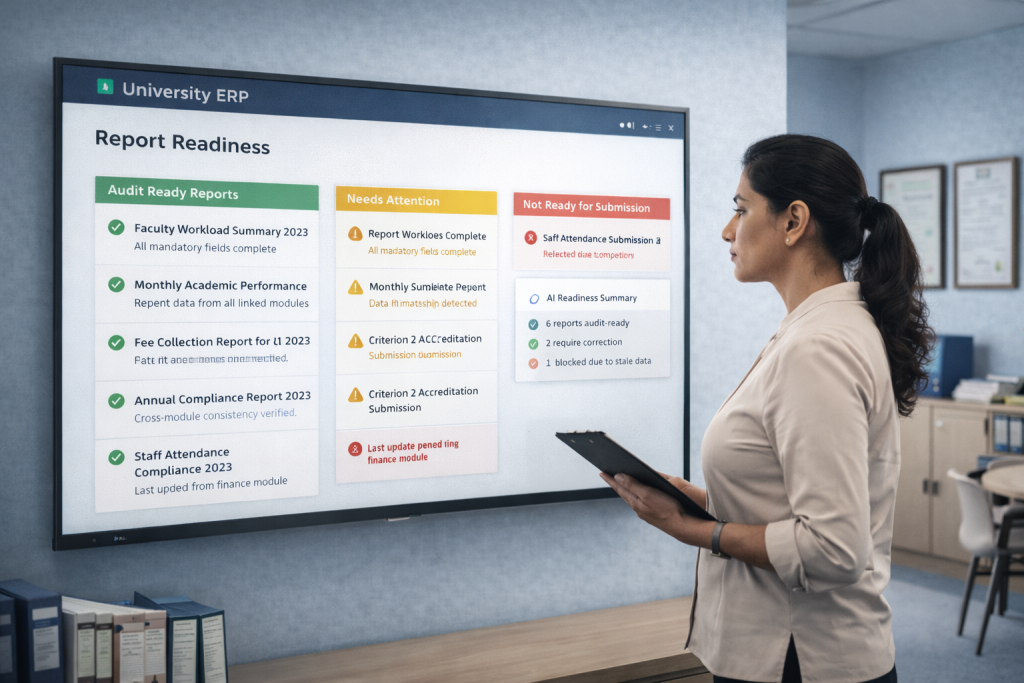
Hack #8: Intelligent Report Readiness Indicators

AI-powered report readiness indicators for compliance and audits in university ERPAI-powered report readiness indicators for compliance and audits in university ERP

The Admin Problem

Reports are generated — but not always reliable.
Admins spend time validating:

  • Missing fields
  • Inconsistent numbers
  • Data freshness

How AI Inside ERP Fixes This

AI flags:

  • Data gaps
  • Inconsistencies
  • Reports that are not audit-ready

Admins trust what they submit.

Time Saved Per Week

1–2 hours

Who Benefits Most

Registrar’s office, compliance teams

Hack #9: Smart Communication Consolidation

AI-driven communication consolidation across email, SMS, and notices in university ERPAI-driven communication consolidation across email, SMS, and notices in university ERP
The Admin Problem

Circulars, notices, and alerts go through:

  • Email
  • SMS
  • WhatsApp
  • Portals

Admins repeat the same message multiple times.

How AI Inside ERP Fixes This

AI selects:

  • Right audience
  • Best channel
  • Optimal timing

One action replaces multiple broadcasts.

Time Saved Per Week

1–2 hours

Who Benefits Most

Admin office, communications team

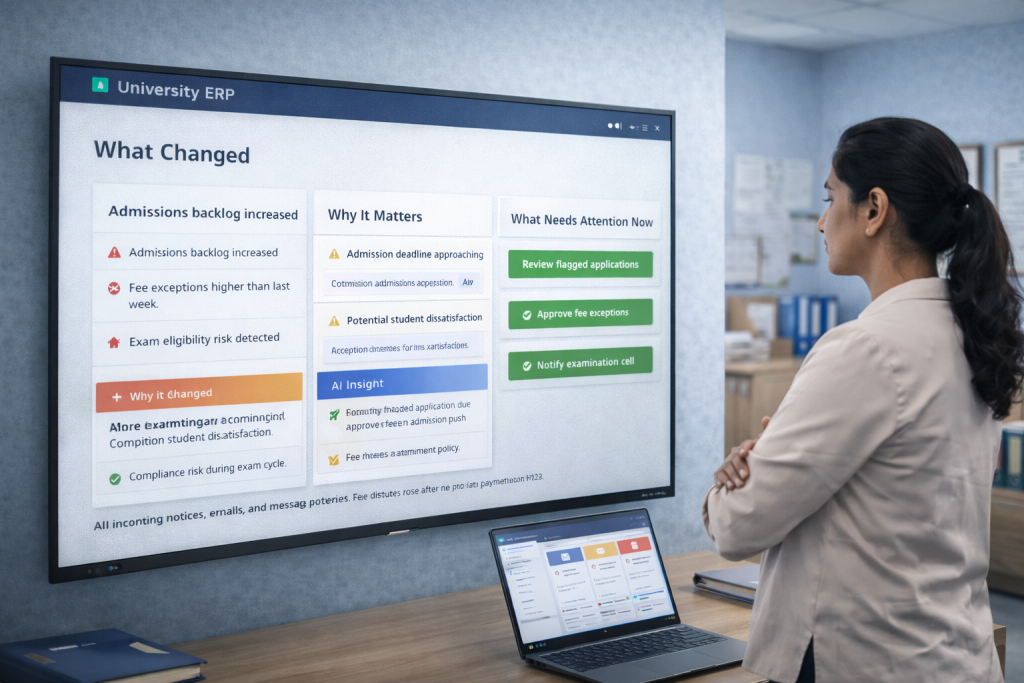
Hack #10: Context-Aware Admin Dashboards

Context-aware AI dashboard helping university administrators prioritise actions in ERPContext-aware AI dashboard helping university administrators prioritise actions in ERP

The Admin Problem

Admins open dashboards but still ask:
“Is this normal?”
“What should I act on first?”

How AI Inside ERP Fixes This

AI highlights:

  • What changed
  • Why it matters
  • What needs attention now

Admins stop scanning — they start acting.

Time Saved Per Week

2–3 hours

Who Benefits Most

Registrar, deans, senior admin leadership

Why Most Universities Still Feel Overworked Even After Implementing ERP

Because automation alone doesn’t reduce cognitive load.

Most ERPs:

  • Execute tasks
  • Store transactions
  • Generate reports

But admins still:

  • Decide priorities
  • Detect risks
  • Coordinate people

AI inside ERP doesn’t replace admins.
It removes mental overhead, uncertainty, and repetitive coordination — which is where most time is lost.

Where a Unified AI-Native ERP Makes the Difference

These AI hacks work only when:

  • Data is unified
  • Workflows are connected
  • Intelligence is embedded, not bolted on

This is where platforms like iCloudEMS, designed as a cloud-native, AI-powered university ERP backbone across 31 integrated modules, enable such efficiencies without increasing complexity.

The goal isn’t more dashboards.
It’s fewer decisions per day.

Frequently Asked Questions

1. What is AI in university ERP systems?

AI in university ERP systems refers to built-in intelligence that helps the software analyse data, identify patterns, prioritise tasks, and support decisions. Unlike basic automation, AI helps administrators detect issues early, reduce manual checking, and manage complex workflows more efficiently across admissions, exams, finance, and student services.

2. How does AI in ERP reduce administrative workload in universities?

AI reduces administrative workload by automating repetitive checks, flagging exceptions, prioritising tasks, and predicting delays. Instead of manually reviewing every record or chasing follow-ups, administrators focus only on items that need attention, saving significant time every week.

3. Can AI-powered university ERP really save admin time every week?

Yes. When AI is embedded inside ERP workflows, it consistently saves time by reducing coordination, verification, and follow-ups. Even small efficiencies across admissions, exams, fees, and reporting add up to 15–25 hours a week across administrative teams in most universities.

4. Which administrative tasks can AI automate inside a university ERP?

AI can support tasks such as admission application screening, timetable conflict detection, exam readiness checks, fee anomaly detection, grievance routing, accreditation evidence mapping, and report validation. These tasks typically consume the most manual effort in university administration.

5. What is the difference between automation and AI in university ERP software?

Automation follows predefined rules to complete tasks. AI goes a step further by learning patterns, understanding context, and highlighting what matters most. In university ERP systems, AI helps administrators prioritise actions and detect risks, not just execute processes.

6. Is AI in university ERP useful for daily operations or only analytics?

AI is most effective when used in daily operations. It supports real-time decision-making in admissions, examinations, finance, and student services by continuously monitoring data and surfacing issues early, rather than being limited to dashboards or historical reports.

7. How does AI help admissions teams save time in universities?

AI helps admissions teams by pre-screening applications, identifying missing documents, validating eligibility rules, and categorising applications automatically. This reduces manual review effort and allows teams to focus on shortlisting and decision-making instead of routine checks.

8. Can AI reduce exam and evaluation workload for university admins?

Yes. AI can monitor exam eligibility, flag compliance issues, detect evaluation anomalies, and track readiness across departments. This reduces last-minute manual verification and coordination, which is a major source of stress during examination cycles.

9. Does AI in university ERP replace administrative staff?

No. AI does not replace administrative staff. It supports them by reducing repetitive work, uncertainty, and coordination overload. Administrators retain control and decision authority while AI helps them work faster, more accurately, and with less pressure.

10. Is AI in university ERP safe for compliance and audits?

When designed correctly, AI operates within role-based access controls, audit trails, and governance rules. It enhances compliance by improving data consistency, traceability, and early detection of issues, which is critical for audits and accreditation processes.

11. Is AI-powered ERP useful for small and mid-sized colleges?

Yes. Smaller institutions often benefit even more because limited staff handle multiple responsibilities. AI helps prioritise work, reduce manual effort, and manage peak workloads without increasing headcount or operational complexity.

12. What should universities look for in an AI-powered ERP system?

Universities should look for AI that is embedded within ERP workflows, not added as separate tools. Key factors include unified data, explainable insights, auditability, ease of use, and practical impact on daily administrative tasks rather than theoretical AI features.

How to Choose the Best University ERP: A Practical Guide for Admissions, Exams, Finance & Campus Operations

Selecting the right university ERP is one of the most important digital decisions a higher education institution makes. With admissions, continuous assessments, attendance, fee collection, faculty workload, accreditation cycles, and student services all happening simultaneously, the wrong ERP can slow everything down — while the right one can transform efficiency, transparency, and student outcomes.

But with dozens of higher education ERP vendors in India and increasing pressure to comply with NEP-2020 frameworks, universities often struggle with one question:

How do we choose the best ERP for our institution?

This guide breaks it down into a simple, structured, and practical framework.

1. What Should a University ERP Really Do?

A university ERP is an integrated digital platform that manages academic, administrative, financial, accreditation, and student-lifecycle workflows across the entire campus.

A strong ERP should be able to handle:

  • Admissions & enrollment
  • Academics & timetable planning
  • Examination & evaluation
  • Finance & fee management
  • HR & payroll
  • LMS & online learning
  • Student information & services
  • Hostel, transport & campus operations
  • Accreditation workflows
  • Mobile app communication

2. Step-by-Step Framework to Choose the Best University ERP

Step 1: Identify Your Institution’s Exact Needs

Before evaluating vendors, ask:

  • How many students do we serve?
  • Which modules are mandatory?
  • Do we need NEP-2020 compliance?
  • Are we currently using fragmented systems?
  • Do we prefer cloud or on-premise?

✔️ Quick Checklist

  • Student strength above 3,000
  • Admissions automation required
  • Exams & evaluation complexity
  • Finance module harmonization
  • HR & payroll workflows
  • Integrated LMS
  • Accreditation automation
  • AI-based alerts and dashboards

Step 2: Evaluate Module Depth — Not Just Availability

Many vendors list modules, but the depth and maturity of those modules matter more.

Evaluate these core modules:

Admissions

  • Online applications, merit lists, and document verification
  • Multi-round counseling
  • Fee payment & seat confirmation

Examinations

  • Continuous assessment
  • Internal marks workflow
  • Digital evaluation
  • Grade publishing
  • Revaluation workflows

Finance

  • Fee plans & fee heads
  • Payment gateways
  • Refund rules
  • Scholarship management

Campus Operations

  • Hostel room allocation
  • Transport route planning
  • ID cards & inventory
  • Discipline and grievances

The best university ERP is the one that handles all these without custom patchwork.

Step 3: Cloud vs On-Premise – What’s Right for Your University?

Cloud ERP (Recommended for 2025 and beyond)

  • Faster deployment
  • Lower infrastructure cost
  • Automatic updates
  • Better security (especially on AWS)
  • Remote access for students & faculty

On-Premise ERP

  • Higher upfront cost
  • Requires IT staff
  • Slower updates
  • Limited scalability

Most growing private universities in India now prefer cloud-based ERPs for flexibility and long-term ROI.

Step 4: Check Compliance & NEP-2020 Readiness

A modern ERP must support:

  • Academic bank of credits (ABC)
  • Outcome-based education (OBE)
  • Multiple entry/exit
  • Flexible curriculum
  • Program mapping & CO-PO matrices
  • Accreditation workflows (NAAC/NBA)

An ERP without NEP-2020 alignment will limit your long-term academic strategy.

Step 5: Evaluate AI Capabilities

AI in a university ERP should provide:

  • Performance alerts
  • Attendance alerts
  • Fee defaulter alerts
  • Predictive analytics
  • Early warning signals for at-risk students

Step 6: Verify Support, Training & Post-Go-Live Execution

The success of ERP depends on:

  • Implementation support
  • Training quality
  • Dedicated customer success managers
  • Issue resolution speed
  • 24/7 helpline availability

3. Why iCloudEMS Stands Out as a Leading University ERP

iCloudEMS is one of India’s most comprehensive higher education ERP platforms, designed specifically for private universities and colleges. Built on secure AWS cloud infrastructure, it offers 31 integrated modules covering the entire student lifecycle.

🔹 Key strengths of iCloudEMS:

  • Admissions to graduation automation
  • Advanced Examination Management System with evaluations, marks entry, CO-PO mapping
  • Finance & HR workflows built for scalability
  • Integrated LMS for teaching-learning
  • AI-driven alerts for attendance, performance & fee tracking
  • Accreditation & OBE workflows aligned with NEP-2020
  • Hostel, transport, grievance & student support
  • Mobile app for students, parents & faculty
  • Real-time dashboards for university leadership

Why it fits the needs of modern universities:

  • End-to-end digital transformation
  • NEP-2020-ready architecture
  • Designed for universities dealing with large student volumes
  • Strong support & implementation team
  • Scalable AWS cloud performance

Key Takeaways

  • There is no single universal “best” ERP — the right one depends on your scale, workflows, compliance, and digital maturity.
  • Always choose an ERP with deep modules, not just a long feature list.
  • Cloud-based ERPs provide superior scalability and security.
  • NEP-2020 and accreditation readiness are non-negotiable for 2025 and beyond.
  • AI-driven alerts and analytics significantly improve student outcomes.
  • iCloudEMS is a strong, comprehensive choice for private universities seeking a fully integrated, AWS-powered, NEP-ready ERP platform.

Final CTA

If you’re exploring a modern, secure, and NEP-aligned university ERP, iCloudEMS offers a complete suite of 31 modules designed for admissions, academics, finance, exams, and campus operations — all on AWS cloud.

👉 Book a personalized demo to see how iCloudEMS can transform your university’s digital ecosystem.

How iCloudEMS helps the Higher Education Institutes to manage the entire lifecycle of their students

Students are the core stakeholders in an educational institution; they are the assets of the institutions and they are in charge of bringing distinct vitality to the setting. Once an individual becomes a student of Institution, its responsibility is to make them shine in every sphere of their life by cultivating the bond between students and their alma mater during graduation and beyond. To build a strong relationship that can meet the needs of 21st century students, there must be a well-defined approach towards regular interaction, timely information, and completing the necessary steps to access the actionable data of every student without any time or place constraint.

Student lifecycle is nothing but the whole journey of an individual’s growth in his education ecosystem from being prospective to alumni. This lifecycle of students consists of a myriad of episodes that generate a huge amount of data and many challenges along with regarding compiling and managing such data to achieve great learning outcomes. The meaningful management of the students’ data is the key to attract future generations in an educational institute. Following are the important points of consideration in the path of student lifecycle management:

  • Actionable data to access and process anytime and anywhere
  • Best action plans to convert the best prospective students.
  • Powerful analytical tools to fetch the required statistics.
  • Leveraging best available technology for the best possible data management.

Today the main challenge before the Higher Education Institutes is not to get acquainted with the potential of technology to solve their day-to-day complexities while to choose the best product and technology that can keep up with advancements of new needs of student lifecycle management. iCloudEMS is a pioneer of offering advanced technological solutions for seamless resources and workflow management in Higher Education Institutes. Our Student Lifecycle Management System is a comprehensive cloud-based solution to automate and integrate the entire academic journey from inquiry to alumni of all the students in a college or university.

The important functionalities of our labour-saving mechanism include:

Enquiry to Enrolment: Our student lifecycle management system uses interactive dashboards to bring together students, instructors, parents, and administration to guarantee that efficient management of admissions operations. Our cutting-edge features promise to convert potential leads, computerised all pre-admission procedures such as forms, student information, documents, and more. Our intelligent system ensures the enrollment of the right student with complete digital support for all post-admission activities including registration ID, fee payment, document verification, course assignment, roll number, library cards, and so on.
Course Management: Our course management module complies with the UGC and MHRD’s Choice Based Credit System (CBCS) standards. Students can enrol in the courses of their choice to earn the program’s required credits. We present a user-friendly interface for selecting core and elective courses as well as their other characteristics. Our smart utilities categorize students for course delivery, assignments, and evaluation in accordance with the course, regardless of semester or programme.
Examination Management: Our Student lifecycle management system facilitates many pre and post arduous examination related activities for instructors and students, such as hall tickets, room allocation, examination schedule, question paper, final marks, records, and so on in a secure and protected cyberspace taking integrity as a top priority. The live proctoring option in online Exam administration ensures a stress-free exam under close monitoring. We make post-examination processes and result processing simple, quick, and error-free.
Training & Placement: Our smart platform serves as a conduit for contact between students, institutes, and employers. Students can register for regular training and placement updates on the digital platform, and institutes can undertake different connected duties on a unified digital space. It also endorses the employer feedback process, which improves career planning and increases placement possibilities.
Alumni relationship management: Our web-based Student lifecycle management fosters alumni-institute collaboration. We offer cloud-based storage and retrieval of vast amounts of data of former pupils. It allows alumni to provide comments on curriculum and other areas in order to improve the campus in all aspects. Our fast-track interaction services mobilizes and nurtures the relationship with pass outs.
Benefits to the stakeholders: iCloudEMS has always fulfilled its promise to cater the assorted needs of all stakeholders of Higher Education Institutes with its ingenious products and services.
Our ground-breaking Student Lifecycle Management System allows faculty members of Higher Education Institutes to access a centralised database of prospective and alumni students for regular information updates, synchronous data access and processing. It guarantees to save their time and effort in tracking and analysing their pupils’ performance under OBE and Bloom’s taxonomy levels mapping framework.
We offer a centralized cyber platform to students, where they can conveniently update their information for various purposes such as fee payment, hall ticket, and timetable.They will be able to easily post their assignments and receive results via a secure online platform. They have all-time access to their attendance and performance records and can also obtain regular training and placement information.
We deliver an easy-going approach to the parents when it comes to online admissions responsibilities, such as form generation and course placement for their ward. They can get complete insights into their children’s attendance and performance records and can always participate in their children’s learning and other activities.
We make it possible to bring the entire institute under one roof and create a transparent system where management can always have an overhead view of students’ details and progress records.
In a nutshell, it can be stated that with its all-inclusive Student lifecycle management system, iCloudEMS aids Colleges and Universities in accessing and processing a plethora of information with a few clicks, anytime and everywhere throughout all students’ academic journeys. It provides a technologically advanced ecosystem for administration and students to streamline student recruitment and management, allowing them to focus their time and energy on more innovative aims.