Your Student Information System Is Lying to You — Here’s What University Leaders Don’t See

Most universities believe their Student Information System works.

Admissions data gets stored. Attendance updates daily. Examination marks reflect in dashboards. Fee reports generate on time.

From a distance, everything appears structured.

But structure does not guarantee intelligence.

A Student Information System that only stores information without detecting institutional risk creates a dangerous illusion of control. University leaders often rely on dashboards that show stability while hidden inefficiencies grow silently beneath the surface.

The real question is not whether your Student Information System functions.

The real question is whether it protects institutional governance.

A Student Information System Must Evolve Beyond Data Storage

Historically, a Student Information System digitized administrative workflows. It replaced manual registers and disconnected spreadsheets.

Today, Digital solutions for higher education demand more.

A modern Student Information System must operate inside a unified ecosystem such as a cloud-native Education Management System (EMS) where admissions, academics, finance, lifecycle, accreditation, and evaluation operate in real time.

Leadership frameworks for evaluating institutional systems consistently emphasize integration, scalability, and predictive capability as non-negotiable criteria. A fragmented platform cannot support executive decision-making at scale.

If your Student Information System cannot:

  • Detect academic risk early
  • Flag financial exposure
  • Integrate lifecycle data
  • Support accreditation workflows
  • Generate predictive alerts

Then it operates as a digital archive, not a governance engine.

Fragmented Student Data Creates Invisible Institutional Risk
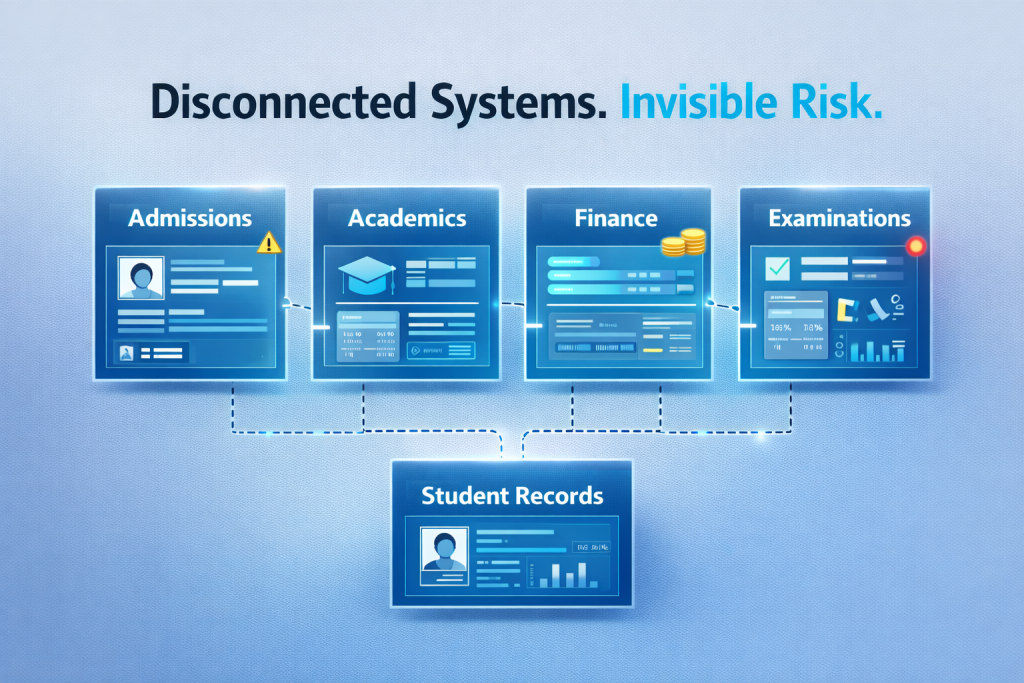
Five-node university Student Information System fragmentation diagram showing disconnected departments

Many institutions still operate across departmental silos:

  • Admissions handles recruitment separately
  • Academics track performance independently
  • Finance reconciles fees manually
  • Examination cells manage isolated records

Without structured student recruitment lifecycle management, the student journey breaks into disconnected segments.

When inquiry, enrollment, progression, and alumni tracking fail to align within one Student Information System, the institution loses visibility.

Lifecycle fragmentation leads to:

  • Duplicate student records
  • Attendance inconsistencies
  • Manual grade adjustments
  • Fee reconciliation delays
  • Delayed intervention in disengagement

A centralized lifecycle intelligence framework, as explored in student lifecycle automation strategies, strengthens data continuity across the entire academic journey.

Disconnected systems increase workload. Integrated systems increase clarity.

When Dashboards Show Stability but Risk Is Rising

University dashboards typically display:

  • Enrollment totals
  • Fee collection summaries
  • Attendance percentages
  • Examination outcomes

These metrics describe the present.

They rarely forecast disruption.

Gradual disengagement, performance decline, and dropout probability often remain invisible until they become irreversible. Institutions that fail to monitor early risk signals experience delayed intervention.

The pattern of missed warning signs becomes clear when analyzing early disengagement detection challenges in siloed systems.

An AI-powered Student Information System must detect anomalies before institutional damage occurs.

Without predictive intelligence, leadership relies on retrospective reporting instead of proactive governance.

Compliance and Accreditation Demand Data Integrity

Accreditation bodies expect structured, verifiable, and audit-ready data.

If your Student Information System requires manual compilation before evaluation cycles, institutional exposure increases.

Modern compliance readiness depends on:

  • Automated audit logs
  • Timestamped academic tracking
  • Outcome mapping
  • Secure documentation workflows

Institutions adopting structured accreditation management automation reduce regulatory friction and improve data transparency.

Data fragmentation often affects accreditation scores more than academic quality itself. Addressing accreditation data intelligence gaps requires systemic integration rather than surface-level reporting.

A Student Information System must embed compliance intelligence at its core.

Academic Intelligence Requires LMS and Evaluation Integration

A Student Information System cannot operate in isolation from learning systems.

Institutions implementing outcome-based learning analytics gain measurable visibility into curriculum alignment and academic performance.

Similarly, structured online classes and examination management ensures transparency in assessments, digital evaluation, and result processing.

When learning delivery, examination workflows, and student progression data integrate within one Student Information System, academic governance strengthens.

Without LMS integration, student performance insights remain incomplete.

Financial Visibility Must Align with Academic Progression

Academic data alone does not define institutional stability.

Financial intelligence plays an equally critical role.

Institutions implementing predictive AI-powered fee tracking systems gain early visibility into revenue exposure and payment behavior patterns.

When fee data integrates directly into the Student Information System, leadership can:

  • Identify high-risk receivables
  • Correlate disengagement with financial stress
  • Reduce manual reconciliation
  • Improve revenue forecasting

Separating academic and financial systems weakens strategic oversight.

From Legacy ERP to Intelligent Governance
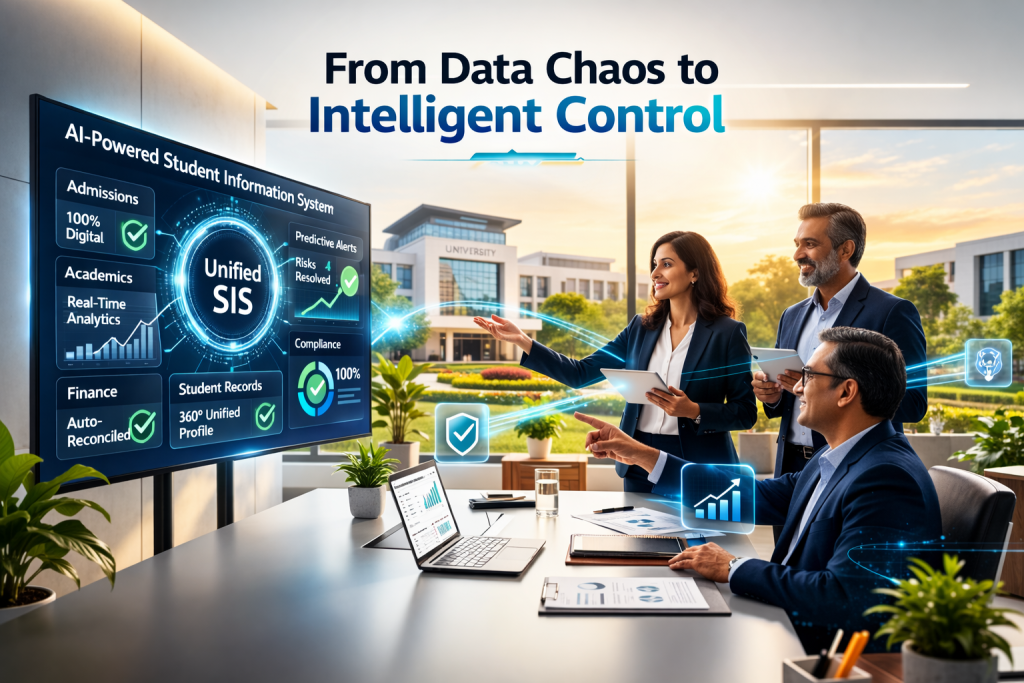
Indian university leadership team reviewing unified AI-powered Student Information System dashboard

Many institutions still operate within legacy university ERP environments or traditional college ERP systems focused primarily on process automation.

However, the sector increasingly recognizes the shift toward AI-driven decision automation as essential for governance maturity.

A modern Student Information System embedded within an intelligent Education Management System (EMS) transforms operational data into institutional foresight.

Process automation is no longer sufficient.

Predictive intelligence defines the next evolution.

Infrastructure and Cybersecurity Cannot Be Secondary

Cloud adoption alone does not guarantee protection.

Universities must implement structured advanced cybersecurity frameworks for higher education systems to ensure data integrity.

A cloud-native Student Information System should provide:

  • Real-time synchronization
  • Secure role-based access
  • Encrypted data storage
  • Automated backups
  • Audit-ready traceability

Infrastructure resilience strengthens governance confidence.

The Strategic Question University Leaders Must Ask

Most institutions ask:

“Does our Student Information System work?”

A more strategic question would be:

“Does our Student Information System prevent risk before it becomes visible?”

If leadership still depends on manual correction, delayed alerts, or disconnected dashboards, the system may be documenting risk instead of preventing it.

Modern Digital solutions for higher education demand predictive intelligence, lifecycle integration, financial alignment, accreditation automation, and secure cloud architecture within one unified ecosystem.

A Student Information System must evolve from administrative software into institutional intelligence infrastructure.

How does your institution currently evaluate the maturity of its student data systems?

Leadership Questions About Student Information Systems

1. What defines a modern Student Information System?

A modern Student Information System integrates admissions, academics, finance, lifecycle tracking, and compliance workflows inside a unified Education Management System (EMS).

2. Why is predictive intelligence critical?

It identifies academic decline, dropout probability, and financial exposure before damage occurs.

3. How does LMS integration improve governance?

Outcome-based learning analytics align curriculum, assessment, and performance tracking within the Student Information System.

4. What risks exist in fragmented systems?

Duplicate data, audit exposure, delayed intervention, and inaccurate reporting weaken institutional control.

5. How does financial integration enhance insight?

Aligned fee and academic data enable early detection of revenue and engagement risks.

6. Why is cloud architecture essential?

It ensures secure access, scalability, synchronization, and audit readiness.

7. Can a Student Information System improve accreditation readiness?

Yes. Structured data architecture and automated documentation streamline regulatory evaluation.
Cybersecurity in Higher Education ERP: Why “Cloud-Based” Alone Is Not Enough

University leadership teams increasingly take comfort in one statement: “Our ERP is cloud-based.”
The assumption is simple—if the system runs on the cloud, security is already taken care of.

In reality, this assumption is where many cybersecurity risks begin.

Cloud hosting solves only one part of the problem: infrastructure reliability. It does not automatically protect sensitive academic data, financial records, examination workflows, or personal information spread across thousands of users. For universities handling long-term student records and high-stake operations, security must be designed far beyond the hosting layer.

Why Universities Are High-Value Cyber Targets

Higher education institutions hold an unusually broad and sensitive data mix under one roof.

They manage:

  • Personal student and parent information
  • Academic records spanning multiple years
  • Examination data with reputational impact
  • Payroll, finance, and vendor payments
  • Research data and intellectual property

Unlike many enterprises, universities retain data for long durations and allow access to diverse user groups—students, faculty, administrators, finance teams, external evaluators, and regulators. This complexity makes higher education systems especially vulnerable when controls are weak or fragmented.

Why “Cloud-Hosted” Does Not Mean “Secure by Design”

A cloud platform secures servers, networks, and physical infrastructure. Everything above that layer—the ERP application, data access rules, workflows, and integrations—remains the institution’s responsibility.

Security failures often arise not from cloud breaches, but from:

  • Poor access control design
  • Excessive permissions across departments
  • Weak approval workflows
  • Manual data handling outside the system

In simple terms, the cloud keeps the building safe. It does not control who gets the keys to every room inside.

The Hidden Security Gaps in Traditional University ERPs

Many legacy or partially modernized ERPs expose institutions to silent risks.

Common gaps include:

  • Users having more access than their role requires
  • Critical actions executed without digital approvals
  • Limited or non-existent audit trails
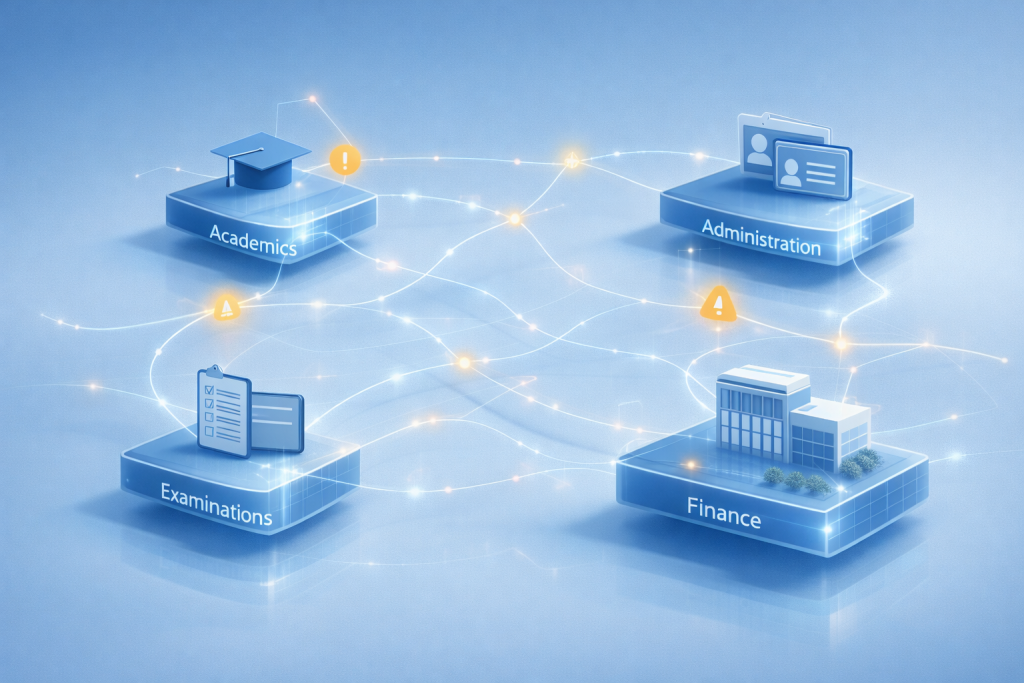
  • Disconnected modules sharing data informally
  • Dependence on spreadsheets for reporting and reconciliation

These gaps rarely trigger immediate alarms. Instead, they accumulate quietly until a compliance issue, data inconsistency, or operational failure surfaces—often too late.

Fragmented university ERP modules creating data visibility and cybersecurity risksFragmented university ERP modules creating data visibility and cybersecurity risks
What Real ERP Cybersecurity Looks Like in Higher Education

Effective cybersecurity in a university ERP is embedded into everyday operations, not bolted on as an afterthought.

Key characteristics include:

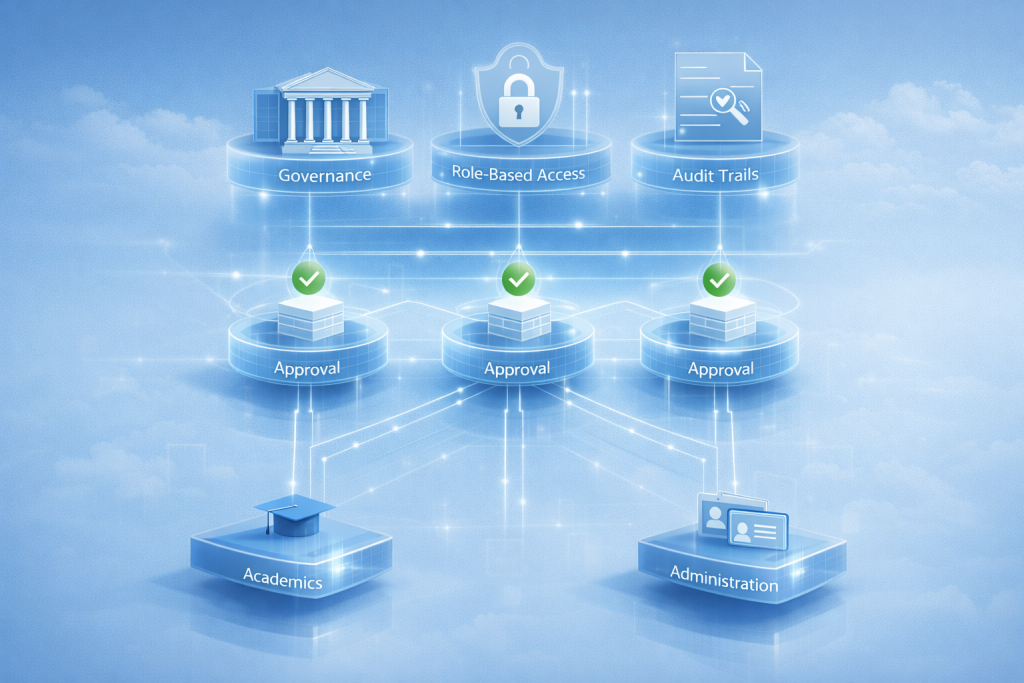
  • Role-based access control aligned with institutional hierarchy
  • Approval workflows for sensitive actions like concessions, results, and payments
  • End-to-end audit logs for every critical transaction
  • Encrypted data flow between academic, finance, and administrative modules
  • Centralized alerts that flag unusual or risky activity early

When security is built into workflows, compliance becomes automatic instead of enforced manually.

Why Governance Matters More Than Firewalls

Firewalls protect perimeters. Governance protects decisions.

In universities, governance defines:

  • Who can access what—and for how long
  • How approvals are granted and recorded
  • How responsibility is assigned and tracked
  • How deviations are identified and addressed

Without governance embedded into the ERP, institutions rely on policies that exist on paper but not in practice. Systems must enforce governance by default, not depend on individual discipline.

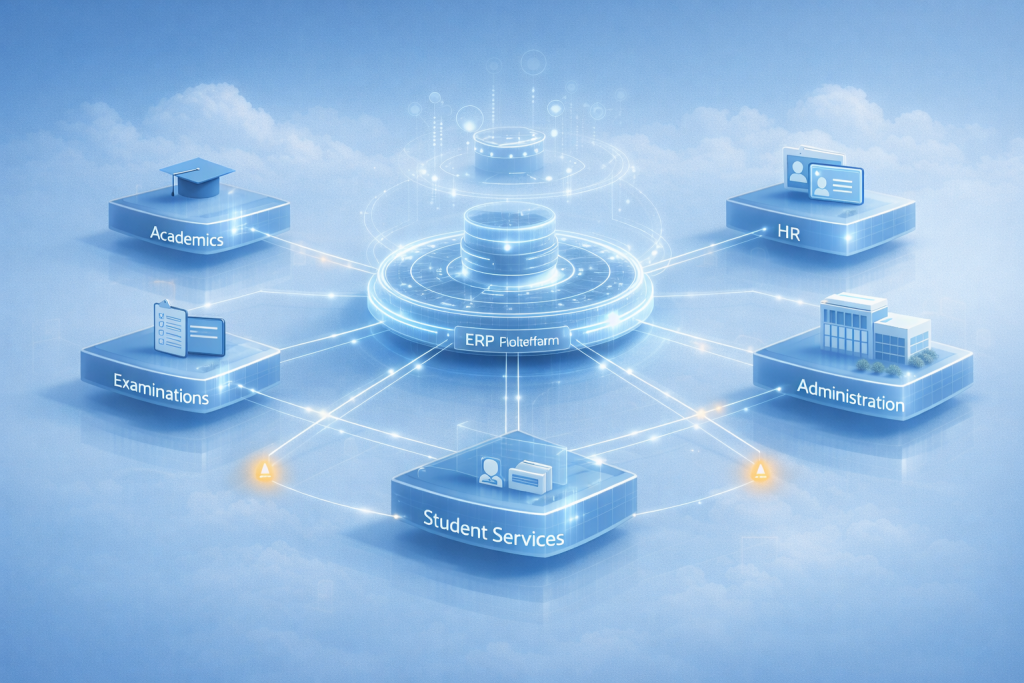
ERP governance framework showing role-based access, approvals, and audit trails in universitiesERP governance framework showing role-based access, approvals, and audit trails in universities
How Cloud-Native Architecture Changes the Security Equation

Cloud-native ERP platforms are designed differently from systems merely hosted on the cloud.

They enable:

  • A unified data model instead of siloed databases
  • Controlled, API-driven integrations with external tools
  • Real-time visibility into operations rather than retrospective reports
  • Consistent security rules applied across all modules

This architectural consistency significantly reduces blind spots and strengthens institutional control.

Unified cloud-native ERP system enabling secure data flow across university departmentsUnified cloud-native ERP system enabling secure data flow across university departments

Where iCloudEMS Fits In

iCloudEMS is designed as a cloud-native, AI-powered ERP backbone for higher education, with security and governance embedded at the architectural level.

Rather than treating cybersecurity as a separate layer, iCloudEMS integrates:

  • Structured access control across academic and administrative functions
  • Built-in auditability for compliance and accountability
  • Unified visibility across departments and campuses

This approach helps institutions move from reactive security measures to proactive risk management—without increasing operational complexity.

Conclusion

Cybersecurity in higher education is not an IT checkbox. It is a leadership decision shaped by architecture, governance, and operational discipline.

A cloud-based ERP is a starting point, not a guarantee. True security emerges when systems are designed to enforce accountability, visibility, and control at every level.

For universities focused on trust, continuity, and long-term reputation, investing in secure-by-design ERP architecture is no longer optional—it is foundational.

What makes higher education ERP systems vulnerable to cyber threats?

Higher education ERP systems manage large volumes of sensitive academic, financial, and personal data while allowing access to many stakeholders. Long data retention periods, complex workflows, and inconsistent access controls increase vulnerability if security is not designed into the system architecture.

Why is cloud hosting alone insufficient for university data security?

Cloud hosting secures infrastructure, not application behavior. Data access rules, approval workflows, audit trails, and integrations are controlled by the ERP design. Without strong governance at the application level, cloud-hosted systems can still expose critical data.

How can universities enforce role-based access in ERP systems?

Universities can enforce role-based access by defining permissions based on job roles rather than individuals, limiting access strictly to required functions, and automatically updating permissions when roles change within the institution.

What are common cybersecurity mistakes in campus management software?

Common mistakes include excessive user permissions, lack of approval workflows, weak audit logging, manual data exports, and disconnected modules that exchange data without proper controls.

How does ERP governance reduce institutional cyber risk?

ERP governance ensures that every action is accountable, approved, and traceable. It embeds institutional policies directly into workflows, reducing reliance on manual enforcement and preventing unauthorized access or changes.

What should university leaders ask ERP vendors about cybersecurity?

University leaders should ask how access controls are designed, how approvals and audit trails work, how data flows between modules, how integrations are secured, and how governance is enforced across the system.

How do audit trails improve accountability in academic systems?

Audit trails record who performed an action, when it was done, and what data was affected. This transparency deters misuse, simplifies compliance, and enables quick investigation when issues arise.

Why are fragmented ERP modules a security risk?

Fragmented modules often duplicate data and bypass centralized controls. This creates inconsistencies, weakens visibility, and increases the likelihood of unauthorized access or data leakage.

How does cloud-native architecture enhance cybersecurity?

Cloud-native architecture uses a unified data model and standardized security rules across modules. This reduces blind spots, strengthens access control, and allows real-time monitoring instead of post-incident analysis.

What role does AI play in detecting early security risks in universities?

AI helps identify unusual patterns, delayed approvals, abnormal access behavior, and operational anomalies early, allowing institutions to respond before issues escalate into serious security incidents.

How can universities protect long-term student data effectively?

Universities can protect long-term data by enforcing strict access lifecycle management, encrypting data flows, maintaining audit logs, and ensuring that security rules remain consistent even as students graduate or staff change.

Why is cybersecurity a leadership issue in higher education?

Cybersecurity impacts institutional reputation, regulatory compliance, financial stability, and student trust. Decisions about architecture, governance, and accountability must be led by institutional leadership, not treated as a purely technical concern.

AI in Universities Is No Longer Optional — But Blind Automation Is Dangerous

Artificial intelligence has crossed a quiet threshold in higher education.

What was once experimental is now embedded in daily academic life. Universities are using AI to assist admissions teams, support learning management systems, analyse assessments, automate finance workflows, monitor attendance patterns, and respond to student queries. In many institutions, AI is no longer discussed as a future initiative. It is already present—sometimes visibly, sometimes quietly—inside operational systems.

This shift is not driven by hype. It is driven by scale.

Universities today manage far more complexity than they did even a decade ago. Student populations are larger. Academic offerings are broader. Regulatory expectations are tighter. Accreditation cycles are more frequent. Leadership decisions are expected to be faster, better informed, and defensible.

In this environment, manual oversight alone cannot keep up. AI becomes not a luxury, but a structural necessity.

Yet there is an emerging risk that deserves equal attention.

As universities rush to adopt AI, many are doing so through blind automation—deploying tools that act quickly, but without institutional awareness, governance context, or architectural integration. When automation outpaces understanding, efficiency gains can quietly turn into academic, compliance, and leadership risks.

The challenge for universities in 2025 is no longer whether to adopt AI.
It is how to adopt AI without losing control.

Why AI Has Become Unavoidable in University Operations

Universities operate at the intersection of education, governance, and public trust. Every academic decision carries reputational and regulatory consequences. Every operational delay compounds across departments. Every data inconsistency eventually surfaces during audits, inspections, or accreditation reviews.

AI responds to these pressures in very practical ways:

  • It processes volume faster than human teams can
  • It detects patterns across large datasets
  • It reduces repetitive manual workload
  • It surfaces anomalies that might otherwise be missed

As student numbers cross into the thousands and processes span dozens of departments, AI-assisted systems become essential simply to maintain baseline reliability.

This is why AI adoption has accelerated so rapidly across:

  • Learning Management Systems
  • Student Information Systems
  • Examination and evaluation workflows
  • Finance, fees, and reconciliation
  • Student support and grievance handling

At scale, the alternative is operational fatigue.

But speed alone is not intelligence.

The Hidden Problem With Automation-First AI Adoption

Many AI deployments in universities are introduced as standalone tools.

A chatbot for admissions queries.
An AI proctoring layer for examinations.
A predictive model for attendance risk.
A reporting engine that auto-generates dashboards.

Individually, each tool appears useful. Together, they often create fragmentation.

Automation-first AI focuses on task completion, not institutional continuity. It answers questions, executes rules, and generates outputs—but it rarely understands how one decision affects another department, another regulation, or another reporting cycle.

This is where danger quietly enters the system.

When AI operates without a unified institutional backbone:

  • Decisions are made in isolation
  • Context is lost between departments
  • Exceptions are automated instead of reviewed
  • Accountability becomes difficult to trace

The university does not fail loudly.
It drifts silently.

Automation Is Not the Same as Institutional Intelligence

It is important to distinguish between three very different concepts that are often grouped together under “AI”.

Task Automation

This is the simplest form. Systems execute predefined actions:

  • Sending reminders
  • Updating records
  • Triggering notifications

Automation reduces workload, but it does not understand the consequences.

Decision Intelligence

Here, systems analyse patterns and suggest actions:

  • Flagging at-risk students
  • Highlighting unusual financial entries
  • Predicting operational bottlenecks

This adds value, but still requires oversight.

Institutional Awareness

This is the highest level—and the rarest.

Institutional awareness means AI understands:

  • Academic calendars
  • Regulatory constraints
  • Approval hierarchies
  • Cross-department dependencies
  • Historical decisions and their outcomes

Without this layer, automation can move faster than governance can respond.

Where Blind Automation Creates Real Risk

Universities do not operate like generic enterprises. They carry academic authority, regulatory responsibility, and social accountability. Blind automation introduces risks precisely because it does not recognise these nuances.

Academic Integrity and Assessment Sensitivity

Automated evaluation systems can flag anomalies, but without an academic context, they may:

  • Misinterpret interdisciplinary grading structures
  • Ignore approved exceptions
  • Escalate false positives during examinations

In assessment environments, speed without judgment is dangerous.

Compliance and Accreditation Pressure

Accreditation frameworks such as NAAC and NIRF depend on consistent, traceable, and explainable data.

When AI systems generate outputs without:

  • Clear data lineage
  • Cross-module consistency
  • Human validation checkpoints

Institutions struggle to justify outcomes during reviews.

Leadership Visibility vs Operational Noise

Dashboards filled with automated metrics can overwhelm leadership instead of informing them.

When every system speaks, clarity disappears.

Leadership does not need more data.
Leadership needs reliable signals.

Why Disconnected AI Tools Increase Institutional Anxiety

A common misconception is that more AI tools equal better intelligence.

In practice, disconnected AI systems create parallel versions of truth:

  • The LMS reports one pattern
  • The SIS reports another
  • Finance flags something unrelated
  • Student support sees a different risk profile

Each system may be “correct” in isolation, yet misleading in combination.

This fragmentation increases:

  • Decision latency
  • Review cycles
  • Leadership uncertainty
  • Audit stress

Universities begin to spend more time reconciling outputs than acting on insights.

Why ERP-Embedded AI Changes the Equation

The alternative is not less AI.
It is architected AI.

When AI is embedded inside a unified ERP backbone, it operates with shared context. Data flows across modules without duplication. Decisions are informed by institutional rules, not just algorithms.

In an ERP-embedded model:

  • Academic actions reflect finance and compliance realities
  • Alerts are contextual, not generic
  • Patterns are evaluated across the institution, not within silos
  • Human authority remains central

AI assists. It does not override.

This distinction is foundational.

Governance Requires Controlled Intelligence, Not Autonomous Automation

University governance is not about speed alone. It is about defensibility.

Every major decision must be explainable:

  • Why was this student flagged?
  • Why was this approval delayed?
  • Why did this outcome differ from last cycle?

Blind automation struggles with “why”.

Controlled intelligence, by contrast:

  • Preserves audit trails
  • Maintains institutional memory
  • Aligns AI outputs with policy frameworks
  • Supports leadership confidence

This is why AI architecture matters more than AI capability.

How iCloudEMS Approaches AI Differently

iCloudEMS was designed with this reality in mind.

Rather than treating AI as an external layer, it embeds intelligence within the operational core of the institution. AI functions are aligned with workflows across academics, examinations, finance, HR, admissions, accreditation, and student services.

Key principles guide this approach:

  • AI operates inside a unified cloud-native ERP backbone
  • Intelligence is contextual, not generic
  • Alerts are advisory, not autonomous
  • Leadership retains decision authority
  • Visibility is prioritised over automation volume

With more than 31 tightly integrated modules running on secure AWS infrastructure, AI insights emerge from real institutional patterns—not isolated datasets.

The result is not faster automation for its own sake, but calmer governance.

AI as an Enabler of Institutional Maturity

When implemented thoughtfully, AI does not destabilise universities. It strengthens them.

It allows leadership to:

  • Detect issues earlier
  • Allocate resources more intelligently
  • Respond to compliance requirements with confidence
  • Support students without reactive firefighting

But this maturity emerges only when AI is aligned with institutional architecture.

The future belongs not to universities with the most AI tools, but to those with the most coherent systems.

The Real Question Universities Must Answer

AI in universities is no longer optional.

The real question is whether institutions will adopt it blindly or wisely.

Automation without awareness accelerates risk.
Intelligence without governance erodes trust.

But AI, grounded in a unified ERP architecture, becomes something far more valuable:
a steady, reliable partner in institutional decision-making.

Questions Universities Are Asking

Is AI adoption mandatory for universities today?

Yes. At current operational scale and regulatory complexity, AI-assisted systems are necessary to maintain reliability, visibility, and responsiveness.

Why is blind automation risky in academic environments?

Because automation often lacks academic, regulatory, and institutional context, leading to decisions that are fast but not defensible.

Can AI replace human judgment in university governance?

No. AI should support decision-making, not replace it. Human oversight is essential for accountability and trust.

How does ERP-embedded AI differ from standalone AI tools?

ERP-embedded AI operates with shared institutional context, ensuring consistency, traceability, and alignment across departments.

Does more AI always mean better outcomes?

Not necessarily. Without integration and governance, more AI tools can increase fragmentation and confusion.

How does AI affect accreditation and compliance?

When properly architected, AI improves data consistency and audit readiness. When poorly integrated, it complicates reviews.

What should leadership expect from AI systems?

Clarity, early warnings, explainable insights, and reduced operational noise—not autonomous decisions.

Is AI mainly an IT concern?

No. AI adoption impacts academic policy, governance structures, compliance, and leadership decision-making.

How can universities adopt AI without destabilising operations?

By embedding AI within a unified ERP system that preserves institutional rules and human authority.

What role does iCloudEMS play in this transition?

iCloudEMS provides a cloud-native ERP foundation where AI enhances visibility and governance rather than creating uncontrolled automation.

Why Traditional University ERPs Struggle with Institutional Visibility — and How Modern Platforms Are Architected Differently

For more than two decades, university ERP systems have played a stabilising role in institutional operations. They introduced an order where paperwork once dominated. They replaced fragmented records with structured databases. They standardised processes across admissions, academics, finance, examinations, and administration.

For a long time, this was enough.

Universities were smaller. Regulatory expectations were episodic. Governance cycles moved at a slower pace. Leadership relied on periodic reports to assess progress and intervene when required. ERP systems were designed precisely for this environment — one where execution certainty mattered more than continuous awareness.

That context no longer exists.

Modern universities operate at a level of complexity that traditional ERP architectures were never designed to observe in real time. The result is not system failure, nor leadership shortfall. It is an architectural mismatch between how institutions now function and how legacy systems were built to see.

The Original Design Assumptions of Traditional ERPs

Most traditional university ERPs were architected with a clear and practical objective: to ensure that institutional processes execute reliably.

Their design logic prioritised:

  • Transaction completion
  • Workflow control
  • Data validation
  • Periodic reporting

This model worked well when institutional activity followed predictable cycles and when governance oversight could rely on consolidated snapshots.

Execution was the primary challenge. Visibility was assumed to follow naturally.

In reality, visibility was never explicitly designed for. It was treated as a by-product of completed transactions rather than a continuous institutional state.

As long as universities remained within the boundaries of this model, ERP systems appeared sufficient.

How Institutional Reality Has Changed

Universities today no longer operate as linear, compartmentalised organisations.

They are:

  • Multi-campus and multi-program
  • Continuously audited and accredited
  • Subject to overlapping regulatory expectations
  • Managing far more data across longer institutional timelines

Academic operations, financial decisions, compliance readiness, student progression, and faculty performance now intersect continuously rather than sequentially.

This change did not happen suddenly. It emerged gradually as institutions scaled, diversified, and matured.

Traditional ERPs did not fail. They were simply not designed for this level of simultaneity.

Execution-First Architecture and Its Visibility Limits

Execution-first systems are excellent at answering a specific question:

Has the process been completed correctly?

They struggle to answer a different, more consequential one:

What does the institution look like right now as a whole?

Because traditional ERPs treat each function as a separate operational domain, visibility becomes fragmented. Information exists, but it is distributed across:

  • Modules
  • Reporting cycles
  • Functional boundaries

Leadership does not lack data. What it lacks is coherence.

Visibility becomes an act of assembly rather than observation. Institutional understanding depends on reconciliation rather than recognition.

This is not a usage issue. It is a design outcome.

Why Reporting Cannot Substitute for Visibility

In response to growing governance pressure, many institutions attempt to compensate for visibility gaps by increasing reporting.

More dashboards are created.
More summaries are generated.
More review meetings are scheduled.

Yet leadership confidence rarely increases proportionally.

Reports describe what has already stabilised. Governance, however, depends on recognising what is still forming.

When systems are built around periodic extraction rather than continuous observation, visibility arrives late by design. By the time reports consolidate reality, decision windows have already narrowed.

The institution appears orderly. Governance feels heavier.

The Transactional Blind Spot

Traditional ERPs are transactional by nature.

They capture events:

  • A student registers
  • A fee is paid
  • An exam is conducted
  • A result is published

What they do not naturally capture is trajectory.

Trajectory requires longitudinal awareness — the ability to observe how patterns evolve across time, departments, and institutional layers without manual synthesis.

When systems focus on events rather than trajectories:

  • Early deviations remain invisible
  • Pressure accumulates quietly
  • Risk surfaces abruptly

Leadership experiences this as sudden complexity, even though the signals existed earlier — just not coherently.

Visibility Gaps Emerge as Institutions Mature

One of the most misunderstood aspects of ERP dissatisfaction is timing.

Visibility gaps often become visible only after institutions grow more complex.

In early stages:

  • Departments are smaller
  • Exceptions are manageable
  • Informal awareness compensates for system limits

As scale increases:

  • Informal channels break down
  • Dependencies multiply
  • Governance relies more heavily on systems

At this stage, execution-first ERPs reveal their limits.

The discomfort that follows is not a sign of regression. It is a sign of institutional maturity exceeding system design assumptions.

The Shift Toward Visibility-First Architecture

Modern university platforms are being architected differently because the problem definition has changed.

Instead of asking:
How do we ensure processes execute correctly?

They ask:
How do we maintain continuous institutional awareness as the university operates?

Visibility-first architecture prioritises:

  • Continuity over completion
  • Coherence over compartmentalisation
  • Awareness over reporting

This does not replace execution. It reframes it.

Processes still matter. But they are observed as part of an institutional flow rather than isolated tasks.

Continuity as a Design Principle

Visibility requires continuity.

Continuity means that academic activity, administrative decisions, financial posture, and compliance readiness are not viewed as separate domains, but as interrelated signals within a single institutional system.

When continuity is designed into the architecture:

  • Leadership does not wait for reconciliation
  • Readiness is sensed, not declared
  • Governance becomes anticipatory

This is the architectural shift modern platforms represent.

Governance Alignment as a System Outcome

Governance alignment cannot be added through policy alone.

It emerges when systems surface reality at the level leadership governs — patterns, timing, and risk.

Visibility-first platforms support governance by:

  • Preserving context across functions
  • Maintaining institutional memory
  • Observing change as it unfolds

This allows leadership to engage with the institution as it is, not as it was during the last reporting cycle.

Where iCloudEMS Fits into This Evolution

Platforms such as iCloudEMS reflect this architectural shift.

They are built as cloud-native, AI-powered institutional backbones — not simply to digitise processes, but to preserve institutional coherence as universities scale.

The emphasis is not on replacing workflows, but on sustaining awareness across:

  • Academics
  • Administration
  • Compliance
  • Governance timelines

iCloudEMS represents a move away from transaction-centric design toward continuity-centric architecture.

This is not an upgrade. It is a rethinking of what institutional systems are expected to do.

From Operational Order to Institutional Sightlines

Traditional ERPs succeeded in bringing order to operations.

Modern platforms are expected to provide sightlines across the institution.

Order ensures stability.
Sightlines enable confidence.

As universities continue to grow in scale, scrutiny, and complexity, visibility is no longer optional. It becomes foundational to governance maturity.

The question is no longer whether systems work.

It is whether institutions can be seen as they work.

Why do traditional university ERPs struggle with institutional visibility?

Because they were architected for transactional execution and periodic reporting, not for continuous, cross-functional awareness as institutions operate in real time.

Is this struggle caused by leadership or system usage?

No. The limitation is architectural. As universities mature and scale, execution-first systems naturally reveal visibility gaps that were not problematic at smaller scales.

Why doesn’t increased reporting solve the visibility problem?

Because reports reflect stabilised outcomes, while governance decisions depend on recognising emerging patterns and trajectories before they formalise.

What is the difference between execution-first and visibility-first ERP design?

Execution-first design focuses on completing tasks correctly. Visibility-first design focuses on maintaining continuous institutional awareness across time, functions, and governance layers.

How does visibility-first architecture support governance readiness?

By preserving continuity and coherence, leadership can sense readiness progressively rather than assess it episodically, reducing urgency and improving confidence.

Why does ERP dissatisfaction often emerge after institutional growth?

Because informal awareness mechanisms break down as complexity increases, exposing architectural limits that were previously masked by scale.

How do modern platforms address these limitations differently?

They are architected around continuity, longitudinal insight, and governance-aligned awareness rather than isolated transactional completion.

What role do cloud-native, AI-powered systems play in visibility?

They enable continuous observation and contextual alignment across institutional domains without relying on manual consolidation or delayed reporting.

How does iCloudEMS align with this architectural evolution?

iCloudEMS is designed as an institutional backbone that preserves coherence and visibility across academics, administration, and governance as universities scale.

AI in Universities Is Not About Automation — It’s About Early Awareness

Digital Maturity and Lingering Discomfort

Digital maturity is now a given across Indian private universities and large colleges. ERP platforms, digital examination systems, dashboards, and analytics tools are embedded into daily operations. Leadership conversations no longer revolve around adoption or basic capability.

Yet within this maturity, an unease persists. Issues often surface later than expected. Patterns become visible only after outcomes are locked in. Data support decisions, but still feel reactive rather than anticipatory. The institution appears efficient, but leadership visibility often arrives after momentum has already shifted.

This discomfort is rarely articulated as a technology gap. It shows up instead as questions around timing, preparedness, and confidence. Despite having systems in place, leadership insight still trails events.

Why Automation-Centric AI Feels Incomplete

AI has largely entered universities through an operational lens. Automation, efficiency, and workload reduction dominate how value is discussed. These outcomes matter, particularly in institutions managing scale, compliance, and administrative complexity.

From a leadership perspective, however, this framing feels incomplete. Automation improves execution after the activity occurs. It enforces consistency and accelerates processing, but it does not consistently provide early understanding. Leadership does not struggle with execution capacity; it struggles with sensing institutional movement early enough to shape direction.

This is why AI, despite growing adoption, can still feel insufficient at the governance level. Institutions become faster and more organised, yet remain surprised by certain outcomes. The limitation is not technological capability, but how AI is positioned within decision-making.

Where Leadership Actually Feels the Pressure

The pressures universities face rarely arrive suddenly. They accumulate quietly across academic, financial, and student-related domains before becoming visible outcomes. Leadership teams encounter this pattern repeatedly.

Common pressure points include:

  • Gradual shifts in attendance that become visible only after thresholds are crossed
  • Fee-cycle stress that escalates once timelines tighten
  • Academic performance gaps recognised after assessments conclude
  • Student disengagement is noticed after participation declines.

In most cases, early signals exist. They simply fail to align with insight soon enough. Fragmentation intensifies this delay, with academic, financial, examination, and student systems operating on parallel tracks rather than as a connected whole.

These experiences do not indicate inattentive leadership. They reflect systems designed to record activity, not to observe behaviour over time.

Early Awareness as a Governance Capability

Early awareness is rarely named explicitly, yet it is something senior leaders instinctively value. It is the ability to recognise when institutional direction is beginning to shift, before that shift hardens into outcomes. This recognition does not arrive through alerts or constant monitoring.

Early awareness emerges through continuity and context. When patterns are allowed to form across time and across functions, leadership begins to see movement rather than snapshots. This awareness creates space for interpretation rather than urgency.

From a governance standpoint, early awareness supports composure. Decisions are made with context, conversations focus on trajectory, and leadership confidence strengthens because insight arrives early enough to matter.

Why Automation Alone Falls Short

Automation plays an important role in institutional efficiency, but its contribution is inherently bounded. It operates on predefined rules and thresholds, responding once conditions are met. Awareness operates on progression and alignment.

Attendance systems can enforce compliance effectively, but leadership insight emerges when attendance behaviour begins to shift gradually across cohorts or programmes. Financial systems process transactions reliably, yet awareness develops when payment behaviour changes consistently within specific segments. Academic systems generate results, but foresight appears when performance trends align or diverge from engagement over time.

Automation answers what action should follow. Awareness reveals what story is unfolding. Universities operate on rhythm, continuity, and institutional memory rather than isolated events.

How AI Supports Leadership Quietly

The most effective AI capabilities in universities are often the least visible. They do not interrupt leadership workflows or demand attention through constant dashboards and alerts. Their influence is felt indirectly, through the quality of institutional conversations they enable.

When awareness is embedded into systems, leadership reviews become more focused because context is already present. Discussions move away from explanation toward interpretation. Decisions feel steadier, not because complexity disappears, but because it is encountered earlier.

AI’s value, in this sense, lies not in visibility but in preparedness. Leadership is supported before questions are asked, not after issues escalate.

Why Unified, Cloud-Native Systems Matter

Early awareness cannot emerge from disconnected tools or short-term datasets. It depends on continuity across the institution and coherence between functions. Longitudinal data allows patterns to surface naturally, while cross-functional integration reveals relationships that isolated systems cannot show.

Unified, cloud-native systems preserve institutional memory. They enable leadership to see progression rather than snapshots and alignment rather than fragmentation. This continuity becomes increasingly critical as universities grow in size, complexity, and geographic spread.

A modern university ERP system, therefore, functions as a governance infrastructure, not merely operational software. It provides the structural foundation on which awareness can develop over time.

Where iCloudEMS Fits Naturally

Within this context, iCloudEMS aligns as an institutional backbone rather than a feature-led platform. As a cloud-native, AI-enabled system built for higher education in India, it supports early awareness by maintaining continuity across academic, administrative, and student domains within a unified environment.

Its presence is not intrusive, nor does it demand constant attention. It ensures that leadership insight arrives early enough to influence direction, while preserving the calm required for confident governance.

A Strategic Leadership Reflection

The conversation around AI in universities is already shifting, even if quietly. The focus is moving away from how many processes can be automated toward why certain outcomes still feel surprising despite digital maturity. This reflects a deeper recognition that efficiency alone does not create foresight.

AI in universities is not fundamentally about acceleration. It is about early understanding. Institutions that recognise this distinction operate with greater composure, stronger timing, and increased leadership confidence. In higher education, that composure is not incidental. It is strategic.

Leadership Questions on AI in Universities

Why does AI still feel insufficient at the governance level?
Most implementations emphasise automation and efficiency, while leadership requires early recognition of institutional patterns rather than post-event processing.

Why do universities struggle with early visibility despite digital systems?
Systems are often designed to record activity in isolation, not to observe behaviour across time and functions in a connected manner.

How is early awareness different from automation?
Automation responds to predefined conditions, while early awareness recognises gradual shifts in institutional rhythm before they become outcomes.

Why does decision timing matter more than operational efficiency?
Because leadership effectiveness depends on when insight arrives, not how quickly processes execute after outcomes are visible.

What role does a university ERP system play in institutional awareness?
A unified ERP system preserves continuity and cross-functional context, enabling leadership to see progression rather than fragmented snapshots.

How does AI support leadership without creating noise?
By improving preparedness and context quietly, allowing leadership conversations and decisions to become more focused and composed.

Next-Gen University ERP: Unifying Cloud, AI & Automation in One Platform

Universities today operate in a rapidly evolving environment shaped by NEP 2020 reforms, accreditation requirements, digital evaluation mandates, multi-campus expansion, and rising expectations from students and faculty. Traditional ERP systems—designed primarily for data storage and basic process digitization—are no longer sufficient to manage these complex, interconnected academic and administrative workflows.

A next-generation university ERP integrates cloud technology, artificial intelligence (AI), and automation into a single, unified platform. This approach enables real-time visibility, predictive intelligence, and end-to-end automation across academics, examinations, accreditation, finance, HR, and student lifecycle management. Platforms like iCloudEMS are purpose-built to support this shift, helping institutions operate with greater efficiency, transparency, and academic control.

What Is a Next-Gen University ERP?

A next-gen university ERP is a cloud-native, AI-powered, automation-driven system that centrally manages academic and administrative operations in real-time. Unlike legacy systems that function in silos, a next-gen ERP acts as a single source of truth across departments such as academics, examinations, accreditation, finance, HR, admissions, LMS, and student services—ensuring consistency, scalability, and institutional visibility.

Why Traditional University ERPs Are No Longer Sufficient

Most legacy ERP platforms were built to digitize records, not to manage dynamic academic ecosystems. As universities grow in size and complexity, these systems struggle with:

  • Heavy dependence on manual academic and administrative workflows
  • Limited automation in examinations and accreditation processes
  • Absence of predictive or AI-driven insights
  • Delayed reporting and data inconsistencies
  • Difficulty supporting multi-campus institutions
  • Weak alignment with NEP 2020 and outcome-based education frameworks

As a result, administrators continue to rely on spreadsheets, emails, and manual reconciliation, increasing operational workload and compliance risk.

What Defines a Next-Generation University ERP?

A next-generation ERP is defined by its architecture, intelligence, and automation capability, not by isolated features. It rests on three foundational pillars:

Cloud-Native Architecture

Provides secure, scalable, real-time access to institutional data without reliance on on-premise infrastructure.

AI-Driven Intelligence

Transforms raw institutional data into insights, predictions, and alerts that support timely academic and administrative decisions.

End-to-End Automation

Eliminates repetitive manual tasks and ensures accuracy, speed, and consistency across academic, examination, accreditation, and administrative workflows.

Together, these pillars form a unified digital backbone for modern higher education institutions.

Cloud-Based ERP: The Foundation of Modern University Operations

Cloud technology enables universities to operate seamlessly across departments and campuses while maintaining high standards of security and performance.

Key advantages of cloud-based ERP systems include:

  • Real-time access to institutional data from any location
  • Secure hosting with enterprise-grade encryption
  • Automatic backups and disaster recovery
  • High availability during peak periods, such as admissions and examinations
  • Easy scalability as student strength increases
  • Reduced IT infrastructure and maintenance costs

By leveraging secure AWS cloud infrastructure, iCloudEMS ensures reliability, performance, and data protection at scale.

How Artificial Intelligence Enhances University ERP Systems

Artificial intelligence is what truly differentiates next-generation ERP platforms from traditional systems. AI enables universities to move from reactive administration to proactive governance.

AI-powered ERP systems help institutions:

  • Predict student dropout and academic risk
  • Identify attendance and performance patterns
  • Support outcome-based education attainment calculations
  • Analyze examination trends and anomalies
  • Assess accreditation readiness
  • Provide intelligent dashboards for leadership

With AI-driven insights, faculty and administrators can intervene early, plan effectively, and continuously improve academic outcomes.

The Role of Automation in Modern University Management

Automation delivers the most immediate operational impact by replacing repetitive, error-prone manual processes with structured digital workflows.

Academic Automation

  • Semester and curriculum setup
  • Timetable generation
  • Attendance tracking and analytics
  • Outcome-based education workflows
  • Course file creation

Examination Automation

  • Question bank and blueprint mapping
  • Automated question paper generation
  • Exam scheduling
  • On-screen marking
  • Result processing and moderation

Accreditation and Compliance Automation

  • Evidence collection and mapping
  • CO–PO–PSO attainment reports
  • AQAR and SSR structuring
  • Continuous gap analysis

Automation improves speed, accuracy, transparency, and compliance across the institution.

Supporting NEP 2020 Through Next-Gen ERP Systems

NEP 2020 emphasizes flexibility, continuous evaluation, interdisciplinary learning, and outcome measurement. Manual systems cannot scale to meet these requirements.

A next-gen ERP supports NEP implementation by enabling:

  • Outcome-based education aligned with curriculum management
  • Continuous Internal Evaluation (CIE)
  • Choice-Based Credit System (CBCS) structures
  • Skill-based and interdisciplinary course tracking
  • Digital academic documentation
  • Student performance analytics

This ensures that NEP compliance becomes an ongoing academic process rather than a last-minute exercise.

How Cloud, AI, and Automation Work Together

The real strength of a next-gen ERP lies in how these technologies operate as a single system:

  • Cloud ensures real-time, secure data availability
  • AI interprets data and predicts outcomes
  • Automation executes workflows without manual intervention

This continuous cycle enables intelligent, always-on campus operations and faster, data-driven decision-making.

How Next-Gen ERP Improves Decision-Making for University Leaders

University leadership gains access to:

  • Real-time dashboards across departments
  • Predictive academic and financial analytics
  • Risk alerts related to attendance, performance, and compliance
  • Accreditation readiness insights
  • Consolidated institutional performance views

These capabilities allow leaders to make informed, timely decisions with confidence.

iCloudEMS: A Unified Next-Gen University ERP Platform

iCloudEMS is purpose-built as a cloud-native, AI-powered, automation-driven ERP for higher education institutions.

Key capabilities include:

  • 31 fully integrated modules covering academics, examinations, accreditation, HR, finance, admissions, LMS, SIS, and campus operations
  • Secure AWS cloud hosting
  • AI-driven alerts and predictive analytics
  • Automated outcome-based education and accreditation workflows
  • Digital evaluation and result processing
  • Multi-campus real-time data synchronization
  • Mobile applications for students, faculty, and administrators

iCloudEMS functions as a single source of truth, enabling universities to manage operations with clarity, efficiency, and strategic control.

Frequently Asked Questions on Next-Gen University ERP

What is a Next-Gen University ERP?

A Next-Gen University ERP is a cloud-native, AI-powered, and automation-driven platform that manages academics, examinations, accreditation, finance, HR, and student lifecycle processes through a single, unified system with real-time visibility.

Why are traditional university ERP systems no longer sufficient?

Traditional ERPs focus mainly on data storage and lack real-time analytics, automation, and predictive capabilities. They cannot effectively support NEP 2020 requirements, accreditation readiness, digital evaluation, or multi-campus operations.

Why is cloud technology essential for modern universities?

Cloud technology enables secure real-time access, scalability, automatic backups, disaster recovery, and seamless multi-campus synchronization without dependence on on-premise servers.

How does AI improve university administration and academics?

AI analyzes academic and operational data to predict student risks, identify performance trends, generate alerts, assist in outcome attainment calculations, and support data-driven decision-making.

What role does automation play in a Next-Gen ERP?

Automation eliminates repetitive manual tasks such as timetable creation, exam scheduling, accreditation documentation, approvals, and reporting, reducing errors and improving efficiency.

How does a Next-Gen ERP support NEP 2020 implementation?

It supports outcome-based education, continuous internal evaluation, flexible curriculum structures, digital documentation, interdisciplinary learning tracking, and transparent academic governance.

How do cloud, AI, and automation work together in a single ERP platform?

Cloud provides real-time secure data access, AI analyzes the data to generate insights, and automation executes workflows based on those insights, creating an intelligent, continuously optimized system.

How does a Next-Gen ERP help university leadership make better decisions?

Leadership gains real-time dashboards, predictive analytics, risk alerts, accreditation readiness indicators, and consolidated institutional data for faster and more accurate decision-making.

What makes iCloudEMS a Next-Gen University ERP?

iCloudEMS combines cloud-native architecture, AI-driven analytics, and end-to-end automation across 31 integrated modules, delivering real-time visibility and NEP-aligned academic and administrative workflows.

Which universities should adopt a Next-Gen ERP platform?

Universities with growing student strength, multi-campus operations, accreditation requirements, digital evaluation needs, and NEP 2020 implementation goals benefit most from adopting a Next-Gen ERP.

Conclusion: Building Future-Ready Universities with Next-Gen ERP

The future of higher education depends on intelligent, integrated digital systems. Cloud, AI, and automation are no longer optional—they are foundational to academic quality, operational efficiency, and regulatory compliance.

A next-generation university ERP enables institutions to improve student outcomes, reduce administrative workload, ensure NEP 2020 and accreditation readiness, achieve transparency, scale seamlessly, and make data-driven decisions.

With iCloudEMS, universities gain a future-ready digital backbone designed to support growth, innovation, and academic excellence for the long term.

How iCloudEMS strengthens the digital capabilities of Higher Education with its Online Classes and Examination management system

Technology has proven its true potential by revolutionizing the conventional teaching learning methodologies and bringing the transformation in Higher Education. Our government has never left any stone unturned to leverage technology in stretching the wings of the Education system to make it accessible and affordable for every student worldwide. COVID-19 has accelerated the deployment of the Education Management System to support uninterrupted Education learning and administration. Online Classes and Examination management System is a cloud-based solution that simplifies the administration intricacies of Classes and Examination. It removes the physical barriers in delivering and assessment of student-centric quality education.

Now, let’s understand the importance of Online Classes and Examination system

Online Classes management:

COVID-19 has made the Institutes transform their traditional classroom-led teaching-learning practices with Online or Virtual learning sessions in blink of an eye and the best part is both faculty and students have leveraged the latest technologies to access quality E-learning and Examination. iCloudEMS has offered a plethora of digital possibilities for an enriching learning experience using online whiteboards, video conferencing, learning management system, instant messaging and many more tools to connect students and instructors any time and from anywhere over the internet. We cater the specific needs of learners with our versatile digital resources for both LIVE and recorded sessions to channelize the valuable efforts of instructors towards a flexible and progressive student-centric learning environment. The major advantages of our Online Classes product are:

  • We deliver an online platform where both teachers and students are free to arrange their learning according to their mutual preferences and learning styles to fill in the gaps and improve outcomes.
  • Our advanced learning methodology tends to promote pupil-teacher and peer networking across borders and cultural boundaries, making it easier to incorporate research and innovation into learning theories.
  • We offer online cloud-based documentation and repository that makes 24/7 access to study materials and progress records that facilitates digital governance of learning goals.
  • Our system is an economical learning investment that can easily be afforded with reasonable service subscriptions and a one-time hardware expenditure.

Online Examination and Evaluation:

iCloudEMS brings a comprehensive cloud-based Online Examination System that simplifies the myriad of tedious and challenging Examination and Evaluation responsibilities with efficient management of material and human resources. The important features of our product include:

  • Automatic scheduling and posting of examination datasheets that eliminates expected scheduling conflicts between exams on the same day.
  • Collaborative question paper setting mechanism that makes the faculty members to easily coordinate with each other and higher authorities to ensure outcome-based learning assessment that follows OBE and Bloom’s taxonomy guidelines.
  • Automated approach for assigning invigilation duties and exam centre to faculty members on different groups of students that streamlines the administration to conduct multiple exams with many students at the same time.
  • Our LIVE proctoring attribute includes fool proof invigilation feature that ascertains integrity of Examination under a reliable digital-driven environment.
  • The digital ecosphere safeguards the purity of evaluation by making the answer sheets and results completely immune to tampering.
  • We present a labour-saving strategy that minimizes the time of assessment and publishing results under a transparent avenue for all the stakeholders.

The importance of online education and on-demand examination has been advocated in the National Education Policy (NEP) 2020 to encourage skill-oriented learning practices. It galvanizes the use of digital platforms and the latest learning endeavors like national MOOC courses, DIKSHA and SWAYAM to empower sustained quality education globally. Recent unfavorable situations such as epidemics and pandemics have necessitated utilizing ICT-based education while addressing all potential hurdles. iCloudEMS is a game changer and has always been supportive of institutes’ technical demands in order to foster a modern education atmosphere in a digitally driven environment where one can reap the unseen benefits in situations where traditional classroom learning is not viable.

Implementation of iCloudEMS to Ensure Effective Execution of the New Education Policy 2020: Advantages of iCloudEMS in Higher Education Institutes

The twenty-first century has witnessed a tremendous change in every walk of life. The domain of human knowledge is one of them affected by the huge transformation of traditional human life into technology enabled ways of living to excel in rapid growth, creativity, development of critical thinking, and evaluative and cognitive skills. Considering these aspects, the New Education Policy 2020 focused on a holistic approach to education with the slogan ‘light but tight’ regulatory framework to ensure integrity, transparency, and resource efficiency of the educational system through audit and public disclosure while encouraging innovation and out-of-the-box ideas through autonomy, good governance, and empowerment. This National Education Policy envisions an education system that has its origin in Indian ethos. It explicitly believes in transformation of India education system in an innovative way and encourages sustainability into an equitable and vibrant knowledge society, by providing high-quality education to all to prepare India a global knowledge superpower. The aim of education should not only be cognitive development, but it should also aim ta building character and creating holistic and well-rounded individuals equipped with the key skills of the21st century learners. The experiential learning will be adopted, including hands-on learning, arts-integrated and sports-integrated education, story-telling-based pedagogy, among others, as standard pedagogy within each subject, and with explorations of relations among different subjects. Further, the NEP states that the curriculum and pedagogy of the higher education institutions must inculcate a deep sense of respect towards the Fundamental Duties and Constitutional values, bonding with one’s country, and a conscious awareness of one’s roles and responsibilities in a changing world among the learners. The vision of the Policy is to instill a deep-rooted pride in being Indian, not only in thought, but also in spirit, intellect, and deeds, as well as to develop knowledge, skills, values, and dispositions that support responsible commitment to human rights, sustainable development and living, and global well-being among the learners to reflect the image of a truly global citizen. The NEP encourages multidisciplinary and a holistic education system across the sciences, social sciences, arts, humanities, and sports for a multidisciplinary approach to ensure the unity and integrity of all knowledge to enhance competency at the global level. However, the NEP has laid emphasis on the conceptual understanding rather than tradition ways of rote learning or examination-oriented learning. It clearly states the especial attention on ethics and human and constitutional values like empathy, respect for others, cleanliness, courtesy, democratic spirit, spirit of service, self-esteem, respect for public property, scientific temper, liberty, responsibility, pluralism, equality, and justice.

To impart the quality education in the educational institutes and the achieve the goals set by the New Education Policy 2020, the software iCloudEMS plays a significant role in digitalization of learning material, and provides free access anytime, and anywhere. It helps universities and colleges streamline activities—academics, accreditation, admissions, administrative, HR, and outcome-based education. It empowers learners, faculty, and management to collaborate efficiently and use insights effectively, deliver benchmarking quality education while creating personalized learning experience.

Advantages of iCloudEMS to Foster Conducive Learning Environments and Effective Pedagogic Skills

            The educational institutes, especially the higher educational institutes aspiring for providing high quality education to the 21st century learners can use this Information and Communication Technology (ICT) based software to achieve the goals of the New Education Policy 2020 and benefit their learners in different ways. Some of the remarkable advantages of iCloudEMS are given below:

  • The New Education Policy emphasizes holistic development of learners to instill them with a logical decision-making power, from school education to the higher education and the iCloudEMS foster learning environment and opens avenues to access learning material from anywhere, anytime. Consequently, learners get opportunity to enrich their creative impulse and critical thinking.
  • The New Education Policy promotes learners’ cognitive skills and comprehension abilities instead of emphasizing of the traditional ways of rote learning. The iCloudEMS helps learners to transform themselves into cognitive learners by inculcating life skills to interact and compete with the global learners.
  • The New Education Policy focuses on learners’ critical, analytical, comprehensive, and competency-based learning skills and abilities. While iCloudEMS supports learners overcome barriers in developing these skills and makes learning strategies easier.
  • The New Education Policy envisions on the learner-centric learning environments and iCloudEMS facilities learner-oriented classroom in a unique way.  The classic features of the iCloudEMS fulfil needs of learners as well course instructors.
  • The New Education Policy promotes outcome-based education where learners and teachers both are aware of the objectives of the outcome based-education, consequently they focus on the desired outcome to make learning comprehensive and effective. The iCloudEMS has been recognized as a milestone in enhancing efficiency and targeted skills of the twenty-first learners.
  • As the NEP reiterates on the extensive use of technology in teaching and learning, removing language barriers, increasing access for Divyang students, and educational planning and management, iCloudEMS has proved to be one of the integral tools of imparting teaching-learning activities.
  • The iCloudEMS conforms to the NEP (respect for diversity and respect for the local context in all curricula, pedagogy, and policy, always keeping in mind that education is a concurrent subject) and helps the Higher Education Institutes to impart quality education.
  • Being one of the technological tools the iCloudEMS established synergy between learners and the course instructors which is core of the New Education Policy 2020.
  • The NEP provides flexibility to the learners, so that learners can opt learning programs of their own choice, and thus decide their own paths in life by showcasing their talents and interests. To enrich teaching-learning experience and make learning learner centric, iCloudEMS helps educational institutes to execute the educational strategies of the NEP in an organized way.
  • Being an integrated solution to conduct and manage virtual classroom settings and Online examination management for effectual educational activities, the software iCloudEMS fulfills needs of the NEP to conduct online blended and flipped classes. Thus, it caters needs of the stakeholders as well.

How digitization empowers the growth of Higher Education Institutes and the role of iCloudEMS in bringing this digital transformation

In today’s era of computerization, the technology is stretching its wings day by day to improve the digital capabilities of organizations and individuals. Automation and storage are two important horizons of technology that aid the progress of organizations transforming their workflow in quick and inexpensive form.  Many developing technologies such as cloud-computing, internet of things, machine learning etc. are contributing to the enhancement of learning, collaborating, and decision making of organizations.

NEP 2020 has advocated the integral use of technology in Higher Education to transform traditional education systems to digitally empowered education systems. NEP has recommended the use of advanced technologies including Artificial Intelligence, Machine learning, Smart classrooms etc. to foster flexible and student-centric learning where focus is on the learning accomplishments rather than the content of learning. Technology catalyses the fulfilment of highest priorities and overcomes various challenges in education sector that include:

  • Web-enabled functionalities for the alignment of administration with visionary strategies.
  • Smart analytics utilities to gauge students’ learning and program efficiency.
  • Technology enabled services for the faculty to enrich the course curriculum and develop e-learning resources.
  • Digital environment to help faculty and students to be part of advanced learning and research across borders.
  • Technology adaptive pedagogy and research practices to achieve a competitive edge in knowledge and learning.
  • Optimum utilization of institutional resources.

All these digital capabilities focus on the multiple dimension growth of core functions of the Higher Education Institutes to encourage sustainable functioning models of tech-savvy campuses.

NEP 2020 has taken following major initiatives regarding leveraging technology in teaching-learning measures of Higher Education Institutes to ensure holistic development of students:

  • Agencies, such as the NETF, CIET, NIOS, IGNOU, IITs, NITs, etc. will be identified to integrate online education for continuous improvement alongside considering its downside effects on students’ activities. 
  • The establishment of open, interoperable technology-based infrastructure in the education sector that can give solutions to solve major challenges of the nation related to India’s scale, diversity, complexity and device penetration. 
  • Online teaching platforms such as SWAYAM, DIKSHA, will be included to provide teachers with a structured, user-friendly, rich set of e-learning tools for monitoring progress of learners. 
  • An online repository for content creation and dissemination will be established for the creation of coursework, Learning Games & Simulations, augmented reality and virtual reality along with a transparent system for ratings by users on effectiveness and quality. 
  • Innovative solutions will be framed to address the digital divide for which existing mass media, such as television, radio, and community radio will be extensively used for 24/7 telecast and broadcasts of educational programmes in all Indian languages.
  • Virtual labs will be created leveraging online platforms such as DIKSHA, SWAYAM and SWAYAMPRABHA to encourage equal access to quality practical and hands-on experiment-based learning experiences.
  • Special training and incentives for teachers will be encouraged to facilitate learner-centric education and creation of high-quality online content.
  • Appropriate bodies will be designed and implemented for developing assessment frameworks and analytics using modern education technologies.
  • The deployment of blended models of learning will be fostered to maintain hybrid learning approach while promoting digital learning and education, the importance of face-to-face in-person learning is fully recognized. Accordingly, different effective models of blended learning will be identified for appropriate replication for different subjects.

It is well mentioned in NEP 2020 that technology in education is a journey and not a destination and capacity will be needed to orchestrate the various ecosystem players to implement policy objectives. In the light of pandemic digitization has been proved the life-saviour for organizations. The education paradigm shifted to remote learning overnight. In such time of crisis, thankfully some Education management systems such as iCloudEMS paved the way to uninterrupted learning & administration and replaced the chalk and board model with the digital learning in a blink of eye iCloudEMS is a market-leader that offers cloud-based Education Management to bring digital transformation in Higher Education Universities to handle every vital operation and cater the needs of all stakeholders for accomplishment of more creative and productive goals. Our ingenious services and products bridge the gap between teaching and effective learning and also extends the digital capabilities of institutes in terms of infrastructure, ecosystem development, assessment, learning, and teaching. Our major key areas include:

  • Cloud-based platform to store massive amounts of data and records that can be accessed without any time or place constraints, such technology eliminates the manual storage and retrieval of information, and along with its limitations.
  • Digital medium to choose and allot the courses of students in line with CBCS guidelines, the credits and other attributes of courses are also saved digitally.
  • Personal Learning Management System that aids the creativity in course creation and delivery under OBE framework and makes the learning flexible and student-centric for upskilling the students.
  • Student lifecycle management system for the digital organization of the integrated academic journey of students from being prospective to alumni.
  • Accreditation management system that automates the groundwork of accreditation and simplifies the compilation of bulk data and reports for the associated staff members.
  • Online Classes and Exam management system for the quality learning and assessment with clearly mapping of results to measure the accomplishment of learning goals.
  • Managed services for ERP of Higher Education Institutes that offer a paper-free approach for important academic and non-academic tasks of Colleges and Universities and assist in channelizing the efforts of faculty in upgrading the standards of research & innovation.

Information technology has brought agility into the educational sector by restructuring the work situations, abridging thoughts from actions and redefining the approaches to mitigate the ongoing complexities of various activities in institutes. In this technofix age, iCloudEMS always comes forward in upgrading Higher Education Institutes with its web-based products and services as we believe that the success of any educational institution is directly proportional to the ability to comprehend, accept and integrate new and effective result-oriented technology into its work.

How leveraging technology in Higher Education envisages the global competitive learning landscape

Education plays a significant role in shaping the future of the nation and technology plays an important role in restructuring the education practices to improve learning outcomes. Thus, Education and Technology has a mutual relationship that foster the national and global progress.

To deliver high quality education in each part of country,especially the remote cities and villages, NEP 2020 has come up with some major recommendations to bridge the digital divide with the deployment of technology in Education, as only technology has the potent to make it accessible and affordable. It also emphasised the role of EdTechs to elevate the digital preparedness of institutes and their stakeholders.

The outbreak of Covid-19 has impacted every sphere of the world, but every dark cloud has a silver lining and the same has been realized with the Education sector. The global pandemic has demonstrated the different phase of globalization in Education. It has made everyone to accept the deployment of technology in learning to maintain its continuity across borders.

Use of Technology in Higher Education

Higher Education Institutes have always taken prompt actions in adopting the technological advancements and made computers and telecommunications technologies as integrated part of their education system including e-mail, projectors, computers and many more. With the 21st century Education demands, there is need to reform Higher Educations system by utilizing the latest technologies to remove the space and time barriers and promote lifelong learning.

Technology has not left any stone unturned to impact on teaching-learning practices of Higher Education Institutes. The fusion of technology with classroom learning has made the sessions more collaborative and practical. Similarly, the Online Classes are organized using the advanced digital learning tools, have proved a flexible and cost-effective approach to obtain the 21st Century skills with innovative and functional pedagogical measures.
Nowadays, the role of instructors has been more inclined as a facilitator who can guide the students to learn the right way to obtain required information from web-based resources that assist the instructors to tailor more active and interactive sessions such as seminars, brainstorming and discussions for better grasping of concept.

The assessment of students has also been computerized with ingenious Online Examination and Evaluation processes, under which the cyberspace is utilized to conduct vigilant examination and the results calculation are also automated that reflect quick and accurate grades computation.

Not only classes and examination but technology has also dramatically changed theway of Institutional managementfor the hassle-free management of human and material resources.

Technology and Globalization in Higher Education

Prime Minister Narendra Modi has emphasised the role of NEP 2020 in creating an Atmanirbhar Bharat. He says NEP 2020 envisages the reformation of Education system to make India a global knowledge superpower by enabling India to play leading role in technology and globalization.

The accelerated use of Information Communication Technology (ICT) has created global communication networks and empowered globalization in Education. Globalization removes the boundaries to work worldwide in teams that ensures the global collaboration among the trained and innovative minds to serve local and global needs. The globalization has stretched the wings of the aspiring students to enhance the world-wide interaction, innovation, resources and prospects. UGC has taken many constructive initiatives towards the technological disruptions and globalization for the delivery of affordable and quality online higher education across regional and national borders. This includes the nod to cover 40% of the course curriculum online so that the students can reap the benefits of learning from experts without the need of classroom boundaries.

Role of iCloudEMS in the development of tech-savvy campus

Higher Education Institutes are putting their best efforts in to practice to implement labour-saving mechanism so that the time and energy of stakeholders can be effectively channelized to foster research and innovation at par with global standards. iCloudEMS has always performed exceptional to incorporate digitization in the daily tasks of Colleges and Universities. Our cutting-edge products automate the workflow of the Institutes to empower student-centric learning. Have a look at our major functions that generate a tech-savvy institute keeping the assorted needs of stakeholders in consideration:

  • We offer a cloud-based platform to access and process huge amount of data and reports that saves the time and efforts of administration.
  • We boost outcomes-oriented education culture by assisting the faculty in designing and mapping of learning outcomes with the academic elements.  
  • We automate the imperative functions such as attendance record, timetable preparation, assignment uploading and many more with a few clicks only.
  • We encourage the Choice based credit System by simplifying the allotment of desired core and elective courses according to the choice of students.
  • We facilitate the groundwork of accreditation computerizing many repeated and tedious tasks.
  • We bring the entire academic journey of all students on a dashboard to make it ready for use anytime and anywhere.
  • We strive for overcoming the physical barriers in high quality learning and assessment with our Online Classes and Examinations utilities. 
  • We make the system user-oriented and convenient for users with our training and assistance team.

Conclusion

Many institutions have technologized their organizational approaches to bring the change in their educational standards and to internationalize their programmes and courses. The NEP’s endeavours such as multi-point entry-exits and credit banks are the provisions to enhance the seamless mobility of students world-wide for a flexible and multi-disciplinary education paradigm. iCloudEMS promises the best efforts to bring the digital revolution in Higher Education Institutes that enable to produce globally adaptive, skilled and responsible workforce.

How to use the cyberspace effectively for uninterrupted learning and secure examination

“Online learning is rapidly becoming one of the most cost-effective ways to educate the world’s rapidly expanding workforce” Jack Messman

To empower technology dynamism with Digital India and to promote digital learning, our Government has persistently pushing its efforts since 2016 into practice to encourage Online Education System and its Digital India Initiatives in Higher Education System.

On July 4th2018, UGC has taken a remarkable step for the development of Higher Education System and issued regulations regarding Online Courses or Programmes under which Higher Education Institutions are allowed to offer globally recognized online mode of Certificate, Diploma Degree Programmes of those disciplines for which the programmes are existing in offline/classroom mode. There are minimum four quadrants for learning which video lecture, e-content, self-assessment and discussion forum for effective education; and online proctored exams would also be organized.

The effect of advanced technology and innovation has shifted the Educational paradigm in the last couple of years. Now a days, physical classroom learning is not the single way of Education, with the rise of cutting-edge technologies, the access of Quality Education can be done irrespective of time and location; and the benefits of Online Education can be given as:

  • Flexibility: Online Education enhances flexibility in teaching-learning practices as both instructors and learners are not required to fix to a specific schedule or miss the deadline, if session cannot be organized. Using comprehensive digital learning tools, the study material can be uploaded and accessed at their own pace and their own space.
  • Cost-effective: Education on a digital space has been proved a cost-effective solution due to less expenditure on associated resources, and the valuable assets can be utilized for training and development.
  • Extensive learning options: Learning through web space can provide wider range of options regarding courses and learning avenues for both teachers and students where students can be awarded certificate, diploma or degree in line with the program and its duration.
  • Self-governance: The teaching-learning without physical boundaries inculcates self-governance in both teachers and students where both are themselves responsible for their milestones and progress. As the instructors expects learner to be independent for basics and use the common time for activity based learning with better time management skills.
  • Alliance cultivation: Working together in virtual environment towards the accomplishment of better learning goals, boosts the communication skills and collaboration to discuss ideas, knowledge and activities for more engaging and creative learning.
  • Improved tech-skills: Online education requires embracing of latest software and tools for trouble-free and effective learning sessions that make the users tech-savvy and updated.

Similarly, Online Examinations are also getting importance and popularity due to its compatible secure digital features to create, conduct and evaluate examination with the additional benefits of saving paper, time and money. Many Higher Educational Institutes have replaced their traditional examination system with online examination system and incorporated digitization from pre-examination to post-examination activities that also led to a comprehensive, flawless and quick Evaluation as well.

Online Education aspects of New Education Policy 2020

The ‘New Education Policy’ (NEP) 2020’ which is the first education policy of 21st century has brought new opportunities of the blending technology in Education sector. Following are the fundamental initiatives by NEP to foster digital ecosystem in Higher Education Institutes:

  • Digital infrastructure:

NEP emphasizes the development of digital infrastructure in HEIs to remove digital divide in the country and facilitate uninterrupted learning regardless of situations.

  • New autonomous body:

A new autonomous body—National Educational Technology Forum (NETF) has been planned to established a central body to discuss and strategize the leveraging new technologies such as blockchain, machine learning, artificial learning etc. at all levels to streamline educational management and execution.

  • Virtual labs

More Virtual labs will be created to support empirical learning and by introducing hands-on experiments, virtual field visits and projects to enhance the creative learning skills.

  • Virtual classrooms

NEP has also aimed to the availability of online learning through virtual classroom and study material to every student in the nation. Online learning is planned to be the alternative mode of learning in the times of crisis.

  • Digital literacy

NEP has futuristic view of producing skilled and computer geek youth whose foundation is planned to be laid in the early age by focusing on improving digital literacy and making the coding and computational thinking part of early age learning.

  • Edtechs

The New Education Policy has paved the way for integration of Edtech and Education sectors to accelerate technology driven educational services with innovative digital products to strengthen online education.

On Aug 10, 2021, a national webinar was organised by Education Ministry and UGC, on the theme of ‘Use of technology in Education’ that focused on the adaption of technology to make the Education available to everyone without physical constraints and smoothening the Education system. iCloudEMS is a market leader that offers cloud based classroom and examination services and empowers Outcome Based Education model in HEIs. The Online classes and examination product of iCloudEMS commits to cater the needs of all stakeholders in simplifying the management of classes and examination by:

For Faculty:

  • Can use the prime virtual class settings integrated with cloud-based iCloudEMS portal to organize online classes, meetings or group-discussions.
  • Can practice the advanced features to use various multimedia formats for making the session more engaging and understandable.
  • Can use the innovative Question paper settings mechanism for preparing group wise or difficulty level wise question paper.
  • Can consider the extensive Question bank and on portal templates for question papers.
  • Can exercise the outcomes designing and mapping approach to construct questions in OBE and Bloom’s taxonomy framework.
  • Can use the LIVE proctoring feature for vigilant and transparent examination.
  • Can use On-screen evaluation to reduce the turnaround time in evaluation and grading.
  • Can deploy the automatic credit counts and storage functionalities to empower flexible academic approach.
  • Can use the powerful reporting tools to generate the results and analysis reports.

For Students:

  • Can experience creative Online LIVE classes to accomplish their learning goals.
  • Can use the customized learning portal to learn at their own pace.
  • Can create interactive and learning LIVE sessions with better peer-peer and teacher-student interaction.
  • Can access their records and performance matrix to track their learning curve.
  • Can observe their learning outcomes accomplishment levels to govern their holistic development.
  • Can add convenience of their own space by appearing in exam through Online Exam management system.
  •  Can experience the creditable and transparent evaluation system with flawless results.

For Administration:

  • Can take well-informed decisions regarding planning and management of available resources to conduct classes and examination.
  • Can maintain massive records with quick information retrieval using centralized web-based platform.
  • Can leverage digital academic bank to access the students’ credits to award certificate, diploma or degree.
  • Can save their valuable time and efforts with digital utilities for seamless workflow management.

For Management:

  • Can get a bird’s eye view to the organization of LIVE classes and Examination.
  • Can monitor the virtual examination space for the smooth organization.
  • Can take prompt action towards the unethical behavior in classes and examination to maintain integrity of system.
  • Can promote continuous quality improvement to raise the academic standards at par with global levels.

The use of technology in Education can never be ignored to enhance our education system. India is the second most popular country in using social media. Thus with such large population, there is immense potential to develop and grow in various horizons including Education, if the right fusion of technology is carried out. Keeping the same in consideration our honourable Prime Minister, has taken groundbreaking Digital India initiative like SWAYAM, e-yantra, Swayam Prabha, National Digital Library to bring digital revolution for high quality and a digital literate Higher Education landscape. iCloudEMS offers comprehensive digital strategies to empower Online Education with our versatile Online Classes and Exam Management System to automate various intricacies of classes and examination activities for a disciplined digital governance working towards the globalization of Digital Education.

A remarkable UGC initiative towards flexible and lifelong learning with Multiple Entry Exit System(MEES) in Higher Education

National Education Policy (NEP) 2020 aims to bring major reforms in the Higher Education System. Multidisciplinary and flexible learning are the key objectives of restructuring the Education System for improved learning outcomes. In accordance with NEP guidelines, students are free to choose their courses and academic pathways in Higher Education, and to support the students’ choice Academic bank of Credit(ABC) and Multiple Entry Exit system are the fundamental recommendations of University Grant Commission(UGC).

Flexible learning paves the way for lifelong learning and to encourage flexible learning in  Higher Education Institutions (HEIs), it is important for the students to choose their academic path leading to the award of certificate, diploma, and degree. There are many circumstances when the learners are required to take a break from their studies, but under present conditions such students are labelled as drop-out students and they get no qualification certificate for the period they were enrolled and studied in HEIs. NEP 2020 offered Multiple Entry Exit System to remove such rigid boundaries of diploma/degree completion years and provided the solution towards reducing the dropout rates with considerable improvement of Gross Enrolment Ratio (GER) to ensure no-loss to students in the case of exiting in between.

Let’s deep dive into the Multiple Entry/Exit System

NEP welcomes the urgent need of reducing the dropout rates and adding flexibility in Higher Education learning with its Multiple Entry Exit System (MEES). MEES allows the students to be their own degree-maker and motivates them to resume learning from the point they were required to leave in between and helps them to achieve their goals in life.  According to NEP regulations, undergraduate degree should be either of three or four year duration with multiple entry as well as exit points. Depending on the completion years within this period, one will be able to earn a certificate, diploma or degree. The four year graduation will be a preferred option as it makes the learners experience multidisciplinary and holistic education with the subjects of their own choice. Depending on the degree years of graduation, HEIs have customized options for their Master Degree Programs; A two-year Master’s programme will be offered to those students who have completed three year Bachelor’s programme and a one year programme for those who have done four-year undergraduate degree with research; one more integrated five year Bachelor’s/Master’s programme will also be offered with option to exit at third years of Bachelor’s degree and entry to a Master’s programme. Certificate, Diploma or Degree are organized in levels ranging from Level 5 to Level 10 where:

Level 5 is the Undergraduate Certificate level and is for those students, who exit studies after the first year of graduation;

Level 6 is the Undergraduate diploma level and is for those students, who exit studies after two years of graduation;

Level 7 is the Bachelor’s Degree of three years;

Level 8 is the Bachelor’s Degree (Honours/Research) of four years;

Level 9 is the Master’s Degree One/Two years depending on three/four year’s Bachelor’s Degree respectively.

Level 10 is the Doctoral Degree.

Academic Bank of Credits (ABC)

Academic Bank of Credit (ABC) is a resourceful cornerstone of the Multiple Entry Exit system to promote flexibility in curriculum and institute, ensuring mobility of learners across the HEIs of their choice. There is also an option for students to gain the credits by learning quality Massive Open Online Courses (MOOC) from UGC approved digital platforms such as Study Webs of Active Learning for Young Aspiring Minds (SWAYAM). This national-level credit account will facilitate the digital storage of earned credits from different HEIs and the certificate/diploma/degree will be awarded in line with the accumulated credit in a specific duration at the undergraduate and Master’s levels. HEIs will be required to register in the national ABC framework for the successful implementation of Multiple Entry Exit system and for smooth execution of multidisciplinary and flexible learning with impeccable credit count, credit transfer and credit acceptance from students’ account.

The innovative ABC and MEES projects will serve the following purpose:

  • Reduce dropout rate and boost GER.
  • Withdraw the fixed boundaries of diploma/degree completion period.
  • Allow different discipline combinations such as to enable multiple entry exit points.
  • Taking students’ choice of courses in consideration for a flexible curriculum approach.
  • A support system towards credit recognition, credit accumulation, credit transfers, and credit redemption to encourage flexible and lifelong learning.

Although these policies boost vocational opportunities and enhance practical knowledge leading to national and global progress,the actual execution of such endeavors may bring real-life issues with them.

Some ground level challenges to be faced by HEI in the course of MEES implementation include:

  • Decision of students’ intake can be a dilemma for the HEIs as there will be multiple entry points available for students in every year.
  • Admission management with dynamic number of students will be a difficulty for potential lead conversions.
  • In accordance to number of students admitted each year, allotting them the courses of their choice in line with Choice Based Credit System (CBCS) norms will also be not easy to handle.
  • Once the students choose their courses, next challenge will be with the course and faculty allotment because with such intake uncertainty teacher pupil ratio will also be disturbed.
  • The organization of associated attributes of each course such as curriculum, credits, number of lectures/labs/tutorials will require a lot of time and efforts of administration.
  • Governance of vital academic elements such as preparation of time table, attendance record, assignments etc. will also be going to be a herculean task as the previous records of the students leaving in-mid will also be required to be maintained along with running batch.
  • The Examination and Evaluation related intricacies incorporating the utilization of human and material resources will be a challenging task for HEIs.
  • Being accredited is the need of the hour for HEIs, but the preparatory measures of accreditation will not be easy as it requires the data and reports of several years, and with MEES each year will have uncertainties with it.
  • Training and placement activities will also be required to be upgraded such that each student irrespective of certificate, diploma or degree holder can get best out of his education.
  • The gist of MEES i.e. academic pathway flexibility will generate a massive data of each student to handle for the HEIs.
  • With all the above mentioned complexities, no stone should be left unturned in the practice of Outcome based education and Bloom’s Taxonomy framework, which will also be a cause of concern.

iCloudEMS is a market leader in providing unified solutions to cater the assorted needs of HEIs and upgrade their academic level on par with global standards in the world of Information and Communication technology.

How iCloudEMS simplifies the accomplishment of MEES goals in HEIs

iCloudEMS has always assisted HEIs to function in congruence with the visionary norms of the Education System. We always encourage student-centric education in HEIs and provide a digital-driven ecosystem for quick and flawless execution of the requirements. ABC and MEES are revolutionary measures of NEP 2020 to empower skill-based learning. iCloudEMS offers a collaborative cloud-based environment to align the workflow of HEIs ensuring the actualization of such insightful endeavors.

Our following key attributes furnish all the technological requirements for efficient utilization of academic resources, and to bring holistic development of students:

  • Integrated managed utilities to support Higher Education ERP for hassle-free management of all pre-admission to post-admission tasks
  • Digital-driven course choice and allotment schemes to encourage multidisciplinary and flexible learning.
  • Automatic Credit assignment and calculation in accordance with the course chosen by students.
  • Personalized Learning management system to enhance students’ engagement and creativity in Outcomes based Education and Bloom’s Taxonomy framework.
  • Online Exam Management system to offer digital governance of planning and management of all exam related activities and associated resources.
  • Innovative outcomes designing and mapping services to promote student-centric learning in HEIs.
  • Smart services to manage and upgrade training and placement services of HEIs taking care to boost career opportunities of each student.
  • Student Lifecycle management system to integrate and computerize students’ academic roles and pathways on a common digital platform.
  • Cloud-based platform for efficient database management of enormous data and reports of large numbers of students with quick information retrieval options.  

In a nutshell, it can be stated that, the strategic execution of these groundbreaking MEES and ABC projects will provide seamless mobility to learners ensuring their zero-year loss with multiple qualification award options at different points. Students will be their own Academic account holders and experience a transparent and flexible academic environment. iCloudEMS has always been a trustful digital support system of HEIs through the structured realization of student-centric education with such insightful projects to bring holistic development of the Education System.