
ERP for University and the AI Shift: From Data Storage to Decision Automation
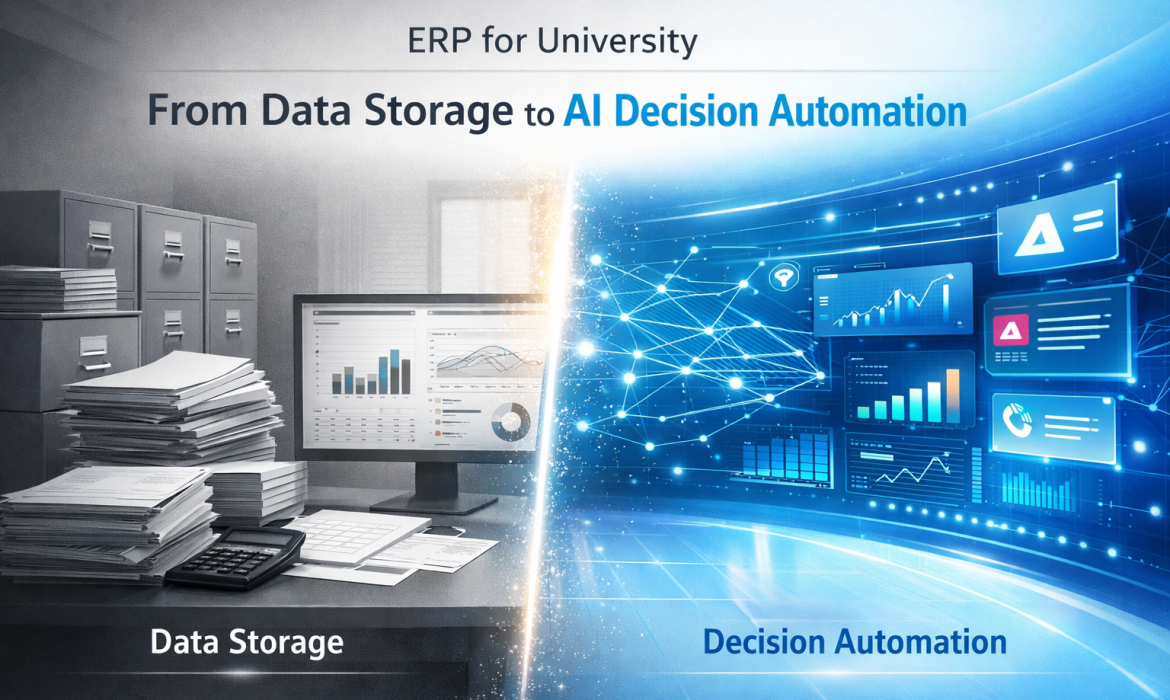
Universities initially adopted ERP for university systems to centralize operations, digitize workflows, and eliminate manual inefficiencies. A structured university ERP system helped institutions unify admissions, academics, finance, and examinations under one digital framework.
That was the first phase of transformation.
Today, the expectation is different.
An ERP for university can no longer function as a data warehouse. It must operate as a decision engine.
This is where the AI shift in ERP higher education begins.
The Traditional ERP University Model: Centralized but Reactive
Most early ERP university platforms focused on:
- Admission tracking
- Fee collection
- Examination management
- Payroll and HR
- Compliance reporting
These systems improved traceability. They reduced paperwork. They streamlined coordination.
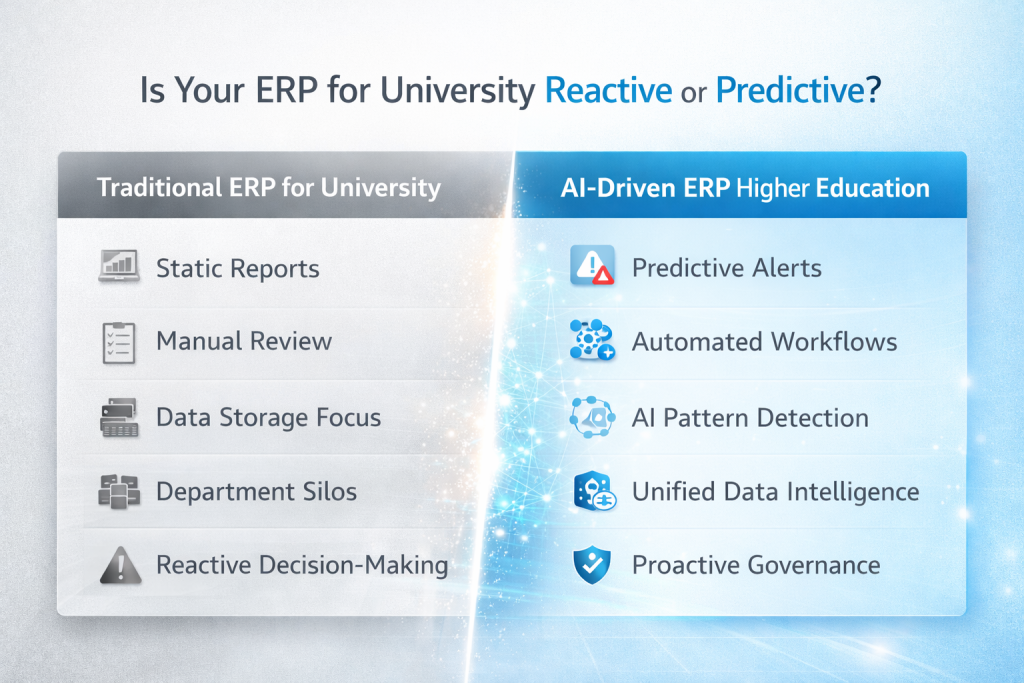
But they remained reactive.
Institutions facing ERP maturity challenges often discover that centralized systems still fail to deliver institutional visibility. Fragmented architecture limits foresight.
A traditional university ERP software solution tells leadership what already happened.
It rarely indicates what might happen next.
Why ERP University Systems Are Reaching Their Ceiling
University leadership must manage:
- Retention instability
- Accreditation pressure
- Financial volatility
- Digital examination complexity
- Outcome-based academic frameworks
Many institutions experience operational blind spots because their university ERP system lacks predictive intelligence. Governance visibility gaps slow decision-making, especially during audits and accreditation cycles.
Without AI-driven support, even a robust higher ed ERP remains dependent on manual analysis.
This dependency creates risk.
The AI Shift in Higher Ed ERP
The AI shift transforms ERP higher education from record-keeping to proactive governance.
Modern ERP higher ed systems embed:
- Predictive alerts
- Risk flagging
- Automated workflows
- Pattern recognition
For example, intelligent systems can detect early disengagement signals using structured early awareness mechanisms, helping prevent escalation.
Similarly, AI-powered analytics enhance academic readiness and improve exam preparedness through integrated learning intelligence.
An evolved ERP for university does not wait for leadership to request reports. It surfaces actionable signals automatically.
From University ERP Software to Decision Automation
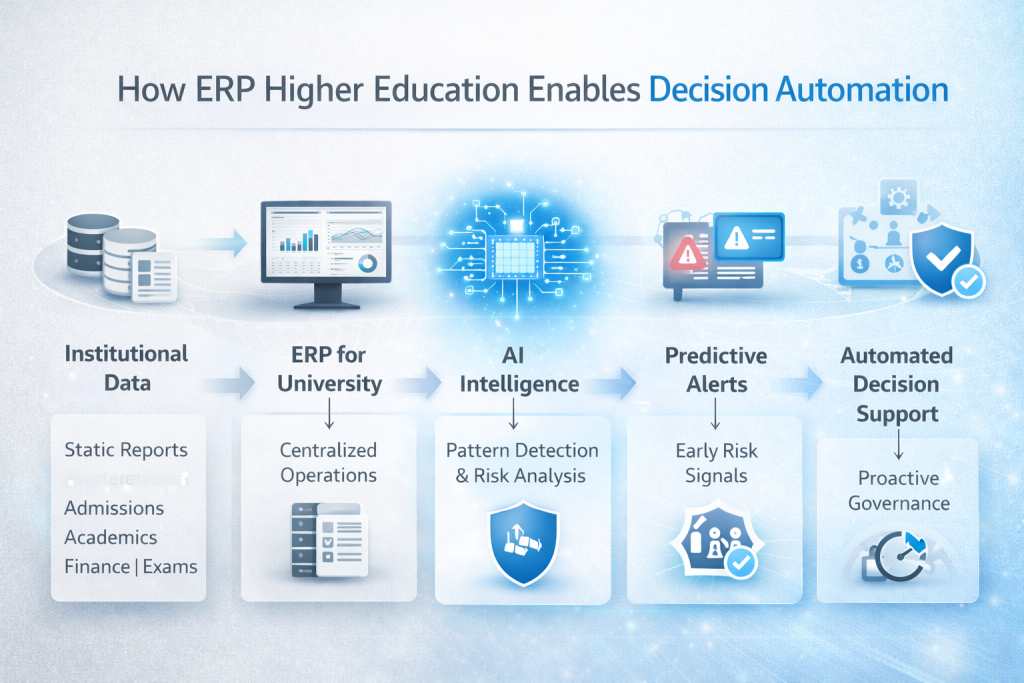
Decision automation changes how institutions operate.
Instead of manual follow-ups:
- Attendance drops trigger mentor alerts.
- Budget deviations activate finance reviews.
- Compliance deadlines initiate documentation workflows.
Automated accreditation management processes reduce last-minute pressure and ensure structured readiness.
Integrated platforms that connect learning, finance, and operations within a unified ERP university architecture reduce institutional friction.
The shift is clear:
From documentation → to intelligent action.
ERP Higher Education and Predictive Governance
Predictive governance requires connected ecosystems.
An advanced ERP for university integrates:
- Recruitment pipelines
- Student lifecycle tracking
- Learning analytics
- Online assessment systems
For instance:
- Structured student recruitment and lifecycle management connects admissions to retention strategies.
- Integrated online classes and exams management supports academic continuity.
- Embedded outcome-based LMS architecture aligns teaching with measurable performance indicators.
When these systems operate independently, leadership loses context.
When unified inside an intelligent Education Management System (EMS), governance becomes predictive.
This is the essence of Digital solutions for higher education.
Governance Visibility and Cybersecurity in ERP Higher Ed
Visibility without security creates vulnerability.
Institutions must ensure that their ERP higher education infrastructure integrates cybersecurity safeguards. Modern governance demands more than cloud hosting; it requires embedded protection layers and risk monitoring frameworks.
An AI-enabled higher ed ERP must combine intelligence with resilience.
Strategic architecture matters.
Evaluating ERP for University in the AI Era
Leadership teams evaluating ERP for university platforms must look beyond feature lists.
They should assess:
- Predictive intelligence capability
- Integration depth
- Accreditation automation
- Lifecycle management
- AI-driven governance visibility
A structured evaluation framework helps institutions avoid fragmented deployments and ensures long-term scalability.
Understanding institutional readiness and governance alignment becomes essential before system adoption.
The Future of ERP Higher Ed Architecture
The next generation of university ERP software will emphasize:
- Cloud-native scalability
- AI-powered analytics
- Modular expansion
- Governance dashboards
- Workflow automation
Institutions no longer ask:
“Does our ERP university platform manage operations?”
They ask:
“Does it strengthen strategic foresight?”
An AI-driven Education Management System (EMS) integrates ERP functionality with predictive alerts, automated workflows, and decision intelligence into a unified backbone.
This shift defines the future of ERP higher education.
Conclusion: ERP for University Must Move Beyond Storage
An ERP for university that only centralizes information limits leadership agility.
An AI-enabled ERP higher ed system empowers institutions to anticipate risk, allocate resources intelligently, and improve governance clarity.
Universities adopting predictive higher ed ERP platforms move from reactive management to proactive strategy.
If your institution is rethinking its digital foundation, explore how a structured university ERP system aligns with comprehensive Digital solutions for higher education.
To understand the broader institutional vision, visit the About Us page.
For strategic discussions, connect directly through the Contact Us page.
Frequently Asked Questions
What is ERP for university?
ERP for university is an integrated platform that manages admissions, academics, finance, examinations, HR, and compliance within higher education institutions.
How does ERP higher education enable decision automation?
ERP higher education systems use AI-driven alerts, predictive analytics, and automated workflows to assist leadership in proactive governance.
What differentiates higher ed ERP from traditional campus software?
Higher ed ERP integrates institutional processes into a unified intelligence system, while traditional campus tools often operate in isolated modules.
What is the difference between ERP for university and AI-driven EMS?
An ERP for university centralizes and manages institutional data.
An AI-driven Education Management System (EMS) goes further. It analyzes patterns, generates predictive alerts, and supports automated interventions.
The difference lies in intelligence depth, not just functionality.
How does higher ed ERP support predictive governance?
Higher ed ERP systems integrate academic, financial, and administrative data streams.
When AI layers analyze these streams, leaders receive early-warning signals instead of delayed reports.
This enables proactive strategy.
What makes university ERP software future-ready?
Future-ready university ERP software must:
- Operate in the cloud
- Integrate AI analytics
- Support automation
- Ensure real-time visibility
- Enable scalable modular architecture
Systems built only for reporting will not sustain long-term competitiveness.
How can ERP higher education systems automate decisions?
ERP higher education platforms automate decisions through rule-based triggers and predictive models.
When predefined conditions occur, the system initiates alerts, assignments, or workflows automatically.
This reduces human delay.
Why is ERP university software evolving beyond reporting?
Universities operate in a high-accountability environment.
Leadership cannot rely solely on historical reports.
ERP university software evolves because institutions now demand intelligence, not just information.
Leadership Reflection
Is your current ERP for university delivering strategic foresight — or only administrative reporting?
What governance blind spots still exist within your university ERP system?
We invite university leaders to share their perspective and experience.
Need Help? Chat with us
Start a Conversation
Hi! Click one of our member below to chat on Whatsapp
The team typically replies in a few minutes.