Best Examination Management System: What Universities Must Evaluate Before Choosing

University examinations are no longer just an administrative activity — they directly influence institutional credibility. Yet many institutions still struggle with delayed results, fragmented workflows, and avoidable errors. This is where a modern Examination Management System becomes essential.

As academic complexity grows, university leaders are not simply looking for digitization. They want reliability, transparency, and intelligent control over the entire examination lifecycle. Institutions that continue to rely on partially manual processes often find themselves reacting to problems instead of preventing them.

The Growing Complexity of University Examinations

Examination management in higher education has evolved significantly. Universities today manage multiple programs, continuous internal assessments, large-scale semester exams, and strict compliance requirements simultaneously.

However, when systems remain disconnected, operational pressure increases. Many universities report challenges such as:

  • Errors during marks entry or consolidation
  • Limited real-time visibility into evaluation progress
  • Heavy dependence on manual verification
  • Difficulty maintaining audit readiness
  • Delays in result declaration

Forward-looking institutions are therefore investing in structured digital ecosystems rather than isolated tools. Many leaders have already begun evaluating how an integrated Education Management System (EMS) can unify academic operations across departments.

Why Traditional Examination Processes Create Institutional Risk

Manual or semi-digital workflows may appear manageable at smaller scales. But as examination volumes grow, hidden risks begin to surface.

Error accumulation across stages

When examination data passes through multiple human checkpoints, discrepancies become almost inevitable. Even minor errors can trigger student grievances and administrative workload.

Limited transparency for leadership

Without centralized monitoring, tracking evaluation status, moderation changes, and approval flows becomes slow and reactive. This lack of visibility makes it difficult for leadership teams to intervene at the right time.

Result delays impact institutional reputation

In a competitive higher education environment, timely results are critical. Delays affect admissions planning, student progression, and placement cycles. Many universities exploring digital transformation have already recognized this shift through platforms such as online classes and exams management, which connect learning and assessment workflows more tightly.

How AI-Powered Examination Management Is Changing the Approach

A modern Examination Management System for universities goes far beyond simple marks entry. With AI and automation embedded, the entire assessment lifecycle becomes more intelligent and predictable.

Intelligent workflow automation

Automation streamlines exam scheduling, hall ticket generation, digital evaluation, moderation, and result compilation. As a result, institutions reduce manual dependency while improving process speed.

Predictive monitoring and alerts

AI-enabled systems can flag missing marks, evaluation delays, and workflow bottlenecks early. Universities that have adopted predictive platforms often see the same benefits highlighted in this detailed guide on AI-powered learning management evolution.

Stronger examination integrity

Modern digital frameworks introduce structured access controls, encrypted data handling, and complete audit trails. These capabilities significantly strengthen institutional trust and compliance readiness.

What Universities Should Evaluate Before Choosing an Examination Management System
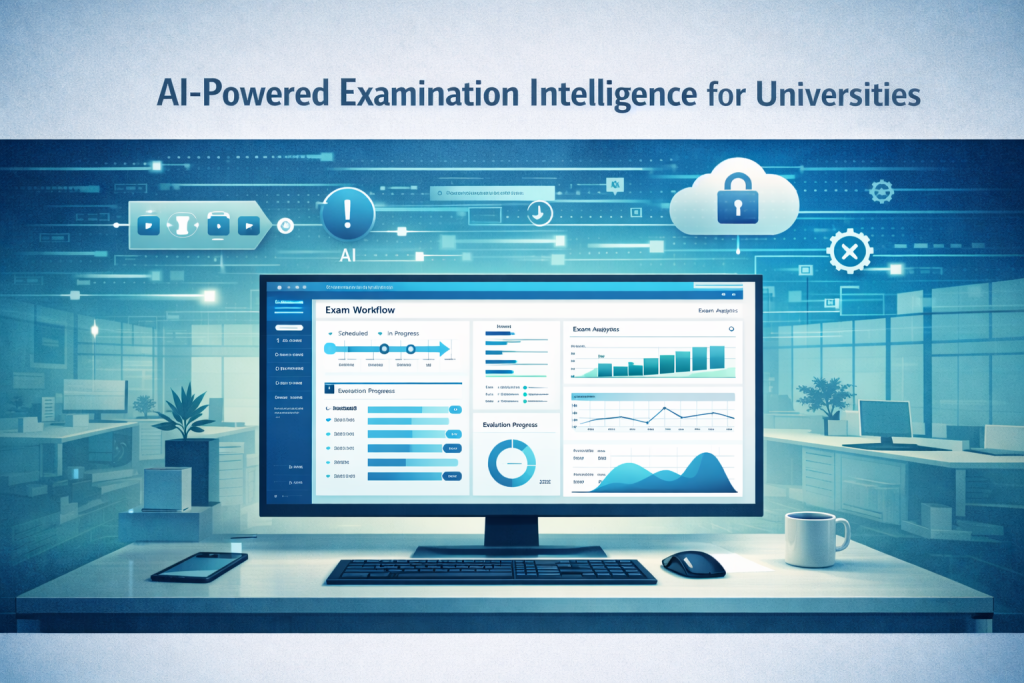
AI-powered Examination Management System dashboard showing automated university exam workflow and analytics

Selecting the right Examination Management System requires more than checking feature lists. University leadership must evaluate long-term institutional fit.

End-to-end examination coverage

The platform should support the full lifecycle — from pre-exam planning to post-result analytics. Fragmented tools often create more complexity than they solve.

AI-driven visibility

Modern institutions benefit from automated alerts, workflow intelligence, and real-time dashboards. Universities already moving toward outcome-based LMS environments are seeing how continuous academic visibility improves decision-making.

Cloud-native scalability

Universities evolve continuously. A cloud-based system ensures flexibility to handle growing data volumes, multi-campus operations, and regulatory changes without performance bottlenecks.

Seamless academic integration

An effective solution should work within the broader Digital solutions for higher education ecosystem. When examination workflows connect smoothly with admissions, academics, and accreditation, institutions gain true operational clarity. Many universities strengthening compliance readiness are already aligning examination data with accreditation management frameworks for better evidence tracking.

The Strategic Importance of Digital Solutions for Higher Education

Leading universities no longer treat examinations as isolated administrative tasks. Instead, they view assessment management as a strategic pillar of academic governance.

Adopting integrated digital platforms enables universities to:

  • Gain real-time academic visibility
  • Reduce operational friction
  • Improve compliance readiness
  • Strengthen stakeholder confidence
  • Build scalable academic processes

Institutions modernizing their examination framework often extend the same intelligence across the student recruitment lifecycle, ensuring continuity from admission to graduation.

How iCloudEMS Supports Modern Examination Management

As universities accelerate digital transformation, iCloudEMS provides a unified and AI-powered approach to managing complex academic workflows.

Built as a cloud-native Education Management System (EMS), the platform helps institutions:

  • Automate the complete examination lifecycle
  • Monitor evaluation progress in real time
  • Reduce manual intervention points
  • Maintain structured audit trails
  • Accelerate accurate result processing

Because iCloudEMS is designed specifically as Digital solutions for higher education, it connects examinations with academics, admissions, accreditation, and student success workflows within a single ecosystem. Universities exploring comprehensive modernization often review the broader capabilities available on the iCloudEMS platform before finalizing their digital roadmap.

The Road Ahead for University Examination Systems

Examination ecosystems are steadily moving toward predictive, connected, and intelligence-driven models. Universities are prioritizing systems that provide not just efficiency but foresight and governance clarity.

Institutions that invest in a robust Examination Management System today position themselves for:

  • Stronger academic integrity
  • Faster decision-making
  • Better regulatory readiness
  • Greater institutional confidence

The shift is no longer optional — it is becoming foundational to future-ready higher education.
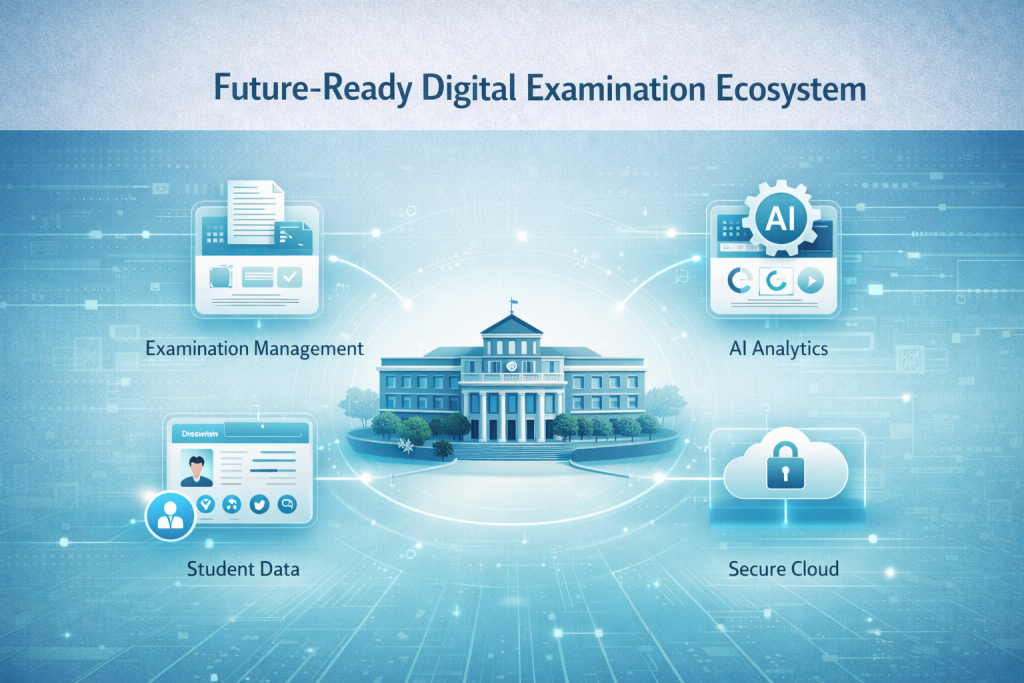
Future-ready Examination Management System ecosystem connecting university AI analytics student data and secure cloud

Conclusion

Examination credibility remains one of the most visible indicators of institutional excellence. As universities grow in scale and complexity, fragmented or manual workflows introduce unnecessary risk.

A modern Examination Management System enables universities to move toward structured, transparent, and intelligence-driven assessment management. By combining automation, AI capabilities, and cloud scalability, institutions can significantly improve accuracy and operational confidence.

As part of the broader evolution toward Digital solutions for higher education, platforms like iCloudEMS are helping universities build examination ecosystems that are not only efficient but truly future-ready.

What do you think universities must prioritize first in examination transformation — speed, accuracy, or complete process visibility?

Frequently Asked Questions

What is an Examination Management System?

An Examination Management System is a digital platform that manages the complete examination lifecycle, including scheduling, evaluation, moderation, and result processing. It helps universities improve accuracy, transparency, and operational efficiency.

How does AI help in examination management?

AI improves examination management by providing predictive alerts, automated monitoring, and real-time workflow visibility. This helps universities detect delays early, reduce manual errors, and maintain stronger control over assessment processes.

Why are universities moving to digital examination systems?

Universities are adopting digital examination systems to manage growing assessment complexity, publish results faster, maintain audit readiness, and reduce dependency on manual processes.

What should universities look for in an Examination Management System?

Universities should evaluate end-to-end workflow coverage, AI-driven alerts, cloud scalability, strong security controls, and seamless integration with their Education Management System (EMS).

Is cloud-based examination management reliable for universities?

Yes. Modern cloud-based platforms use encryption, role-based access, and complete audit trails to ensure data security and reliability. When properly implemented, they significantly strengthen examination governance.
Why Every University Is Upgrading to an AI-Powered Learning Management System (LMS)

Universities are no longer asking whether digital learning matters.
They are asking how fast they can modernize.

Across higher education, institutional leaders are confronting a hard reality: traditional platforms cannot keep pace with evolving academic expectations. Students expect seamless digital learning. Faculty demand intelligent automation. Meanwhile, administrators need real-time academic visibility to make confident decisions.

As a result, the shift toward an AI-Powered Learning Management System is accelerating. Universities are not simply upgrading software — they are redesigning the digital learning backbone that supports teaching, engagement, and outcomes.

The New Expectations from University Learning Environments

Higher education has entered a performance-driven era. Today’s institutions operate under pressure to improve retention, enhance learning quality, and deliver measurable academic outcomes. However, many legacy systems were never designed for this level of complexity.

Students now expect:

  • Always-on access to course materials
  • Mobile-first learning experiences
  • Personalized academic support
  • Faster feedback cycles
  • Seamless digital interactions

Faculty expectations have also evolved. They want tools that reduce administrative burden while improving instructional effectiveness. Moreover, leadership teams require consolidated academic intelligence rather than fragmented reports.

Therefore, universities are rethinking the role of the modern Learning Management System for universities. It is no longer just a content repository — it must function as an intelligent academic engine supported by an integrated Education Management System (EMS).

What Defines an AI-Powered Learning Management System

A traditional LMS primarily manages content delivery and assignment tracking. In contrast, an AI-Powered Learning Management System introduces intelligence, prediction, and automation into the learning ecosystem.

At its core, an AI-enabled platform can:

  • Analyze student engagement patterns
  • Predict academic risk early
  • Automate routine academic workflows
  • Personalize learning pathways
  • Provide real-time institutional insights

However, the true transformation occurs when the LMS operates as part of a unified Education Management System (EMS). When learning data connects with admissions, attendance, and examinations, universities gain a 360-degree academic view.

Forward-looking institutions are therefore investing in Digital solutions for higher education that combine learning intelligence with lifecycle visibility such as student recruitment lifecycle management.

Must-Have Capabilities Universities Now Demand

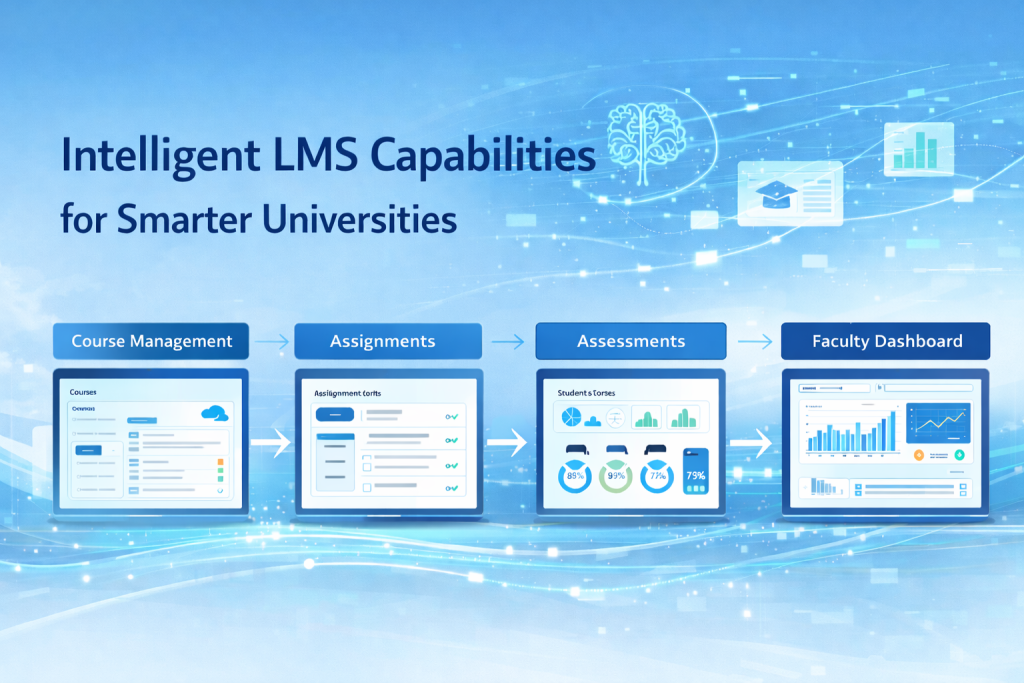
AI-powered Learning Management System capabilities dashboard for universities

University decision-makers have become far more strategic in evaluating LMS platforms. Basic functionality is no longer sufficient. Instead, institutions are prioritizing intelligence, scalability, and ecosystem integration.

Predictive Academic Intelligence

Modern universities want early warning systems. An advanced AI LMS platform should identify:

  • At-risk students
  • Low engagement patterns
  • Course-level performance gaps
  • Attendance-risk correlations

Consequently, leadership teams can intervene before problems escalate — a challenge widely discussed in student risk detection strategies.

Unified Academic Visibility

Fragmented dashboards create confusion. Institutions now prefer a cloud-based LMS that integrates seamlessly within a broader Education Management System.

Key expectations include:

  • Single academic view across departments
  • Real-time performance monitoring
  • Automated alerts for stakeholders
  • Cross-functional data flow

This unified approach aligns with best practices in evaluating an Education Management System.

Automation-First Workflows

Manual academic processes slow institutions down. Therefore, universities increasingly demand automation in areas such as:

  • Assignment workflows
  • Evaluation cycles
  • Course publishing
  • Faculty notifications
  • Student communications

Automation not only saves time but also reduces operational errors, as highlighted in AI-driven administrative automation.

Mobile-First Learning Experience

Today’s learners are mobile-native. As a result, the university learning platform must deliver:

  • Responsive student portals
  • Mobile assessments
  • On-the-go faculty tools
  • Instant notifications

Institutions that ignore mobile experience often see declining engagement, a pattern explored in AI-powered student portal strategies.

Strategic Advantages for Institutional Leadership

The decision to adopt an AI-Powered Learning Management System is no longer purely technical. It is strategic.

Improved Academic Governance

With AI-driven insights, administrators can monitor academic health continuously. Instead of reactive firefighting, institutions move toward proactive governance supported by modern AI-enabled academic management.

Data-Driven Decision Making

When learning analytics connect with institutional data, leaders can:

  • Identify program effectiveness
  • Optimize faculty workload
  • Monitor student progression
  • Forecast academic risks

Therefore, decisions become evidence-based rather than assumption-driven — addressing gaps often caused by limited student information visibility.

Scalable Digital Infrastructure

As universities expand programs and student populations, scalability becomes critical. A modern LMS in higher education must support institutional growth without performance bottlenecks.

Cloud-first ecosystems such as online classes and exams management demonstrate how scalable infrastructure supports uninterrupted academic delivery.

Stronger Compliance and Accreditation Readiness

Accreditation bodies increasingly expect documented academic processes. An intelligent platform automatically maintains audit trails, reports, and performance records.

Institutions pursuing stronger compliance maturity often align LMS strategy with accreditation management systems and improved institutional data readiness.

How Students and Faculty Experience the Transformation

Technology investments succeed only when end users feel the impact. Fortunately, AI-driven platforms deliver measurable improvements across the academic community.

Student Experience Improvements

Students benefit from:

  • Personalized learning recommendations
  • Early academic alerts
  • Faster feedback cycles
  • Centralized learning access
  • Greater academic transparency

These improvements closely align with outcome-focused frameworks such as outcome-based education and a dedicated outcome-based LMS approach.

Faculty Experience Improvements

Faculty members experience:

  • Reduced manual workload
  • Automated grading assistance
  • Better class performance insights
  • Streamlined course management
  • Improved student communication

Consequently, instructors can focus more on teaching quality rather than administrative overhead.

Warning Signs Your University Has Outgrown Its Current LMS

Many institutions continue using legacy platforms longer than they should. However, several indicators clearly signal the need for modernization.

Watch for these red flags:

  • Faculty relying on external tools outside the LMS
  • Delayed academic reporting cycles
  • Limited mobile usability
  • No predictive student alerts
  • Manual intervention required for routine workflows
  • Fragmented academic data across systems
  • Difficulty scaling new programs

If multiple symptoms appear, the institution is likely operating below its digital potential — a maturity gap often seen in university system maturity challenges.

Future Trends Shaping AI-Driven Learning Ecosystems

The evolution of AI in higher education is only accelerating. Universities planning long-term digital strategy should pay attention to emerging shifts.

Hyper-Personalized Learning Paths

AI will increasingly tailor course journeys based on student behavior, performance, and learning style.

Continuous Academic Risk Prediction

Predictive models will move from periodic analysis to continuous monitoring, enabling near real-time intervention — similar to modern AI-enabled exam readiness systems.

Intelligent Faculty Assistants

AI will support instructors with automated content suggestions, assessment insights, and engagement recommendations.

Unified Digital Campus Architecture

Forward-looking institutions are moving toward fully integrated Digital solutions for higher education, where LMS, academics, finance, and student lifecycle systems operate as one ecosystem.

Universities that delay this transition risk falling behind more agile competitors.

How iCloudEMS Enables Intelligent Digital Learning

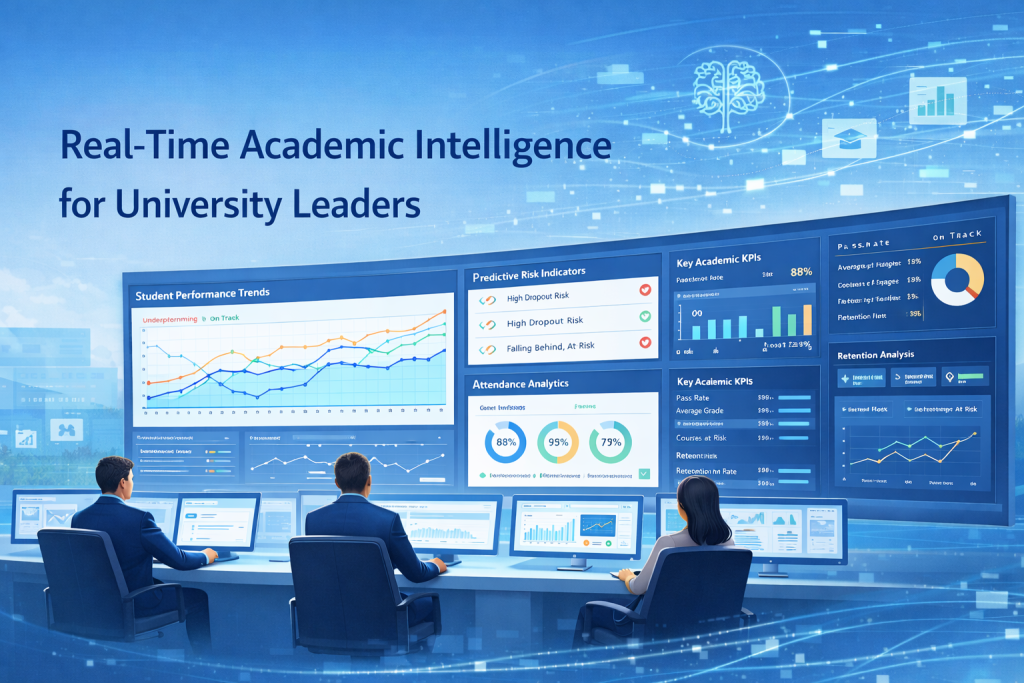
AI-powered academic intelligence dashboard for university leadership decision making

Institutions seeking a future-ready approach are increasingly adopting platforms that unify learning intelligence with institutional operations.

As part of its advanced Education Management System (EMS) framework, iCloudEMS delivers:

  • AI-powered academic monitoring
  • Cloud-native scalability
  • Real-time performance alerts
  • Integrated student lifecycle visibility
  • Automation-driven academic workflows
  • Mobile-first learning access
  • Unified institutional dashboards

Importantly, iCloudEMS approaches the AI-Powered Learning Management System not as an isolated module but as a connected intelligence layer within the broader digital campus — including solutions for university management and college management.

Therefore, universities gain not just a learning platform, but a coordinated academic ecosystem designed for long-term institutional growth.

Conclusion: The Upgrade Is No Longer Optional

Higher education is entering an intelligence-driven decade. Universities that continue relying on static learning platforms may struggle to meet rising expectations from students, faculty, and regulators.

An AI-Powered Learning Management System is rapidly becoming the foundation of modern academic strategy. However, the real advantage emerges when the LMS operates within a unified Education Management System (EMS) supported by robust Digital solutions for higher education.

The question is no longer whether institutions will upgrade.
The real question is how prepared they are for the transition ahead.

How prepared is your institution for AI-driven learning transformation? Share your perspective and experiences.

Frequently Asked Questions

What is an AI-powered Learning Management System?

An AI-powered Learning Management System uses artificial intelligence to analyze student behavior, automate academic workflows, and provide predictive insights. Unlike traditional platforms, it enables proactive academic support, personalized learning experiences, and real-time institutional visibility for universities.

Why do universities need AI in LMS platforms?

Universities need AI in LMS platforms to move from reactive to proactive academic management. AI helps identify at-risk students early, improves engagement tracking, automates routine tasks, and provides leadership with data-driven insights that enhance academic outcomes and operational efficiency.

How does an LMS improve student outcomes?

A modern LMS improves student outcomes by centralizing learning resources, enabling continuous assessment, providing faster feedback, and supporting personalized learning paths. When enhanced with AI, it can also predict academic risks and trigger timely interventions that support student success.

What features should universities look for in an LMS?

Universities should prioritize AI-driven analytics, mobile accessibility, automation capabilities, real-time dashboards, seamless integration within an Education Management System (EMS), and cloud-native scalability. These features ensure the platform supports both current academic needs and future institutional growth.

How is iCloudEMS different from traditional LMS platforms?

iCloudEMS delivers an AI-powered Learning Management System as part of a unified Education Management System (EMS). Instead of operating as a standalone tool, it connects learning data with the broader digital campus, enabling real-time academic visibility, automation-driven workflows, and intelligent decision support for institutional leadership.

Is a cloud-based LMS better for universities?

Yes. A cloud-based LMS offers better scalability, remote accessibility, automatic updates, and reduced infrastructure burden. For universities managing complex academic operations, cloud deployment also supports faster innovation and stronger system reliability.

How an AI-Powered Student Portal Improves Student Experience and Retention

In today’s digital-first academic environment, the Student Portal has evolved from a basic information window into a strategic engine for institutional success. Universities that still rely on fragmented systems often struggle with delayed insights and reactive decision-making — a concern highlighted in this analysis of hidden gaps in traditional student information environments.

However, a modern AI-powered student portal changes the equation. It transforms disconnected student data into actionable intelligence, enabling institutions to deliver personalized support, proactive communication, and seamless digital experiences.

For university leaders focused on outcomes, the Student Portal is no longer just a convenience layer — it is a critical lever for improving both student experience and retention.

The Growing Pressure on Universities to Deliver Better Student Experiences

Higher education expectations have shifted dramatically. Students now compare their university experience with the digital convenience they receive elsewhere.

Yet many institutions still operate with:

  • Fragmented student touchpoints
  • Limited visibility into engagement patterns
  • Manual follow-up processes
  • Delayed academic risk identification
  • Disconnected communication channels

As explored in the discussion on the silent dropout challenge, many risks remain invisible until it is too late.

Without real-time intelligence, even well-managed universities remain in reactive mode. This is where a modern university student portal powered by AI begins to create measurable impact.

What Defines a Modern AI-Powered Student Portal

A traditional portal typically acts as a static dashboard. In contrast, an AI-enabled Student Portal functions as an intelligent engagement layer that continuously analyzes student behavior, academic signals, and interaction patterns.

A modern student self-service portal should provide:

  • Centralized access to academic, financial, and administrative data
  • Real-time status updates across the student lifecycle
  • Intelligent alerts and notifications
  • Personalized dashboards for students and faculty
  • Seamless mobile accessibility
  • Cross-department data visibility

Institutions adopting Digital solutions for higher education through iCloudEMS are already seeing how unified intelligence changes campus decision-making.

How an AI-Powered Student Portal Elevates Student Experience

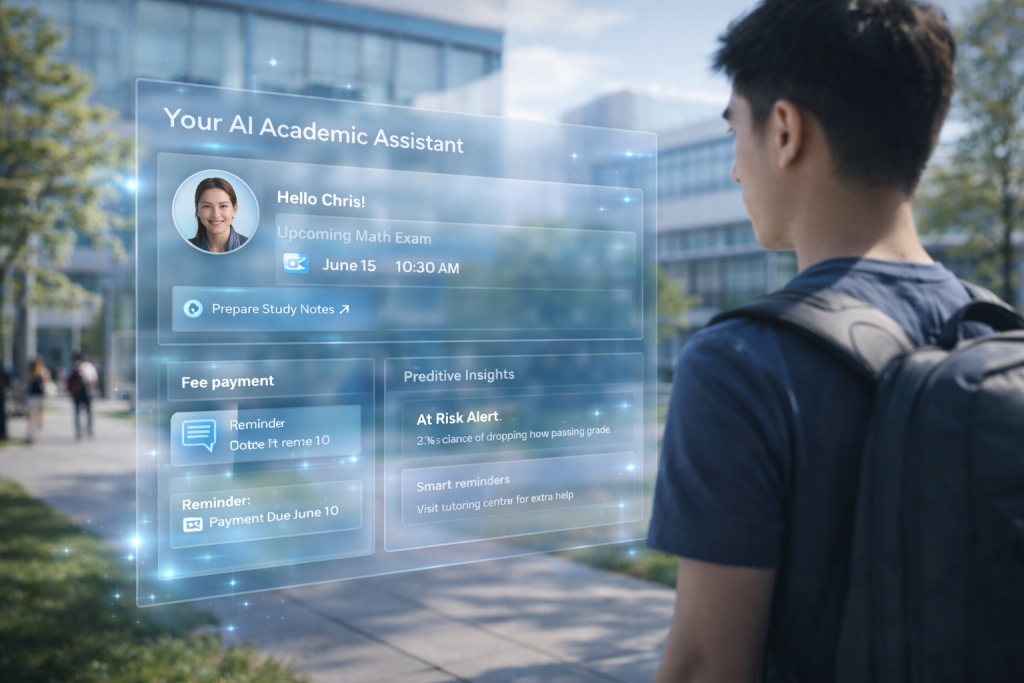
University student using AI-powered student portal on mobile for real-time academic updates

Student experience is shaped by speed, clarity, and personalization. When these elements are missing, frustration builds quietly across the campus ecosystem.

An AI-powered higher education student portal improves experience in several high-impact ways.

Real-Time Transparency Builds Student Trust

Students no longer want to chase departments for updates. With a modern portal:

  • Attendance updates appear instantly
  • Fee status is always visible
  • Examination information is centralized
  • Academic progress is continuously tracked

This level of visibility becomes even more powerful when integrated with intelligent finance workflows such as the AI-powered fee management approach.

Personalized Digital Journeys Increase Engagement

AI enables the Student Portal to move beyond one-size-fits-all dashboards. Instead, it can:

  • Highlight pending student actions
  • Recommend academic resources
  • Surface important deadlines
  • Provide contextual reminders

When combined with outcome-driven learning environments like the Outcome-Based LMS, universities can create deeply personalized academic journeys.

Frictionless Self-Service Reduces Administrative Dependency

Modern students expect autonomy. A well-designed student engagement platform allows them to:

  • Download documents instantly
  • Submit requests digitally
  • Track approvals in real time
  • Access learning resources on demand

Institutions modernizing their academic operations — as discussed in the future-ready academics management strategy — are seeing measurable reductions in administrative load.

Unified Communication Eliminates Information Gaps

One of the biggest experience failures in higher education is fragmented communication. An AI-enabled modern student portal centralizes:

  • Academic notifications
  • Fee reminders
  • Institutional announcements
  • Faculty communications

When paired with integrated online classes and exams management, communication becomes both timely and contextual.

The Direct Link Between Student Portal Intelligence and Retention

While experience improvements are visible, the deeper strategic value of a Student Portal lies in retention intelligence. Universities rarely lose students suddenly — warning signals usually appear months in advance.

AI helps institutions detect those signals early.

How AI-Powered Portals Strengthen Student Retention

Early Risk Detection Through Behavioral Signals

An advanced AI-powered student portal continuously monitors patterns such as:

  • Declining attendance
  • Reduced portal activity
  • Assignment delays
  • Fee payment irregularities
  • LMS engagement drops

These signals align closely with modern student recruitment and lifecycle management strategies.

Predictive Alerts Enable Proactive Intervention

AI-powered academic assistant providing personalized student success guidance on a modern university campus

Instead of waiting for semester-end surprises, leadership teams receive:

  • Automated risk alerts
  • Engagement anomaly notifications
  • Academic performance warnings
  • Escalation triggers for counselors

This shift toward predictive operations reflects the broader evolution explained in the AI shift in university systems.

Data-Driven Retention Strategies Replace Guesswork

Historically, retention initiatives relied heavily on manual reviews. A modern Student Portal now provides:

  • Cohort-level engagement analytics
  • Department-wise risk heatmaps
  • Intervention tracking dashboards
  • Outcome-based retention insights

These capabilities strongly complement institutional quality frameworks supported by accreditation management systems.

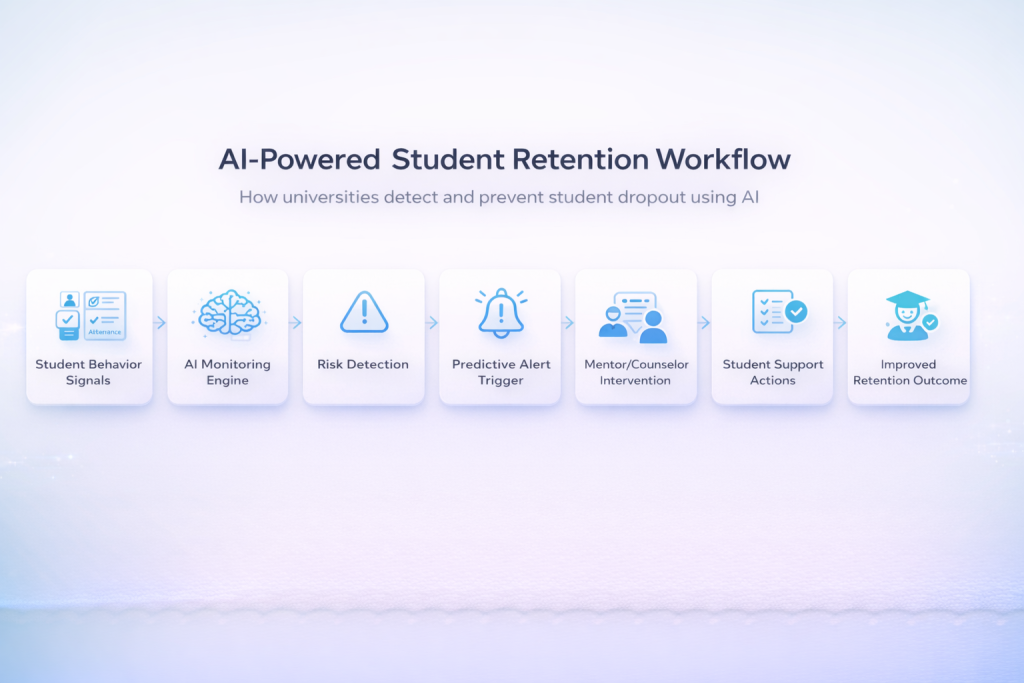
Automated Workflows Ensure No Student Falls Through the Cracks

AI-powered workflows can automatically:

  • Notify mentors
  • Trigger counseling workflows
  • Escalate unresolved issues
  • Track follow-up completion

Institutions evaluating next-generation platforms often compare traditional approaches versus modern EMS capabilities in the EMS vs traditional systems comparison.

The Strategic Role of iCloudEMS in Enabling Intelligent Student Portals

Forward-looking universities are increasingly adopting Digital solutions for higher education that unify data, intelligence, and user experience.

The iCloudEMS Education Management System (EMS) provides a cloud-native, AI-powered Student Portal that enables institutions to:

  • Achieve unified student visibility across departments
  • Monitor engagement through intelligent dashboards
  • Activate predictive alerts for at-risk students
  • Deliver personalized digital experiences at scale
  • Automate cross-campus workflows
  • Maintain real-time operational transparency

Institutions exploring comprehensive modernization paths often review capabilities across both the university solution environment and the college solution environment to understand the full transformation scope.

The Future of the Student Portal: From Access Point to Intelligence Hub

The next generation of the Student Portal will not merely display information — it will actively guide student success.

We are already seeing the emergence of:

  • AI copilots for student support
  • Hyper-personalized academic pathways
  • Predictive campus ecosystems
  • Intelligent nudges for engagement
  • Autonomous administrative workflows

Universities that modernize early will build stronger student relationships, while those that delay risk operating with blind spots in an increasingly data-driven education landscape.

Conclusion

The Student Portal has quietly become one of the most influential digital assets in higher education. When powered by AI, it delivers visibility, personalization, and predictive intelligence that directly impact student experience and retention.

For university leaders navigating rising expectations and competitive pressures, the real question is no longer whether a portal exists — but whether it is intelligent enough to support proactive student success.

AI-powered student retention workflow flowchart showing predictive alerts and intervention process in universities

Reflection

How effectively is your current Student Portal helping your institution identify disengaged or at-risk students early?

University leaders who are re-evaluating their digital student experience strategy often uncover significant improvement opportunities once they begin examining real-time engagement intelligence.

Key Questions University Leaders Ask

What is a student portal in higher education?

A student portal is a centralized digital platform that gives students secure access to academic records, fees, schedules, communication, and institutional services. Modern portals use AI to provide real-time insights, personalized dashboards, and proactive alerts that improve engagement and operational visibility.

How does an AI-powered student portal improve retention?

An AI-powered student portal improves retention by continuously analyzing behavioral and academic signals to identify at-risk students early. It generates predictive alerts, enables timely interventions, and helps universities track engagement trends so leadership teams can act proactively before disengagement turns into attrition.

Why do universities need a modern student portal?

Universities need a modern student portal to provide real-time transparency, seamless self-service, and unified communication. Traditional systems lack predictive intelligence, whereas AI-enabled portals help institutions monitor engagement, reduce administrative friction, and support data-driven decision-making across the student lifecycle.

What features should a university student portal include?

A robust university student portal should include real-time dashboards, AI-driven alerts, mobile accessibility, self-service workflows, unified communication tools, and cross-department data visibility. These capabilities ensure students receive timely information while administrators gain actionable insights into engagement and performance.

How does a student portal improve student engagement?

A student portal improves engagement by centralizing information, delivering personalized notifications, and simplifying access to academic and administrative services. When students can easily track progress, receive reminders, and interact digitally with the institution, their participation and satisfaction levels typically increase.

Can a student portal support personalized learning journeys?

Yes, AI-enabled student portals can support personalized learning journeys by analyzing academic performance, behavior patterns, and engagement data. The system can recommend resources, highlight risks, and surface relevant actions, helping institutions guide each student more effectively toward academic success.

Your Student Information System Is Lying to You — Here’s What University Leaders Don’t See

Most universities believe their Student Information System works.

Admissions data gets stored. Attendance updates daily. Examination marks reflect in dashboards. Fee reports generate on time.

From a distance, everything appears structured.

But structure does not guarantee intelligence.

A Student Information System that only stores information without detecting institutional risk creates a dangerous illusion of control. University leaders often rely on dashboards that show stability while hidden inefficiencies grow silently beneath the surface.

The real question is not whether your Student Information System functions.

The real question is whether it protects institutional governance.

A Student Information System Must Evolve Beyond Data Storage

Historically, a Student Information System digitized administrative workflows. It replaced manual registers and disconnected spreadsheets.

Today, Digital solutions for higher education demand more.

A modern Student Information System must operate inside a unified ecosystem such as a cloud-native Education Management System (EMS) where admissions, academics, finance, lifecycle, accreditation, and evaluation operate in real time.

Leadership frameworks for evaluating institutional systems consistently emphasize integration, scalability, and predictive capability as non-negotiable criteria. A fragmented platform cannot support executive decision-making at scale.

If your Student Information System cannot:

  • Detect academic risk early
  • Flag financial exposure
  • Integrate lifecycle data
  • Support accreditation workflows
  • Generate predictive alerts

Then it operates as a digital archive, not a governance engine.

Fragmented Student Data Creates Invisible Institutional Risk

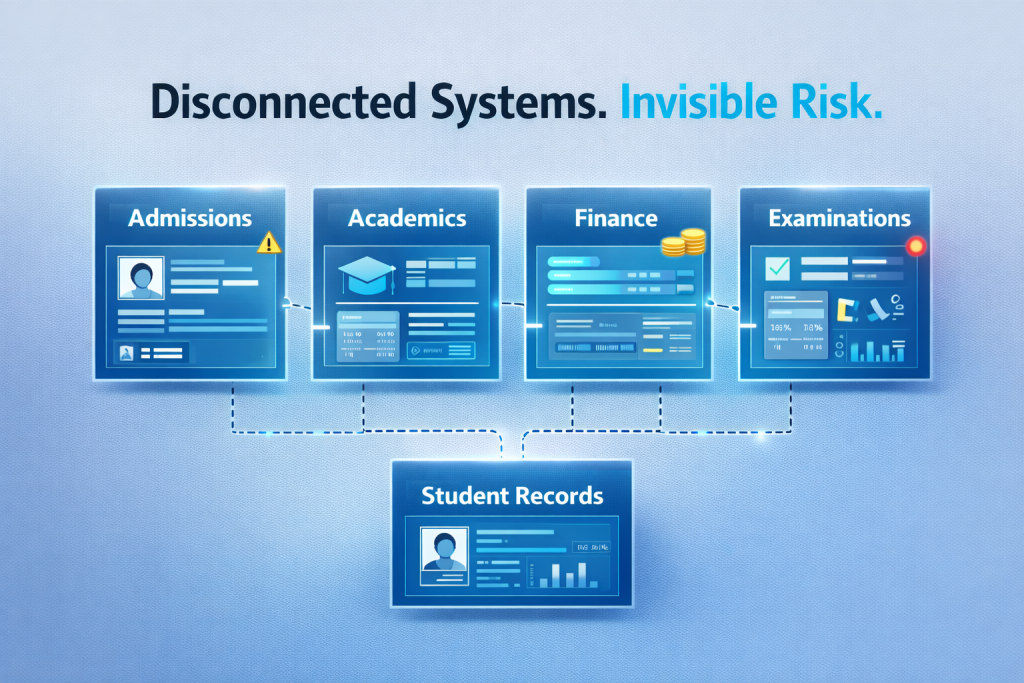
Five-node university Student Information System fragmentation diagram showing disconnected departments

Many institutions still operate across departmental silos:

  • Admissions handles recruitment separately
  • Academics track performance independently
  • Finance reconciles fees manually
  • Examination cells manage isolated records

Without structured student recruitment lifecycle management, the student journey breaks into disconnected segments.

When inquiry, enrollment, progression, and alumni tracking fail to align within one Student Information System, the institution loses visibility.

Lifecycle fragmentation leads to:

  • Duplicate student records
  • Attendance inconsistencies
  • Manual grade adjustments
  • Fee reconciliation delays
  • Delayed intervention in disengagement

A centralized lifecycle intelligence framework, as explored in student lifecycle automation strategies, strengthens data continuity across the entire academic journey.

Disconnected systems increase workload. Integrated systems increase clarity.

When Dashboards Show Stability but Risk Is Rising

University dashboards typically display:

  • Enrollment totals
  • Fee collection summaries
  • Attendance percentages
  • Examination outcomes

These metrics describe the present.

They rarely forecast disruption.

Gradual disengagement, performance decline, and dropout probability often remain invisible until they become irreversible. Institutions that fail to monitor early risk signals experience delayed intervention.

The pattern of missed warning signs becomes clear when analyzing early disengagement detection challenges in siloed systems.

An AI-powered Student Information System must detect anomalies before institutional damage occurs.

Without predictive intelligence, leadership relies on retrospective reporting instead of proactive governance.

Compliance and Accreditation Demand Data Integrity

Accreditation bodies expect structured, verifiable, and audit-ready data.

If your Student Information System requires manual compilation before evaluation cycles, institutional exposure increases.

Modern compliance readiness depends on:

  • Automated audit logs
  • Timestamped academic tracking
  • Outcome mapping
  • Secure documentation workflows

Institutions adopting structured accreditation management automation reduce regulatory friction and improve data transparency.

Data fragmentation often affects accreditation scores more than academic quality itself. Addressing accreditation data intelligence gaps requires systemic integration rather than surface-level reporting.

A Student Information System must embed compliance intelligence at its core.

Academic Intelligence Requires LMS and Evaluation Integration

A Student Information System cannot operate in isolation from learning systems.

Institutions implementing outcome-based learning analytics gain measurable visibility into curriculum alignment and academic performance.

Similarly, structured online classes and examination management ensures transparency in assessments, digital evaluation, and result processing.

When learning delivery, examination workflows, and student progression data integrate within one Student Information System, academic governance strengthens.

Without LMS integration, student performance insights remain incomplete.

Financial Visibility Must Align with Academic Progression

Academic data alone does not define institutional stability.

Financial intelligence plays an equally critical role.

Institutions implementing predictive AI-powered fee tracking systems gain early visibility into revenue exposure and payment behavior patterns.

When fee data integrates directly into the Student Information System, leadership can:

  • Identify high-risk receivables
  • Correlate disengagement with financial stress
  • Reduce manual reconciliation
  • Improve revenue forecasting

Separating academic and financial systems weakens strategic oversight.

From Legacy ERP to Intelligent Governance

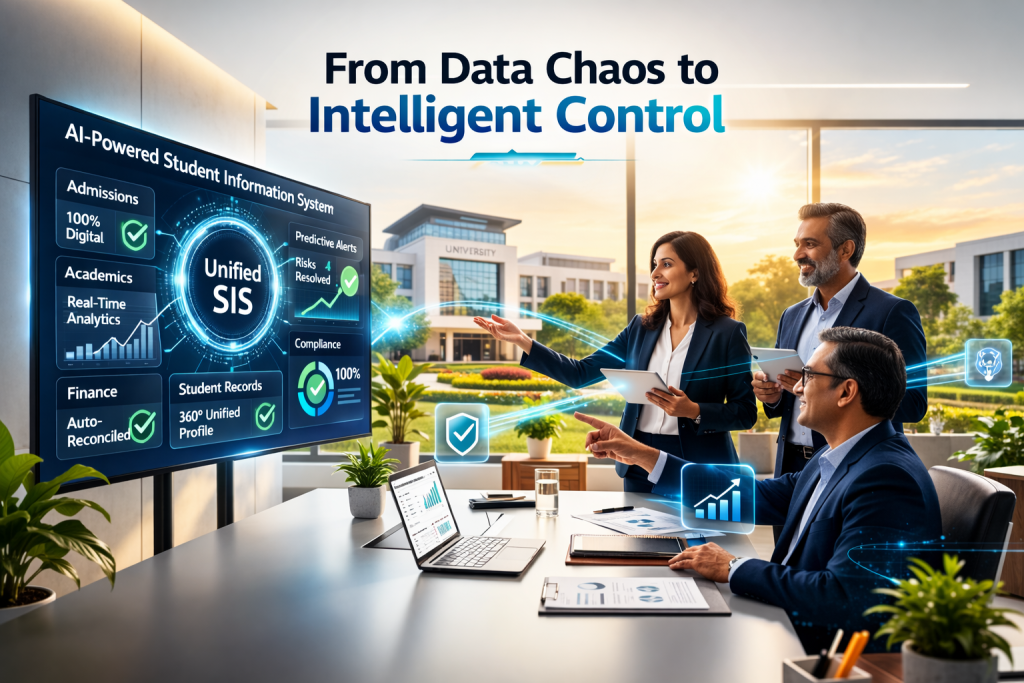
Indian university leadership team reviewing unified AI-powered Student Information System dashboard

Many institutions still operate within legacy university ERP environments or traditional college ERP systems focused primarily on process automation.

However, the sector increasingly recognizes the shift toward AI-driven decision automation as essential for governance maturity.

A modern Student Information System embedded within an intelligent Education Management System (EMS) transforms operational data into institutional foresight.

Process automation is no longer sufficient.

Predictive intelligence defines the next evolution.

Infrastructure and Cybersecurity Cannot Be Secondary

Cloud adoption alone does not guarantee protection.

Universities must implement structured advanced cybersecurity frameworks for higher education systems to ensure data integrity.

A cloud-native Student Information System should provide:

  • Real-time synchronization
  • Secure role-based access
  • Encrypted data storage
  • Automated backups
  • Audit-ready traceability

Infrastructure resilience strengthens governance confidence.

The Strategic Question University Leaders Must Ask

Most institutions ask:

“Does our Student Information System work?”

A more strategic question would be:

“Does our Student Information System prevent risk before it becomes visible?”

If leadership still depends on manual correction, delayed alerts, or disconnected dashboards, the system may be documenting risk instead of preventing it.

Modern Digital solutions for higher education demand predictive intelligence, lifecycle integration, financial alignment, accreditation automation, and secure cloud architecture within one unified ecosystem.

A Student Information System must evolve from administrative software into institutional intelligence infrastructure.

How does your institution currently evaluate the maturity of its student data systems?

Leadership Questions About Student Information Systems

1. What defines a modern Student Information System?

A modern Student Information System integrates admissions, academics, finance, lifecycle tracking, and compliance workflows inside a unified Education Management System (EMS).

2. Why is predictive intelligence critical?

It identifies academic decline, dropout probability, and financial exposure before damage occurs.

3. How does LMS integration improve governance?

Outcome-based learning analytics align curriculum, assessment, and performance tracking within the Student Information System.

4. What risks exist in fragmented systems?

Duplicate data, audit exposure, delayed intervention, and inaccurate reporting weaken institutional control.

5. How does financial integration enhance insight?

Aligned fee and academic data enable early detection of revenue and engagement risks.

6. Why is cloud architecture essential?

It ensures secure access, scalability, synchronization, and audit readiness.

7. Can a Student Information System improve accreditation readiness?

Yes. Structured data architecture and automated documentation streamline regulatory evaluation.

AI in Universities Is No Longer Optional — But Blind Automation Is Dangerous

Artificial intelligence has crossed a quiet threshold in higher education.

What was once experimental is now embedded in daily academic life. Universities are using AI to assist admissions teams, support learning management systems, analyse assessments, automate finance workflows, monitor attendance patterns, and respond to student queries. In many institutions, AI is no longer discussed as a future initiative. It is already present—sometimes visibly, sometimes quietly—inside operational systems.

This shift is not driven by hype. It is driven by scale.

Universities today manage far more complexity than they did even a decade ago. Student populations are larger. Academic offerings are broader. Regulatory expectations are tighter. Accreditation cycles are more frequent. Leadership decisions are expected to be faster, better informed, and defensible.

In this environment, manual oversight alone cannot keep up. AI becomes not a luxury, but a structural necessity.

Yet there is an emerging risk that deserves equal attention.

As universities rush to adopt AI, many are doing so through blind automation—deploying tools that act quickly, but without institutional awareness, governance context, or architectural integration. When automation outpaces understanding, efficiency gains can quietly turn into academic, compliance, and leadership risks.

The challenge for universities in 2025 is no longer whether to adopt AI.
It is how to adopt AI without losing control.

Why AI Has Become Unavoidable in University Operations

Universities operate at the intersection of education, governance, and public trust. Every academic decision carries reputational and regulatory consequences. Every operational delay compounds across departments. Every data inconsistency eventually surfaces during audits, inspections, or accreditation reviews.

AI responds to these pressures in very practical ways:

  • It processes volume faster than human teams can
  • It detects patterns across large datasets
  • It reduces repetitive manual workload
  • It surfaces anomalies that might otherwise be missed

As student numbers cross into the thousands and processes span dozens of departments, AI-assisted systems become essential simply to maintain baseline reliability.

This is why AI adoption has accelerated so rapidly across:

  • Learning Management Systems
  • Student Information Systems
  • Examination and evaluation workflows
  • Finance, fees, and reconciliation
  • Student support and grievance handling

At scale, the alternative is operational fatigue.

But speed alone is not intelligence.

The Hidden Problem With Automation-First AI Adoption

Many AI deployments in universities are introduced as standalone tools.

A chatbot for admissions queries.
An AI proctoring layer for examinations.
A predictive model for attendance risk.
A reporting engine that auto-generates dashboards.

Individually, each tool appears useful. Together, they often create fragmentation.

Automation-first AI focuses on task completion, not institutional continuity. It answers questions, executes rules, and generates outputs—but it rarely understands how one decision affects another department, another regulation, or another reporting cycle.

This is where danger quietly enters the system.

When AI operates without a unified institutional backbone:

  • Decisions are made in isolation
  • Context is lost between departments
  • Exceptions are automated instead of reviewed
  • Accountability becomes difficult to trace

The university does not fail loudly.
It drifts silently.

Automation Is Not the Same as Institutional Intelligence

It is important to distinguish between three very different concepts that are often grouped together under “AI”.

Task Automation

This is the simplest form. Systems execute predefined actions:

  • Sending reminders
  • Updating records
  • Triggering notifications

Automation reduces workload, but it does not understand the consequences.

Decision Intelligence

Here, systems analyse patterns and suggest actions:

  • Flagging at-risk students
  • Highlighting unusual financial entries
  • Predicting operational bottlenecks

This adds value, but still requires oversight.

Institutional Awareness

This is the highest level—and the rarest.

Institutional awareness means AI understands:

  • Academic calendars
  • Regulatory constraints
  • Approval hierarchies
  • Cross-department dependencies
  • Historical decisions and their outcomes

Without this layer, automation can move faster than governance can respond.

Where Blind Automation Creates Real Risk

Universities do not operate like generic enterprises. They carry academic authority, regulatory responsibility, and social accountability. Blind automation introduces risks precisely because it does not recognise these nuances.

Academic Integrity and Assessment Sensitivity

Automated evaluation systems can flag anomalies, but without an academic context, they may:

  • Misinterpret interdisciplinary grading structures
  • Ignore approved exceptions
  • Escalate false positives during examinations

In assessment environments, speed without judgment is dangerous.

Compliance and Accreditation Pressure

Accreditation frameworks such as NAAC and NIRF depend on consistent, traceable, and explainable data.

When AI systems generate outputs without:

  • Clear data lineage
  • Cross-module consistency
  • Human validation checkpoints

Institutions struggle to justify outcomes during reviews.

Leadership Visibility vs Operational Noise

Dashboards filled with automated metrics can overwhelm leadership instead of informing them.

When every system speaks, clarity disappears.

Leadership does not need more data.
Leadership needs reliable signals.

Why Disconnected AI Tools Increase Institutional Anxiety

A common misconception is that more AI tools equal better intelligence.

In practice, disconnected AI systems create parallel versions of truth:

  • The LMS reports one pattern
  • The SIS reports another
  • Finance flags something unrelated
  • Student support sees a different risk profile

Each system may be “correct” in isolation, yet misleading in combination.

This fragmentation increases:

  • Decision latency
  • Review cycles
  • Leadership uncertainty
  • Audit stress

Universities begin to spend more time reconciling outputs than acting on insights.

Why ERP-Embedded AI Changes the Equation

The alternative is not less AI.
It is architected AI.

When AI is embedded inside a unified ERP backbone, it operates with shared context. Data flows across modules without duplication. Decisions are informed by institutional rules, not just algorithms.

In an ERP-embedded model:

  • Academic actions reflect finance and compliance realities
  • Alerts are contextual, not generic
  • Patterns are evaluated across the institution, not within silos
  • Human authority remains central

AI assists. It does not override.

This distinction is foundational.

Governance Requires Controlled Intelligence, Not Autonomous Automation

University governance is not about speed alone. It is about defensibility.

Every major decision must be explainable:

  • Why was this student flagged?
  • Why was this approval delayed?
  • Why did this outcome differ from last cycle?

Blind automation struggles with “why”.

Controlled intelligence, by contrast:

  • Preserves audit trails
  • Maintains institutional memory
  • Aligns AI outputs with policy frameworks
  • Supports leadership confidence

This is why AI architecture matters more than AI capability.

How iCloudEMS Approaches AI Differently

iCloudEMS was designed with this reality in mind.

Rather than treating AI as an external layer, it embeds intelligence within the operational core of the institution. AI functions are aligned with workflows across academics, examinations, finance, HR, admissions, accreditation, and student services.

Key principles guide this approach:

  • AI operates inside a unified cloud-native ERP backbone
  • Intelligence is contextual, not generic
  • Alerts are advisory, not autonomous
  • Leadership retains decision authority
  • Visibility is prioritised over automation volume

With more than 31 tightly integrated modules running on secure AWS infrastructure, AI insights emerge from real institutional patterns—not isolated datasets.

The result is not faster automation for its own sake, but calmer governance.

AI as an Enabler of Institutional Maturity

When implemented thoughtfully, AI does not destabilise universities. It strengthens them.

It allows leadership to:

  • Detect issues earlier
  • Allocate resources more intelligently
  • Respond to compliance requirements with confidence
  • Support students without reactive firefighting

But this maturity emerges only when AI is aligned with institutional architecture.

The future belongs not to universities with the most AI tools, but to those with the most coherent systems.

The Real Question Universities Must Answer

AI in universities is no longer optional.

The real question is whether institutions will adopt it blindly or wisely.

Automation without awareness accelerates risk.
Intelligence without governance erodes trust.

But AI, grounded in a unified ERP architecture, becomes something far more valuable:
a steady, reliable partner in institutional decision-making.

Questions Universities Are Asking

Is AI adoption mandatory for universities today?

Yes. At current operational scale and regulatory complexity, AI-assisted systems are necessary to maintain reliability, visibility, and responsiveness.

Why is blind automation risky in academic environments?

Because automation often lacks academic, regulatory, and institutional context, leading to decisions that are fast but not defensible.

Can AI replace human judgment in university governance?

No. AI should support decision-making, not replace it. Human oversight is essential for accountability and trust.

How does ERP-embedded AI differ from standalone AI tools?

ERP-embedded AI operates with shared institutional context, ensuring consistency, traceability, and alignment across departments.

Does more AI always mean better outcomes?

Not necessarily. Without integration and governance, more AI tools can increase fragmentation and confusion.

How does AI affect accreditation and compliance?

When properly architected, AI improves data consistency and audit readiness. When poorly integrated, it complicates reviews.

What should leadership expect from AI systems?

Clarity, early warnings, explainable insights, and reduced operational noise—not autonomous decisions.

Is AI mainly an IT concern?

No. AI adoption impacts academic policy, governance structures, compliance, and leadership decision-making.

How can universities adopt AI without destabilising operations?

By embedding AI within a unified ERP system that preserves institutional rules and human authority.

What role does iCloudEMS play in this transition?

iCloudEMS provides a cloud-native ERP foundation where AI enhances visibility and governance rather than creating uncontrolled automation.

Why Traditional University ERPs Struggle with Institutional Visibility — and How Modern Platforms Are Architected Differently

For more than two decades, university ERP systems have played a stabilising role in institutional operations. They introduced an order where paperwork once dominated. They replaced fragmented records with structured databases. They standardised processes across admissions, academics, finance, examinations, and administration.

For a long time, this was enough.

Universities were smaller. Regulatory expectations were episodic. Governance cycles moved at a slower pace. Leadership relied on periodic reports to assess progress and intervene when required. ERP systems were designed precisely for this environment — one where execution certainty mattered more than continuous awareness.

That context no longer exists.

Modern universities operate at a level of complexity that traditional ERP architectures were never designed to observe in real time. The result is not system failure, nor leadership shortfall. It is an architectural mismatch between how institutions now function and how legacy systems were built to see.

The Original Design Assumptions of Traditional ERPs

Most traditional university ERPs were architected with a clear and practical objective: to ensure that institutional processes execute reliably.

Their design logic prioritised:

  • Transaction completion
  • Workflow control
  • Data validation
  • Periodic reporting

This model worked well when institutional activity followed predictable cycles and when governance oversight could rely on consolidated snapshots.

Execution was the primary challenge. Visibility was assumed to follow naturally.

In reality, visibility was never explicitly designed for. It was treated as a by-product of completed transactions rather than a continuous institutional state.

As long as universities remained within the boundaries of this model, ERP systems appeared sufficient.

How Institutional Reality Has Changed

Universities today no longer operate as linear, compartmentalised organisations.

They are:

  • Multi-campus and multi-program
  • Continuously audited and accredited
  • Subject to overlapping regulatory expectations
  • Managing far more data across longer institutional timelines

Academic operations, financial decisions, compliance readiness, student progression, and faculty performance now intersect continuously rather than sequentially.

This change did not happen suddenly. It emerged gradually as institutions scaled, diversified, and matured.

Traditional ERPs did not fail. They were simply not designed for this level of simultaneity.

Execution-First Architecture and Its Visibility Limits

Execution-first systems are excellent at answering a specific question:

Has the process been completed correctly?

They struggle to answer a different, more consequential one:

What does the institution look like right now as a whole?

Because traditional ERPs treat each function as a separate operational domain, visibility becomes fragmented. Information exists, but it is distributed across:

  • Modules
  • Reporting cycles
  • Functional boundaries

Leadership does not lack data. What it lacks is coherence.

Visibility becomes an act of assembly rather than observation. Institutional understanding depends on reconciliation rather than recognition.

This is not a usage issue. It is a design outcome.

Why Reporting Cannot Substitute for Visibility

In response to growing governance pressure, many institutions attempt to compensate for visibility gaps by increasing reporting.

More dashboards are created.
More summaries are generated.
More review meetings are scheduled.

Yet leadership confidence rarely increases proportionally.

Reports describe what has already stabilised. Governance, however, depends on recognising what is still forming.

When systems are built around periodic extraction rather than continuous observation, visibility arrives late by design. By the time reports consolidate reality, decision windows have already narrowed.

The institution appears orderly. Governance feels heavier.

The Transactional Blind Spot

Traditional ERPs are transactional by nature.

They capture events:

  • A student registers
  • A fee is paid
  • An exam is conducted
  • A result is published

What they do not naturally capture is trajectory.

Trajectory requires longitudinal awareness — the ability to observe how patterns evolve across time, departments, and institutional layers without manual synthesis.

When systems focus on events rather than trajectories:

  • Early deviations remain invisible
  • Pressure accumulates quietly
  • Risk surfaces abruptly

Leadership experiences this as sudden complexity, even though the signals existed earlier — just not coherently.

Visibility Gaps Emerge as Institutions Mature

One of the most misunderstood aspects of ERP dissatisfaction is timing.

Visibility gaps often become visible only after institutions grow more complex.

In early stages:

  • Departments are smaller
  • Exceptions are manageable
  • Informal awareness compensates for system limits

As scale increases:

  • Informal channels break down
  • Dependencies multiply
  • Governance relies more heavily on systems

At this stage, execution-first ERPs reveal their limits.

The discomfort that follows is not a sign of regression. It is a sign of institutional maturity exceeding system design assumptions.

The Shift Toward Visibility-First Architecture

Modern university platforms are being architected differently because the problem definition has changed.

Instead of asking:
How do we ensure processes execute correctly?

They ask:
How do we maintain continuous institutional awareness as the university operates?

Visibility-first architecture prioritises:

  • Continuity over completion
  • Coherence over compartmentalisation
  • Awareness over reporting

This does not replace execution. It reframes it.

Processes still matter. But they are observed as part of an institutional flow rather than isolated tasks.

Continuity as a Design Principle

Visibility requires continuity.

Continuity means that academic activity, administrative decisions, financial posture, and compliance readiness are not viewed as separate domains, but as interrelated signals within a single institutional system.

When continuity is designed into the architecture:

  • Leadership does not wait for reconciliation
  • Readiness is sensed, not declared
  • Governance becomes anticipatory

This is the architectural shift modern platforms represent.

Governance Alignment as a System Outcome

Governance alignment cannot be added through policy alone.

It emerges when systems surface reality at the level leadership governs — patterns, timing, and risk.

Visibility-first platforms support governance by:

  • Preserving context across functions
  • Maintaining institutional memory
  • Observing change as it unfolds

This allows leadership to engage with the institution as it is, not as it was during the last reporting cycle.

Where iCloudEMS Fits into This Evolution

Platforms such as iCloudEMS reflect this architectural shift.

They are built as cloud-native, AI-powered institutional backbones — not simply to digitise processes, but to preserve institutional coherence as universities scale.

The emphasis is not on replacing workflows, but on sustaining awareness across:

  • Academics
  • Administration
  • Compliance
  • Governance timelines

iCloudEMS represents a move away from transaction-centric design toward continuity-centric architecture.

This is not an upgrade. It is a rethinking of what institutional systems are expected to do.

From Operational Order to Institutional Sightlines

Traditional ERPs succeeded in bringing order to operations.

Modern platforms are expected to provide sightlines across the institution.

Order ensures stability.
Sightlines enable confidence.

As universities continue to grow in scale, scrutiny, and complexity, visibility is no longer optional. It becomes foundational to governance maturity.

The question is no longer whether systems work.

It is whether institutions can be seen as they work.

Why do traditional university ERPs struggle with institutional visibility?

Because they were architected for transactional execution and periodic reporting, not for continuous, cross-functional awareness as institutions operate in real time.

Is this struggle caused by leadership or system usage?

No. The limitation is architectural. As universities mature and scale, execution-first systems naturally reveal visibility gaps that were not problematic at smaller scales.

Why doesn’t increased reporting solve the visibility problem?

Because reports reflect stabilised outcomes, while governance decisions depend on recognising emerging patterns and trajectories before they formalise.

What is the difference between execution-first and visibility-first ERP design?

Execution-first design focuses on completing tasks correctly. Visibility-first design focuses on maintaining continuous institutional awareness across time, functions, and governance layers.

How does visibility-first architecture support governance readiness?

By preserving continuity and coherence, leadership can sense readiness progressively rather than assess it episodically, reducing urgency and improving confidence.

Why does ERP dissatisfaction often emerge after institutional growth?

Because informal awareness mechanisms break down as complexity increases, exposing architectural limits that were previously masked by scale.

How do modern platforms address these limitations differently?

They are architected around continuity, longitudinal insight, and governance-aligned awareness rather than isolated transactional completion.

What role do cloud-native, AI-powered systems play in visibility?

They enable continuous observation and contextual alignment across institutional domains without relying on manual consolidation or delayed reporting.

How does iCloudEMS align with this architectural evolution?

iCloudEMS is designed as an institutional backbone that preserves coherence and visibility across academics, administration, and governance as universities scale.

AI in Universities Is Not About Automation — It’s About Early Awareness

Digital Maturity and Lingering Discomfort

Digital maturity is now a given across Indian private universities and large colleges. ERP platforms, digital examination systems, dashboards, and analytics tools are embedded into daily operations. Leadership conversations no longer revolve around adoption or basic capability.

Yet within this maturity, an unease persists. Issues often surface later than expected. Patterns become visible only after outcomes are locked in. Data support decisions, but still feel reactive rather than anticipatory. The institution appears efficient, but leadership visibility often arrives after momentum has already shifted.

This discomfort is rarely articulated as a technology gap. It shows up instead as questions around timing, preparedness, and confidence. Despite having systems in place, leadership insight still trails events.

Why Automation-Centric AI Feels Incomplete

AI has largely entered universities through an operational lens. Automation, efficiency, and workload reduction dominate how value is discussed. These outcomes matter, particularly in institutions managing scale, compliance, and administrative complexity.

From a leadership perspective, however, this framing feels incomplete. Automation improves execution after the activity occurs. It enforces consistency and accelerates processing, but it does not consistently provide early understanding. Leadership does not struggle with execution capacity; it struggles with sensing institutional movement early enough to shape direction.

This is why AI, despite growing adoption, can still feel insufficient at the governance level. Institutions become faster and more organised, yet remain surprised by certain outcomes. The limitation is not technological capability, but how AI is positioned within decision-making.

Where Leadership Actually Feels the Pressure

The pressures universities face rarely arrive suddenly. They accumulate quietly across academic, financial, and student-related domains before becoming visible outcomes. Leadership teams encounter this pattern repeatedly.

Common pressure points include:

  • Gradual shifts in attendance that become visible only after thresholds are crossed
  • Fee-cycle stress that escalates once timelines tighten
  • Academic performance gaps recognised after assessments conclude
  • Student disengagement is noticed after participation declines.

In most cases, early signals exist. They simply fail to align with insight soon enough. Fragmentation intensifies this delay, with academic, financial, examination, and student systems operating on parallel tracks rather than as a connected whole.

These experiences do not indicate inattentive leadership. They reflect systems designed to record activity, not to observe behaviour over time.

Early Awareness as a Governance Capability

Early awareness is rarely named explicitly, yet it is something senior leaders instinctively value. It is the ability to recognise when institutional direction is beginning to shift, before that shift hardens into outcomes. This recognition does not arrive through alerts or constant monitoring.

Early awareness emerges through continuity and context. When patterns are allowed to form across time and across functions, leadership begins to see movement rather than snapshots. This awareness creates space for interpretation rather than urgency.

From a governance standpoint, early awareness supports composure. Decisions are made with context, conversations focus on trajectory, and leadership confidence strengthens because insight arrives early enough to matter.

Why Automation Alone Falls Short

Automation plays an important role in institutional efficiency, but its contribution is inherently bounded. It operates on predefined rules and thresholds, responding once conditions are met. Awareness operates on progression and alignment.

Attendance systems can enforce compliance effectively, but leadership insight emerges when attendance behaviour begins to shift gradually across cohorts or programmes. Financial systems process transactions reliably, yet awareness develops when payment behaviour changes consistently within specific segments. Academic systems generate results, but foresight appears when performance trends align or diverge from engagement over time.

Automation answers what action should follow. Awareness reveals what story is unfolding. Universities operate on rhythm, continuity, and institutional memory rather than isolated events.

How AI Supports Leadership Quietly

The most effective AI capabilities in universities are often the least visible. They do not interrupt leadership workflows or demand attention through constant dashboards and alerts. Their influence is felt indirectly, through the quality of institutional conversations they enable.

When awareness is embedded into systems, leadership reviews become more focused because context is already present. Discussions move away from explanation toward interpretation. Decisions feel steadier, not because complexity disappears, but because it is encountered earlier.

AI’s value, in this sense, lies not in visibility but in preparedness. Leadership is supported before questions are asked, not after issues escalate.

Why Unified, Cloud-Native Systems Matter

Early awareness cannot emerge from disconnected tools or short-term datasets. It depends on continuity across the institution and coherence between functions. Longitudinal data allows patterns to surface naturally, while cross-functional integration reveals relationships that isolated systems cannot show.

Unified, cloud-native systems preserve institutional memory. They enable leadership to see progression rather than snapshots and alignment rather than fragmentation. This continuity becomes increasingly critical as universities grow in size, complexity, and geographic spread.

A modern university ERP system, therefore, functions as a governance infrastructure, not merely operational software. It provides the structural foundation on which awareness can develop over time.

Where iCloudEMS Fits Naturally

Within this context, iCloudEMS aligns as an institutional backbone rather than a feature-led platform. As a cloud-native, AI-enabled system built for higher education in India, it supports early awareness by maintaining continuity across academic, administrative, and student domains within a unified environment.

Its presence is not intrusive, nor does it demand constant attention. It ensures that leadership insight arrives early enough to influence direction, while preserving the calm required for confident governance.

A Strategic Leadership Reflection

The conversation around AI in universities is already shifting, even if quietly. The focus is moving away from how many processes can be automated toward why certain outcomes still feel surprising despite digital maturity. This reflects a deeper recognition that efficiency alone does not create foresight.

AI in universities is not fundamentally about acceleration. It is about early understanding. Institutions that recognise this distinction operate with greater composure, stronger timing, and increased leadership confidence. In higher education, that composure is not incidental. It is strategic.

Leadership Questions on AI in Universities

Why does AI still feel insufficient at the governance level?
Most implementations emphasise automation and efficiency, while leadership requires early recognition of institutional patterns rather than post-event processing.

Why do universities struggle with early visibility despite digital systems?
Systems are often designed to record activity in isolation, not to observe behaviour across time and functions in a connected manner.

How is early awareness different from automation?
Automation responds to predefined conditions, while early awareness recognises gradual shifts in institutional rhythm before they become outcomes.

Why does decision timing matter more than operational efficiency?
Because leadership effectiveness depends on when insight arrives, not how quickly processes execute after outcomes are visible.

What role does a university ERP system play in institutional awareness?
A unified ERP system preserves continuity and cross-functional context, enabling leadership to see progression rather than fragmented snapshots.

How does AI support leadership without creating noise?
By improving preparedness and context quietly, allowing leadership conversations and decisions to become more focused and composed.

Next-Gen University ERP: Unifying Cloud, AI & Automation in One Platform

Universities today operate in a rapidly evolving environment shaped by NEP 2020 reforms, accreditation requirements, digital evaluation mandates, multi-campus expansion, and rising expectations from students and faculty. Traditional ERP systems—designed primarily for data storage and basic process digitization—are no longer sufficient to manage these complex, interconnected academic and administrative workflows.

A next-generation university ERP integrates cloud technology, artificial intelligence (AI), and automation into a single, unified platform. This approach enables real-time visibility, predictive intelligence, and end-to-end automation across academics, examinations, accreditation, finance, HR, and student lifecycle management. Platforms like iCloudEMS are purpose-built to support this shift, helping institutions operate with greater efficiency, transparency, and academic control.

What Is a Next-Gen University ERP?

A next-gen university ERP is a cloud-native, AI-powered, automation-driven system that centrally manages academic and administrative operations in real-time. Unlike legacy systems that function in silos, a next-gen ERP acts as a single source of truth across departments such as academics, examinations, accreditation, finance, HR, admissions, LMS, and student services—ensuring consistency, scalability, and institutional visibility.

Why Traditional University ERPs Are No Longer Sufficient

Most legacy ERP platforms were built to digitize records, not to manage dynamic academic ecosystems. As universities grow in size and complexity, these systems struggle with:

  • Heavy dependence on manual academic and administrative workflows
  • Limited automation in examinations and accreditation processes
  • Absence of predictive or AI-driven insights
  • Delayed reporting and data inconsistencies
  • Difficulty supporting multi-campus institutions
  • Weak alignment with NEP 2020 and outcome-based education frameworks

As a result, administrators continue to rely on spreadsheets, emails, and manual reconciliation, increasing operational workload and compliance risk.

What Defines a Next-Generation University ERP?

A next-generation ERP is defined by its architecture, intelligence, and automation capability, not by isolated features. It rests on three foundational pillars:

Cloud-Native Architecture

Provides secure, scalable, real-time access to institutional data without reliance on on-premise infrastructure.

AI-Driven Intelligence

Transforms raw institutional data into insights, predictions, and alerts that support timely academic and administrative decisions.

End-to-End Automation

Eliminates repetitive manual tasks and ensures accuracy, speed, and consistency across academic, examination, accreditation, and administrative workflows.

Together, these pillars form a unified digital backbone for modern higher education institutions.

Cloud-Based ERP: The Foundation of Modern University Operations

Cloud technology enables universities to operate seamlessly across departments and campuses while maintaining high standards of security and performance.

Key advantages of cloud-based ERP systems include:

  • Real-time access to institutional data from any location
  • Secure hosting with enterprise-grade encryption
  • Automatic backups and disaster recovery
  • High availability during peak periods, such as admissions and examinations
  • Easy scalability as student strength increases
  • Reduced IT infrastructure and maintenance costs

By leveraging secure AWS cloud infrastructure, iCloudEMS ensures reliability, performance, and data protection at scale.

How Artificial Intelligence Enhances University ERP Systems

Artificial intelligence is what truly differentiates next-generation ERP platforms from traditional systems. AI enables universities to move from reactive administration to proactive governance.

AI-powered ERP systems help institutions:

  • Predict student dropout and academic risk
  • Identify attendance and performance patterns
  • Support outcome-based education attainment calculations
  • Analyze examination trends and anomalies
  • Assess accreditation readiness
  • Provide intelligent dashboards for leadership

With AI-driven insights, faculty and administrators can intervene early, plan effectively, and continuously improve academic outcomes.

The Role of Automation in Modern University Management

Automation delivers the most immediate operational impact by replacing repetitive, error-prone manual processes with structured digital workflows.

Academic Automation

  • Semester and curriculum setup
  • Timetable generation
  • Attendance tracking and analytics
  • Outcome-based education workflows
  • Course file creation

Examination Automation

  • Question bank and blueprint mapping
  • Automated question paper generation
  • Exam scheduling
  • On-screen marking
  • Result processing and moderation

Accreditation and Compliance Automation

  • Evidence collection and mapping
  • CO–PO–PSO attainment reports
  • AQAR and SSR structuring
  • Continuous gap analysis

Automation improves speed, accuracy, transparency, and compliance across the institution.

Supporting NEP 2020 Through Next-Gen ERP Systems

NEP 2020 emphasizes flexibility, continuous evaluation, interdisciplinary learning, and outcome measurement. Manual systems cannot scale to meet these requirements.

A next-gen ERP supports NEP implementation by enabling:

  • Outcome-based education aligned with curriculum management
  • Continuous Internal Evaluation (CIE)
  • Choice-Based Credit System (CBCS) structures
  • Skill-based and interdisciplinary course tracking
  • Digital academic documentation
  • Student performance analytics

This ensures that NEP compliance becomes an ongoing academic process rather than a last-minute exercise.

How Cloud, AI, and Automation Work Together

The real strength of a next-gen ERP lies in how these technologies operate as a single system:

  • Cloud ensures real-time, secure data availability
  • AI interprets data and predicts outcomes
  • Automation executes workflows without manual intervention

This continuous cycle enables intelligent, always-on campus operations and faster, data-driven decision-making.

How Next-Gen ERP Improves Decision-Making for University Leaders

University leadership gains access to:

  • Real-time dashboards across departments
  • Predictive academic and financial analytics
  • Risk alerts related to attendance, performance, and compliance
  • Accreditation readiness insights
  • Consolidated institutional performance views

These capabilities allow leaders to make informed, timely decisions with confidence.

iCloudEMS: A Unified Next-Gen University ERP Platform

iCloudEMS is purpose-built as a cloud-native, AI-powered, automation-driven ERP for higher education institutions.

Key capabilities include:

  • 31 fully integrated modules covering academics, examinations, accreditation, HR, finance, admissions, LMS, SIS, and campus operations
  • Secure AWS cloud hosting
  • AI-driven alerts and predictive analytics
  • Automated outcome-based education and accreditation workflows
  • Digital evaluation and result processing
  • Multi-campus real-time data synchronization
  • Mobile applications for students, faculty, and administrators

iCloudEMS functions as a single source of truth, enabling universities to manage operations with clarity, efficiency, and strategic control.

Frequently Asked Questions on Next-Gen University ERP

What is a Next-Gen University ERP?

A Next-Gen University ERP is a cloud-native, AI-powered, and automation-driven platform that manages academics, examinations, accreditation, finance, HR, and student lifecycle processes through a single, unified system with real-time visibility.

Why are traditional university ERP systems no longer sufficient?

Traditional ERPs focus mainly on data storage and lack real-time analytics, automation, and predictive capabilities. They cannot effectively support NEP 2020 requirements, accreditation readiness, digital evaluation, or multi-campus operations.

Why is cloud technology essential for modern universities?

Cloud technology enables secure real-time access, scalability, automatic backups, disaster recovery, and seamless multi-campus synchronization without dependence on on-premise servers.

How does AI improve university administration and academics?

AI analyzes academic and operational data to predict student risks, identify performance trends, generate alerts, assist in outcome attainment calculations, and support data-driven decision-making.

What role does automation play in a Next-Gen ERP?

Automation eliminates repetitive manual tasks such as timetable creation, exam scheduling, accreditation documentation, approvals, and reporting, reducing errors and improving efficiency.

How does a Next-Gen ERP support NEP 2020 implementation?

It supports outcome-based education, continuous internal evaluation, flexible curriculum structures, digital documentation, interdisciplinary learning tracking, and transparent academic governance.

How do cloud, AI, and automation work together in a single ERP platform?

Cloud provides real-time secure data access, AI analyzes the data to generate insights, and automation executes workflows based on those insights, creating an intelligent, continuously optimized system.

How does a Next-Gen ERP help university leadership make better decisions?

Leadership gains real-time dashboards, predictive analytics, risk alerts, accreditation readiness indicators, and consolidated institutional data for faster and more accurate decision-making.

What makes iCloudEMS a Next-Gen University ERP?

iCloudEMS combines cloud-native architecture, AI-driven analytics, and end-to-end automation across 31 integrated modules, delivering real-time visibility and NEP-aligned academic and administrative workflows.

Which universities should adopt a Next-Gen ERP platform?

Universities with growing student strength, multi-campus operations, accreditation requirements, digital evaluation needs, and NEP 2020 implementation goals benefit most from adopting a Next-Gen ERP.

Conclusion: Building Future-Ready Universities with Next-Gen ERP

The future of higher education depends on intelligent, integrated digital systems. Cloud, AI, and automation are no longer optional—they are foundational to academic quality, operational efficiency, and regulatory compliance.

A next-generation university ERP enables institutions to improve student outcomes, reduce administrative workload, ensure NEP 2020 and accreditation readiness, achieve transparency, scale seamlessly, and make data-driven decisions.

With iCloudEMS, universities gain a future-ready digital backbone designed to support growth, innovation, and academic excellence for the long term.

How to Choose the Best University ERP: A Practical Guide for Admissions, Exams, Finance & Campus Operations

Selecting the right university ERP is one of the most important digital decisions a higher education institution makes. With admissions, continuous assessments, attendance, fee collection, faculty workload, accreditation cycles, and student services all happening simultaneously, the wrong ERP can slow everything down — while the right one can transform efficiency, transparency, and student outcomes.

But with dozens of higher education ERP vendors in India and increasing pressure to comply with NEP-2020 frameworks, universities often struggle with one question:

How do we choose the best ERP for our institution?

This guide breaks it down into a simple, structured, and practical framework.

1. What Should a University ERP Really Do?

A university ERP is an integrated digital platform that manages academic, administrative, financial, accreditation, and student-lifecycle workflows across the entire campus.

A strong ERP should be able to handle:

  • Admissions & enrollment
  • Academics & timetable planning
  • Examination & evaluation
  • Finance & fee management
  • HR & payroll
  • LMS & online learning
  • Student information & services
  • Hostel, transport & campus operations
  • Accreditation workflows
  • Mobile app communication

2. Step-by-Step Framework to Choose the Best University ERP

Step 1: Identify Your Institution’s Exact Needs

Before evaluating vendors, ask:

  • How many students do we serve?
  • Which modules are mandatory?
  • Do we need NEP-2020 compliance?
  • Are we currently using fragmented systems?
  • Do we prefer cloud or on-premise?

✔️ Quick Checklist

  • Student strength above 3,000
  • Admissions automation required
  • Exams & evaluation complexity
  • Finance module harmonization
  • HR & payroll workflows
  • Integrated LMS
  • Accreditation automation
  • AI-based alerts and dashboards

Step 2: Evaluate Module Depth — Not Just Availability

Many vendors list modules, but the depth and maturity of those modules matter more.

Evaluate these core modules:

Admissions

  • Online applications, merit lists, and document verification
  • Multi-round counseling
  • Fee payment & seat confirmation

Examinations

  • Continuous assessment
  • Internal marks workflow
  • Digital evaluation
  • Grade publishing
  • Revaluation workflows

Finance

  • Fee plans & fee heads
  • Payment gateways
  • Refund rules
  • Scholarship management

Campus Operations

  • Hostel room allocation
  • Transport route planning
  • ID cards & inventory
  • Discipline and grievances

The best university ERP is the one that handles all these without custom patchwork.

Step 3: Cloud vs On-Premise – What’s Right for Your University?

Cloud ERP (Recommended for 2025 and beyond)

  • Faster deployment
  • Lower infrastructure cost
  • Automatic updates
  • Better security (especially on AWS)
  • Remote access for students & faculty

On-Premise ERP

  • Higher upfront cost
  • Requires IT staff
  • Slower updates
  • Limited scalability

Most growing private universities in India now prefer cloud-based ERPs for flexibility and long-term ROI.

Step 4: Check Compliance & NEP-2020 Readiness

A modern ERP must support:

  • Academic bank of credits (ABC)
  • Outcome-based education (OBE)
  • Multiple entry/exit
  • Flexible curriculum
  • Program mapping & CO-PO matrices
  • Accreditation workflows (NAAC/NBA)

An ERP without NEP-2020 alignment will limit your long-term academic strategy.

Step 5: Evaluate AI Capabilities

AI in a university ERP should provide:

  • Performance alerts
  • Attendance alerts
  • Fee defaulter alerts
  • Predictive analytics
  • Early warning signals for at-risk students

Step 6: Verify Support, Training & Post-Go-Live Execution

The success of ERP depends on:

  • Implementation support
  • Training quality
  • Dedicated customer success managers
  • Issue resolution speed
  • 24/7 helpline availability

3. Why iCloudEMS Stands Out as a Leading University ERP

iCloudEMS is one of India’s most comprehensive higher education ERP platforms, designed specifically for private universities and colleges. Built on secure AWS cloud infrastructure, it offers 31 integrated modules covering the entire student lifecycle.

🔹 Key strengths of iCloudEMS:

  • Admissions to graduation automation
  • Advanced Examination Management System with evaluations, marks entry, CO-PO mapping
  • Finance & HR workflows built for scalability
  • Integrated LMS for teaching-learning
  • AI-driven alerts for attendance, performance & fee tracking
  • Accreditation & OBE workflows aligned with NEP-2020
  • Hostel, transport, grievance & student support
  • Mobile app for students, parents & faculty
  • Real-time dashboards for university leadership

Why it fits the needs of modern universities:

  • End-to-end digital transformation
  • NEP-2020-ready architecture
  • Designed for universities dealing with large student volumes
  • Strong support & implementation team
  • Scalable AWS cloud performance

Key Takeaways

  • There is no single universal “best” ERP — the right one depends on your scale, workflows, compliance, and digital maturity.
  • Always choose an ERP with deep modules, not just a long feature list.
  • Cloud-based ERPs provide superior scalability and security.
  • NEP-2020 and accreditation readiness are non-negotiable for 2025 and beyond.
  • AI-driven alerts and analytics significantly improve student outcomes.
  • iCloudEMS is a strong, comprehensive choice for private universities seeking a fully integrated, AWS-powered, NEP-ready ERP platform.

Final CTA

If you’re exploring a modern, secure, and NEP-aligned university ERP, iCloudEMS offers a complete suite of 31 modules designed for admissions, academics, finance, exams, and campus operations — all on AWS cloud.

👉 Book a personalized demo to see how iCloudEMS can transform your university’s digital ecosystem.

Digital Evaluation vs Traditional Evaluation: Which Is Better for Universities?

1. Introduction: The Urgent Need for Faster, Transparent Digital Evaluation

Why do universities in India still struggle with delayed results, inconsistent marking, and rising student grievances—even after conducting exams on time?

The answer, in most cases, lies not in how exams are conducted, but how evaluations are handled.

Every academic season, universities face the same pressure cycle: completed exams, massive bundles of answer scripts, faculty burnout, manual checking errors, and anxious students waiting weeks—sometimes months—for results. In a higher education ecosystem where transparency and speed directly influence accreditation and student satisfaction, the old approach can no longer keep pace.

This is where the comparison between digital evaluation and traditional evaluation becomes not just relevant, but urgent.

2. Why Evaluation Quality Matters Today

Evaluation is no longer an internal process—it’s now an institutional performance indicator.

With NEP 2020, universities are expected to adopt tech-enabled, student-centric, data-driven academic systems. Evaluation quality directly influences:

  • NAAC scores (fairness, transparency, governance)
  • NBA outcomes (OBE-based assessment validity)
  • OBE mapping and continuous improvement
  • Student grievance redressal timelines
  • Multi-campus academic management

Regulators want universities to demonstrate accuracy, auditability, and timely results—all of which traditional evaluation often fails to ensure at scale.

This shift in expectations forces a natural question: Can manual evaluation cope with modern higher education requirements?

3. Traditional Evaluation — Key Pain Points

Traditional evaluation relies heavily on physical scripts, manual coordination, and human judgment. While it has worked for decades, its limitations are becoming more visible in large institutions.

Major Pain Points

  • Chronic delays caused by manual script distribution and faculty availability
  • High risk of script misplacement or tampering during transit
  • Inconsistent marking due to human bias, fatigue, or varied interpretation
  • Faculty overload, especially during peak academic cycles
  • Difficult revaluation, as physical scripts must be retrieved and rechecked again
  • Escalating student complaints, especially in competitive programs
  • Limited transparency, making audit processes lengthy and complex

4. Digital Evaluation — How It Works

Digital evaluation modernizes the entire process by turning physical scripts into secure digital files and enabling faculty to evaluate them online through On-Screen Marking (OSM).

How Digital Evaluation Functions

  • On-Screen Marking (OSM): Faculty evaluate answer sheets on a secure digital interface.
  • AI-Assisted Checking (supporting, not replacing): Autosuggestive tools highlight skipped answers, total mismatches, and marking inconsistencies.
  • Secure Cloud Script Management: Every script is digitally stored, encrypted, and accessible only to authorized faculty.
  • Audit Trails: Every marking action—timestamps, comments, corrections, re-evaluations—is recorded.
  • Rapid Revaluation: No physical retrieval; re-evaluators simply log in and review the digital script.
  • Error-Free Result Processing: Automated score totaling eliminates calculation errors.

Digital evaluation does not remove the academic authority of faculty—it simply removes everything that slows them down.

5. Comparison Table: Traditional vs Digital Evaluation

Criteria Traditional Evaluation Digital Evaluation
Accuracy Prone to human error Automated checks reduce mistakes
Speed Weeks to months Results in days
Transparency Limited Full audit trails
Security Physical risks Encrypted digital storage
Faculty Time High manual effort Streamlined workflows
Cost Repetitive operational cost Lower long-term cost
Scalability Difficult across campuses Effortless multi-campus scalability
Compliance Hard to document Auto-generated digital proofs

6. Benefits of Digital Evaluation for Indian Universities

Digital evaluation delivers measurable improvements in academic operations.

Key Advantages

  • Faster result processing across all programs and campuses
  • Bias-free evaluation through standard rubrics and AI-supported consistency checks
  • High data integrity, with zero risk of lost scripts
  • Real-time monitoring for COE, HODs, and evaluators
  • Cloud storage, eliminating physical script handling
  • Multi-campus scalability, enabling large universities to centralize evaluation
  • Lower operational costs over time
  • Better compliance and audit readiness, especially for NAAC and OBE requirements

7. The iCloudEMS Advantage

Many leading private universities adopt iCloudEMS because it blends seamlessly into existing academic workflows without forcing institutions to rebuild their systems from scratch.

How iCloudEMS Supports Digital Evaluation

  • AI-supported On-Screen Marking (OSM) that helps faculty maintain accuracy
  • QBMS integration enabling structured, mapped assessments
  • End-to-end evaluation workflows, from script upload to result declaration
  • Secure cloud environment that eliminates server maintenance
  • Rapid revaluation cycles, reducing student grievances
  • Result automation with total accuracy
  • Real-time dashboards giving COEs and academic leaders full visibility

It supports digital evaluation the way Indian universities actually operate—fast, scalable, and compliant.

8. Future Outlook (AI + Automation) — Already Available in iCloudEMS

Digital evaluation is no longer a future aspiration—it’s already becoming the operational reality for many progressive Indian universities. While the industry still talks about AI-driven evaluation and predictive insights as “upcoming trends,” institutions using iCloudEMS are already experiencing these advantages today.

What the Future Promises — and What iCloudEMS Already Delivers

  • Predictive analytics for learning and assessment: Universities using iCloudEMS can already study course-wise performance patterns, identify learning gaps, and generate insights that directly support OBE and curriculum improvement.
  • Automatic anomaly detection in marking: iCloudEMS algorithms highlight unusual scoring patterns, skipped answers, total mismatches, and deviations from rubrics—reducing oversight errors.
  • AI-driven evaluation insights for accreditation: Instead of searching for data during NAAC or NBA visits, iCloudEMS auto-aggregates evaluation insights, attainment analytics, mapping evidence, and audit trails.
  • Paperless exam ecosystem—already functional: From question paper generation (QBMS) to digital evaluation, revaluation, moderation, and result processing, many universities on iCloudEMS are already operating a near-paperless examination process.
  • NEP-ready continuous assessment frameworks: iCloudEMS supports continuous internal evaluation, multiple assessment types, rubrics, attainment mapping, and multi-semester analytics—aligned with NEP expectations.

The “future” of digital evaluation is not years away—it’s simply a matter of adoption. Universities that embrace platforms like iCloudEMS today will move ahead of the curve, with academic operations designed for the next decade of regulatory and technological evolution.

9. Conclusion

Digital evaluation is clearly better for universities because it provides faster results, higher accuracy, greater transparency, stronger compliance, and a significantly better student experience—advantages that traditional evaluation simply cannot match at scale.

iCloudEMS: Revolutionizing Higher Education with Comprehensive College and University ERP Solutions

In the fast-paced world of higher education, efficient management and seamless administration are crucial for colleges and universities. iCloudEMS emerges as a market leader, offering cutting-edge end-to-end Unified Education Management Solutions. This article explores iCloudEMS expertise in college ERP and university ERP software, highlighting the benefits of their innovative ERP system for educational institutions.

Section 1: The Importance of College ERP and University ERP Systems

Understanding the challenges faced by colleges and universities in managing diverse academic, administrative, and financial processes.

Exploring the need for integrated solutions to streamline operations, enhance communication, and improve productivity.

Highlighting the growing demand for robust college ERP software and university ERP systems.

Section 2: iCloudEMS: Pioneers in Unified Education Management Solutions

Introducing iCloudEMS as a market leader in providing end-to-end solutions tailored specifically for colleges and universities.

Showcasing their comprehensive suite of features designed to meet the unique requirements of higher education institutions.

Discussing the company’s commitment to innovation, user experience, and continuous improvement.

Section 3: Key Features and Benefits of iCloudEMS College ERP Software

Detailing the functionalities of iCloudEMS college ERP software, including admissions management, student information system, course planning, and examination management.

Highlighting how the software simplifies administrative tasks, reduces manual errors, and enables efficient decision-making.

Emphasizing the positive impact of iCloudEMS college ERP software on student engagement, retention, and overall academic performance.

Section 4: iCloudEMS University ERP System: Empowering Higher Education Institutions

Exploring the advanced capabilities of iCloudEMS university ERP system, such as academic program management, faculty management, research administration, and alumni engagement.

Demonstrating how the system enhances collaboration among departments, streamlines resource allocation, and facilitates data-driven decision-making at the institutional level.

Showcasing success stories and testimonials from universities that have implemented iCloudEMS ERP system.

Section 5: Future Trends and Continuous Innovation

Discussing the evolving landscape of higher education and the importance of staying ahead with cutting-edge technology solutions.

Highlighting iCloudEMS commitment to continuous innovation, adaptation to industry trends, and future-proofing their ERP solutions.

Providing insights into the company’s roadmap and upcoming features to meet the changing needs of colleges and universities.

Conclusion:

As the education sector embraces digital transformation, iCloudEMS stands out as a market leader in providing end-to-end Unified Education Management Solutions. Their comprehensive college ERP software and university ERP system empower higher education institutions to streamline operations, enhance collaboration, and optimize outcomes. With a commitment to innovation and continuous improvement, iCloudEMS is revolutionizing the way colleges and universities manage their academic and administrative processes.

iCloudEMS: Revolutionizing Accreditation Management with Unified Solutions

In the ever-evolving landscape of education, effective management of accreditation processes has become essential for educational institutions worldwide. iCloudEMS has emerged as a market leader, offering end-to-end Unified Education Management Solutions that streamline and enhance the accreditation management experience. With their state-of-the-art accreditation management system and software, iCloudEMS is transforming the way institutions manage and maintain their accreditation status.

Streamlining Accreditation Processes:

iCloudEMS accreditation management system provides educational institutions with a comprehensive platform to simplify and automate the complex accreditation procedures. By integrating all aspects of the accreditation process into a unified system, institutions can easily manage tasks, documents, and communication related to accreditation, saving time and resources.

Cutting-Edge Accreditation Management Software:

iCloudEMS offers cutting-edge accreditation management software that caters to the unique needs of educational institutions. The software provides a user-friendly interface with intuitive features, enabling institutions to effortlessly navigate through the accreditation process. From data collection and analysis to generating reports and tracking progress, iCloudEMS software empowers institutions with efficient and accurate accreditation management.

Ensuring Compliance and Quality Assurance:

Accreditation management is crucial for maintaining compliance and ensuring quality assurance in education. iCloudEMS understands this importance and has developed advanced tools within their solutions to help institutions meet accreditation standards. By centralizing data and facilitating real-time collaboration, iCloudEMS solutions enable institutions to identify gaps, address areas of improvement, and maintain continuous compliance with accreditation requirements.

Enhanced Collaboration and Communication:

Effective collaboration and communication are vital in accreditation management. iCloudEMS unified solutions foster seamless collaboration among stakeholders, including faculty, administrators, and accreditation bodies. The system enables efficient document sharing, feedback exchange, and progress tracking, promoting transparency and accountability throughout the accreditation process.

Customizable and Scalable Solutions:

Recognizing the diverse needs of educational institutions, iCloudEMS offers customizable and scalable solutions. Whether it’s a small school or a large university, iCloudEMS solutions can be tailored to fit the unique requirements of any institution. Their flexible architecture allows for easy integration with existing systems and the ability to adapt to future accreditation changes.

Conclusion:

In the rapidly evolving educational landscape, iCloudEMS stands out as a market leader, providing end-to-end Unified Education Management Solutions that revolutionize accreditation management. With their state-of-the-art accreditation management system and software, iCloudEMS empowers institutions to streamline processes, ensure compliance, enhance collaboration, and maintain quality assurance. By choosing iCloudEMS, educational institutions can embrace a seamless and efficient accreditation journey, making them well-equipped to meet the challenges of the modern education industry.