
University ERP in India: Why Most Systems Never Reach Institutional Maturity

Most Indian universities today are digitally active.
Admissions are online.
Fees are collected digitally.
Exams are conducted using software.
Reports are generated on dashboards.
Yet very few institutions can confidently say their university operates as one coordinated digital system.
This gap between digital activity and institutional maturity is where most ERP initiatives in Indian higher education stall. The problem is not adoption. The problem is evolution.
This article examines why ERP systems in universities rarely mature beyond basic automation, and how forward-looking institutions move from digital tools to institutional intelligence.
ERP Adoption vs ERP Maturity: A Critical Difference
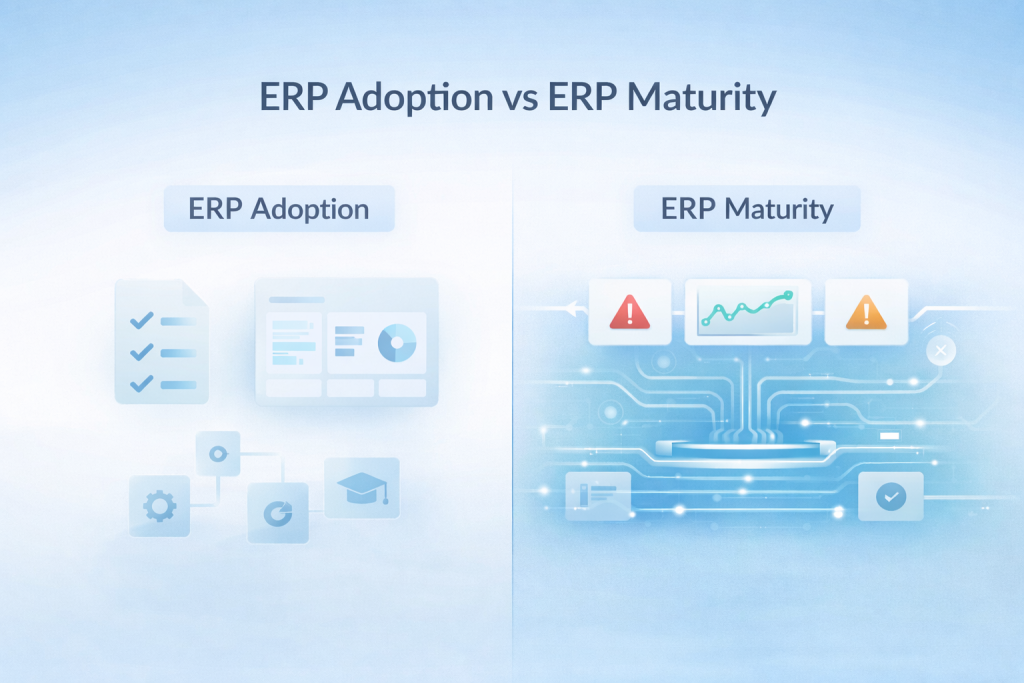
ERP adoption answers one question:
“Is the software installed and in use?”
ERP maturity answers a far more important one:
“Does the system actively improve institutional decision-making?”
In many universities, ERP stops at adoption. The system records transactions but does not influence outcomes. It captures data but does not create foresight. It stores information but does not reduce risk.
Mature ERP systems behave differently. They do not wait for reports to be generated. They surface issues early. They guide leadership attention. They reduce dependence on individuals.
This distinction is rarely discussed, yet it explains why similar ERP investments produce very different results across institutions.
The Hidden Ceiling Most University ERPs Hit

After initial implementation, most university ERP systems hit an invisible ceiling.
At this stage:
- Core workflows are digitized
- Users are trained at a functional level
- Basic reports are available
- Compliance requirements are technically met
But beyond this point, progress slows dramatically.
Why?
Because the ERP was never designed to support institution-wide intelligence, only process digitization.
Universities then compensate by adding:
- More tools
- More reports
- More manual coordination
- More people to “manage the system”
Ironically, the ERP meant to reduce complexity begins to add it.
Why Fragmentation Persists Even After ERP Implementation
Process Digitization Without Process Alignment
Many ERP implementations digitize existing workflows exactly as they are — including inefficiencies, exceptions, and inconsistencies.
When each department digitizes its own version of “how things work,” the ERP becomes a digital reflection of silos rather than a unifying force.
Without process alignment at the institutional level, ERP cannot create a single source of truth.
Data Visibility Without Decision Context
Universities often generate large volumes of data but struggle to answer simple leadership questions:
- Which students are at academic risk right now?
- Where are fee delays likely to escalate?
- Which departments are operationally overloaded?
- What compliance risks are emerging this semester?
The issue is not lack of data. It is lack of decision context.
ERP systems that stop at reporting force leadership to interpret data manually. Mature systems embed logic, thresholds, and alerts so leadership attention is directed automatically.
Over-Reliance on Individuals
In many institutions, ERP effectiveness depends on a few key people who “know how things really work.”
They reconcile data.
They handle exceptions.
They bridge gaps between departments.
When systems rely on people instead of logic, scalability suffers. Institutional memory becomes personal memory. Continuity becomes fragile.
True ERP maturity reduces this dependency by embedding institutional rules into the system itself.
How Mature Universities Think About ERP Differently
Institutions that move beyond ERP stagnation adopt a fundamentally different mindset.
They stop asking:
“What features does the ERP have?”
They start asking:
“What institutional behavior should the system enforce?”
This shift changes everything.
ERP as Governance Infrastructure
Mature universities treat ERP as governance infrastructure, not operational software.
This means:
- Rules are enforced consistently across departments
- Exceptions are visible, not hidden
- Accountability is systemic, not personal
- Leadership oversight is continuous, not periodic
ERP becomes a mechanism for institutional discipline rather than administrative convenience.
Intelligence Before Expansion
Instead of adding more modules or tools, successful institutions first strengthen intelligence.
They focus on:
- Early warning systems
- Automated alerts for deviations
- Predictive indicators, not historical summaries
- Real-time visibility into student and operational health
This aligns closely with concepts discussed in iCloudEMS’ perspective on early awareness systems in higher education, where ERP acts as a preventive layer rather than a reactive one.
Unified Lifecycle Thinking
Rather than treating admissions, academics, exams, finance, and placement as separate domains, mature institutions design ERP around the student lifecycle.
This ensures:
- Data continuity across years
- Reduced duplication
- Better academic and financial forecasting
- Improved student experience without added effort
This lifecycle-based design philosophy is foundational to long-term ERP success.
Why Cloud Alone Does Not Create ERP Maturity
Many universities assume that moving ERP to the cloud automatically improves outcomes. In reality, cloud infrastructure solves availability and scalability problems — not intelligence problems.
A cloud-hosted system with fragmented logic will still behave like a fragmented system.
What matters is:
- Whether the system is cloud-native
- Whether intelligence is embedded into workflows
- Whether real-time monitoring is designed into operations
This distinction is explored in iCloudEMS’ analysis of why cloud-based ERP alone is not enough for higher education.
ERP as an Institutional Nervous System
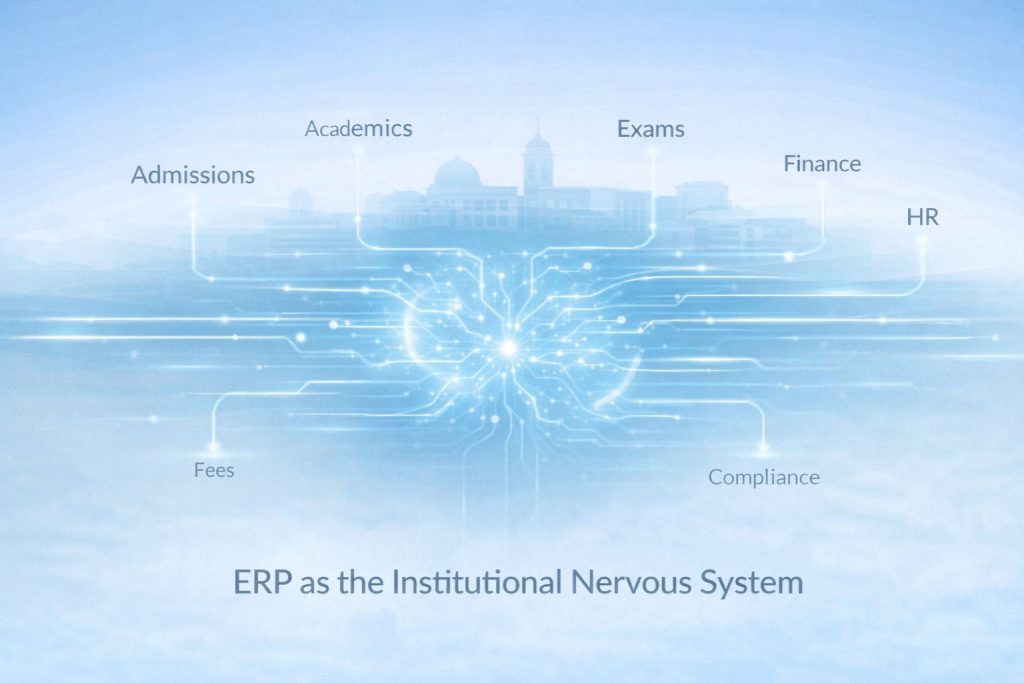
The most advanced universities treat ERP as an institutional nervous system.
Just as a nervous system:
- Detects signals early
- Prioritizes responses
- Coordinates actions across organs
A mature ERP:
- Detects risks early
- Prioritizes leadership attention
- Coordinates departments automatically
In this model, ERP does not replace people. It amplifies their effectiveness by reducing noise and delay.
Where iCloudEMS Aligns with Institutional Maturity
iCloudEMS is designed around this maturity-first philosophy.
Rather than focusing on isolated digitization, it emphasizes:
- Unified data architecture
- AI-driven alerts and monitoring
- Lifecycle-based design
- Governance-friendly workflows
- Cloud-native scalability for Indian higher education realities
This approach aligns with institutions seeking long-term institutional resilience, not short-term automation.
Final Thought: ERP Success Is a Maturity Journey
ERP success in universities is not binary. It is evolutionary.
Institutions that remain stuck at adoption experience frustration, fragmentation, and rising operational cost. Institutions that pursue maturity build systems that quietly support leadership, faculty, and students every day.
The difference lies not in the software alone, but in how the institution defines the role of ERP in its future.
Frequently Asked Questions
What does ERP maturity mean in higher education?
ERP maturity refers to how effectively an ERP system supports institutional decision-making, governance, and early risk detection—not just transaction recording.
Why do universities still rely on Excel after ERP implementation?
This usually indicates fragmented workflows, lack of unified data architecture, and ERP systems that digitize processes without enforcing institutional alignment.
Is cloud-based ERP enough for universities?
Cloud infrastructure improves scalability and access, but without embedded intelligence and lifecycle integration, it does not ensure ERP maturity.
How does AI improve university ERP outcomes?
AI enables early alerts, predictive monitoring, and proactive intervention—helping institutions address issues before they escalate.
What should universities prioritize after ERP implementation?
Universities should prioritize intelligence, governance alignment, and lifecycle integration rather than adding more tools or modules.
