
Best Examination Management System: What Universities Must Evaluate Before Choosing
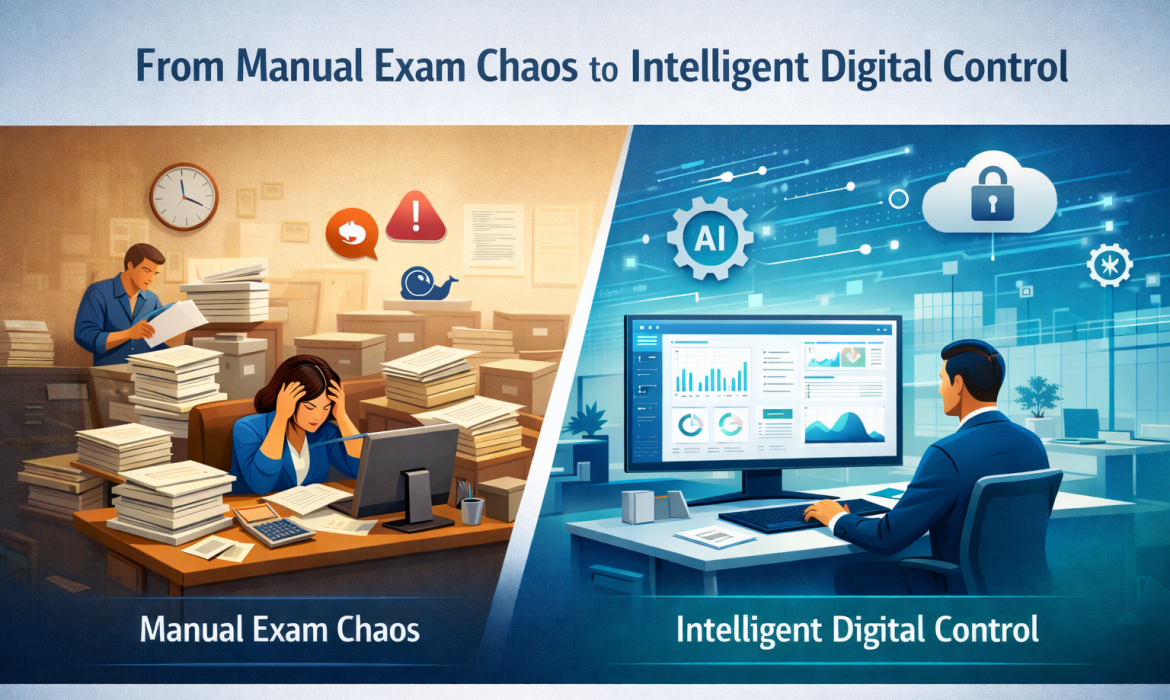
University examinations are no longer just an administrative activity — they directly influence institutional credibility. Yet many institutions still struggle with delayed results, fragmented workflows, and avoidable errors. This is where a modern Examination Management System becomes essential.
As academic complexity grows, university leaders are not simply looking for digitization. They want reliability, transparency, and intelligent control over the entire examination lifecycle. Institutions that continue to rely on partially manual processes often find themselves reacting to problems instead of preventing them.
The Growing Complexity of University Examinations
Examination management in higher education has evolved significantly. Universities today manage multiple programs, continuous internal assessments, large-scale semester exams, and strict compliance requirements simultaneously.
However, when systems remain disconnected, operational pressure increases. Many universities report challenges such as:
- Errors during marks entry or consolidation
- Limited real-time visibility into evaluation progress
- Heavy dependence on manual verification
- Difficulty maintaining audit readiness
- Delays in result declaration
Forward-looking institutions are therefore investing in structured digital ecosystems rather than isolated tools. Many leaders have already begun evaluating how an integrated Education Management System (EMS) can unify academic operations across departments.
Why Traditional Examination Processes Create Institutional Risk
Manual or semi-digital workflows may appear manageable at smaller scales. But as examination volumes grow, hidden risks begin to surface.
Error accumulation across stages
When examination data passes through multiple human checkpoints, discrepancies become almost inevitable. Even minor errors can trigger student grievances and administrative workload.
Limited transparency for leadership
Without centralized monitoring, tracking evaluation status, moderation changes, and approval flows becomes slow and reactive. This lack of visibility makes it difficult for leadership teams to intervene at the right time.
Result delays impact institutional reputation
In a competitive higher education environment, timely results are critical. Delays affect admissions planning, student progression, and placement cycles. Many universities exploring digital transformation have already recognized this shift through platforms such as online classes and exams management, which connect learning and assessment workflows more tightly.
How AI-Powered Examination Management Is Changing the Approach
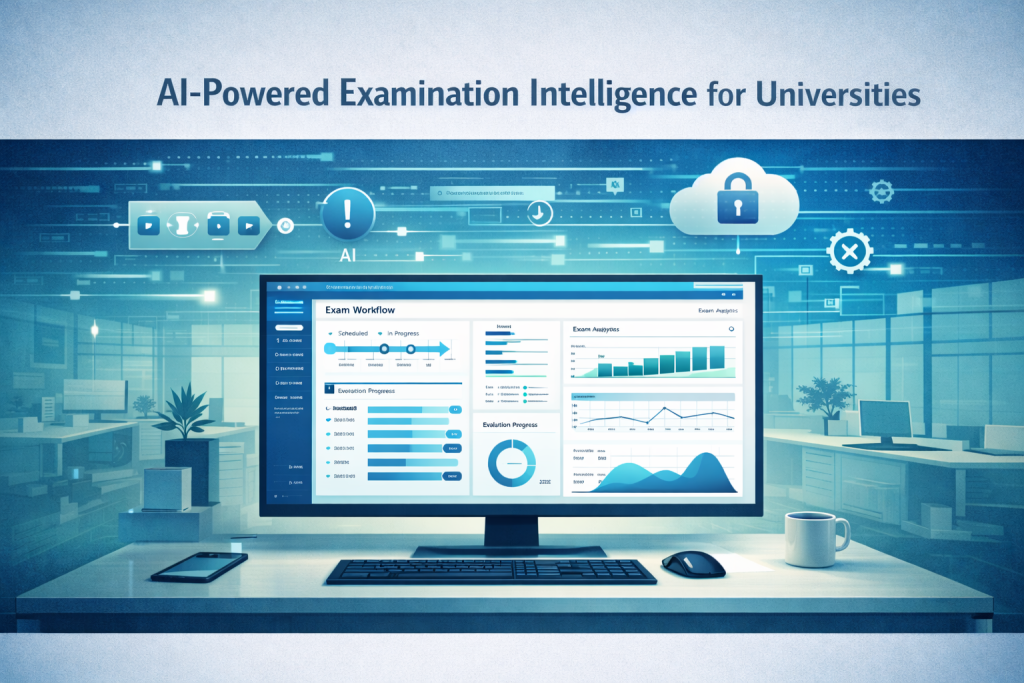
A modern Examination Management System for universities goes far beyond simple marks entry. With AI and automation embedded, the entire assessment lifecycle becomes more intelligent and predictable.
Intelligent workflow automation
Automation streamlines exam scheduling, hall ticket generation, digital evaluation, moderation, and result compilation. As a result, institutions reduce manual dependency while improving process speed.
Predictive monitoring and alerts
AI-enabled systems can flag missing marks, evaluation delays, and workflow bottlenecks early. Universities that have adopted predictive platforms often see the same benefits highlighted in this detailed guide on AI-powered learning management evolution.
Stronger examination integrity
Modern digital frameworks introduce structured access controls, encrypted data handling, and complete audit trails. These capabilities significantly strengthen institutional trust and compliance readiness.
What Universities Should Evaluate Before Choosing an Examination Management System
Selecting the right Examination Management System requires more than checking feature lists. University leadership must evaluate long-term institutional fit.
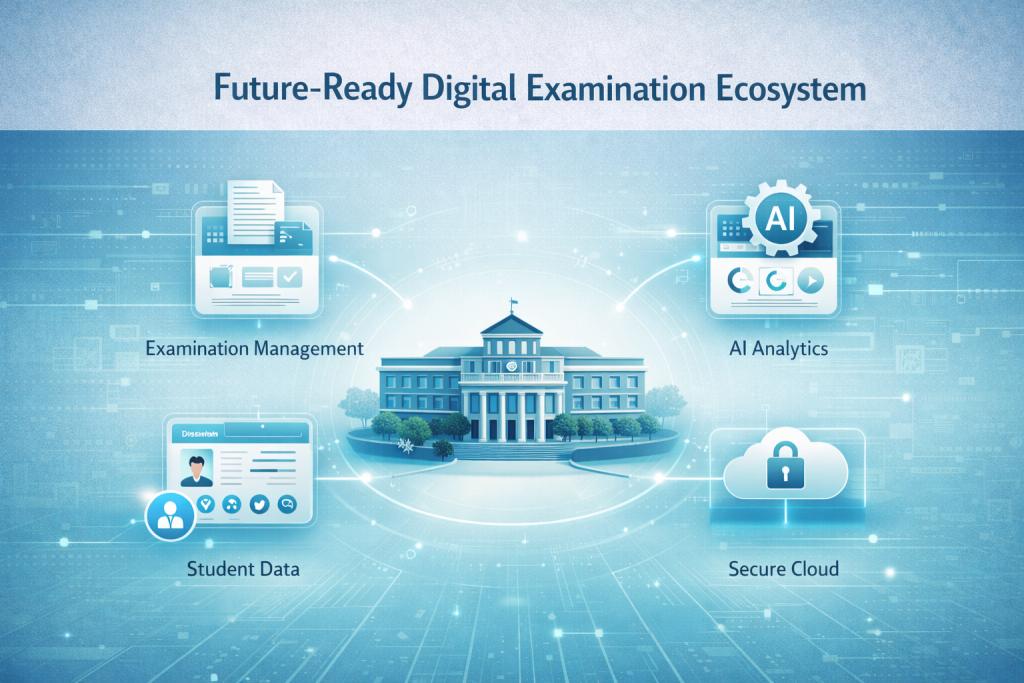
End-to-end examination coverage
The platform should support the full lifecycle — from pre-exam planning to post-result analytics. Fragmented tools often create more complexity than they solve.
AI-driven visibility
Modern institutions benefit from automated alerts, workflow intelligence, and real-time dashboards. Universities already moving toward outcome-based LMS environments are seeing how continuous academic visibility improves decision-making.
Cloud-native scalability
Universities evolve continuously. A cloud-based system ensures flexibility to handle growing data volumes, multi-campus operations, and regulatory changes without performance bottlenecks.
Seamless academic integration
An effective solution should work within the broader Digital solutions for higher education ecosystem. When examination workflows connect smoothly with admissions, academics, and accreditation, institutions gain true operational clarity. Many universities strengthening compliance readiness are already aligning examination data with accreditation management frameworks for better evidence tracking.
The Strategic Importance of Digital Solutions for Higher Education
Leading universities no longer treat examinations as isolated administrative tasks. Instead, they view assessment management as a strategic pillar of academic governance.
Adopting integrated digital platforms enables universities to:
- Gain real-time academic visibility
- Reduce operational friction
- Improve compliance readiness
- Strengthen stakeholder confidence
- Build scalable academic processes
Institutions modernizing their examination framework often extend the same intelligence across the student recruitment lifecycle, ensuring continuity from admission to graduation.
How iCloudEMS Supports Modern Examination Management
As universities accelerate digital transformation, iCloudEMS provides a unified and AI-powered approach to managing complex academic workflows.
Built as a cloud-native Education Management System (EMS), the platform helps institutions:
- Automate the complete examination lifecycle
- Monitor evaluation progress in real time
- Reduce manual intervention points
- Maintain structured audit trails
- Accelerate accurate result processing
Because iCloudEMS is designed specifically as Digital solutions for higher education, it connects examinations with academics, admissions, accreditation, and student success workflows within a single ecosystem. Universities exploring comprehensive modernization often review the broader capabilities available on the iCloudEMS platform before finalizing their digital roadmap.
The Road Ahead for University Examination Systems
Examination ecosystems are steadily moving toward predictive, connected, and intelligence-driven models. Universities are prioritizing systems that provide not just efficiency but foresight and governance clarity.
Institutions that invest in a robust Examination Management System today position themselves for:
- Stronger academic integrity
- Faster decision-making
- Better regulatory readiness
- Greater institutional confidence
The shift is no longer optional — it is becoming foundational to future-ready higher education.
Conclusion
Examination credibility remains one of the most visible indicators of institutional excellence. As universities grow in scale and complexity, fragmented or manual workflows introduce unnecessary risk.
A modern Examination Management System enables universities to move toward structured, transparent, and intelligence-driven assessment management. By combining automation, AI capabilities, and cloud scalability, institutions can significantly improve accuracy and operational confidence.
As part of the broader evolution toward Digital solutions for higher education, platforms like iCloudEMS are helping universities build examination ecosystems that are not only efficient but truly future-ready.
What do you think universities must prioritize first in examination transformation — speed, accuracy, or complete process visibility?
Frequently Asked Questions
What is an Examination Management System?
An Examination Management System is a digital platform that manages the complete examination lifecycle, including scheduling, evaluation, moderation, and result processing. It helps universities improve accuracy, transparency, and operational efficiency.
How does AI help in examination management?
AI improves examination management by providing predictive alerts, automated monitoring, and real-time workflow visibility. This helps universities detect delays early, reduce manual errors, and maintain stronger control over assessment processes.
Why are universities moving to digital examination systems?
Universities are adopting digital examination systems to manage growing assessment complexity, publish results faster, maintain audit readiness, and reduce dependency on manual processes.
What should universities look for in an Examination Management System?
Universities should evaluate end-to-end workflow coverage, AI-driven alerts, cloud scalability, strong security controls, and seamless integration with their Education Management System (EMS).
Is cloud-based examination management reliable for universities?
Yes. Modern cloud-based platforms use encryption, role-based access, and complete audit trails to ensure data security and reliability. When properly implemented, they significantly strengthen examination governance.
Why Every University Is Upgrading to an AI-Powered Learning Management System (LMS)
Universities are no longer asking whether digital learning matters.
They are asking how fast they can modernize.
Across higher education, institutional leaders are confronting a hard reality: traditional platforms cannot keep pace with evolving academic expectations. Students expect seamless digital learning. Faculty demand intelligent automation. Meanwhile, administrators need real-time academic visibility to make confident decisions.
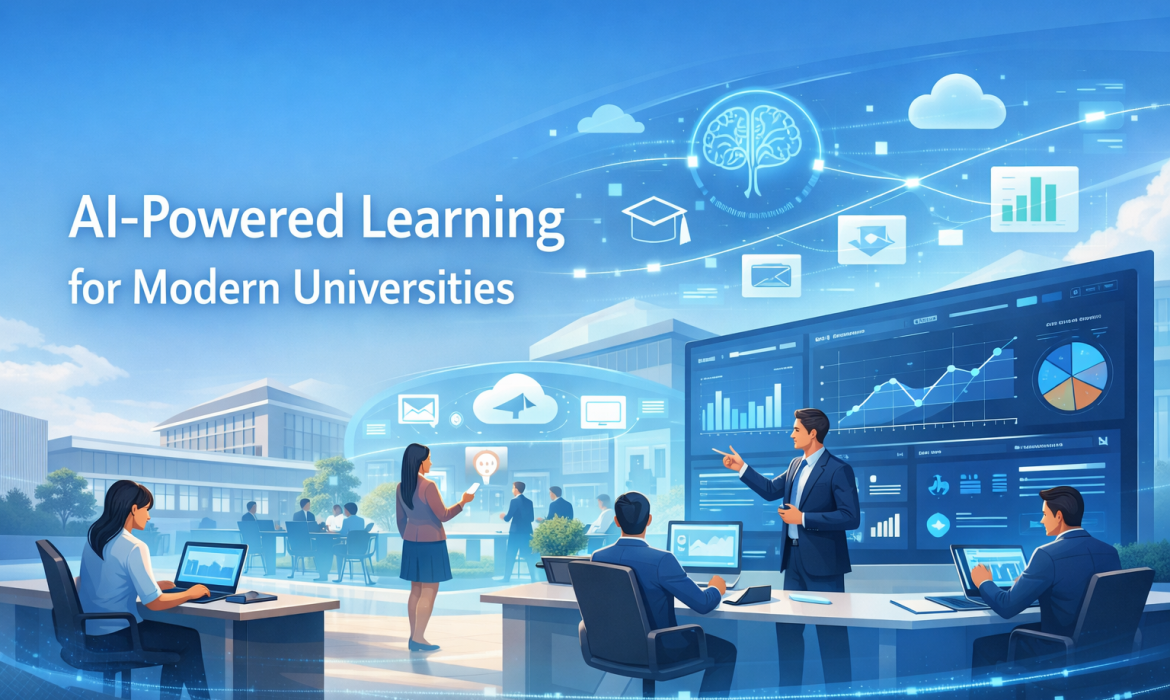
As a result, the shift toward an AI-Powered Learning Management System is accelerating. Universities are not simply upgrading software — they are redesigning the digital learning backbone that supports teaching, engagement, and outcomes.
The New Expectations from University Learning Environments
Higher education has entered a performance-driven era. Today’s institutions operate under pressure to improve retention, enhance learning quality, and deliver measurable academic outcomes. However, many legacy systems were never designed for this level of complexity.
Students now expect:
- Always-on access to course materials
- Mobile-first learning experiences
- Personalized academic support
- Faster feedback cycles
- Seamless digital interactions
Faculty expectations have also evolved. They want tools that reduce administrative burden while improving instructional effectiveness. Moreover, leadership teams require consolidated academic intelligence rather than fragmented reports.
Therefore, universities are rethinking the role of the modern Learning Management System for universities. It is no longer just a content repository — it must function as an intelligent academic engine supported by an integrated Education Management System (EMS).
What Defines an AI-Powered Learning Management System
A traditional LMS primarily manages content delivery and assignment tracking. In contrast, an AI-Powered Learning Management System introduces intelligence, prediction, and automation into the learning ecosystem.
At its core, an AI-enabled platform can:
- Analyze student engagement patterns
- Predict academic risk early
- Automate routine academic workflows
- Personalize learning pathways
- Provide real-time institutional insights
However, the true transformation occurs when the LMS operates as part of a unified Education Management System (EMS). When learning data connects with admissions, attendance, and examinations, universities gain a 360-degree academic view.
Forward-looking institutions are therefore investing in Digital solutions for higher education that combine learning intelligence with lifecycle visibility such as student recruitment lifecycle management.
Must-Have Capabilities Universities Now Demand
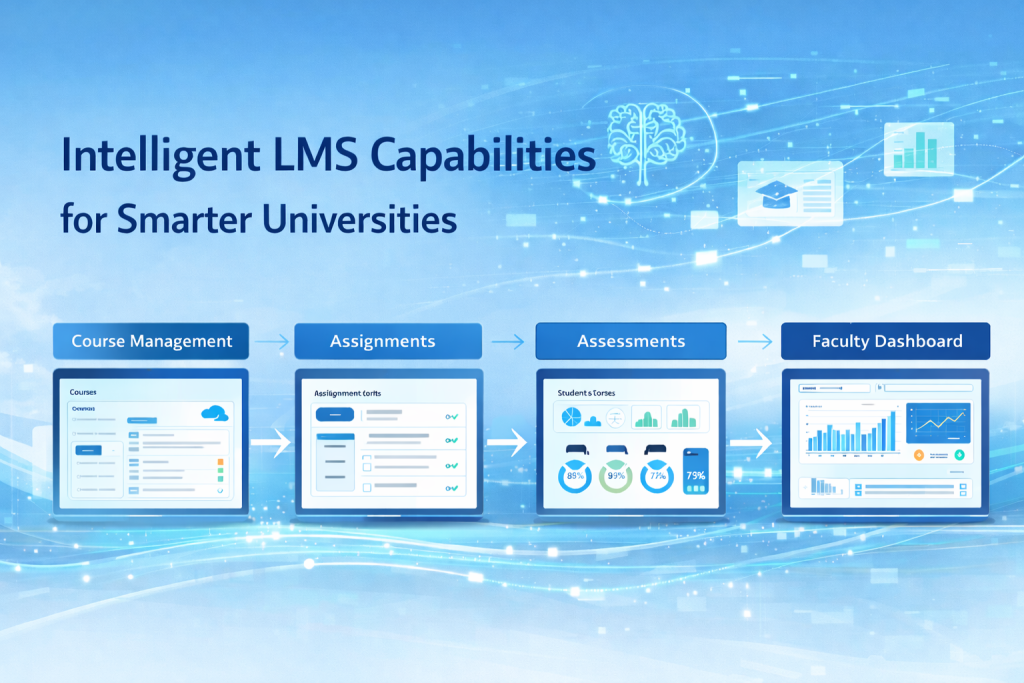
University decision-makers have become far more strategic in evaluating LMS platforms. Basic functionality is no longer sufficient. Instead, institutions are prioritizing intelligence, scalability, and ecosystem integration.
Predictive Academic Intelligence
Modern universities want early warning systems. An advanced AI LMS platform should identify:
- At-risk students
- Low engagement patterns
- Course-level performance gaps
- Attendance-risk correlations
Consequently, leadership teams can intervene before problems escalate — a challenge widely discussed in student risk detection strategies.
Unified Academic Visibility
Fragmented dashboards create confusion. Institutions now prefer a cloud-based LMS that integrates seamlessly within a broader Education Management System.
Key expectations include:
- Single academic view across departments
- Real-time performance monitoring
- Automated alerts for stakeholders
- Cross-functional data flow
This unified approach aligns with best practices in evaluating an Education Management System.
Automation-First Workflows
Manual academic processes slow institutions down. Therefore, universities increasingly demand automation in areas such as:
- Assignment workflows
- Evaluation cycles
- Course publishing
- Faculty notifications
- Student communications
Automation not only saves time but also reduces operational errors, as highlighted in AI-driven administrative automation.
Mobile-First Learning Experience
Today’s learners are mobile-native. As a result, the university learning platform must deliver:
- Responsive student portals
- Mobile assessments
- On-the-go faculty tools
- Instant notifications
Institutions that ignore mobile experience often see declining engagement, a pattern explored in AI-powered student portal strategies.
Strategic Advantages for Institutional Leadership
The decision to adopt an AI-Powered Learning Management System is no longer purely technical. It is strategic.
Improved Academic Governance
With AI-driven insights, administrators can monitor academic health continuously. Instead of reactive firefighting, institutions move toward proactive governance supported by modern AI-enabled academic management.
Data-Driven Decision Making
When learning analytics connect with institutional data, leaders can:
- Identify program effectiveness
- Optimize faculty workload
- Monitor student progression
- Forecast academic risks
Therefore, decisions become evidence-based rather than assumption-driven — addressing gaps often caused by limited student information visibility.
Scalable Digital Infrastructure
As universities expand programs and student populations, scalability becomes critical. A modern LMS in higher education must support institutional growth without performance bottlenecks.
Cloud-first ecosystems such as online classes and exams management demonstrate how scalable infrastructure supports uninterrupted academic delivery.
Stronger Compliance and Accreditation Readiness
Accreditation bodies increasingly expect documented academic processes. An intelligent platform automatically maintains audit trails, reports, and performance records.
Institutions pursuing stronger compliance maturity often align LMS strategy with accreditation management systems and improved institutional data readiness.
How Students and Faculty Experience the Transformation
Technology investments succeed only when end users feel the impact. Fortunately, AI-driven platforms deliver measurable improvements across the academic community.
Student Experience Improvements
Students benefit from:
- Personalized learning recommendations
- Early academic alerts
- Faster feedback cycles
- Centralized learning access
- Greater academic transparency
These improvements closely align with outcome-focused frameworks such as outcome-based education and a dedicated outcome-based LMS approach.
Faculty Experience Improvements
Faculty members experience:
- Reduced manual workload
- Automated grading assistance
- Better class performance insights
- Streamlined course management
- Improved student communication
Consequently, instructors can focus more on teaching quality rather than administrative overhead.
Warning Signs Your University Has Outgrown Its Current LMS
Many institutions continue using legacy platforms longer than they should. However, several indicators clearly signal the need for modernization.
Watch for these red flags:
- Faculty relying on external tools outside the LMS
- Delayed academic reporting cycles
- Limited mobile usability
- No predictive student alerts
- Manual intervention required for routine workflows
- Fragmented academic data across systems
- Difficulty scaling new programs
If multiple symptoms appear, the institution is likely operating below its digital potential — a maturity gap often seen in university system maturity challenges.
Future Trends Shaping AI-Driven Learning Ecosystems
The evolution of AI in higher education is only accelerating. Universities planning long-term digital strategy should pay attention to emerging shifts.
Hyper-Personalized Learning Paths
AI will increasingly tailor course journeys based on student behavior, performance, and learning style.
Continuous Academic Risk Prediction
Predictive models will move from periodic analysis to continuous monitoring, enabling near real-time intervention — similar to modern AI-enabled exam readiness systems.
Intelligent Faculty Assistants
AI will support instructors with automated content suggestions, assessment insights, and engagement recommendations.
Unified Digital Campus Architecture
Forward-looking institutions are moving toward fully integrated Digital solutions for higher education, where LMS, academics, finance, and student lifecycle systems operate as one ecosystem.
Universities that delay this transition risk falling behind more agile competitors.
How iCloudEMS Enables Intelligent Digital Learning
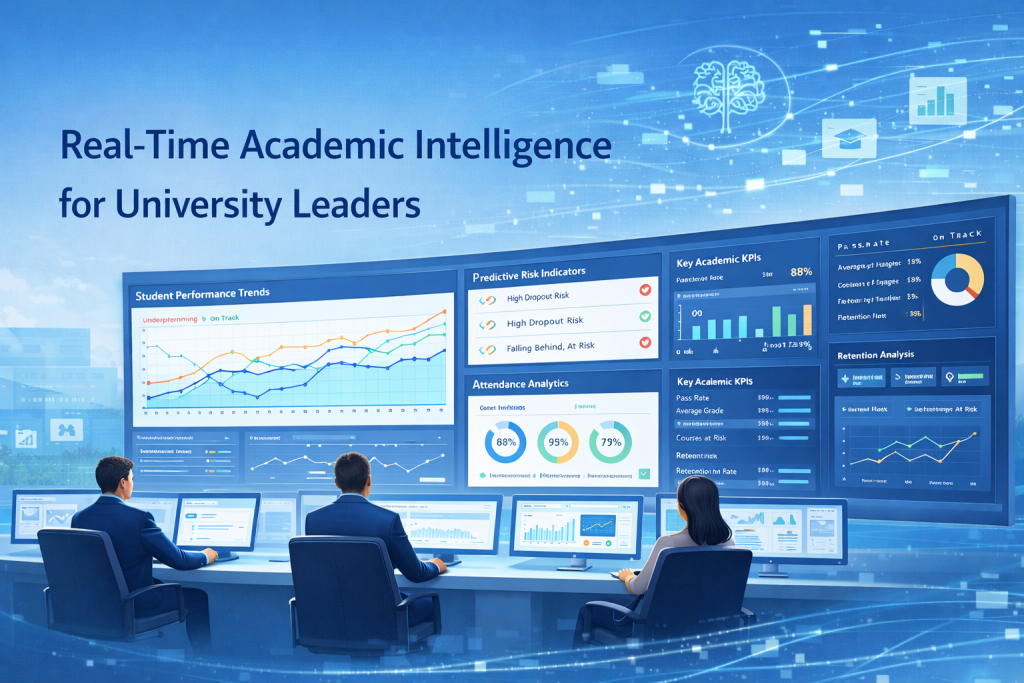
Institutions seeking a future-ready approach are increasingly adopting platforms that unify learning intelligence with institutional operations.
As part of its advanced Education Management System (EMS) framework, iCloudEMS delivers:
- AI-powered academic monitoring
- Cloud-native scalability
- Real-time performance alerts
- Integrated student lifecycle visibility
- Automation-driven academic workflows
- Mobile-first learning access
- Unified institutional dashboards
Importantly, iCloudEMS approaches the AI-Powered Learning Management System not as an isolated module but as a connected intelligence layer within the broader digital campus — including solutions for university management and college management.
Therefore, universities gain not just a learning platform, but a coordinated academic ecosystem designed for long-term institutional growth.
Conclusion: The Upgrade Is No Longer Optional
Higher education is entering an intelligence-driven decade. Universities that continue relying on static learning platforms may struggle to meet rising expectations from students, faculty, and regulators.
An AI-Powered Learning Management System is rapidly becoming the foundation of modern academic strategy. However, the real advantage emerges when the LMS operates within a unified Education Management System (EMS) supported by robust Digital solutions for higher education.
The question is no longer whether institutions will upgrade.
The real question is how prepared they are for the transition ahead.
How prepared is your institution for AI-driven learning transformation? Share your perspective and experiences.
Frequently Asked Questions
What is an AI-powered Learning Management System?
An AI-powered Learning Management System uses artificial intelligence to analyze student behavior, automate academic workflows, and provide predictive insights. Unlike traditional platforms, it enables proactive academic support, personalized learning experiences, and real-time institutional visibility for universities.
Why do universities need AI in LMS platforms?
Universities need AI in LMS platforms to move from reactive to proactive academic management. AI helps identify at-risk students early, improves engagement tracking, automates routine tasks, and provides leadership with data-driven insights that enhance academic outcomes and operational efficiency.
How does an LMS improve student outcomes?
A modern LMS improves student outcomes by centralizing learning resources, enabling continuous assessment, providing faster feedback, and supporting personalized learning paths. When enhanced with AI, it can also predict academic risks and trigger timely interventions that support student success.
What features should universities look for in an LMS?
Universities should prioritize AI-driven analytics, mobile accessibility, automation capabilities, real-time dashboards, seamless integration within an Education Management System (EMS), and cloud-native scalability. These features ensure the platform supports both current academic needs and future institutional growth.
How is iCloudEMS different from traditional LMS platforms?
iCloudEMS delivers an AI-powered Learning Management System as part of a unified Education Management System (EMS). Instead of operating as a standalone tool, it connects learning data with the broader digital campus, enabling real-time academic visibility, automation-driven workflows, and intelligent decision support for institutional leadership.
Is a cloud-based LMS better for universities?
Yes. A cloud-based LMS offers better scalability, remote accessibility, automatic updates, and reduced infrastructure burden. For universities managing complex academic operations, cloud deployment also supports faster innovation and stronger system reliability.
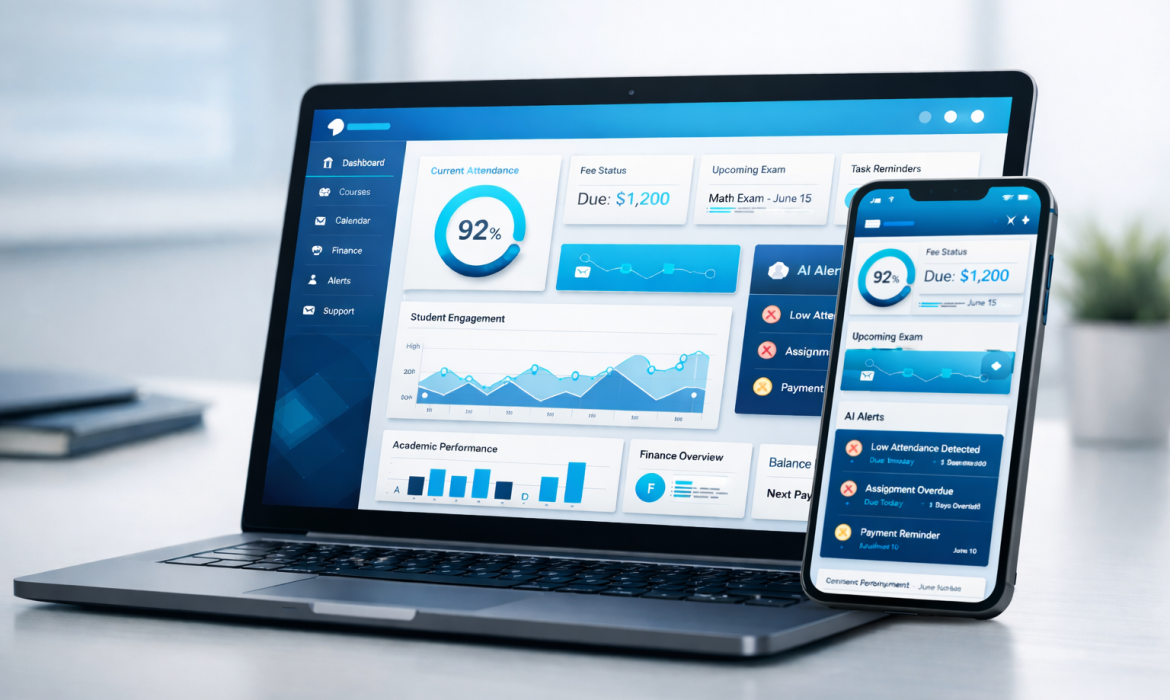
How an AI-Powered Student Portal Improves Student Experience and Retention
In today’s digital-first academic environment, the Student Portal has evolved from a basic information window into a strategic engine for institutional success. Universities that still rely on fragmented systems often struggle with delayed insights and reactive decision-making — a concern highlighted in this analysis of hidden gaps in traditional student information environments.
However, a modern AI-powered student portal changes the equation. It transforms disconnected student data into actionable intelligence, enabling institutions to deliver personalized support, proactive communication, and seamless digital experiences.
For university leaders focused on outcomes, the Student Portal is no longer just a convenience layer — it is a critical lever for improving both student experience and retention.
The Growing Pressure on Universities to Deliver Better Student Experiences
Higher education expectations have shifted dramatically. Students now compare their university experience with the digital convenience they receive elsewhere.
Yet many institutions still operate with:
- Fragmented student touchpoints
- Limited visibility into engagement patterns
- Manual follow-up processes
- Delayed academic risk identification
- Disconnected communication channels
As explored in the discussion on the silent dropout challenge, many risks remain invisible until it is too late.
Without real-time intelligence, even well-managed universities remain in reactive mode. This is where a modern university student portal powered by AI begins to create measurable impact.
What Defines a Modern AI-Powered Student Portal
A traditional portal typically acts as a static dashboard. In contrast, an AI-enabled Student Portal functions as an intelligent engagement layer that continuously analyzes student behavior, academic signals, and interaction patterns.
A modern student self-service portal should provide:
- Centralized access to academic, financial, and administrative data
- Real-time status updates across the student lifecycle
- Intelligent alerts and notifications
- Personalized dashboards for students and faculty
- Seamless mobile accessibility
- Cross-department data visibility
Institutions adopting Digital solutions for higher education through iCloudEMS are already seeing how unified intelligence changes campus decision-making.
How an AI-Powered Student Portal Elevates Student Experience

Student experience is shaped by speed, clarity, and personalization. When these elements are missing, frustration builds quietly across the campus ecosystem.
An AI-powered higher education student portal improves experience in several high-impact ways.
Real-Time Transparency Builds Student Trust
Students no longer want to chase departments for updates. With a modern portal:
- Attendance updates appear instantly
- Fee status is always visible
- Examination information is centralized
- Academic progress is continuously tracked
This level of visibility becomes even more powerful when integrated with intelligent finance workflows such as the AI-powered fee management approach.
Personalized Digital Journeys Increase Engagement
AI enables the Student Portal to move beyond one-size-fits-all dashboards. Instead, it can:
- Highlight pending student actions
- Recommend academic resources
- Surface important deadlines
- Provide contextual reminders
When combined with outcome-driven learning environments like the Outcome-Based LMS, universities can create deeply personalized academic journeys.
Frictionless Self-Service Reduces Administrative Dependency
Modern students expect autonomy. A well-designed student engagement platform allows them to:
- Download documents instantly
- Submit requests digitally
- Track approvals in real time
- Access learning resources on demand
Institutions modernizing their academic operations — as discussed in the future-ready academics management strategy — are seeing measurable reductions in administrative load.
Unified Communication Eliminates Information Gaps
One of the biggest experience failures in higher education is fragmented communication. An AI-enabled modern student portal centralizes:
- Academic notifications
- Fee reminders
- Institutional announcements
- Faculty communications
When paired with integrated online classes and exams management, communication becomes both timely and contextual.
The Direct Link Between Student Portal Intelligence and Retention
While experience improvements are visible, the deeper strategic value of a Student Portal lies in retention intelligence. Universities rarely lose students suddenly — warning signals usually appear months in advance.
AI helps institutions detect those signals early.
How AI-Powered Portals Strengthen Student Retention
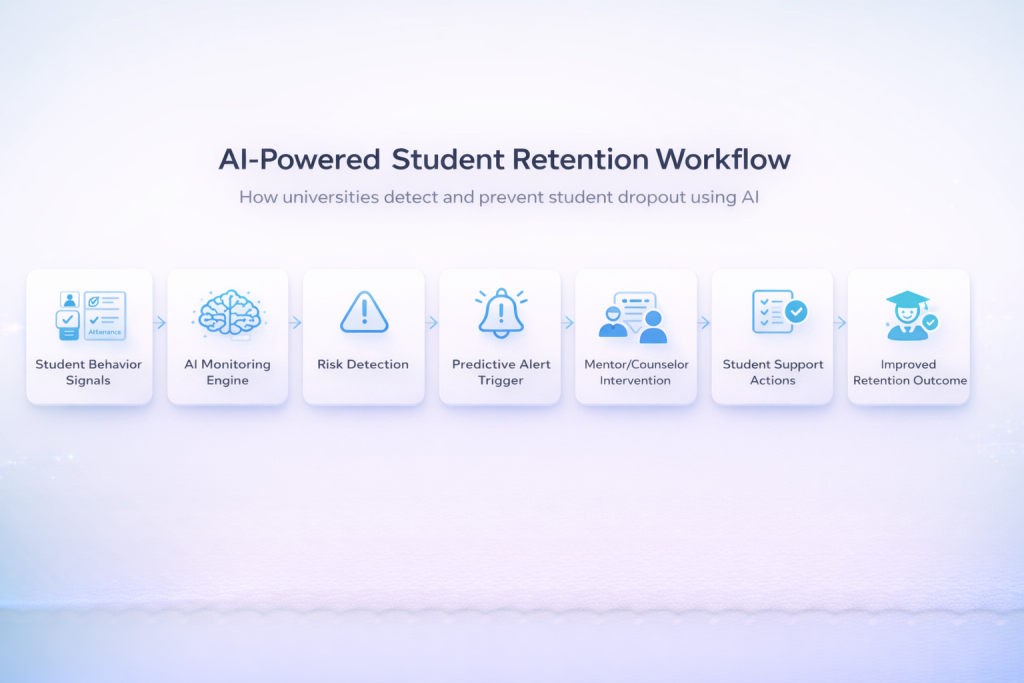
Early Risk Detection Through Behavioral Signals
An advanced AI-powered student portal continuously monitors patterns such as:
- Declining attendance
- Reduced portal activity
- Assignment delays
- Fee payment irregularities
- LMS engagement drops
These signals align closely with modern student recruitment and lifecycle management strategies.
Predictive Alerts Enable Proactive Intervention
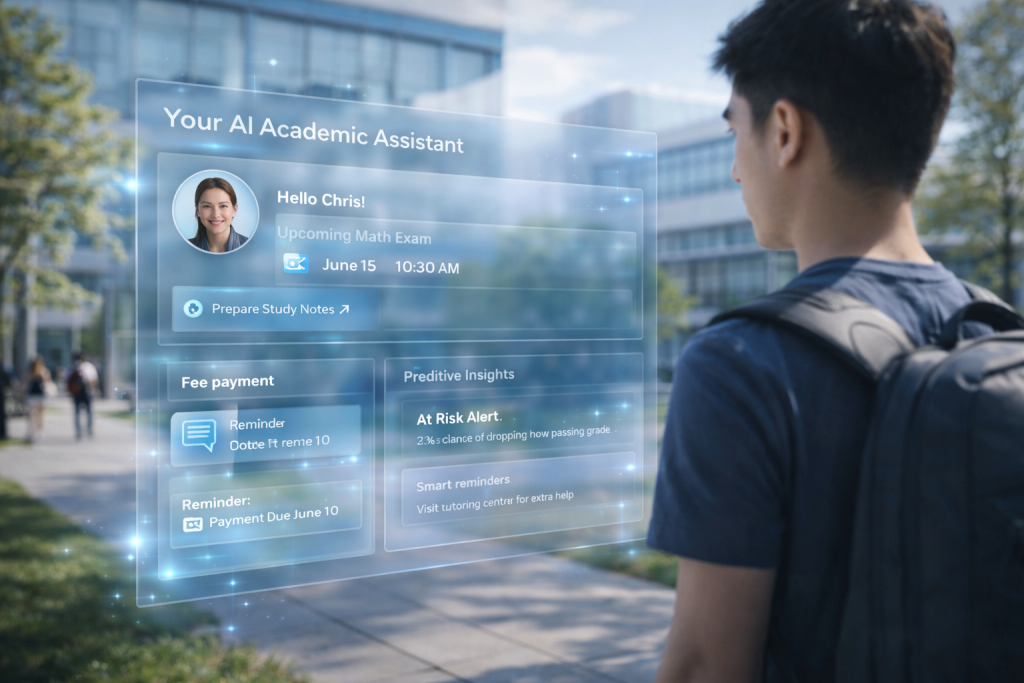
Instead of waiting for semester-end surprises, leadership teams receive:
- Automated risk alerts
- Engagement anomaly notifications
- Academic performance warnings
- Escalation triggers for counselors
This shift toward predictive operations reflects the broader evolution explained in the AI shift in university systems.
Data-Driven Retention Strategies Replace Guesswork
Historically, retention initiatives relied heavily on manual reviews. A modern Student Portal now provides:
- Cohort-level engagement analytics
- Department-wise risk heatmaps
- Intervention tracking dashboards
- Outcome-based retention insights
These capabilities strongly complement institutional quality frameworks supported by accreditation management systems.
Automated Workflows Ensure No Student Falls Through the Cracks
AI-powered workflows can automatically:
- Notify mentors
- Trigger counseling workflows
- Escalate unresolved issues
- Track follow-up completion
Institutions evaluating next-generation platforms often compare traditional approaches versus modern EMS capabilities in the EMS vs traditional systems comparison.
The Strategic Role of iCloudEMS in Enabling Intelligent Student Portals
Forward-looking universities are increasingly adopting Digital solutions for higher education that unify data, intelligence, and user experience.
The iCloudEMS Education Management System (EMS) provides a cloud-native, AI-powered Student Portal that enables institutions to:
- Achieve unified student visibility across departments
- Monitor engagement through intelligent dashboards
- Activate predictive alerts for at-risk students
- Deliver personalized digital experiences at scale
- Automate cross-campus workflows
- Maintain real-time operational transparency
Institutions exploring comprehensive modernization paths often review capabilities across both the university solution environment and the college solution environment to understand the full transformation scope.
The Future of the Student Portal: From Access Point to Intelligence Hub
The next generation of the Student Portal will not merely display information — it will actively guide student success.
We are already seeing the emergence of:
- AI copilots for student support
- Hyper-personalized academic pathways
- Predictive campus ecosystems
- Intelligent nudges for engagement
- Autonomous administrative workflows
Universities that modernize early will build stronger student relationships, while those that delay risk operating with blind spots in an increasingly data-driven education landscape.
Conclusion
The Student Portal has quietly become one of the most influential digital assets in higher education. When powered by AI, it delivers visibility, personalization, and predictive intelligence that directly impact student experience and retention.
For university leaders navigating rising expectations and competitive pressures, the real question is no longer whether a portal exists — but whether it is intelligent enough to support proactive student success.
Reflection
How effectively is your current Student Portal helping your institution identify disengaged or at-risk students early?
University leaders who are re-evaluating their digital student experience strategy often uncover significant improvement opportunities once they begin examining real-time engagement intelligence.
Key Questions University Leaders Ask
What is a student portal in higher education?
A student portal is a centralized digital platform that gives students secure access to academic records, fees, schedules, communication, and institutional services. Modern portals use AI to provide real-time insights, personalized dashboards, and proactive alerts that improve engagement and operational visibility.
How does an AI-powered student portal improve retention?
An AI-powered student portal improves retention by continuously analyzing behavioral and academic signals to identify at-risk students early. It generates predictive alerts, enables timely interventions, and helps universities track engagement trends so leadership teams can act proactively before disengagement turns into attrition.
Why do universities need a modern student portal?
Universities need a modern student portal to provide real-time transparency, seamless self-service, and unified communication. Traditional systems lack predictive intelligence, whereas AI-enabled portals help institutions monitor engagement, reduce administrative friction, and support data-driven decision-making across the student lifecycle.
What features should a university student portal include?
A robust university student portal should include real-time dashboards, AI-driven alerts, mobile accessibility, self-service workflows, unified communication tools, and cross-department data visibility. These capabilities ensure students receive timely information while administrators gain actionable insights into engagement and performance.
How does a student portal improve student engagement?
A student portal improves engagement by centralizing information, delivering personalized notifications, and simplifying access to academic and administrative services. When students can easily track progress, receive reminders, and interact digitally with the institution, their participation and satisfaction levels typically increase.
Can a student portal support personalized learning journeys?
Yes, AI-enabled student portals can support personalized learning journeys by analyzing academic performance, behavior patterns, and engagement data. The system can recommend resources, highlight risks, and surface relevant actions, helping institutions guide each student more effectively toward academic success.
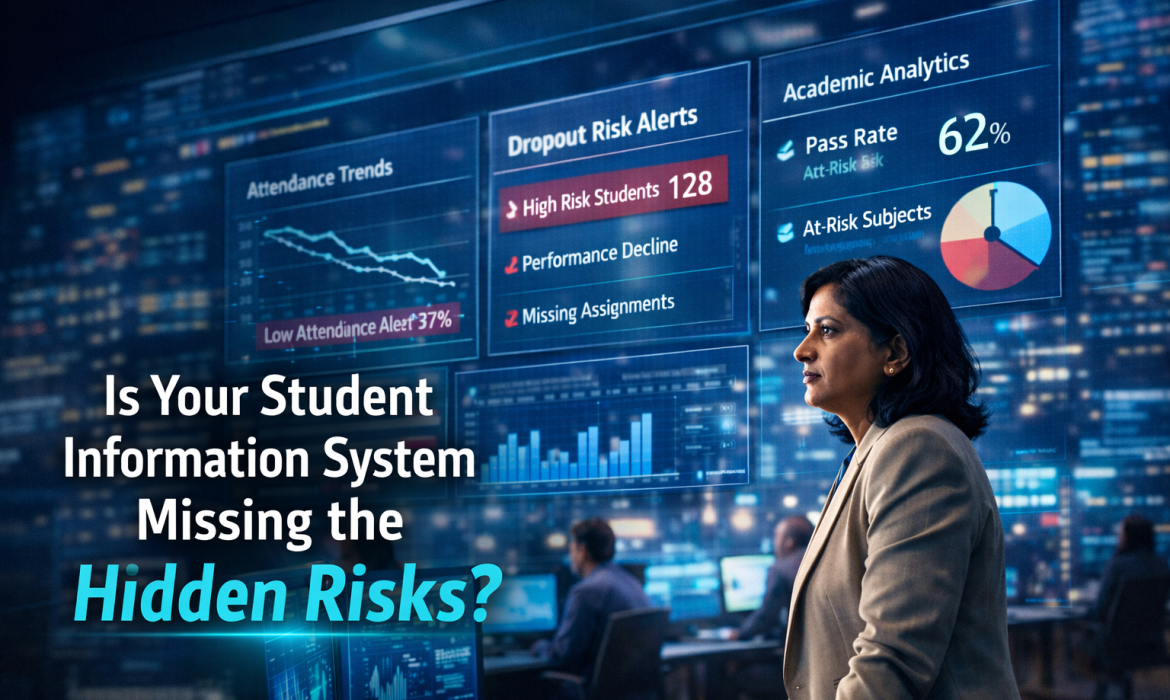
Your Student Information System Is Lying to You — Here’s What University Leaders Don’t See
Most universities believe their Student Information System works.
Admissions data gets stored. Attendance updates daily. Examination marks reflect in dashboards. Fee reports generate on time.
From a distance, everything appears structured.
But structure does not guarantee intelligence.
A Student Information System that only stores information without detecting institutional risk creates a dangerous illusion of control. University leaders often rely on dashboards that show stability while hidden inefficiencies grow silently beneath the surface.
The real question is not whether your Student Information System functions.
The real question is whether it protects institutional governance.
A Student Information System Must Evolve Beyond Data Storage
Historically, a Student Information System digitized administrative workflows. It replaced manual registers and disconnected spreadsheets.
Today, Digital solutions for higher education demand more.
A modern Student Information System must operate inside a unified ecosystem such as a cloud-native Education Management System (EMS) where admissions, academics, finance, lifecycle, accreditation, and evaluation operate in real time.
Leadership frameworks for evaluating institutional systems consistently emphasize integration, scalability, and predictive capability as non-negotiable criteria. A fragmented platform cannot support executive decision-making at scale.
If your Student Information System cannot:
- Detect academic risk early
- Flag financial exposure
- Integrate lifecycle data
- Support accreditation workflows
- Generate predictive alerts
Then it operates as a digital archive, not a governance engine.
Fragmented Student Data Creates Invisible Institutional Risk
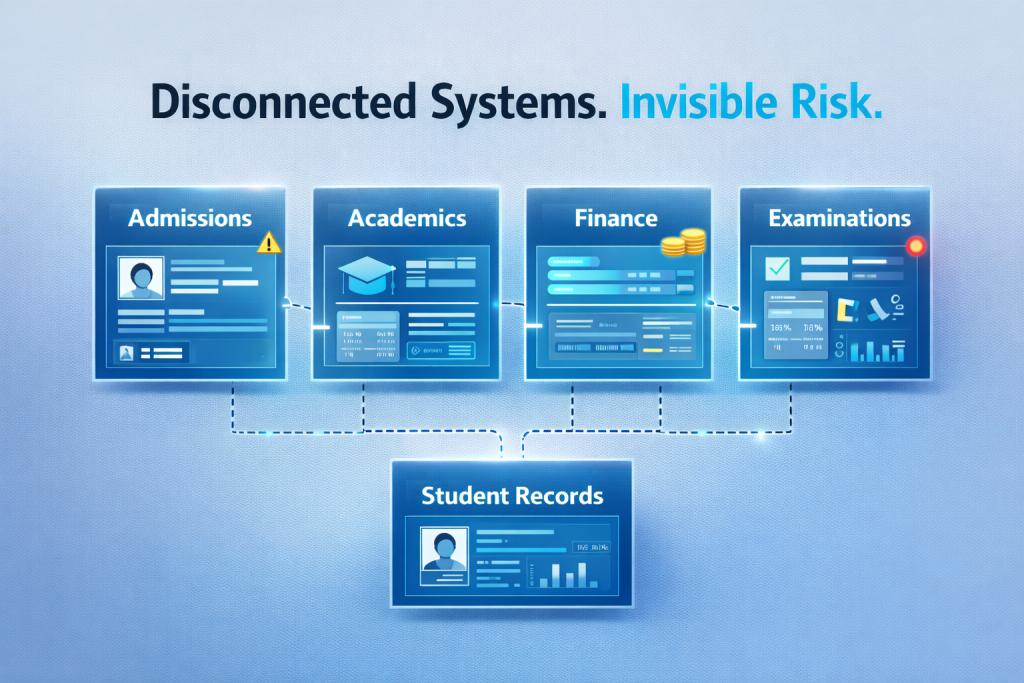
Many institutions still operate across departmental silos:
- Admissions handles recruitment separately
- Academics track performance independently
- Finance reconciles fees manually
- Examination cells manage isolated records
Without structured student recruitment lifecycle management, the student journey breaks into disconnected segments.
When inquiry, enrollment, progression, and alumni tracking fail to align within one Student Information System, the institution loses visibility.
Lifecycle fragmentation leads to:
- Duplicate student records
- Attendance inconsistencies
- Manual grade adjustments
- Fee reconciliation delays
- Delayed intervention in disengagement
A centralized lifecycle intelligence framework, as explored in student lifecycle automation strategies, strengthens data continuity across the entire academic journey.
Disconnected systems increase workload. Integrated systems increase clarity.
When Dashboards Show Stability but Risk Is Rising
University dashboards typically display:
- Enrollment totals
- Fee collection summaries
- Attendance percentages
- Examination outcomes
These metrics describe the present.
They rarely forecast disruption.
Gradual disengagement, performance decline, and dropout probability often remain invisible until they become irreversible. Institutions that fail to monitor early risk signals experience delayed intervention.
The pattern of missed warning signs becomes clear when analyzing early disengagement detection challenges in siloed systems.
An AI-powered Student Information System must detect anomalies before institutional damage occurs.
Without predictive intelligence, leadership relies on retrospective reporting instead of proactive governance.
Compliance and Accreditation Demand Data Integrity
Accreditation bodies expect structured, verifiable, and audit-ready data.
If your Student Information System requires manual compilation before evaluation cycles, institutional exposure increases.
Modern compliance readiness depends on:
- Automated audit logs
- Timestamped academic tracking
- Outcome mapping
- Secure documentation workflows
Institutions adopting structured accreditation management automation reduce regulatory friction and improve data transparency.
Data fragmentation often affects accreditation scores more than academic quality itself. Addressing accreditation data intelligence gaps requires systemic integration rather than surface-level reporting.
A Student Information System must embed compliance intelligence at its core.
Academic Intelligence Requires LMS and Evaluation Integration
A Student Information System cannot operate in isolation from learning systems.
Institutions implementing outcome-based learning analytics gain measurable visibility into curriculum alignment and academic performance.
Similarly, structured online classes and examination management ensures transparency in assessments, digital evaluation, and result processing.
When learning delivery, examination workflows, and student progression data integrate within one Student Information System, academic governance strengthens.
Without LMS integration, student performance insights remain incomplete.
Financial Visibility Must Align with Academic Progression
Academic data alone does not define institutional stability.
Financial intelligence plays an equally critical role.
Institutions implementing predictive AI-powered fee tracking systems gain early visibility into revenue exposure and payment behavior patterns.
When fee data integrates directly into the Student Information System, leadership can:
- Identify high-risk receivables
- Correlate disengagement with financial stress
- Reduce manual reconciliation
- Improve revenue forecasting
Separating academic and financial systems weakens strategic oversight.
From Legacy ERP to Intelligent Governance
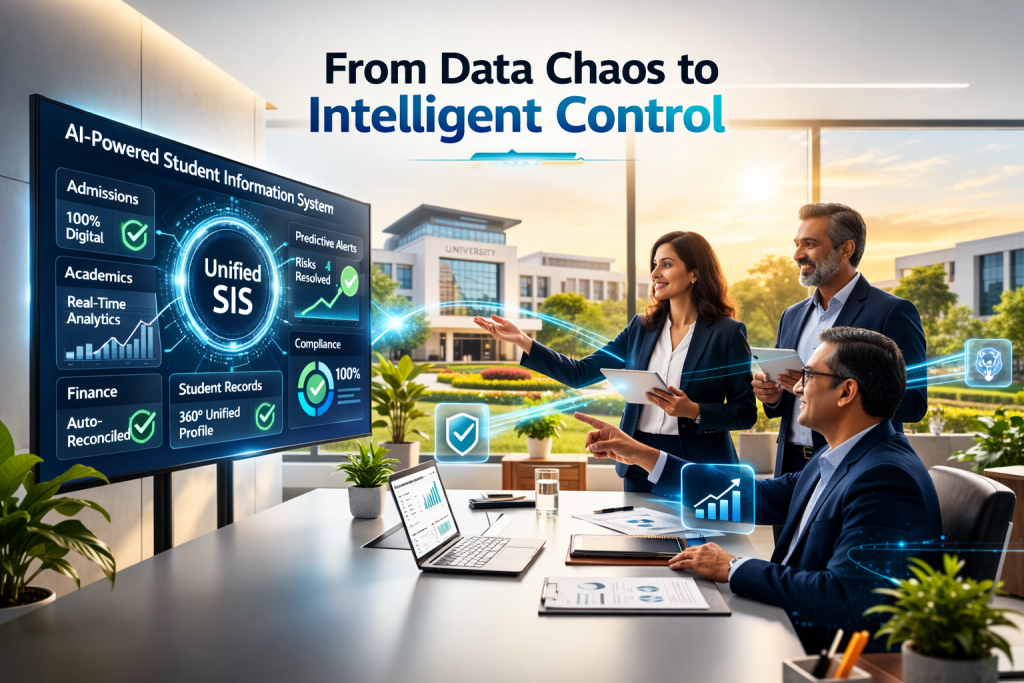
Many institutions still operate within legacy university ERP environments or traditional college ERP systems focused primarily on process automation.
However, the sector increasingly recognizes the shift toward AI-driven decision automation as essential for governance maturity.
A modern Student Information System embedded within an intelligent Education Management System (EMS) transforms operational data into institutional foresight.
Process automation is no longer sufficient.
Predictive intelligence defines the next evolution.
Infrastructure and Cybersecurity Cannot Be Secondary
Cloud adoption alone does not guarantee protection.
Universities must implement structured advanced cybersecurity frameworks for higher education systems to ensure data integrity.
A cloud-native Student Information System should provide:
- Real-time synchronization
- Secure role-based access
- Encrypted data storage
- Automated backups
- Audit-ready traceability
Infrastructure resilience strengthens governance confidence.
The Strategic Question University Leaders Must Ask
Most institutions ask:
“Does our Student Information System work?”
A more strategic question would be:
“Does our Student Information System prevent risk before it becomes visible?”
If leadership still depends on manual correction, delayed alerts, or disconnected dashboards, the system may be documenting risk instead of preventing it.
Modern Digital solutions for higher education demand predictive intelligence, lifecycle integration, financial alignment, accreditation automation, and secure cloud architecture within one unified ecosystem.
A Student Information System must evolve from administrative software into institutional intelligence infrastructure.
How does your institution currently evaluate the maturity of its student data systems?
Leadership Questions About Student Information Systems
1. What defines a modern Student Information System?
A modern Student Information System integrates admissions, academics, finance, lifecycle tracking, and compliance workflows inside a unified Education Management System (EMS).
2. Why is predictive intelligence critical?
It identifies academic decline, dropout probability, and financial exposure before damage occurs.
3. How does LMS integration improve governance?
Outcome-based learning analytics align curriculum, assessment, and performance tracking within the Student Information System.
4. What risks exist in fragmented systems?
Duplicate data, audit exposure, delayed intervention, and inaccurate reporting weaken institutional control.
5. How does financial integration enhance insight?
Aligned fee and academic data enable early detection of revenue and engagement risks.
6. Why is cloud architecture essential?
It ensures secure access, scalability, synchronization, and audit readiness.
7. Can a Student Information System improve accreditation readiness?
Yes. Structured data architecture and automated documentation streamline regulatory evaluation.
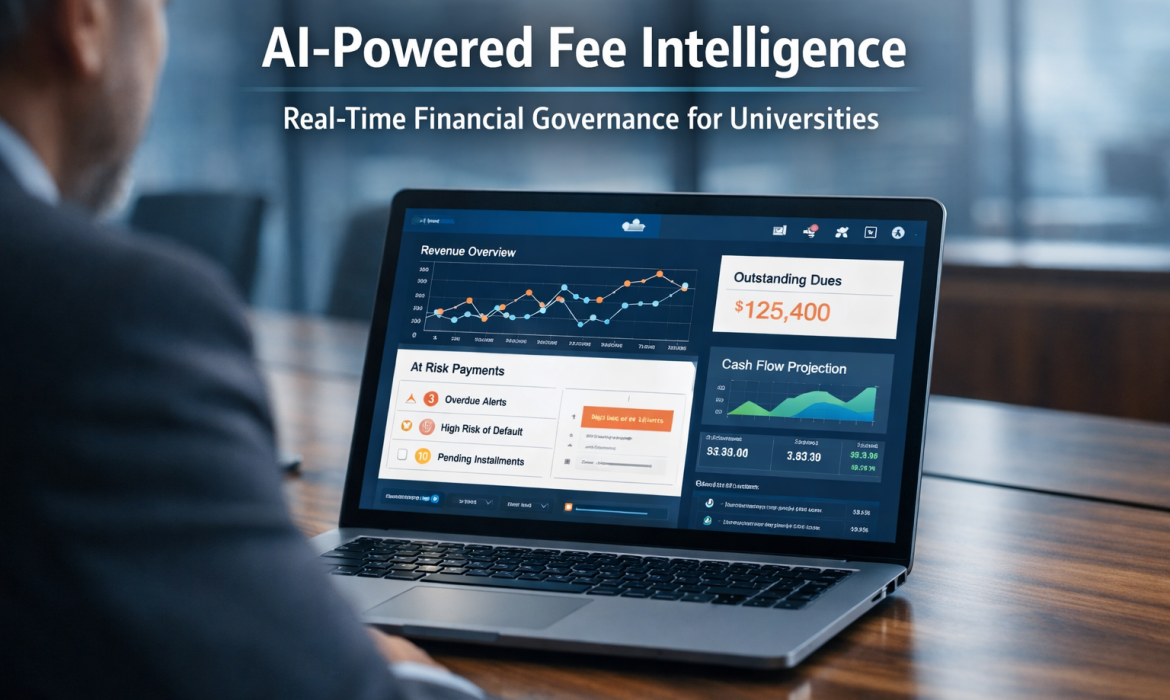
Transforming University Finance Through an AI-Powered Fee Management System
University finance is no longer a back-office function. It directly influences institutional stability, accreditation readiness, and long-term sustainability. However, many institutions still rely on semi-digital fee processes, delayed reconciliation, and reactive tracking models.
An AI-Powered Fee Management System for Universities redefines this structure. Instead of merely collecting payments, it builds predictive intelligence into financial governance. Moreover, when embedded within a unified Education Management System (EMS), it strengthens Digital solutions for higher education across departments.
Financial digitization is no longer about convenience. It is about institutional control.
The Hidden Risk Inside Traditional Fee Systems
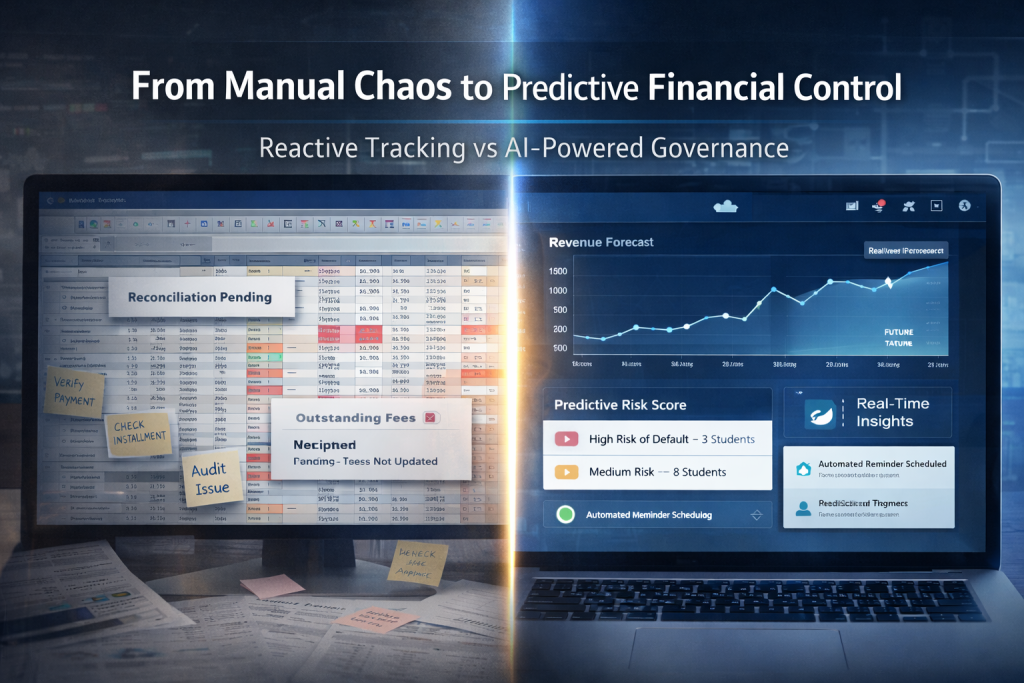
Most universities offer online payments. Yet digital transactions alone do not create financial visibility.
Manual reconciliation, spreadsheet dependency, and fragmented dashboards create:
- Revenue leakage
- Delayed financial forecasting
- Limited audit readiness
- Compliance exposure
- Student dissatisfaction due to unclear fee tracking
As discussed in our analysis on legacy university systems, fragmented data architectures often prevent institutions from reaching operational maturity.
Therefore, the real challenge is not payment collection. It is intelligent orchestration.
The Evolution Toward an AI-Powered Fee Management System for Universities
An AI-Powered Fee Management System for Universities transforms static finance operations into predictive ecosystems.
AI-driven fee analytics identify:
- High-risk delayed payment patterns
- Installment default probability
- Scholarship impact forecasting
- Seasonal cash flow variations
Consequently, finance leaders gain foresight rather than reactive insight.
This predictive approach mirrors how AI now supports academics and lifecycle tracking, as explored in our work on student lifecycle management. When institutions connect financial data with behavioral analytics, risk detection becomes proactive.
Automation does not replace teams. It empowers them.
Cloud-Based Financial Governance and Real-Time Dashboards
AI intelligence must operate on scalable infrastructure. Therefore, cloud-native architecture becomes essential.
A cloud-based fee management system ensures:
- Real-time revenue dashboards
- Instant reconciliation across gateways
- Secure payment processing
- Centralized compliance visibility
- Anywhere access for authorized stakeholders
As emphasized in our insights on cloud security in higher education, institutions require more than hosting—they require encrypted governance frameworks.
Meanwhile, centralized dashboards allow leadership to align budgets with live revenue data. This shift transforms financial reporting into strategic intelligence.
Predictive Alerts and Intelligent Automation
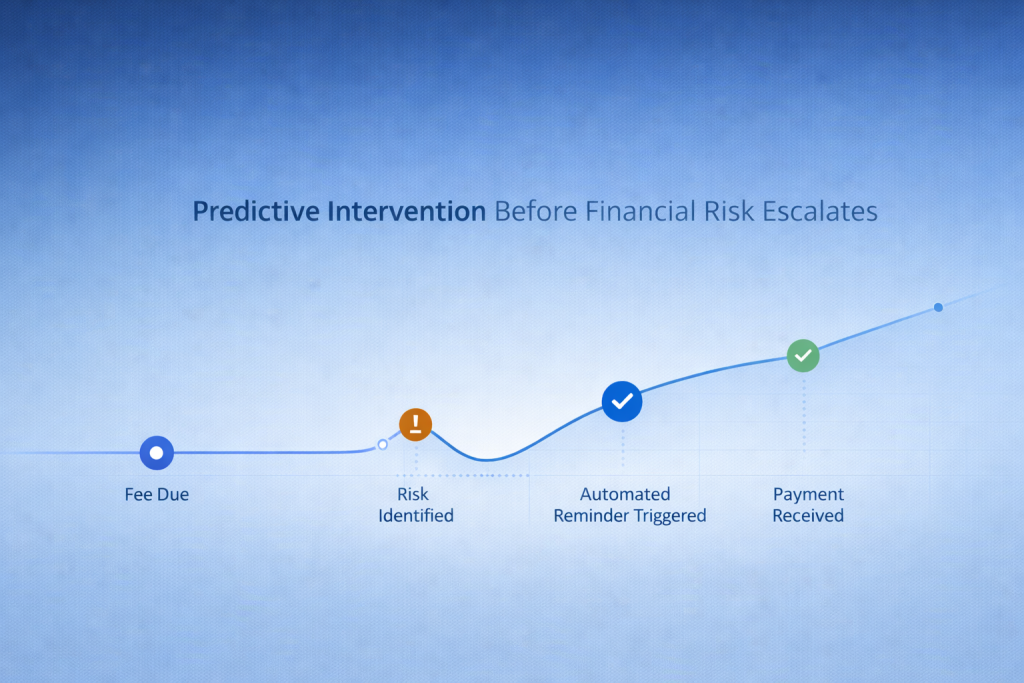
Traditional reminder systems follow fixed schedules. However, predictive fee defaulter alerts adapt to real-time behavior.
For instance:
- AI flags potential delays early
- Contextual reminders trigger automatically
- Installment plans adjust dynamically
- Finance heads receive priority exception alerts
Therefore, institutions improve collection rates without creating friction.
This predictive logic reflects the same AI-enabled readiness philosophy used in exam preparation analytics, where early detection improves outcomes.
Intelligence always outperforms reaction.
Eliminating Reconciliation Chaos Through Digital Precision
Manual reconciliation consumes administrative hours. More importantly, it introduces avoidable risk.
An intelligent fee reconciliation engine:
- Matches payments across gateways instantly
- Aligns scholarships and concessions automatically
- Flags discrepancies in real time
- Maintains transparent audit trails
Consequently, audit readiness improves without additional workload.
As institutions have learned from accreditation data challenges, governance failures rarely stem from absence of effort. They stem from fragmented systems.
Precision eliminates fragmentation.
Connecting Fee Intelligence With the Academic Ecosystem
Finance does not operate in isolation. It influences admissions, course registration, examination access, and accreditation documentation.
When integrated with:
- student recruitment lifecycle management
- Outcome-Based LMS
- online classes and examination systems
- accreditation management workflows
Fee data becomes part of a unified governance model.
Moreover, institutions transitioning from traditional college ERP systems to modern EMS architectures experience stronger operational coherence.
Digital solutions for higher education require interconnected intelligence—not isolated modules.
Leadership-Level Decision Intelligence

University boards and finance committees require forward-looking insights.
An AI-Powered Fee Management System for Universities provides:
- Cash flow projections
- Department-wise revenue mapping
- Predictive defaulter modeling
- Scholarship impact dashboards
- Compliance monitoring visibility
Therefore, leadership decisions become data-backed rather than assumption-driven.
When fee management integrates within iCloudEMS, financial governance aligns seamlessly with academics, examinations, and institutional reporting.
Digital transformation becomes measurable.
A Strategic Reflection for Institutional Leaders
If your university still reconciles fees manually or tracks defaulters reactively, what invisible risks remain buried in spreadsheets?
And more importantly — does your finance system generate intelligence, or only transactions?
The institutions that will lead the next decade of higher education will not merely digitize payments. They will operationalize predictive financial governance.
Frequently Asked Leadership Questions
What is an AI-Powered Fee Management System for Universities?
It is a predictive financial automation platform that analyzes payment behavior, triggers intelligent alerts, automates reconciliation, and provides real-time dashboards within a unified Education Management System (EMS).
How does cloud-based fee management improve institutional governance?
Cloud infrastructure centralizes financial data, enables secure access, strengthens compliance tracking, and delivers real-time reporting. Consequently, leadership gains continuous visibility into institutional cash flow.
Why are predictive fee defaulter alerts critical?
Predictive alerts identify potential payment delays before they disrupt revenue cycles. Therefore, finance teams intervene early and reduce collection risk while preserving student relationships.
How does fee intelligence support accreditation and compliance?
Automated audit trails and centralized reporting simplify documentation for regulatory bodies. When connected with accreditation workflows, financial transparency strengthens institutional credibility.
How does fee management integrate with broader Digital solutions for higher education?
When embedded inside a unified Education Management System (EMS), fee operations align with admissions, academics, examinations, and compliance. This integration creates a cohesive institutional ecosystem.
If you are evaluating your institution’s financial transformation roadmap, what strategic capability matters most—automation, predictive alerts, or real-time governance visibility?
Your answer will define the next stage of institutional maturity.
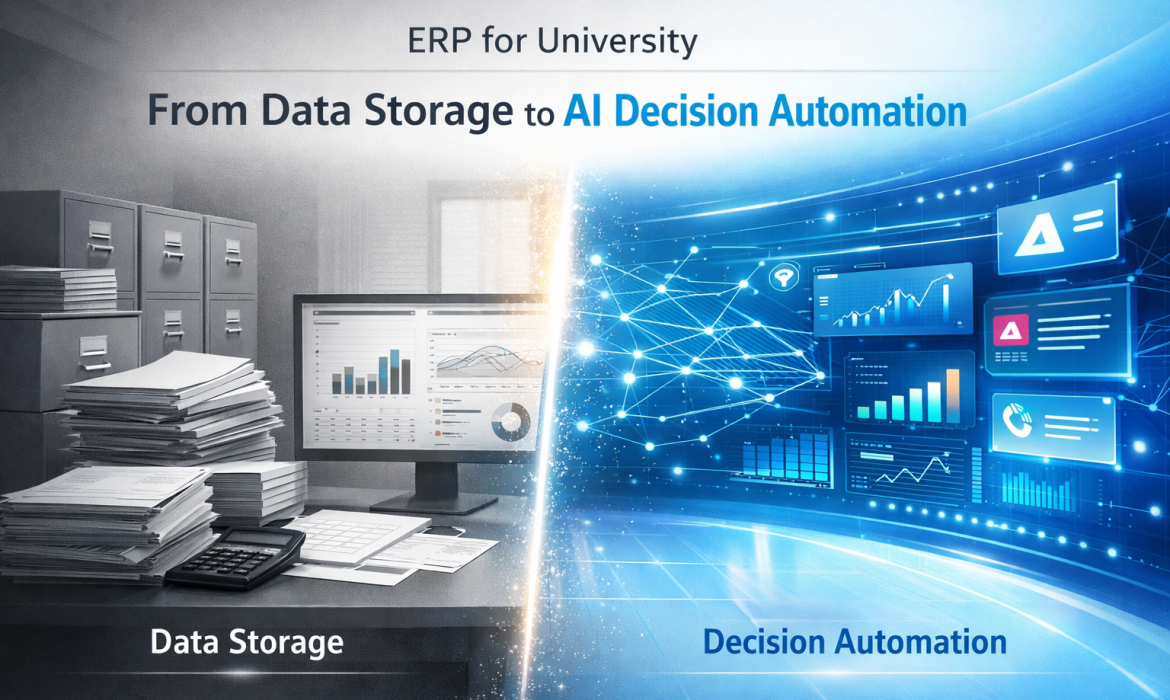
ERP for University and the AI Shift: From Data Storage to Decision Automation
Universities initially adopted ERP for university systems to centralize operations, digitize workflows, and eliminate manual inefficiencies. A structured university ERP system helped institutions unify admissions, academics, finance, and examinations under one digital framework.
That was the first phase of transformation.
Today, the expectation is different.
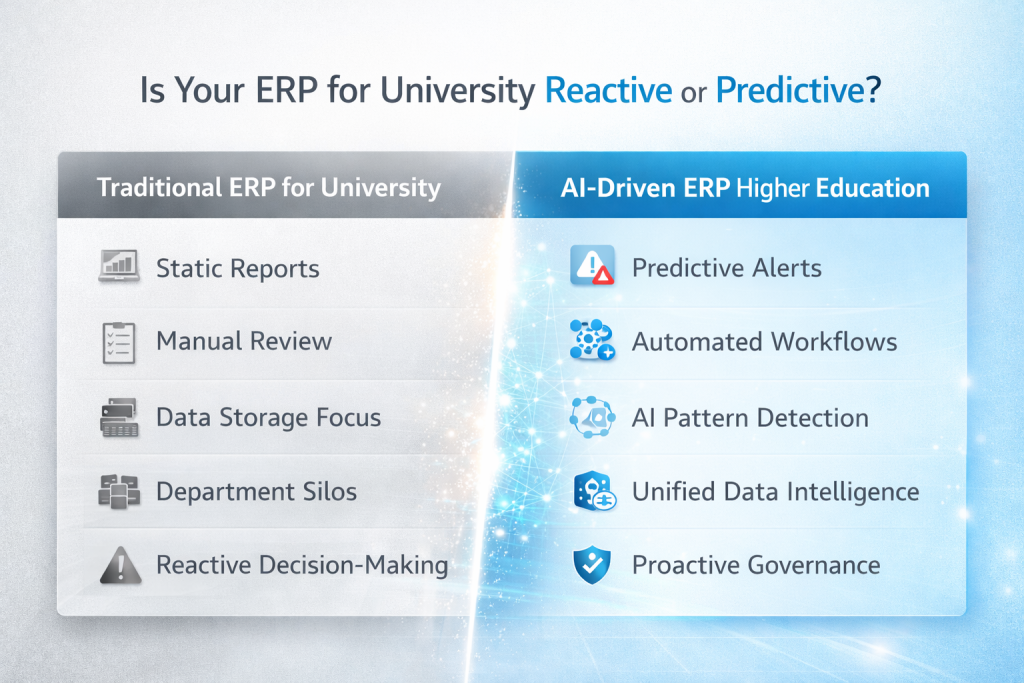
An ERP for university can no longer function as a data warehouse. It must operate as a decision engine.
This is where the AI shift in ERP higher education begins.
The Traditional ERP University Model: Centralized but Reactive
Most early ERP university platforms focused on:
- Admission tracking
- Fee collection
- Examination management
- Payroll and HR
- Compliance reporting
These systems improved traceability. They reduced paperwork. They streamlined coordination.
But they remained reactive.
Institutions facing ERP maturity challenges often discover that centralized systems still fail to deliver institutional visibility. Fragmented architecture limits foresight.
A traditional university ERP software solution tells leadership what already happened.
It rarely indicates what might happen next.
Why ERP University Systems Are Reaching Their Ceiling
University leadership must manage:
- Retention instability
- Accreditation pressure
- Financial volatility
- Digital examination complexity
- Outcome-based academic frameworks
Many institutions experience operational blind spots because their university ERP system lacks predictive intelligence. Governance visibility gaps slow decision-making, especially during audits and accreditation cycles.
Without AI-driven support, even a robust higher ed ERP remains dependent on manual analysis.
This dependency creates risk.
The AI Shift in Higher Ed ERP
The AI shift transforms ERP higher education from record-keeping to proactive governance.
Modern ERP higher ed systems embed:
- Predictive alerts
- Risk flagging
- Automated workflows
- Pattern recognition
For example, intelligent systems can detect early disengagement signals using structured early awareness mechanisms, helping prevent escalation.
Similarly, AI-powered analytics enhance academic readiness and improve exam preparedness through integrated learning intelligence.
An evolved ERP for university does not wait for leadership to request reports. It surfaces actionable signals automatically.
From University ERP Software to Decision Automation
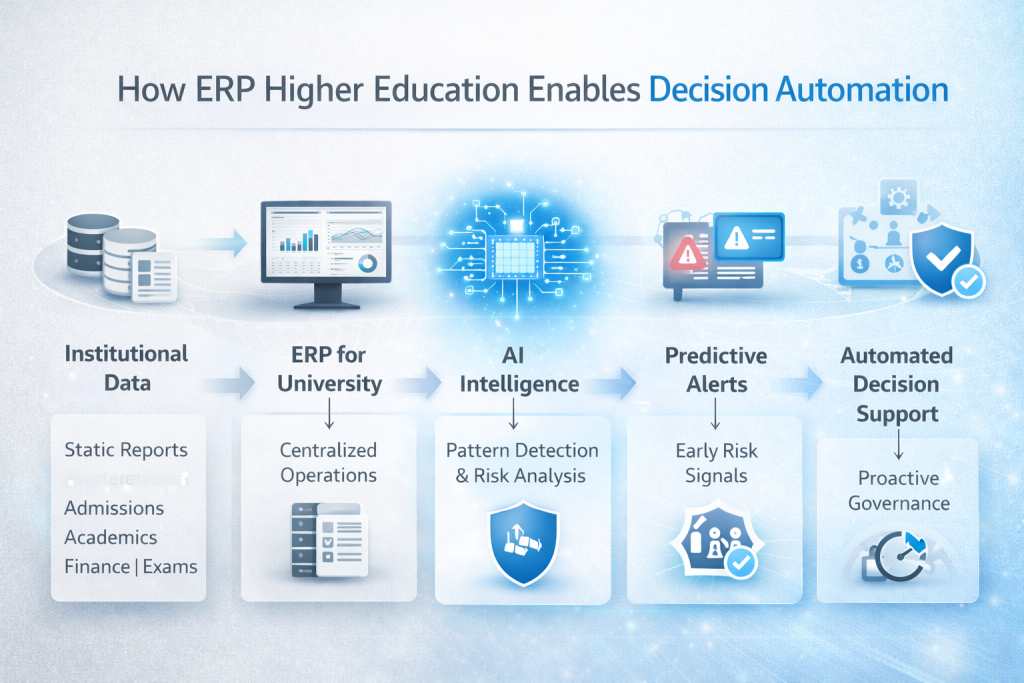
Decision automation changes how institutions operate.
Instead of manual follow-ups:
- Attendance drops trigger mentor alerts.
- Budget deviations activate finance reviews.
- Compliance deadlines initiate documentation workflows.
Automated accreditation management processes reduce last-minute pressure and ensure structured readiness.
Integrated platforms that connect learning, finance, and operations within a unified ERP university architecture reduce institutional friction.
The shift is clear:
From documentation → to intelligent action.
ERP Higher Education and Predictive Governance
Predictive governance requires connected ecosystems.
An advanced ERP for university integrates:
- Recruitment pipelines
- Student lifecycle tracking
- Learning analytics
- Online assessment systems
For instance:
- Structured student recruitment and lifecycle management connects admissions to retention strategies.
- Integrated online classes and exams management supports academic continuity.
- Embedded outcome-based LMS architecture aligns teaching with measurable performance indicators.
When these systems operate independently, leadership loses context.
When unified inside an intelligent Education Management System (EMS), governance becomes predictive.
This is the essence of Digital solutions for higher education.
Governance Visibility and Cybersecurity in ERP Higher Ed
Visibility without security creates vulnerability.
Institutions must ensure that their ERP higher education infrastructure integrates cybersecurity safeguards. Modern governance demands more than cloud hosting; it requires embedded protection layers and risk monitoring frameworks.
An AI-enabled higher ed ERP must combine intelligence with resilience.
Strategic architecture matters.
Evaluating ERP for University in the AI Era
Leadership teams evaluating ERP for university platforms must look beyond feature lists.
They should assess:
- Predictive intelligence capability
- Integration depth
- Accreditation automation
- Lifecycle management
- AI-driven governance visibility
A structured evaluation framework helps institutions avoid fragmented deployments and ensures long-term scalability.
Understanding institutional readiness and governance alignment becomes essential before system adoption.
The Future of ERP Higher Ed Architecture
The next generation of university ERP software will emphasize:
- Cloud-native scalability
- AI-powered analytics
- Modular expansion
- Governance dashboards
- Workflow automation
Institutions no longer ask:
“Does our ERP university platform manage operations?”
They ask:
“Does it strengthen strategic foresight?”
An AI-driven Education Management System (EMS) integrates ERP functionality with predictive alerts, automated workflows, and decision intelligence into a unified backbone.
This shift defines the future of ERP higher education.
Conclusion: ERP for University Must Move Beyond Storage
An ERP for university that only centralizes information limits leadership agility.
An AI-enabled ERP higher ed system empowers institutions to anticipate risk, allocate resources intelligently, and improve governance clarity.
Universities adopting predictive higher ed ERP platforms move from reactive management to proactive strategy.
If your institution is rethinking its digital foundation, explore how a structured university ERP system aligns with comprehensive Digital solutions for higher education.
To understand the broader institutional vision, visit the About Us page.
For strategic discussions, connect directly through the Contact Us page.
Frequently Asked Questions
What is ERP for university?
ERP for university is an integrated platform that manages admissions, academics, finance, examinations, HR, and compliance within higher education institutions.
How does ERP higher education enable decision automation?
ERP higher education systems use AI-driven alerts, predictive analytics, and automated workflows to assist leadership in proactive governance.
What differentiates higher ed ERP from traditional campus software?
Higher ed ERP integrates institutional processes into a unified intelligence system, while traditional campus tools often operate in isolated modules.
What is the difference between ERP for university and AI-driven EMS?
An ERP for university centralizes and manages institutional data.
An AI-driven Education Management System (EMS) goes further. It analyzes patterns, generates predictive alerts, and supports automated interventions.
The difference lies in intelligence depth, not just functionality.
How does higher ed ERP support predictive governance?
Higher ed ERP systems integrate academic, financial, and administrative data streams.
When AI layers analyze these streams, leaders receive early-warning signals instead of delayed reports.
This enables proactive strategy.
What makes university ERP software future-ready?
Future-ready university ERP software must:
- Operate in the cloud
- Integrate AI analytics
- Support automation
- Ensure real-time visibility
- Enable scalable modular architecture
Systems built only for reporting will not sustain long-term competitiveness.
How can ERP higher education systems automate decisions?
ERP higher education platforms automate decisions through rule-based triggers and predictive models.
When predefined conditions occur, the system initiates alerts, assignments, or workflows automatically.
This reduces human delay.
Why is ERP university software evolving beyond reporting?
Universities operate in a high-accountability environment.
Leadership cannot rely solely on historical reports.
ERP university software evolves because institutions now demand intelligence, not just information.
Leadership Reflection
Is your current ERP for university delivering strategic foresight — or only administrative reporting?
What governance blind spots still exist within your university ERP system?
We invite university leaders to share their perspective and experience.

The Silent Dropout Crisis: Why Universities Don’t See Student Risk Until It’s Too Late
Most students don’t drop out in a single moment.
They disengage gradually.
Attendance declines.
Internal marks fluctuate.
Fee payments become irregular.
LMS activity slows.
Mentorship meetings are missed.
By the time a withdrawal application reaches the administration, the decision has already been forming for months.
Student attrition is rarely sudden.
It is usually undetected.
And in many institutions, the issue is not effort.
It is visibility.
Dropout Is a Pattern, Not an Event
Universities often attribute attrition to external pressures:
- Financial constraints
- Family circumstances
- Career shifts
- Personal transitions
But these external factors almost always surface internally first — through measurable signals.
The warning signs are already present inside the institution:
- Gradual attendance decline
- Repeated assessment dips
- Reduced LMS engagement
- Fee payment irregularity
- Placement disengagement
- Hostel or transport withdrawal
- Repeated grievances
Individually, these look operational.
Collectively, they reveal emerging risk.
This structural blind spot is similar to what many institutions experience during accreditation cycles — as discussed in Your NAAC Score Isn’t the Problem — Your Data Is.
Fragmented data prevents pattern recognition.
The same fragmentation quietly affects retention.
The Leadership Visibility Gap

Most universities already collect the right data.
Academic departments monitor attendance.
Examination cells track performance.
Finance teams manage fee records.
Placement offices observe engagement.
LMS platforms record learning activity.
Yet these systems rarely communicate with each other in real time.
As explored in Why Traditional University ERPs Struggle with Institutional Visibility — and How Modern Platforms Are Architected Differently, many legacy architectures were built for recording transactions — not interpreting patterns.
Leadership receives summaries.
Not risk intelligence.
Monthly dashboards cannot detect weekly deterioration.
Siloed systems cannot reveal cumulative behavioral shifts.
The result is reactive governance.
Reactive Monitoring vs Early Awareness
Most institutions operate on a post-event model:
- Dropout occurs
- Exit reasons are recorded
- Reports are generated
- Policies are reviewed
But forward-looking universities are shifting toward early awareness models.
As detailed in Early Awareness Systems in Universities: How AI-Driven ERP Prevents Problems Before They Escalate, predictive frameworks monitor behavioral shifts continuously rather than waiting for formal withdrawal.
This distinction defines digital maturity.
Student disengagement is rarely invisible.
It is simply not connected.
Why Data Fragmentation Prevents Early Intervention
Consider a student who shows:
- 20% attendance decline
- Two consecutive internal assessment drops
- Reduced engagement in the Learning Management System
- Delayed fee installment
Separately, these look manageable.
Together, they represent escalation.
The importance of LMS visibility in academic engagement is explored in Learning Management Software for Modern Institutions: Enabling Better Teaching and Stronger Academic Outcomes.
But LMS insight alone is insufficient.
Without cross-department correlation, institutions cannot identify risk trajectories.
An integrated Education Management System (EMS) connects these signals into one analytical layer — transforming operational data into predictive intelligence.
AI as a Risk Detection Engine — Not a Buzzword
AI in universities must go beyond automation.
As emphasized in AI in Universities Is Not About Automation — It’s About Early Awareness, its real value lies in pattern detection.
A structured predictive framework can:
- Identify attendance trajectory deviation
- Detect academic volatility
- Flag prolonged LMS inactivity
- Monitor cumulative risk scoring
However, AI is only as reliable as the data architecture beneath it.
Blind automation — as discussed in AI in Universities Is No Longer Optional — But Blind Automation Is Dangerous — creates noise without clarity.
Retention strategy requires structured, unified data flow.
The Lifecycle Perspective
Student disengagement often begins long before final withdrawal.
It may originate in:
- Admission-stage mismatch
- Early academic overload
- Lack of mentoring
- Financial stress
- Career uncertainty
A lifecycle-based institutional approach — explained in How iCloudEMS Helps the Higher Education Institutes to Manage the Entire Lifecycle of Their Students — enables universities to monitor student progression from entry to alumni status.
Retention cannot be addressed in isolation.
It must be embedded in lifecycle intelligence.
From Administrative Software to Institutional Intelligence

Traditional ERP-style systems were built to log data.
Modern Digital solutions for higher education must interpret it.
University leaders evaluating technology infrastructure — as discussed in How University Leaders Should Evaluate an Education Management System (EMS) — should ask a critical question:
Does the system only record what happened?
Or does it identify what might happen next?
An advanced Education Management System (EMS) acts as:
- A cross-module intelligence layer
- A behavioral analytics engine
- A risk-scoring framework
- A real-time alert mechanism
This shift transforms retention from reactive reporting to predictive governance.
The Institutional Cost of Late Detection
When dropout risk is detected late, consequences extend beyond student loss:
Academic Impact
- Reduced completion rates
- Disrupted cohorts
- Increased faculty workload
Financial Impact
- Revenue volatility
- Higher dependence on fresh admissions
Governance Impact
- Reactive board meetings
- Limited forecasting capability
Reputational Impact
- Weak retention indicators
- Lower alumni trust
Attrition is not merely an operational statistic.
It is a strategic performance indicator.
Retention Is a Visibility Strategy
Student support improves when institutions detect risk early.
Intervention becomes structured.
Outcomes become measurable.
Governance becomes proactive.
When Digital solutions for higher education are architected strategically — as seen across modern integrated platforms like iCloudEMS — universities gain the clarity required to act before disengagement becomes permanent.
The goal is not surveillance.
It is timely support.
Key Questions Institutional Leaders Are Asking
Why do universities fail to identify student dropout risk early?
Because academic, financial, and behavioral data are stored in disconnected systems, preventing cumulative pattern detection.
How can predictive analytics reduce student attrition?
By continuously monitoring attendance trends, assessment volatility, and engagement shifts to identify probability before formal withdrawal.
What data should institutions monitor to prevent dropouts?
Attendance trajectory, internal performance trends, LMS engagement, fee behavior, grievance frequency, and placement participation.
How does an Education Management System (EMS) support early intervention?
An integrated EMS connects cross-departmental data, applies risk scoring models, and generates timely alerts for structured intervention.
What is the difference between reactive and predictive monitoring?
Reactive monitoring records dropout after departure. Predictive monitoring identifies risk while intervention is still possible.
Can AI alone solve retention challenges?
No. AI requires structured, unified data architecture to produce reliable early warning insights.
Student attrition rarely begins with a resignation letter.
It begins with small, measurable shifts.
The strategic question for institutional leadership is simple:
Does your university detect risk early —
or only after the seat is already vacant?We invite university leaders to reflect:
How visible is student risk within your current system architecture?

Your NAAC Score Isn’t the Problem — Your Data Is
Every NAAC cycle starts with confidence.
Committees are re-formed.
Departments are instructed to submit updated information.
IQAC teams begin intense coordination across the institution.
Yet despite months of preparation, many universities exit the accreditation process with the same quiet frustration:
“We did everything right. Why didn’t the score reflect it?”
The uncomfortable truth is this:
NAAC outcomes rarely disappoint because institutions misunderstand the framework.
They disappoint because institutions overestimate the strength of their data foundation.
Until leadership recognises this gap, accreditation will continue to feel stressful, unpredictable, and disproportionately demanding—no matter how committed the teams involved.
NAAC Is Not an Event You Prepare For
One of the most persistent myths in higher education governance is that NAAC is an event.
In reality, NAAC is a mirror.
Peer teams are not evaluating how efficiently documents were assembled over a few months. They are observing whether academic intent, execution, monitoring, and outcomes align over multiple years.
Institutions that treat NAAC as a documentation exercise inevitably struggle. Those that treat it as a governance outcome experience far less disruption.
This difference becomes evident when examining why legacy campus platforms fail to provide institutional clarity, a challenge clearly explained in Why Traditional University ERPs Struggle with Institutional Visibility — and How Modern Platforms Are Architected Differently.
When systems are built for transactions rather than academic evidence, accreditation exposes the gap mercilessly.
Where Accreditation Actually Breaks Down
Accreditation does not fail during the peer visit.
It breaks down much earlier—inside daily academic and administrative workflows.
Every institution generates data continuously:
- Teaching plans
- Attendance records
- Internal assessments
- Learning outcomes
- Student feedback
- Action-taken reports
The problem is not data creation.
The problem is data continuity.
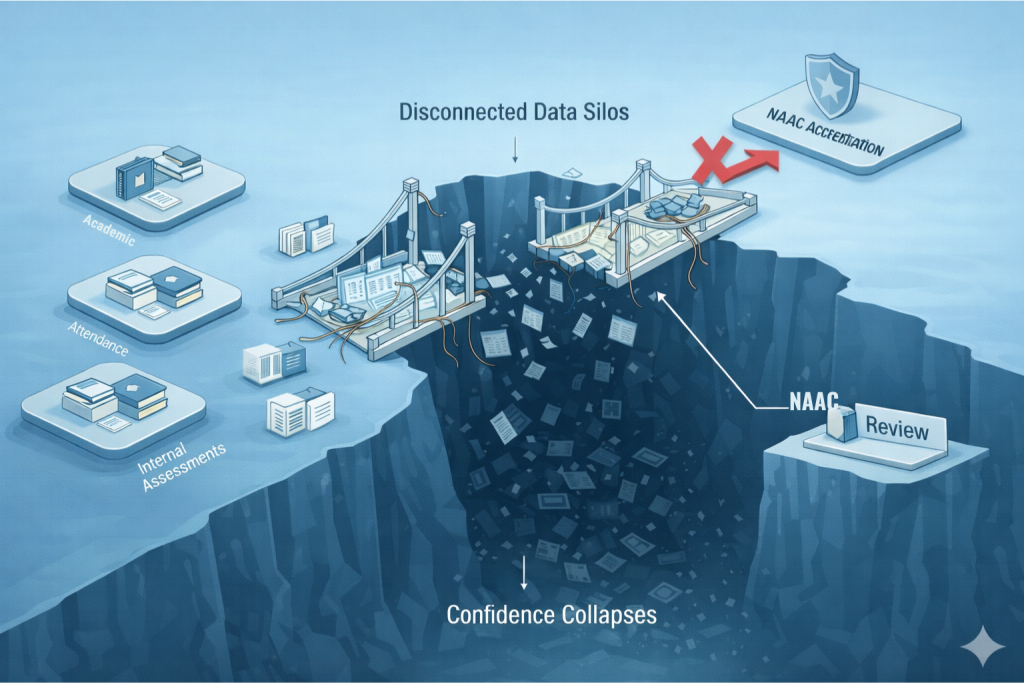
When these elements live in silos, are maintained independently by departments, and reconciled manually only during accreditation cycles, confidence collapses.
This is precisely why accreditation bodies focus on institutional processes rather than isolated evidence, as outlined in How Accreditation Bodies Evaluate Higher Education Institutes for Quality Assurance.
“We Have the Data” Is the Most Dangerous Assumption
Almost every university believes it has the data NAAC requires.
Technically, this is true.
But NAAC does not assess whether data exists.
It assesses whether data is reliable, traceable, and defensible.
Reliable data means:
- Metrics are defined consistently across departments
- Numbers can be traced back to academic actions
- Evidence holds across academic cycles
- No individual “fixes” data under pressure
When IQAC teams must reconcile multiple versions of the same metric, leadership is forced to rely on trust instead of verification. At that point, accreditation outcomes become uncertain—regardless of effort.
Why Documentation-First NAAC Preparation Is Structurally Weak
The conventional NAAC preparation model follows a familiar pattern:
- Collect departmental data
- Standardise formats
- Resolve inconsistencies manually
- Draft criterion-aligned narratives
- Validate with leadership
This approach fails because documentation is being asked to repair fragmented data.
Documentation cannot do that.
Accreditation-ready evidence must be produced as a natural by-product of academic operations—not assembled retrospectively under pressure.
This philosophy underpins modern Digital solutions for higher education, particularly platforms designed to automate evidence continuity rather than reporting effort, as explained in A Guide on Various Aspects of Accreditation and How iCloudEMS Automates the Groundwork of Accreditation.
NAAC Is a Governance Stress Test
Viewed objectively, NAAC is not merely a compliance exercise.
It is a governance stress test.
Implicitly, it asks leadership:
- Can you see institutional performance clearly?
- Can decisions be defended with evidence?
- Can improvement cycles be demonstrated over time?
- Can data speak without reinterpretation?
These are governance capabilities, not clerical ones.
This shift in thinking explains why leadership now evaluates platforms as governance infrastructure rather than simple software tools, a perspective discussed in How University Leaders Should Evaluate an Education Management System (EMS).
The Registrar’s Invisible Risk Load
No role experiences accreditation pressure more acutely than the Registrar.
During NAAC cycles, the Registrar becomes:
- The final checkpoint for conflicting data
- The escalation point for unresolved inconsistencies
- The institutional guarantor of accuracy
When systems are fragmented, every query requires manual reconciliation. Every reconciliation increases dependency on individuals and introduces institutional risk.
This is not a workload issue.
It is a system-architecture issue.
In a mature Education Management System (EMS), the Registrar validates data rather than repairing it—dramatically reducing exposure during audits.
Evidence-Assembled vs Evidence-Ready Institutions
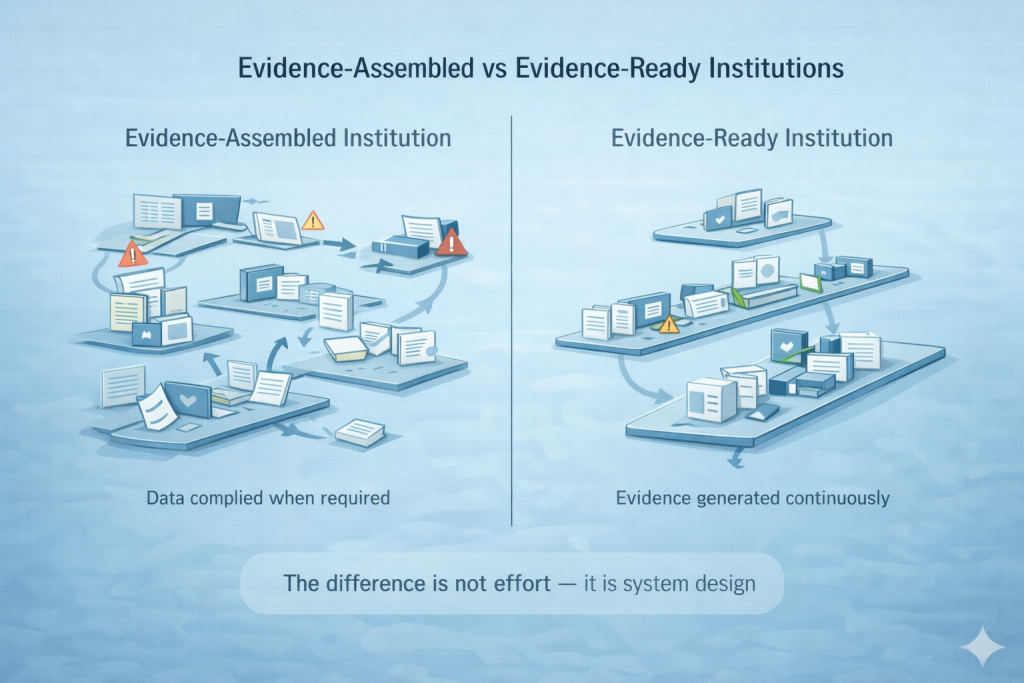
After observing accreditation outcomes across institutions, a clear pattern emerges.
Evidence-Assembled Institutions
- Data compiled only when required
- Heavy reliance on spreadsheets
- High dependency on individuals
- Elevated audit stress
- NAAC perceived as disruption
Evidence-Ready Institutions
- Data generated continuously
- System-validated records
- Minimal individual dependency
- Calm audit environments
- NAAC perceived as confirmation
The difference is not effort or intent.
It is system design.
Why ERP Thinking No Longer Supports Accreditation
Many institutions still search for “college ERP” or “university ERP software.” This reflects historical market language, not present-day requirements.
Traditional ERP systems were designed to manage transactions—fees, payroll, inventory—not academic outcomes, assessment mapping, or accreditation intelligence.
This maturity gap is analysed in University ERP in India: Why Most Systems Never Reach Institutional Maturity.
A modern Education Management System (EMS) goes beyond ERP logic by connecting:
- Academics to assessments
- Assessments to outcomes
- Outcomes to feedback
- Feedback to action plans
- Action plans to leadership decisions
This is the architecture NAAC implicitly evaluates.
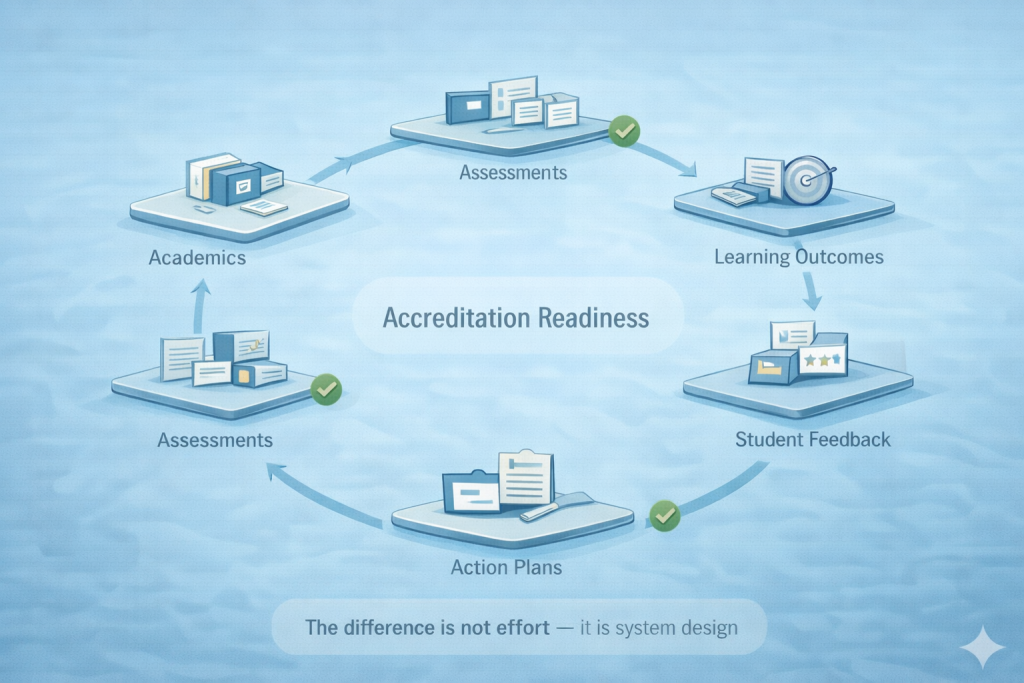
Early Awareness Changes Accreditation Outcomes
Institutions that perform confidently during NAAC cycles share one trait: they are rarely surprised.
Issues are identified early—long before they escalate into audit findings.
AI-driven early awareness systems detect:
- Attendance anomalies
- Academic risk patterns
- Assessment inconsistencies
- Compliance drift
This proactive approach is detailed in AI in Universities Is Not About Automation — It’s About Early Awareness.
Accreditation improves not because AI generates documents, but because it prevents data decay.
Where iCloudEMS Fits—Quietly but Structurally
The purpose of iCloudEMS is not to impose additional processes or cultural disruption.
It exists to:
- Align academic workflows with outcomes
- Maintain evidence continuity across years
- Embed accreditation readiness into daily operations
- Support leadership with decision-grade insights
As a cloud-native, AI-powered Education Management System (EMS), iCloudEMS strengthens governance quietly—so accreditation reflects reality, not last-minute preparation.
Why Less Anxiety Often Produces Better NAAC Scores
This is the paradox leadership often overlooks.
Institutions that worry less about NAAC tend to perform better.
Because quality is not created under pressure.
It is revealed under review.
Frequently Asked Leadership Questions
Is NAAC primarily about documentation or data systems?
Documentation matters only when backed by consistent, traceable data generated through daily academic operations.
Can spreadsheets still support accreditation?
They may work temporarily, but they increase dependency, inconsistency, and audit risk as institutions grow.
Is ERP sufficient for NAAC readiness?
Traditional ERP systems were not designed for outcome mapping, evidence continuity, or accreditation intelligence.
When should NAAC preparation actually begin?
NAAC readiness should be continuous and embedded into governance, not initiated close to assessment cycles.
Does technology alone improve NAAC scores?
No. Governance discipline supported by the right Education Management System (EMS) does.
What is leadership’s role in data governance?
Leadership must demand clarity, not just reports. Systems should support decision-making, not paperwork.
Is NAAC becoming stricter?
NAAC is becoming more data-driven. Transparency exposes inconsistencies faster than ever before.
A Final Reflection for Institutional Leaders
If NAAC feels exhausting,
the framework is not the problem.
The fragility of data truth is.
Strengthen the data foundation, and accreditation stops being a struggle—and starts becoming validation.
If you’ve experienced this challenge—or solved it differently—your perspective matters.
What has NAAC revealed about your institution’s data reality?
