How an AI-Powered Student Portal Improves Student Experience and Retention

In today’s digital-first academic environment, the Student Portal has evolved from a basic information window into a strategic engine for institutional success. Universities that still rely on fragmented systems often struggle with delayed insights and reactive decision-making — a concern highlighted in this analysis of hidden gaps in traditional student information environments.

However, a modern AI-powered student portal changes the equation. It transforms disconnected student data into actionable intelligence, enabling institutions to deliver personalized support, proactive communication, and seamless digital experiences.

For university leaders focused on outcomes, the Student Portal is no longer just a convenience layer — it is a critical lever for improving both student experience and retention.

The Growing Pressure on Universities to Deliver Better Student Experiences

Higher education expectations have shifted dramatically. Students now compare their university experience with the digital convenience they receive elsewhere.

Yet many institutions still operate with:

  • Fragmented student touchpoints
  • Limited visibility into engagement patterns
  • Manual follow-up processes
  • Delayed academic risk identification
  • Disconnected communication channels

As explored in the discussion on the silent dropout challenge, many risks remain invisible until it is too late.

Without real-time intelligence, even well-managed universities remain in reactive mode. This is where a modern university student portal powered by AI begins to create measurable impact.

What Defines a Modern AI-Powered Student Portal

A traditional portal typically acts as a static dashboard. In contrast, an AI-enabled Student Portal functions as an intelligent engagement layer that continuously analyzes student behavior, academic signals, and interaction patterns.

A modern student self-service portal should provide:

  • Centralized access to academic, financial, and administrative data
  • Real-time status updates across the student lifecycle
  • Intelligent alerts and notifications
  • Personalized dashboards for students and faculty
  • Seamless mobile accessibility
  • Cross-department data visibility

Institutions adopting Digital solutions for higher education through iCloudEMS are already seeing how unified intelligence changes campus decision-making.

How an AI-Powered Student Portal Elevates Student Experience
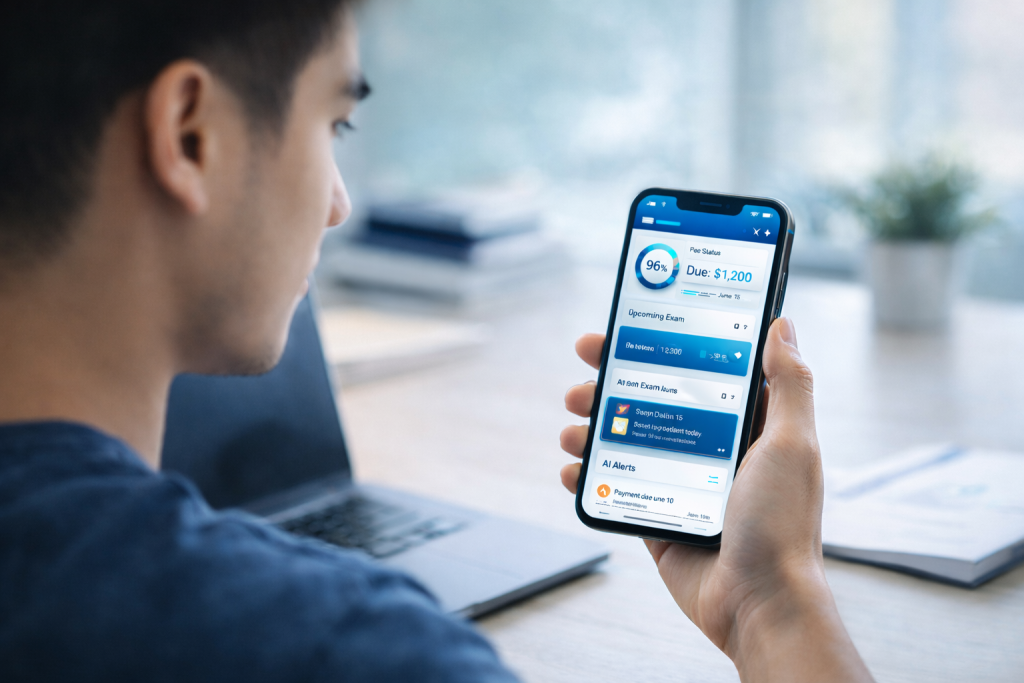
University student using AI-powered student portal on mobile for real-time academic updates

Student experience is shaped by speed, clarity, and personalization. When these elements are missing, frustration builds quietly across the campus ecosystem.

An AI-powered higher education student portal improves experience in several high-impact ways.

Real-Time Transparency Builds Student Trust

Students no longer want to chase departments for updates. With a modern portal:

  • Attendance updates appear instantly
  • Fee status is always visible
  • Examination information is centralized
  • Academic progress is continuously tracked

This level of visibility becomes even more powerful when integrated with intelligent finance workflows such as the AI-powered fee management approach.

Personalized Digital Journeys Increase Engagement

AI enables the Student Portal to move beyond one-size-fits-all dashboards. Instead, it can:

  • Highlight pending student actions
  • Recommend academic resources
  • Surface important deadlines
  • Provide contextual reminders

When combined with outcome-driven learning environments like the Outcome-Based LMS, universities can create deeply personalized academic journeys.

Frictionless Self-Service Reduces Administrative Dependency

Modern students expect autonomy. A well-designed student engagement platform allows them to:

  • Download documents instantly
  • Submit requests digitally
  • Track approvals in real time
  • Access learning resources on demand

Institutions modernizing their academic operations — as discussed in the future-ready academics management strategy — are seeing measurable reductions in administrative load.

Unified Communication Eliminates Information Gaps

One of the biggest experience failures in higher education is fragmented communication. An AI-enabled modern student portal centralizes:

  • Academic notifications
  • Fee reminders
  • Institutional announcements
  • Faculty communications

When paired with integrated online classes and exams management, communication becomes both timely and contextual.

The Direct Link Between Student Portal Intelligence and Retention

While experience improvements are visible, the deeper strategic value of a Student Portal lies in retention intelligence. Universities rarely lose students suddenly — warning signals usually appear months in advance.

AI helps institutions detect those signals early.

How AI-Powered Portals Strengthen Student Retention

Early Risk Detection Through Behavioral Signals

An advanced AI-powered student portal continuously monitors patterns such as:

  • Declining attendance
  • Reduced portal activity
  • Assignment delays
  • Fee payment irregularities
  • LMS engagement drops

These signals align closely with modern student recruitment and lifecycle management strategies.

Predictive Alerts Enable Proactive Intervention
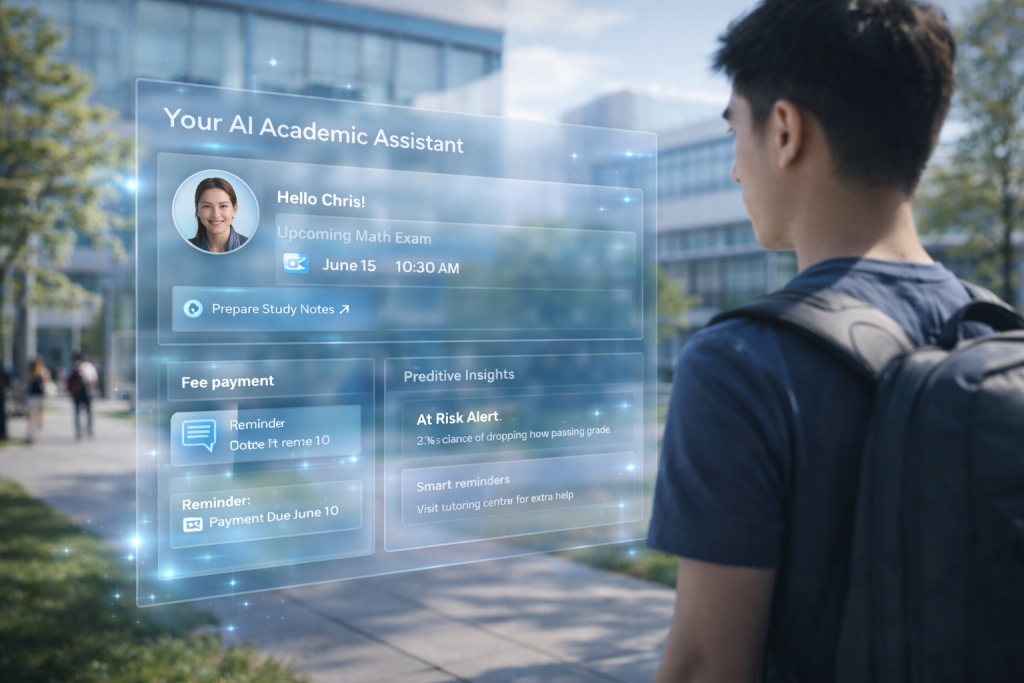
AI-powered academic assistant providing personalized student success guidance on a modern university campus

Instead of waiting for semester-end surprises, leadership teams receive:

  • Automated risk alerts
  • Engagement anomaly notifications
  • Academic performance warnings
  • Escalation triggers for counselors

This shift toward predictive operations reflects the broader evolution explained in the AI shift in university systems.

Data-Driven Retention Strategies Replace Guesswork

Historically, retention initiatives relied heavily on manual reviews. A modern Student Portal now provides:

  • Cohort-level engagement analytics
  • Department-wise risk heatmaps
  • Intervention tracking dashboards
  • Outcome-based retention insights

These capabilities strongly complement institutional quality frameworks supported by accreditation management systems.

Automated Workflows Ensure No Student Falls Through the Cracks

AI-powered workflows can automatically:

  • Notify mentors
  • Trigger counseling workflows
  • Escalate unresolved issues
  • Track follow-up completion

Institutions evaluating next-generation platforms often compare traditional approaches versus modern EMS capabilities in the EMS vs traditional systems comparison.

The Strategic Role of iCloudEMS in Enabling Intelligent Student Portals

Forward-looking universities are increasingly adopting Digital solutions for higher education that unify data, intelligence, and user experience.

The iCloudEMS Education Management System (EMS) provides a cloud-native, AI-powered Student Portal that enables institutions to:

  • Achieve unified student visibility across departments
  • Monitor engagement through intelligent dashboards
  • Activate predictive alerts for at-risk students
  • Deliver personalized digital experiences at scale
  • Automate cross-campus workflows
  • Maintain real-time operational transparency

Institutions exploring comprehensive modernization paths often review capabilities across both the university solution environment and the college solution environment to understand the full transformation scope.

The Future of the Student Portal: From Access Point to Intelligence Hub

The next generation of the Student Portal will not merely display information — it will actively guide student success.

We are already seeing the emergence of:

  • AI copilots for student support
  • Hyper-personalized academic pathways
  • Predictive campus ecosystems
  • Intelligent nudges for engagement
  • Autonomous administrative workflows

Universities that modernize early will build stronger student relationships, while those that delay risk operating with blind spots in an increasingly data-driven education landscape.

Conclusion

The Student Portal has quietly become one of the most influential digital assets in higher education. When powered by AI, it delivers visibility, personalization, and predictive intelligence that directly impact student experience and retention.

For university leaders navigating rising expectations and competitive pressures, the real question is no longer whether a portal exists — but whether it is intelligent enough to support proactive student success.
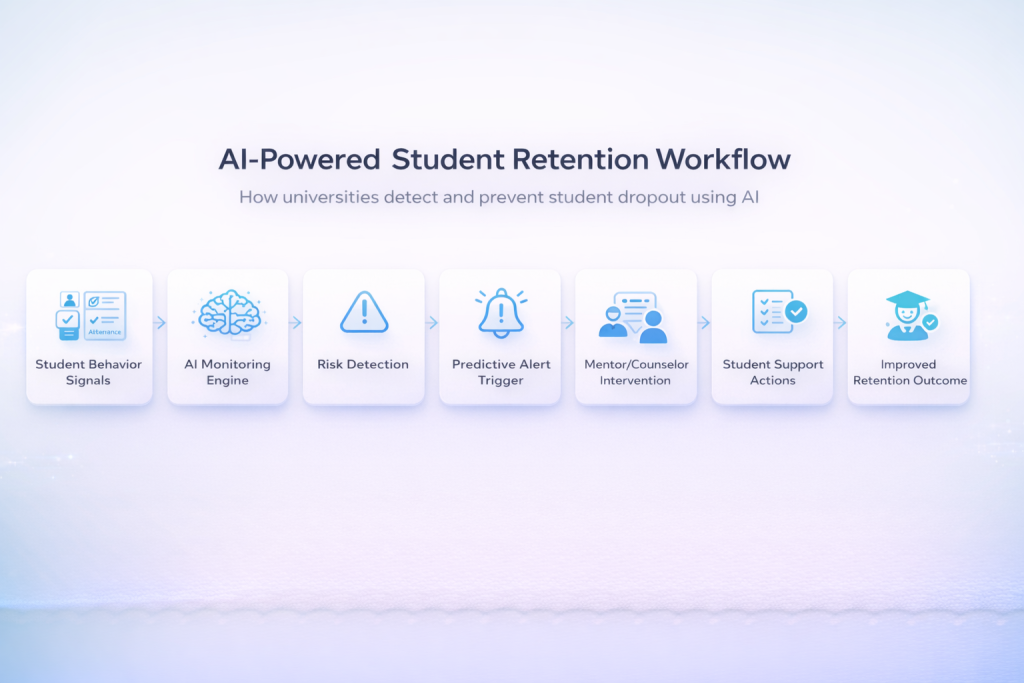
AI-powered student retention workflow flowchart showing predictive alerts and intervention process in universities

Reflection

How effectively is your current Student Portal helping your institution identify disengaged or at-risk students early?

University leaders who are re-evaluating their digital student experience strategy often uncover significant improvement opportunities once they begin examining real-time engagement intelligence.

Key Questions University Leaders Ask

What is a student portal in higher education?

A student portal is a centralized digital platform that gives students secure access to academic records, fees, schedules, communication, and institutional services. Modern portals use AI to provide real-time insights, personalized dashboards, and proactive alerts that improve engagement and operational visibility.

How does an AI-powered student portal improve retention?

An AI-powered student portal improves retention by continuously analyzing behavioral and academic signals to identify at-risk students early. It generates predictive alerts, enables timely interventions, and helps universities track engagement trends so leadership teams can act proactively before disengagement turns into attrition.

Why do universities need a modern student portal?

Universities need a modern student portal to provide real-time transparency, seamless self-service, and unified communication. Traditional systems lack predictive intelligence, whereas AI-enabled portals help institutions monitor engagement, reduce administrative friction, and support data-driven decision-making across the student lifecycle.

What features should a university student portal include?

A robust university student portal should include real-time dashboards, AI-driven alerts, mobile accessibility, self-service workflows, unified communication tools, and cross-department data visibility. These capabilities ensure students receive timely information while administrators gain actionable insights into engagement and performance.

How does a student portal improve student engagement?

A student portal improves engagement by centralizing information, delivering personalized notifications, and simplifying access to academic and administrative services. When students can easily track progress, receive reminders, and interact digitally with the institution, their participation and satisfaction levels typically increase.

Can a student portal support personalized learning journeys?

Yes, AI-enabled student portals can support personalized learning journeys by analyzing academic performance, behavior patterns, and engagement data. The system can recommend resources, highlight risks, and surface relevant actions, helping institutions guide each student more effectively toward academic success.

The Silent Dropout Crisis: Why Universities Don’t See Student Risk Until It’s Too Late

Most students don’t drop out in a single moment.

They disengage gradually.

Attendance declines.
Internal marks fluctuate.
Fee payments become irregular.
LMS activity slows.
Mentorship meetings are missed.

By the time a withdrawal application reaches the administration, the decision has already been forming for months.

Student attrition is rarely sudden.
It is usually undetected.

And in many institutions, the issue is not effort.
It is visibility.

Dropout Is a Pattern, Not an Event

Universities often attribute attrition to external pressures:

  • Financial constraints
  • Family circumstances
  • Career shifts
  • Personal transitions

But these external factors almost always surface internally first — through measurable signals.

The warning signs are already present inside the institution:

  • Gradual attendance decline
  • Repeated assessment dips
  • Reduced LMS engagement
  • Fee payment irregularity
  • Placement disengagement
  • Hostel or transport withdrawal
  • Repeated grievances

Individually, these look operational.
Collectively, they reveal emerging risk.

This structural blind spot is similar to what many institutions experience during accreditation cycles — as discussed in Your NAAC Score Isn’t the Problem — Your Data Is.

Fragmented data prevents pattern recognition.

The same fragmentation quietly affects retention.

The Leadership Visibility Gap

University administrator viewing separate academic, financial, and engagement reports without unified visibilityData exists across departments — but without integration, patterns remain invisible.

Most universities already collect the right data.

Academic departments monitor attendance.
Examination cells track performance.
Finance teams manage fee records.
Placement offices observe engagement.
LMS platforms record learning activity.

Yet these systems rarely communicate with each other in real time.

As explored in Why Traditional University ERPs Struggle with Institutional Visibility — and How Modern Platforms Are Architected Differently, many legacy architectures were built for recording transactions — not interpreting patterns.

Leadership receives summaries.
Not risk intelligence.

Monthly dashboards cannot detect weekly deterioration.
Siloed systems cannot reveal cumulative behavioral shifts.

The result is reactive governance.

Reactive Monitoring vs Early Awareness

Most institutions operate on a post-event model:

  • Dropout occurs
  • Exit reasons are recorded
  • Reports are generated
  • Policies are reviewed

But forward-looking universities are shifting toward early awareness models.

As detailed in Early Awareness Systems in Universities: How AI-Driven ERP Prevents Problems Before They Escalate, predictive frameworks monitor behavioral shifts continuously rather than waiting for formal withdrawal.

This distinction defines digital maturity.

Student disengagement is rarely invisible.
It is simply not connected.

Why Data Fragmentation Prevents Early Intervention

Consider a student who shows:

  • 20% attendance decline
  • Two consecutive internal assessment drops
  • Reduced engagement in the Learning Management System
  • Delayed fee installment

Separately, these look manageable.

Together, they represent escalation.

The importance of LMS visibility in academic engagement is explored in Learning Management Software for Modern Institutions: Enabling Better Teaching and Stronger Academic Outcomes.

But LMS insight alone is insufficient.

Without cross-department correlation, institutions cannot identify risk trajectories.

An integrated Education Management System (EMS) connects these signals into one analytical layer — transforming operational data into predictive intelligence.

AI as a Risk Detection Engine — Not a Buzzword

AI in universities must go beyond automation.

As emphasized in AI in Universities Is Not About Automation — It’s About Early Awareness, its real value lies in pattern detection.

A structured predictive framework can:

  • Identify attendance trajectory deviation
  • Detect academic volatility
  • Flag prolonged LMS inactivity
  • Monitor cumulative risk scoring

However, AI is only as reliable as the data architecture beneath it.

Blind automation — as discussed in AI in Universities Is No Longer Optional — But Blind Automation Is Dangerous — creates noise without clarity.

Retention strategy requires structured, unified data flow.

The Lifecycle Perspective

Student disengagement often begins long before final withdrawal.

It may originate in:

  • Admission-stage mismatch
  • Early academic overload
  • Lack of mentoring
  • Financial stress
  • Career uncertainty

A lifecycle-based institutional approach — explained in How iCloudEMS Helps the Higher Education Institutes to Manage the Entire Lifecycle of Their Students — enables universities to monitor student progression from entry to alumni status.

Retention cannot be addressed in isolation.
It must be embedded in lifecycle intelligence.

From Administrative Software to Institutional Intelligence

University executive reviewing institutional early warning dashboard showing aggregated student risk analyticsPredictive visibility enables institutions to detect risk patterns before student disengagement becomes irreversible.

Traditional ERP-style systems were built to log data.

Modern Digital solutions for higher education must interpret it.

University leaders evaluating technology infrastructure — as discussed in How University Leaders Should Evaluate an Education Management System (EMS) — should ask a critical question:

Does the system only record what happened?
Or does it identify what might happen next?

An advanced Education Management System (EMS) acts as:

  • A cross-module intelligence layer
  • A behavioral analytics engine
  • A risk-scoring framework
  • A real-time alert mechanism

This shift transforms retention from reactive reporting to predictive governance.

The Institutional Cost of Late Detection

When dropout risk is detected late, consequences extend beyond student loss:

Academic Impact

  • Reduced completion rates
  • Disrupted cohorts
  • Increased faculty workload

Financial Impact

  • Revenue volatility
  • Higher dependence on fresh admissions

Governance Impact

  • Reactive board meetings
  • Limited forecasting capability

Reputational Impact

  • Weak retention indicators
  • Lower alumni trust

Attrition is not merely an operational statistic.

It is a strategic performance indicator.

Retention Is a Visibility Strategy

Student support improves when institutions detect risk early.

Intervention becomes structured.
Outcomes become measurable.
Governance becomes proactive.

When Digital solutions for higher education are architected strategically — as seen across modern integrated platforms like iCloudEMS — universities gain the clarity required to act before disengagement becomes permanent.

The goal is not surveillance.
It is timely support.

Key Questions Institutional Leaders Are Asking

Why do universities fail to identify student dropout risk early?

Because academic, financial, and behavioral data are stored in disconnected systems, preventing cumulative pattern detection.

How can predictive analytics reduce student attrition?

By continuously monitoring attendance trends, assessment volatility, and engagement shifts to identify probability before formal withdrawal.

What data should institutions monitor to prevent dropouts?

Attendance trajectory, internal performance trends, LMS engagement, fee behavior, grievance frequency, and placement participation.

How does an Education Management System (EMS) support early intervention?

An integrated EMS connects cross-departmental data, applies risk scoring models, and generates timely alerts for structured intervention.

What is the difference between reactive and predictive monitoring?

Reactive monitoring records dropout after departure. Predictive monitoring identifies risk while intervention is still possible.

Can AI alone solve retention challenges?

No. AI requires structured, unified data architecture to produce reliable early warning insights.

Student attrition rarely begins with a resignation letter.

It begins with small, measurable shifts.

The strategic question for institutional leadership is simple:

Does your university detect risk early —
or only after the seat is already vacant?We invite university leaders to reflect:
How visible is student risk within your current system architecture?

How workflow automation system helps in comprehensive management of Higher Education Institutes

In the last few decades, India’s education sector has seen a massive increase in the number of schools, colleges, universities, and private institutions. Admissions, teaching, timetables, fee management, examinations, and other educational duties have become complex, and policies and functions connected to them are often updated. 

However, in today’s fast-paced world, manually managing of administrative activities is difficult and lead to following challenges:

  • Missed or Duplicate information 
  • Compiling and Formatting errors of information 
  • Wastage of physical resources
  • Constraints in Communication and Networking

Latest technologies such as artificial intelligence, machine learning and internet of things etc. promote the automation that offer numerous benefits to Higher Education Institutes including:

  • Cloud-based data storage and retrieval to maintain data backup and privacy.
  • Smart administration and management for effective utilization of resources. 
  • Web analytics tools to track and measure students’ learning and performance. 
  • Digital tools for faculty to enhance their course curriculum and customized teaching.
  • Advanced learning and research across borders which empower globalization.

iCloudEMS has been a market-leader in today’s technology-driven education sector, extending digital capabilities of colleges and universities throughout India. Our cutting-edge products and services are built with the most up-to-date technologies, ensuring that they are extremely reliable, secure, optimised, and user-friendly. We provide a comprehensive Education Management System for any educational organisation, and we have also successfully produced individual modules based on requirements. Our unequalled support system ensures great dependability and confidence, allowing any educational organisation to attain its learning goals with its full potential by eliminating manual errors and cutting costs of resources.

Following are our important products and services that provides cloud-based unified solution to various Colleges and Universities:

Personalized Learning Management System: It provides students and professors with a collaborative digital platform to create a creative learning environment that bridges knowledge gaps and aids in the institute’s constructive learning aims. Our OBE-based LMS enhances the learning environment under the framework of OBE and Bloom’s taxonomy to promote the holistic development of students.

Online LIVE Classes and Examination Management System: It is an advanced solution that helps the stakeholders to effortlessly conduct and manage virtual classroom and examination settings keeping integrity as priority. We mobilise the utilisation of digital platforms and cutting-edge learning initiatives such as national MOOC courses, DIKSHA, and SWAYAM to support global education sustainability.

Student Lifecycle Management System: iCloudEMS assists Colleges and Universities in accessing and processing a profusion of students’ information with a few clicks, anytime and anywhere. It provides a technologically advanced ecosystem for administration and students to streamline student recruitment and management, freeing up time and resources to focus on more innovative goals.

Accreditation Management System: iCloudEMS is a well-managed digital environment that automates and simplifies time-consuming and repetitive accreditation operations. We propose a cloud-based approach to automate the groundwork of Accreditation operations such as generate, collect, organize and administer the cumulative data and reports in the standard formats of regulatory bodies such NAAC, NBA, ABET, NIRF etc.

Managed Services for Colleges and Universities: We offer managed services to Colleges ERP & Universities ERP and automate various academic and non-academic procedures. Our specialized modules streamline the workflow governed by important operations including Pre-admission, admission, fee payment, attendance, assignment, examination, library administration, accreditation management in a comprehensible and paperless manner.

iCloudEMS has played a huge and pivotal part in automating the workflow of higher education. The main benefits of our innovative venture include the digital transformation of universities and colleges, which leads to improved quality education, personalised learning, blended classroom experience, learner-centric classroom, and increased industry collaboration, as well as generating new revenue streams and increasing productivity for all stakeholders – students, faculty, management, accreditation bodies, alumni, and industry experts.

How can Higher Education Institutes Leverage Automation to Accomplish their Academic Goals

In today’s world, where everyone is surrounded by gadgets, the stakeholders in Higher Education Institutes can efficiently automate their workflow to make best of their important time and accomplish their learning goals. 

Now there is no need to spend numerous hours doing tedious and repeated tasks such as attendance tracking, admission and examination activities. The cutting-edge technologies are changing the ways of performing administrative and non-administrative activities in Higher Education Institutes(HEIs).

Learners are overwhelmed with abundant information on the Internet, so they no longer enjoy the traditional practices of one size fits all and automation has encouraged Individual learning rather than group learning in HEIs. The digital facilitators complement the physical facilitators in HEIs to bring revolution in the Education sector and put emphasis on holistic development of youth.

Automation

The term automation in Education deals with leveraging labour-saving mechanisms to promote Quality Education System in Education Institutes.  The instructors can resolve the intricacies of daily activities with a couple of clicks and spend more time serving their learners. 

Automation not only saves time but also proves to be more cost effective in the long run. Various advantages of automation can be seen as:

  • Instructors can spend quality time on delivering skills and knowledge according to 21st Century education demands to shape bright minds. 
  • Students can learn at their own pace and at their space that enables them to follow their learning trajectory.
  • Administration can be benefited with the paperless approach to perform various admission and examination activities.
  • Automation of education processes like grading and attendance decreases the risk of errors and missing data.
  • Automation of progress records helps the stakeholders to follow the milestones and decide the further steps to be taken.

Let’s have a virtual tour on digital capabilities of iCloudEMS that can comply with the institutional workflow with the visionary requisites and rules, allowing faculty members to be more creative and channelize their efforts in a more effective way. The Higher Education Institutes

  • iCloudEMS streamlines the admission process by maintaining students’ databases on cloud with all of their relevant personal and academic details, that can be retrieved at any time for preserving and updating records.
  • Specialized Managed services for the ERP of HEIs, in order to automate and streamline administrative and non-administrative activities of colleges and universities.
  • We offer an automatic schedule generation system that can create numerous sorts of timetables, such as class-by-class, room-by-room, and faculty-by-faculty without any conflicts or redundancies.
  • Personalized Learning Management System that permits the creation of an online repository of lecture notes and other study material that can be quickly downloaded for course file documentation.
  • Our Online Examination system provides a digitally governed cyberspace that can optimize the overhead cost of resource management keeping the integrity of system at priority. 
  • We empower the smooth implementation of Outcome based Education in HEIs and ensure the continuous quality improvement of the system.
  • We propose an ICT based curriculum designing approach under the framework of OBE and Bloom’s taxonomy framework.

The Bottom Line

The above-mentioned features can be taken only a glance of benefits that you can reap with iCloudEMS. Apart from them, there are numerous activities such as attendance monitoring, record maintenance, accreditation groundwork and so on, which can be performed at your fingertips that saves your ample time to build a productive and efficient work system.

How iCloudEMS helps the Higher Education Institutes to manage the entire lifecycle of their students

Students are the core stakeholders in an educational institution; they are the assets of the institutions and they are in charge of bringing distinct vitality to the setting. Once an individual becomes a student of Institution, its responsibility is to make them shine in every sphere of their life by cultivating the bond between students and their alma mater during graduation and beyond. To build a strong relationship that can meet the needs of 21st century students, there must be a well-defined approach towards regular interaction, timely information, and completing the necessary steps to access the actionable data of every student without any time or place constraint.

Student lifecycle is nothing but the whole journey of an individual’s growth in his education ecosystem from being prospective to alumni. This lifecycle of students consists of a myriad of episodes that generate a huge amount of data and many challenges along with regarding compiling and managing such data to achieve great learning outcomes. The meaningful management of the students’ data is the key to attract future generations in an educational institute. Following are the important points of consideration in the path of student lifecycle management:

  • Actionable data to access and process anytime and anywhere
  • Best action plans to convert the best prospective students.
  • Powerful analytical tools to fetch the required statistics.
  • Leveraging best available technology for the best possible data management.

Today the main challenge before the Higher Education Institutes is not to get acquainted with the potential of technology to solve their day-to-day complexities while to choose the best product and technology that can keep up with advancements of new needs of student lifecycle management. iCloudEMS is a pioneer of offering advanced technological solutions for seamless resources and workflow management in Higher Education Institutes. Our Student Lifecycle Management System is a comprehensive cloud-based solution to automate and integrate the entire academic journey from inquiry to alumni of all the students in a college or university.

The important functionalities of our labour-saving mechanism include:

Enquiry to Enrolment: Our student lifecycle management system uses interactive dashboards to bring together students, instructors, parents, and administration to guarantee that efficient management of admissions operations. Our cutting-edge features promise to convert potential leads, computerised all pre-admission procedures such as forms, student information, documents, and more. Our intelligent system ensures the enrollment of the right student with complete digital support for all post-admission activities including registration ID, fee payment, document verification, course assignment, roll number, library cards, and so on.
Course Management: Our course management module complies with the UGC and MHRD’s Choice Based Credit System (CBCS) standards. Students can enrol in the courses of their choice to earn the program’s required credits. We present a user-friendly interface for selecting core and elective courses as well as their other characteristics. Our smart utilities categorize students for course delivery, assignments, and evaluation in accordance with the course, regardless of semester or programme.
Examination Management: Our Student lifecycle management system facilitates many pre and post arduous examination related activities for instructors and students, such as hall tickets, room allocation, examination schedule, question paper, final marks, records, and so on in a secure and protected cyberspace taking integrity as a top priority. The live proctoring option in online Exam administration ensures a stress-free exam under close monitoring. We make post-examination processes and result processing simple, quick, and error-free.
Training & Placement: Our smart platform serves as a conduit for contact between students, institutes, and employers. Students can register for regular training and placement updates on the digital platform, and institutes can undertake different connected duties on a unified digital space. It also endorses the employer feedback process, which improves career planning and increases placement possibilities.
Alumni relationship management: Our web-based Student lifecycle management fosters alumni-institute collaboration. We offer cloud-based storage and retrieval of vast amounts of data of former pupils. It allows alumni to provide comments on curriculum and other areas in order to improve the campus in all aspects. Our fast-track interaction services mobilizes and nurtures the relationship with pass outs.
Benefits to the stakeholders: iCloudEMS has always fulfilled its promise to cater the assorted needs of all stakeholders of Higher Education Institutes with its ingenious products and services.
Our ground-breaking Student Lifecycle Management System allows faculty members of Higher Education Institutes to access a centralised database of prospective and alumni students for regular information updates, synchronous data access and processing. It guarantees to save their time and effort in tracking and analysing their pupils’ performance under OBE and Bloom’s taxonomy levels mapping framework.
We offer a centralized cyber platform to students, where they can conveniently update their information for various purposes such as fee payment, hall ticket, and timetable.They will be able to easily post their assignments and receive results via a secure online platform. They have all-time access to their attendance and performance records and can also obtain regular training and placement information.
We deliver an easy-going approach to the parents when it comes to online admissions responsibilities, such as form generation and course placement for their ward. They can get complete insights into their children’s attendance and performance records and can always participate in their children’s learning and other activities.
We make it possible to bring the entire institute under one roof and create a transparent system where management can always have an overhead view of students’ details and progress records.
In a nutshell, it can be stated that with its all-inclusive Student lifecycle management system, iCloudEMS aids Colleges and Universities in accessing and processing a plethora of information with a few clicks, anytime and everywhere throughout all students’ academic journeys. It provides a technologically advanced ecosystem for administration and students to streamline student recruitment and management, allowing them to focus their time and energy on more innovative aims.

How iCloudEMS is beneficial to Higher Education Institutes

The ultimate objective of all educational institutes is the accomplishment of learning goals in the best possible manner. In today’s dynamic world of Education, it is getting difficult for the institutions to maintain the quality standards along with the plethora of daily activities.  Manual intervention in such a large number of activities can lead to redundancy of information, missed information or wrong information that can sometimes produce irreversible consequences. The advancement in Information and Technology has brought solutions and alternatives to such workflow issues with the Education Management Software (EMS). EMS is a set of software modules that automates the imperative daily administrative and non-administrative activities and assists the institutions to streamline the workflow in line with regulatory guidelines. The major benefits of an efficient EMS include:

Huge data storage

The massive amount of important data and reports are generated at each and every level of process in the campus. The web-based Education Management System makes the herculean task of data storage and retrieval easy for all stakeholders. 

Cost-effective

The cloud-based services of an efficient EMS avoid the hardware requirement and its maintenance that makes it a cost-effective utility to solve campus tasks.

Creative teaching-learning

The smart features of an effective Education Management Solution make the teaching-learning practices creative and engaging that helps to bridge the learning gap.

Paper-free approach

A large number of non-academic tasks such as admission, fee collection, result generation etc. are paper-based and require much time and efforts of associated staff.  A flawless EMS saves the valuable energy of the staff members and supports all the activities with a couple of clicks only.

Data Privacy

The access of data with individual login credentials ensures the right access of data to right users that enhances the data safety and privacy.

Mobile-supported

Today smartphones have become an indispensable part of life. So it has become inevitable to design mobile technology supported EMS that can make the information at the fingertips of the stakeholders.

iCloudEMS promises to offer prime cloud-based Education Management in Higher Education Institutes that bring digital transformation in handling the important academic and non-academic operations of the institute for efficient utilization of available resources for accomplishment of more productive goals.
Our following breakthrough products and managed services foster student-centric learning and cater to the needs of all stakeholders.

  1. Accreditation Management System: 

iCloudEMS offers a cloud-based Accreditation Management System, an integrable solution to generate, collect, organize and administer all required data and reports in the predefined formats given by regulatory bodies such as NAAC, NBA etc. and helps Institutes throughout the preparation and submission of quick and accurate information for evaluation. It also includes many graphical and analytic tools with collaborative dashboards to easily track the progress of data submission. Its main features and benefits include:

  • Predefined Question Set in line with different criteria of governing bodies that eases to enter and govern data for faculty on a centralized platform.
  • Standard utilities and formula set that help them to generate main reports and supporting reports for assessments and qualification analysis.
  • Powerful reporting tools with a standard formula set to generate analysis reports such as SER/SAR/AQAR/IQAC/ AACSB.
  • We also offer provision for kind perusal of data by concerned authorities. 
  • Innovative templates to streamline the administration of bulk data uploading for several years.
  • Swift multilevel evaluation process for management to benchmark standards and get a ready reckoner on the current status.
  • Automatic and precise results with a couple of clicks to ease the DVV clarification by governing bodies.

2. OBE supported Learning Management System

Our personalized interactive Outcome Based LMS brings the right fusion of technology in the traditional chalk-and-board model to strengthen the deployment of prime technology in upgrading the academic standards at par with global level. It provides a common digital platform for students and teachers for knowledge sharing and tracking the learning trajectory via user-friendly gateway. Its innovative functionalities help the instructors to create and deliver the content under the OBE framework. Have a look at the major benefits of our OBE-LMS product.

  • Faculty can easily plan and design the curriculum, course content, assignments in the framework of OBE and Bloom’s taxonomy model.
  • They can create online repository of e-content and deliver 
  • Can create online storehouse for e-content such that students can find the content available prior to session for quality learning
  • Students can set milestones and govern their learning with the help of easy access to study content and performance records.
  • Our system fosters the teacher-pupil interaction and increases the students’ engagement in learning sessions.
  • Parents can actively participate in learning of their children and Can get complete insights of their wards’ attendance and performance grades anytime.
  • They are able to judge their children’s all-round progress with OBE and Bloom’s levels mapping records. and can have effective communication with teachers and management.
  • Management can get the overhead view of course planning and coverage progress to find any gap and take well-informed decisions at all levels.

3. Online Classes and Exam management system

iCloudEMS utilizes a 360-degree platform that presents unified solutions to Online Exam Management System and LIVE Classes services that work on all the intricacies of classes and examination that replaces the cumbersome manual operations with a disciplined digital governance for effective planning and execution of time and resources. It offers following benefits to cater the assorted needs of all stakeholders: 

  • Faculty can organize the interactive LIVE classes supporting multimedia to boost students’ engagement 
  • They can easily generate Question papers using extensive question banks and innovative template papers in line with OBE and Bloom’s taxonomy norms.
  • Virtual examination space with LIVE proctoring maintains the integrity of examination space and can promote smooth planning and conduction of exams.
  • On-screen evaluation and grading save the time of faculty members and support quick and flawless evaluation and results.
  • Students can reap the benefits of Online Classes and Examination sessions to accomplish their learning goals at their own pace and at their own space.
  • Administration can seamlessly plan and manage material and human resources to conduct classes and examinations.
  • Management can get the eagle’s view of the cyberspace of LIVE classes and Examination at a single click and can continuously put their efforts towards raising the academic standards for continuous quality improvement.

4. Student Lifecycle Management System

iCloudEMS assists the Colleges and Universities with its versatile Student lifecycle management system to access and process a plethora of information with a couple of clicks, anytime and anywhere throughout the academic journey of all students. It gives integrated solutions to smoothen student recruitment and management for both administration and students to save their valuable time and energy for achievement of more creative goals. The major benefits of our innovative product comprise of:

  • Faculty can save their time and efforts to access and process integrated databases of students from being prospective to alumni.
  • They can easily track and analyse the cognitive abilities of students with OBE and Bloom’s taxonomy levels mapping.
  • Students can retrieve and update their required information on a central platform only for different uses and can easily perform tasks such as fee payment, hall ticket, timetable etc.
  • Parents can be more relaxed with online admission and fee payment tasks can involve in the learning and other activities of their children.
  • Management can experience a technology-oriented transparent ecosystem for the quick analysis of accomplishments.

5. Managed Services for ERP

iCloudEMS offers Managed Services comprise to ERP of various Higher Educational Institutes different that digitize various academic and non-academic operations like pre-admission, admission, fee payment, attendance, assignment, examination, library management, accreditation management, etc. and channelizes the efforts of all stakeholder for quality improvement. The significant benefits our managed services include: 

  • Hassle-free admission process from pre-admission to post-admission activities.
  • User-friendly fee payment and record maintenance that adds convenience for both students and administration.
  • Computerized time-table preparation and management to overcome the challenges in multiple time table generation.
  • Centralized digital training & placement avenue to facilitate recruitment activities.  

In a nutshell, it can be mentioned that in the era of innovation & technology NEP has recommended Higher Education Institutes investment should invest in the generation of tech-savvy infrastructure and services to bring the best of time and energy of the staff members and iCloudEMS is a reliable partner to bring the digital revolution in Higher Education Institutes.

Role of iCloudEMS in Managing in Students’ Life Cycle Management System

No matter whether it’s about school, college or university, the amount of information that is supposed to be handled has always been surplus encompassing the data of students, teachers, parents, examination, administration, results, funds, payment and so on, but, with the advent of ERP software (Enterprise Resource Planning), things have become a lot easier. For all the educational institutions, ERP has become an exclusive solution assisting them to ameliorate their standard. Although ERP is used in many fields but the implementation of ERP in the education sector serves a wide and varied purpose and iCloudEMS with its unified web-based products like LMS, Accreditation Management System, Online Classes & Online Exams, Outcome-based Education System and Students’ Lifecycle Management System, dextrously manages the entire operations of an educational institutions in few clicks.

Taking Students’ Lifecycle Management (SLM) into consideration, we need to understand what exactly it means and what its importance is. SLM is an inclusive data-driven method that manages “Student Success” by covering their entire journey starting from admission to becoming alumni. It is, indeed, one of the most crucial goals of any educational institution that the student who has taken admission, spends the best days of their lives, experiencing a positive transformation and leave the institution with the graduation degree and satisfactory job-offer letter.

 Earlier, before the appearance of web-based technologies, student’s success was very much dependent on a lot of manual work in order to organize marketing & branding activities so that new prospects can be attracted. Other target of that tedious task was to track students’ interests, nurture them through consistent engagement, scholarship programs to help deserving and meritorious students etc. and after all this work, a student’s academic journey actually started. Once the journey begins, retention and progress become the next important goals but knowing and understanding along with maintaining the information of every single student is a herculean task. Moreover, once the students graduate from the institution and start their career, there comes another challenge comes forward i.e. staying connected to the alumni, facilitating a friendly environment for them so that they willingly come forward to mentor the new students who need a role model to follow their footsteps and improve their chances of employ ability and add value and reputation to the institution. So, Student Lifecycle can be represented as a complete circle of an important journey which decides the future of the students.

As discussed above, we can see how it becomes necessary for all the educational institutions to sustain the information of each and every student without making any mistake. 
iCloudEMS through its unique product ‘Student Life Cycle Management’ provide the solution to the challenges faced by Educational Institutes like:

  • Improvement in resource management.
  • Softcopy based or paperless campus management.
  • Errorless and Efficient Administration.
  • Automating Payment Process.
  • Safe & Secured Student information system management.
  • Recording of attendance and maintenance of data.
  • Effective Online Classes and Proctored Online Exams.
  • Generation of Results along with Grades without any grievances.
  • Augmentation in daily productivity.
  • Assurance of Quality Education.
  • Making campus management cost-effective.
  • Providing platform for new opportunities.

Role of iCloudEMS in maintaining the Students Lifecycle can be identified as follows:

  • Supervised and complete Automated Processes: It is difficult for the Management to handle all the processes at single point and that’s why our product Students Lifecycle management system automates all the systems and helps the management to monitor the institutional work at micro as well as macro level.
  • Centralized Power and control over multiple departments: In the educational Institute, there can be multiple departments which can be unmanageable sometimes. With the help of our product, the management can have a centralized control over different departments on a single screen.
  • Data driven updates and instant reports: Management of an institution can get the required data on a single click and can keep themselves updated about the institution’s daily activities. Moreover, instant reports can be generated at any time without any error and confusion.
  • Data Security: Our product provides high technology security to make sure that the data is well secured & managed.
  • Tracking of Student’s Admission: Our product makes tiresome jobs like applications & admission process easy with its reliable online process.
  • Fee Collection & Revenue Management: Our managed services assist in fee collection, receipt generation and data maintenance online without any computational errors because a minor mistake can have a major impact on the cash flow.
  • With the help of our product, teachers can take digital attendance, track lectures, students’ performance and upload important materials and assignment with burdening themselves with excessive work load.
  • Our product Student Lifecycle Management System facilitates an easy communication between students & parents and later on with the alumni who can play an integral role in students’ retention process.
  • Students can view their attendance, timetables, academic calendar and results without taking much trouble. iCloudEMS with the help of its LMS, provides a learning platform for the students to attend online classes, take their assessment exams and try to attain the course outcomes for overall development. Moreover, it also keeps the records of placed and unplaced students as per campus recruitment management program.
  • iCloudEMS with its product plays an integral role in managing the students’ data strengthening the Alumni Management System by handling all the information related to a student once they graduate. If the institution shows concern to the alumni in their future endeavours, the same attitude will be reflected from them as well. They can willingly become a donor by showing their concern about the institution and guide their juniors to become a valuable asset for the same institution.

To conclude, we can say that iCloudEMS with its effective product Students Lifecycle Management System proposes a purpose-built, highly effective, techno-friendly solutions which can be customized as per the needs of the institutions that are relying on the working of ERP for improved admission, students’ retention, academic achievements, career needs and overall satisfaction while completing an important phase of their lifecycle.