
Why Every University Is Upgrading to an AI-Powered Learning Management System (LMS)
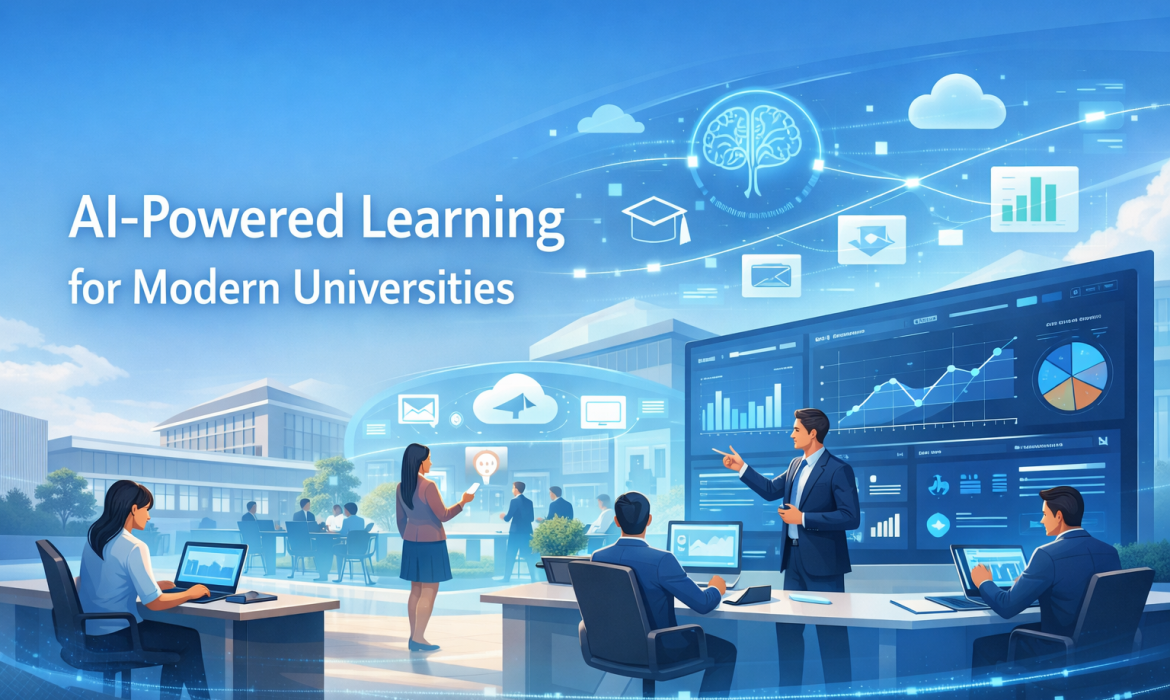
Universities are no longer asking whether digital learning matters.
They are asking how fast they can modernize.
Across higher education, institutional leaders are confronting a hard reality: traditional platforms cannot keep pace with evolving academic expectations. Students expect seamless digital learning. Faculty demand intelligent automation. Meanwhile, administrators need real-time academic visibility to make confident decisions.
As a result, the shift toward an AI-Powered Learning Management System is accelerating. Universities are not simply upgrading software — they are redesigning the digital learning backbone that supports teaching, engagement, and outcomes.
The New Expectations from University Learning Environments
Higher education has entered a performance-driven era. Today’s institutions operate under pressure to improve retention, enhance learning quality, and deliver measurable academic outcomes. However, many legacy systems were never designed for this level of complexity.
Students now expect:
- Always-on access to course materials
- Mobile-first learning experiences
- Personalized academic support
- Faster feedback cycles
- Seamless digital interactions
Faculty expectations have also evolved. They want tools that reduce administrative burden while improving instructional effectiveness. Moreover, leadership teams require consolidated academic intelligence rather than fragmented reports.
Therefore, universities are rethinking the role of the modern Learning Management System for universities. It is no longer just a content repository — it must function as an intelligent academic engine supported by an integrated Education Management System (EMS).
What Defines an AI-Powered Learning Management System
A traditional LMS primarily manages content delivery and assignment tracking. In contrast, an AI-Powered Learning Management System introduces intelligence, prediction, and automation into the learning ecosystem.
At its core, an AI-enabled platform can:
- Analyze student engagement patterns
- Predict academic risk early
- Automate routine academic workflows
- Personalize learning pathways
- Provide real-time institutional insights
However, the true transformation occurs when the LMS operates as part of a unified Education Management System (EMS). When learning data connects with admissions, attendance, and examinations, universities gain a 360-degree academic view.
Forward-looking institutions are therefore investing in Digital solutions for higher education that combine learning intelligence with lifecycle visibility such as student recruitment lifecycle management.
Must-Have Capabilities Universities Now Demand
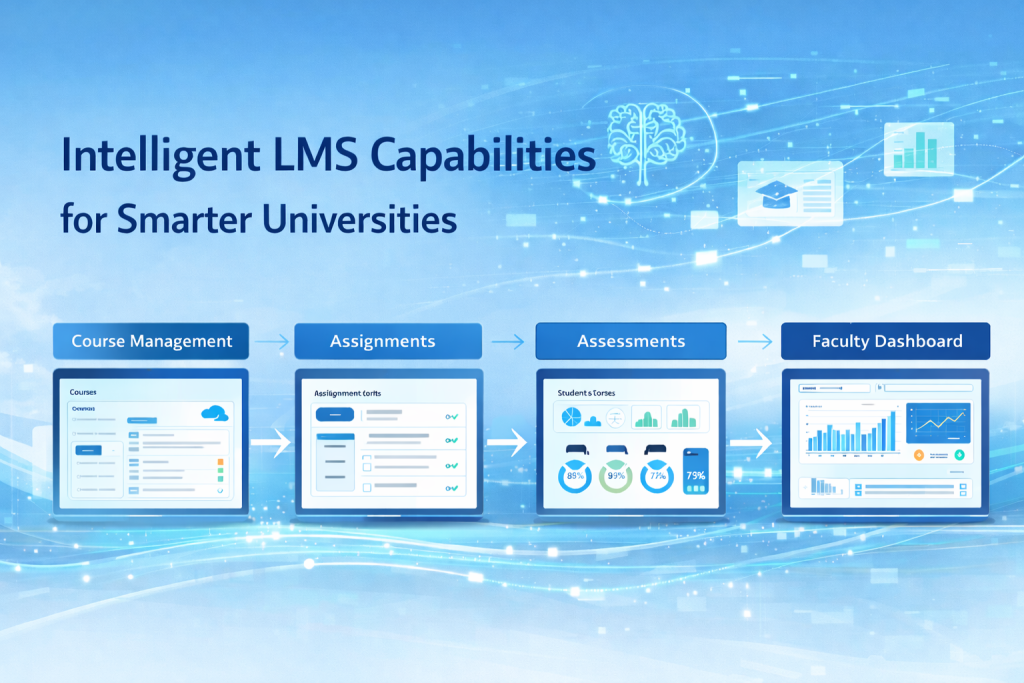
University decision-makers have become far more strategic in evaluating LMS platforms. Basic functionality is no longer sufficient. Instead, institutions are prioritizing intelligence, scalability, and ecosystem integration.
Predictive Academic Intelligence
Modern universities want early warning systems. An advanced AI LMS platform should identify:
- At-risk students
- Low engagement patterns
- Course-level performance gaps
- Attendance-risk correlations
Consequently, leadership teams can intervene before problems escalate — a challenge widely discussed in student risk detection strategies.
Unified Academic Visibility
Fragmented dashboards create confusion. Institutions now prefer a cloud-based LMS that integrates seamlessly within a broader Education Management System.
Key expectations include:
- Single academic view across departments
- Real-time performance monitoring
- Automated alerts for stakeholders
- Cross-functional data flow
This unified approach aligns with best practices in evaluating an Education Management System.
Automation-First Workflows
Manual academic processes slow institutions down. Therefore, universities increasingly demand automation in areas such as:
- Assignment workflows
- Evaluation cycles
- Course publishing
- Faculty notifications
- Student communications
Automation not only saves time but also reduces operational errors, as highlighted in AI-driven administrative automation.
Mobile-First Learning Experience
Today’s learners are mobile-native. As a result, the university learning platform must deliver:
- Responsive student portals
- Mobile assessments
- On-the-go faculty tools
- Instant notifications
Institutions that ignore mobile experience often see declining engagement, a pattern explored in AI-powered student portal strategies.
Strategic Advantages for Institutional Leadership
The decision to adopt an AI-Powered Learning Management System is no longer purely technical. It is strategic.
Improved Academic Governance
With AI-driven insights, administrators can monitor academic health continuously. Instead of reactive firefighting, institutions move toward proactive governance supported by modern AI-enabled academic management.
Data-Driven Decision Making
When learning analytics connect with institutional data, leaders can:
- Identify program effectiveness
- Optimize faculty workload
- Monitor student progression
- Forecast academic risks
Therefore, decisions become evidence-based rather than assumption-driven — addressing gaps often caused by limited student information visibility.
Scalable Digital Infrastructure
As universities expand programs and student populations, scalability becomes critical. A modern LMS in higher education must support institutional growth without performance bottlenecks.
Cloud-first ecosystems such as online classes and exams management demonstrate how scalable infrastructure supports uninterrupted academic delivery.
Stronger Compliance and Accreditation Readiness
Accreditation bodies increasingly expect documented academic processes. An intelligent platform automatically maintains audit trails, reports, and performance records.
Institutions pursuing stronger compliance maturity often align LMS strategy with accreditation management systems and improved institutional data readiness.
How Students and Faculty Experience the Transformation
Technology investments succeed only when end users feel the impact. Fortunately, AI-driven platforms deliver measurable improvements across the academic community.
Student Experience Improvements
Students benefit from:
- Personalized learning recommendations
- Early academic alerts
- Faster feedback cycles
- Centralized learning access
- Greater academic transparency
These improvements closely align with outcome-focused frameworks such as outcome-based education and a dedicated outcome-based LMS approach.
Faculty Experience Improvements
Faculty members experience:
- Reduced manual workload
- Automated grading assistance
- Better class performance insights
- Streamlined course management
- Improved student communication
Consequently, instructors can focus more on teaching quality rather than administrative overhead.
Warning Signs Your University Has Outgrown Its Current LMS
Many institutions continue using legacy platforms longer than they should. However, several indicators clearly signal the need for modernization.
Watch for these red flags:
- Faculty relying on external tools outside the LMS
- Delayed academic reporting cycles
- Limited mobile usability
- No predictive student alerts
- Manual intervention required for routine workflows
- Fragmented academic data across systems
- Difficulty scaling new programs
If multiple symptoms appear, the institution is likely operating below its digital potential — a maturity gap often seen in university system maturity challenges.
Future Trends Shaping AI-Driven Learning Ecosystems
The evolution of AI in higher education is only accelerating. Universities planning long-term digital strategy should pay attention to emerging shifts.
Hyper-Personalized Learning Paths
AI will increasingly tailor course journeys based on student behavior, performance, and learning style.
Continuous Academic Risk Prediction
Predictive models will move from periodic analysis to continuous monitoring, enabling near real-time intervention — similar to modern AI-enabled exam readiness systems.
Intelligent Faculty Assistants
AI will support instructors with automated content suggestions, assessment insights, and engagement recommendations.
Unified Digital Campus Architecture
Forward-looking institutions are moving toward fully integrated Digital solutions for higher education, where LMS, academics, finance, and student lifecycle systems operate as one ecosystem.
Universities that delay this transition risk falling behind more agile competitors.
How iCloudEMS Enables Intelligent Digital Learning
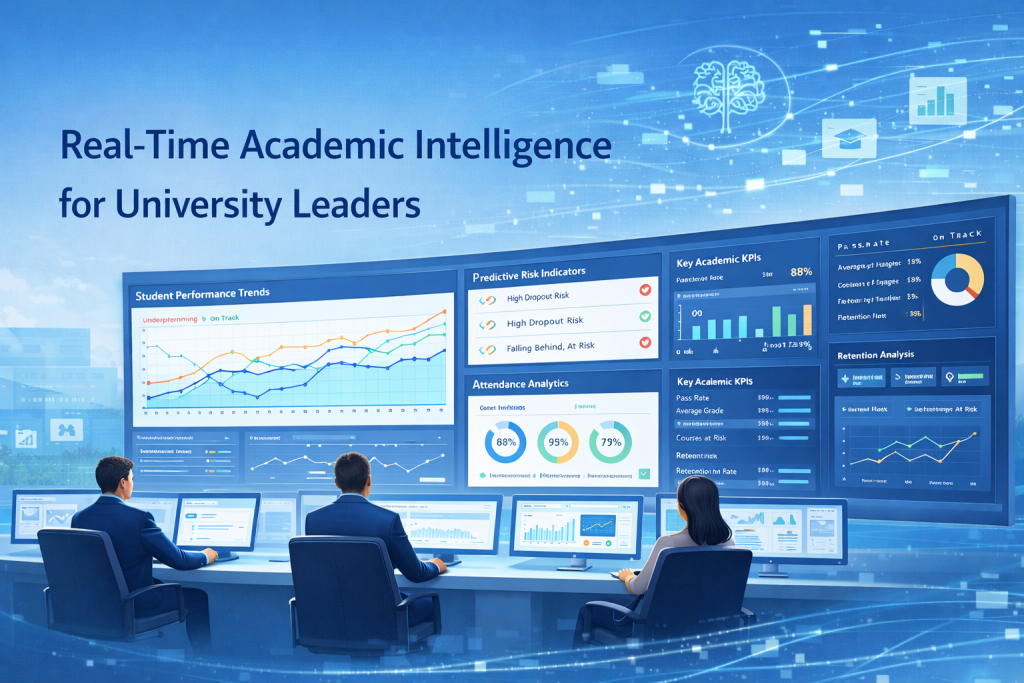
Institutions seeking a future-ready approach are increasingly adopting platforms that unify learning intelligence with institutional operations.
As part of its advanced Education Management System (EMS) framework, iCloudEMS delivers:
- AI-powered academic monitoring
- Cloud-native scalability
- Real-time performance alerts
- Integrated student lifecycle visibility
- Automation-driven academic workflows
- Mobile-first learning access
- Unified institutional dashboards
Importantly, iCloudEMS approaches the AI-Powered Learning Management System not as an isolated module but as a connected intelligence layer within the broader digital campus — including solutions for university management and college management.
Therefore, universities gain not just a learning platform, but a coordinated academic ecosystem designed for long-term institutional growth.
Conclusion: The Upgrade Is No Longer Optional
Higher education is entering an intelligence-driven decade. Universities that continue relying on static learning platforms may struggle to meet rising expectations from students, faculty, and regulators.
An AI-Powered Learning Management System is rapidly becoming the foundation of modern academic strategy. However, the real advantage emerges when the LMS operates within a unified Education Management System (EMS) supported by robust Digital solutions for higher education.
The question is no longer whether institutions will upgrade.
The real question is how prepared they are for the transition ahead.
How prepared is your institution for AI-driven learning transformation? Share your perspective and experiences.
Frequently Asked Questions
What is an AI-powered Learning Management System?
An AI-powered Learning Management System uses artificial intelligence to analyze student behavior, automate academic workflows, and provide predictive insights. Unlike traditional platforms, it enables proactive academic support, personalized learning experiences, and real-time institutional visibility for universities.
Why do universities need AI in LMS platforms?
Universities need AI in LMS platforms to move from reactive to proactive academic management. AI helps identify at-risk students early, improves engagement tracking, automates routine tasks, and provides leadership with data-driven insights that enhance academic outcomes and operational efficiency.
How does an LMS improve student outcomes?
A modern LMS improves student outcomes by centralizing learning resources, enabling continuous assessment, providing faster feedback, and supporting personalized learning paths. When enhanced with AI, it can also predict academic risks and trigger timely interventions that support student success.
What features should universities look for in an LMS?
Universities should prioritize AI-driven analytics, mobile accessibility, automation capabilities, real-time dashboards, seamless integration within an Education Management System (EMS), and cloud-native scalability. These features ensure the platform supports both current academic needs and future institutional growth.
How is iCloudEMS different from traditional LMS platforms?
iCloudEMS delivers an AI-powered Learning Management System as part of a unified Education Management System (EMS). Instead of operating as a standalone tool, it connects learning data with the broader digital campus, enabling real-time academic visibility, automation-driven workflows, and intelligent decision support for institutional leadership.
Is a cloud-based LMS better for universities?
Yes. A cloud-based LMS offers better scalability, remote accessibility, automatic updates, and reduced infrastructure burden. For universities managing complex academic operations, cloud deployment also supports faster innovation and stronger system reliability.
